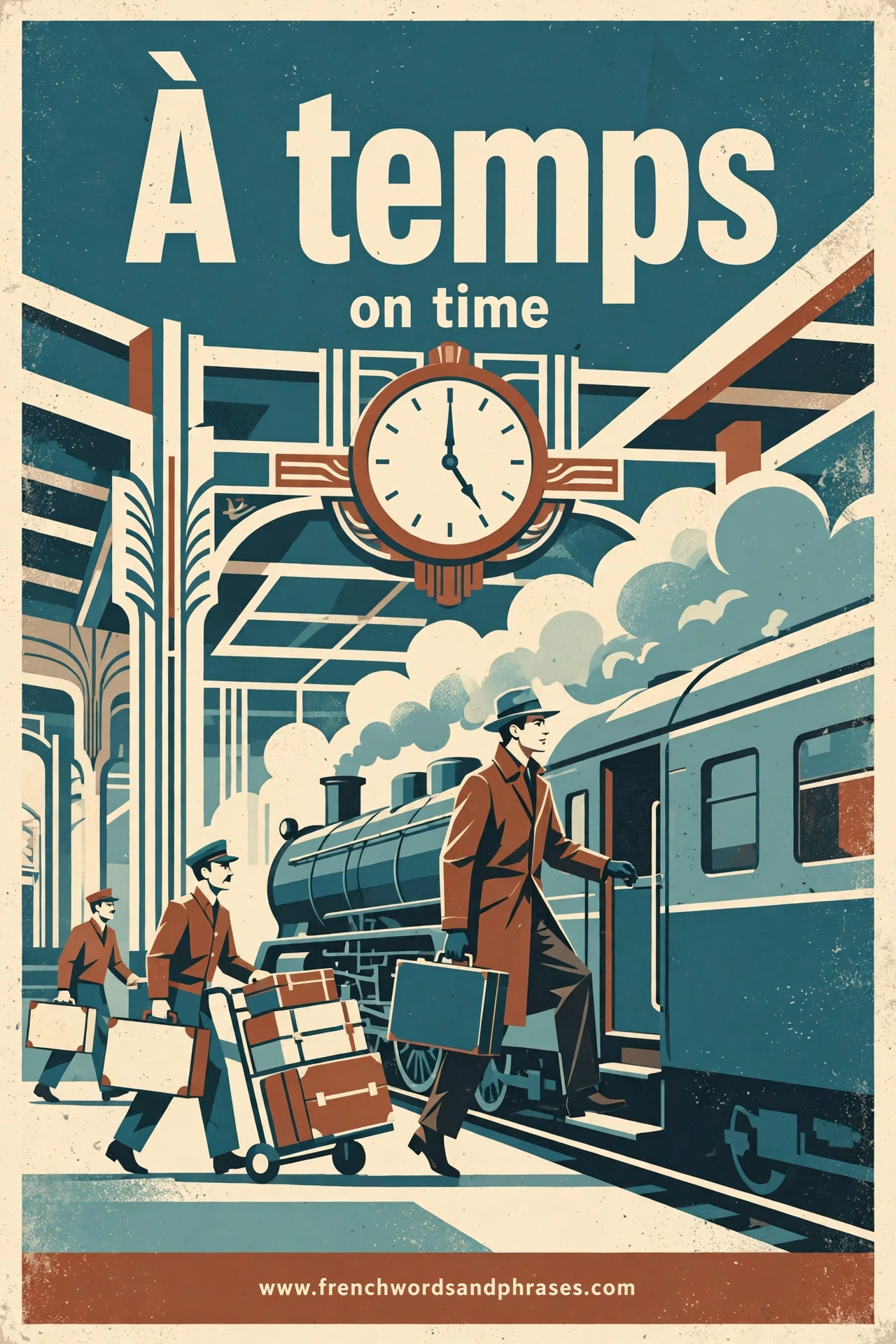
A French Word to Live By
Translate À temps to English
/a tɑ̃/
À temps means on time, in time — before the deadline, before it is too late.
The train for Lyon leaves at 8:02 and it is already 7:51. Your neighbour from the third floor is sprinting down the platform, coat half on, suitcase banging against her legs. She throws herself into the carriage as the doors sigh shut, drops into the seat opposite you, and laughs: « Je suis arrivée à temps ! » She made it — in time.
Let’s explore how à temps works in French, beginning with the whole phrase on one card.
Understanding the French Phrase À temps
À temps is a French adverbial phrase built from à (at, in) and le temps (time). Short as it is, it carries two shades: arriving before the deadline — on time — and arriving before disaster — in time, with moments to spare.
It means on time or in time: the thing happened inside the window where it still counted. The parcel posted à temps arrives for the birthday; the doctor called à temps stops the illness early. The phrase always looks at the clock — and the clock, for once, is on your side.
Type: Adverbial phrase — time (à + temps)
Answers the need: Saying something happened before the deadline or before it was too late
Register: Neutral — safe everywhere, in speech and writing
Strength: Reassuring — it always carries a small sigh of relief
One important usage detail: à temps is not the same as à l’heure. À l’heure means punctual, exactly on the schedule — the train arrived à l’heure. À temps means within the limit, with the deadline beaten — even if you arrived panting and one minute early. English splits the same pair: on time versus in time.
Experience the Word
À temps is the phrase of the near miss that missed — the dash down the platform that ends in a seat, not in tears.
Imagine the baker sliding the last tray into the oven as the first customers rattle the door. Everything in a good morning is a small race against a closing window, and à temps is the cheer when the window is beaten.
Two words, and a whole story of relief inside them. À temps is the sound of a deadline losing.
How to Use À temps in French: Complete Guide
Let’s explore how à temps works in French, beginning with the whole phrase on one card.
À temps at a Glance
The Whole Phrase on One Card
Real meaning, literal picture, English twin and register — à temps in five lines.
| Point | À temps |
|---|---|
| What it really means | on time, in time — before the deadline, before it is too late |
| Word for word | at time — inside the time allowed |
| English equivalent | on time / in time / in good time |
| Register | neutral — safe everywhere |
| Use it for | arrivals, deliveries, rescues and warnings that beat the clock |
Example
Nous sommes arrivés à temps pour le début du film.
We arrived in time for the start of the film.
Word by Word: Building the Deadline
Two small pieces — take them one by one and the window opens.
| Word | Literal meaning | Its job in the phrase |
|---|---|---|
| à | at, in | places the action inside a boundary — here, inside the time limit |
| temps | time | the limit itself: the deadline, the last moment, the closing window |
Example
Préviens-moi à temps si tu es en retard.
Let me know in time if you are going to be late.
Quick Quiz 1
Which phrase means punctual, exactly on schedule — à temps or à l’heure?
Reveal the answer
À l’heure — the train that arrives à l’heure follows the timetable. À temps means you beat the deadline, however breathlessly.
Le train est arrivé à l’heure, et nous sommes montés à temps.
The train arrived on time, and we got on in time.
When You Say It: The Deadline Moments
À temps fires at moments like these — wherever a window is closing and someone beats it.
| Situation | Example |
|---|---|
| Catching transport | arriver à temps pour le train — to arrive in time for the train |
| Posting and sending | envoyer le dossier à temps — to send the file in time |
| Health | détecter la maladie à temps — to catch the illness in time |
| Warnings | freiner à temps — to brake in time |
| Cooking | sortir le gâteau du four à temps — to take the cake out of the oven in time |
Example
Il a freiné à temps, juste avant le passage piéton.
He braked in time, just before the crossing.
Make It Yours: Beating Every Clock
The phrase stretches from a gentle ‘early enough’ to a dramatic ‘just in time’.
| Form | French | In English |
|---|---|---|
| Plain | à temps | on time, in time |
| With room to spare | largement à temps | in good time, with plenty to spare |
| Only just | juste à temps | just in time |
| Too late — the opposite | trop tard | too late |
| Beforehand | à temps pour + infinitive | in time to do something |
| Asking the question | tu crois qu’on arrivera à temps ? | do you think we’ll get there in time? |
Example
Elle a rendu son devoir juste à temps.
She handed in her homework just in time.
Quick Quiz 2
How do you strengthen à temps to say you had plenty of time to spare?
Reveal the answer
Largement à temps — largement, amply, widens the margin.
Partez tôt, vous arriverez largement à temps.
Leave early and you will arrive in good time.
Everyday Expressions: Building on the Clock
À temps slots into these everyday frames — each one ready to use as it stands.
| Frame | In English |
|---|---|
| arriver à temps | to arrive in time |
| à temps pour + infinitive | in time to do something |
| juste à temps | just in time |
| largement à temps | in good time |
| s’y prendre à temps | to set about it in time, to start early enough |
Example
Prenez rendez-vous maintenant, il faut s’y prendre à temps.
Book now — you need to set about it in time.
Close Cousins: The Other Time Phrases
French keeps its clock phrases carefully separated — à temps is the deadline-beater of the family.
| Expression | The difference |
|---|---|
| à temps | in time, on time — the deadline beaten, relief included |
| à l’heure | punctual — exactly matching the schedule, no drama |
| en avance | early — ahead of the expected moment |
| à la dernière minute | at the last minute — the race, win or lose |
| trop tard | too late — the window already closed |
Example
Elle est toujours à l’heure, jamais à la dernière minute.
She is always punctual, never at the last minute.
Quick Quiz 3
The doctor caught the illness early enough to cure it. À temps or à l’heure?
Reveal the answer
À temps — there is no timetable in a diagnosis; there is a window, and it was beaten.
Heureusement, la maladie a été détectée à temps.
Fortunately, the illness was caught in time.
À temps and Its Neighbours
The clock shelf around the phrase — from being early to missing the moment entirely.
| French | In English |
|---|---|
| à l’heure | on time, punctual |
| en avance | early |
| en retard | late |
| trop tard | too late |
| à la dernière minute | at the last minute |
| le délai | the deadline, the time allowed |
Example
Mieux vaut arriver en avance que trop tard.
Better to arrive early than too late.
Watch Out: The Traps Around À temps
The traps: a weather word hiding inside, and two English phrases for one French one.
| Trap | The truth |
|---|---|
| temps is also weather | le temps means both time and the weather — quel temps fait-il ? asks about the sky, not the clock |
| one phrase, two English twins | à temps covers both on time and in time; let the situation choose the English |
| not a tense name | à temps says when something happened relative to a limit — it is not about verb tenses |
| the à matters | temps alone is just ‘time’; the little à is what turns it into ‘in time’ |
Example
On a fini la réparation à temps, malgré le mauvais temps.
We finished the repair in time, despite the bad weather.
Quick Quiz 4
True or false: à temps and à l’heure are exact synonyms.
Reveal the answer
False — à l’heure is punctuality against a timetable; à temps is beating a limit, however close the shave.
Le facteur est à l’heure, et le colis arrive à temps pour l’anniversaire.
The postman is punctual, and the parcel arrives in time for the birthday.
À temps in Everyday French: Real-Life Examples
Now that you know the word, let’s see how à temps appears in everyday French.
Example 1 — At the station
Nous avons couru, mais nous sommes arrivés à temps.
We ran, but we arrived in time.
Example 2 — The parcel
Poste la lettre aujourd’hui, elle arrivera à temps.
Post the letter today and it will arrive in time.
Example 3 — At the doctor’s
Le traitement a commencé à temps, tout ira bien.
The treatment started in time; everything will be fine.
Example 4 — In the kitchen
Elle a sorti le rôti du four juste à temps.
She took the roast out of the oven just in time.
Example 5 — At work
Le rapport est parti à temps, ouf !
The report went off in time — phew!
Example 6 — On the road
Le conducteur a vu l’enfant et a freiné à temps.
The driver saw the child and braked in time.
Beyond Translation: The Meaning of À temps
English keeps two phrases where French keeps one: on time for the timetable, in time for the rescue. French à temps holds both in a single breath, because the heart of the idea is the same — the window was still open when you reached it.
À temps is not about the clock being kind; it is about you arriving while the door is still open.
That is why the phrase so often travels with a sigh — ouf, juste à temps. The deadline lost, and everyone can breathe again.
How to Remember the French Phrase À temps
Remember it this way: À temps is the sprint down the platform that ends in a seat — the deadline beaten, the window still open.
- You picture the closing window — à temps means you slipped through before it shut.
- You split the English twins — timetable punctuality is à l’heure; beating the limit is à temps.
- You widen or narrow the margin — largement à temps with room to spare, juste à temps by a hair.
The key idea is à temps means on time, in time — before the deadline and before it is too late.
Test Your Knowledge of À temps
Let’s see how much you’ve learned. Try answering these questions before revealing the answers.
Question 1
What does à temps mean?
Reveal the answer
On time, in time — before the deadline, or before it was too late.
Question 2
What is the literal, word-for-word meaning?
Reveal the answer
At time — inside the time allowed, within the limit.
Question 3
How do you say ‘We arrived just in time’?
Reveal the answer
Nous sommes arrivés juste à temps — juste narrows the margin to a hair.
Question 4
What is the difference between à temps and à l’heure?
Reveal the answer
À l’heure is punctuality — matching the timetable exactly. À temps is beating a deadline or a closing window, even by a minute.
Question 5
Complete the sentence:
Elle a freiné juste à ______, avant le passage piéton. (She braked just in time, before the crossing.)
Reveal the answer
temps
Elle a freiné juste à temps, avant le passage piéton.
She braked just in time, before the crossing.
Your Final Challenge
Can You Use It?
How would you say this in French?
“We ran down the platform and caught the train just in time.”
Reveal the answer
Nous avons couru sur le quai et nous avons attrapé le train juste à temps.
We ran down the platform and caught the train just in time.
A little French. A little curiosity. A richer everyday life.
LEARN FRENCH ONE WORD AT A TIME