
A French Word to Live By
Translate À l’heure to English
/a lœʁ/
À l’heure means on time.
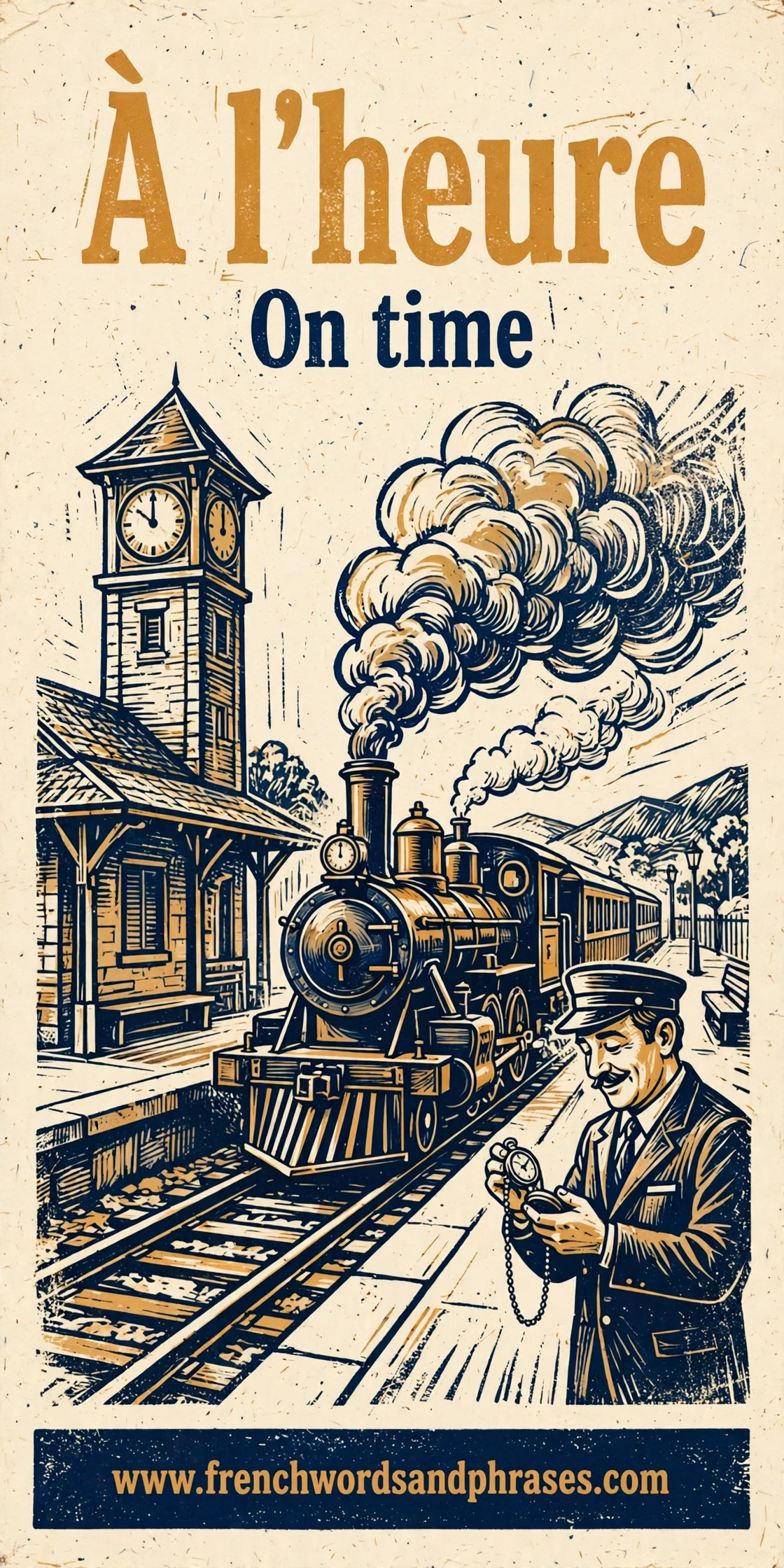
The station clock clicks to six o’clock, and at that exact second the train sighs to a stop at the platform edge — not a minute early, not a minute late. A conductor nods with quiet pride. The train is à l’heure, and in France that is a small civic ceremony.
Let’s explore how à l’heure works in French, beginning with the whole phrase on one card.
Understanding the French Phrase À l’heure
À l’heure is a French time phrase built from à (at) and l’heure — the hour, the time. Heure does double duty in French: it is both the hour on the clock and time itself. À l’heure pins a person, a train or a meeting to the exact minute that was promised.
It means on time — neither early nor late, but at the scheduled moment. French keeps the whole timetable in three phrases: en avance for early, en retard for late, and à l’heure for the golden middle. It is praise when said of a train and a compliment when said of a friend.
Type: Time phrase — à + l’heure (the hour, the time)
Answers the need: Saying that something or someone kept the schedule exactly
Register: Neutral — stations, offices, schools and everyday arrangements
Strength: Everyday — trains, meetings, deliveries and punctual friends
One important usage detail: à l’heure is exact — it means the promised minute, not roughly then. And mind its cousin à l’heure actuelle, which has nothing to do with punctuality: it means at the present time, nowadays, and belongs to news bulletins.
Experience the Word
À l’heure is the phrase of the kept promise — the friend who rings the bell at eight because dinner was at eight, the train that treats the timetable as a contract.
Imagine the small suspense it resolves: the platform, the clock, the held breath of two hundred travellers — and then the headlights, exactly on the minute. À l’heure. A whole carriage exhales.
It also quietly grades character. In French, être toujours à l’heure — to be always on time — is not a detail; it is a portrait of someone who respects other people’s hours as much as their own.
How to Use À l’heure in French: Complete Guide
Let’s explore how à l’heure works in French, beginning with the whole phrase on one card.
À l’heure at a Glance
The Whole Phrase on One Card
Real meaning, literal building blocks, English twin and register — à l’heure in five lines.
| Point | À l’heure |
|---|---|
| What it really means | on time — at exactly the scheduled minute |
| Word for word | at the hour / at the time (à + l’heure) |
| English equivalent | on time / on schedule |
| Register | neutral — praise for trains, meetings and friends |
| Use it for | arrivals, departures, meetings, deliveries, punctual people |
Example
Le train est arrivé à l’heure, à dix-huit heures précises.
The train arrived on time, at exactly six in the evening.
Word by Word: Building the Exact Minute
Two pieces — a little peg, and the word that means both hour and time.
| Word | Literal meaning | Its job in the phrase |
|---|---|---|
| à | at / to | the little peg that fixes you to one point on the clock |
| l’heure | the hour, the time | heure is feminine and covers both jobs — quelle heure est-il ? asks what time it is |
Example
Quelle heure est-il ? — Six heures, et le train est à l’heure.
What time is it? — Six o’clock, and the train is on time.
Quick Quiz 1
Heure means hour. In quelle heure est-il ?, what is it really asking?
Reveal the answer
What time is it — heure covers both the hour and time itself in French.
Quelle heure est-il ? Il est midi.
What time is it? It is noon.
When You Say It: The Punctual Moments
À l’heure belongs to platforms, meeting rooms and every appointment that was kept.
| Situation | Example |
|---|---|
| Trains and planes | l’avion est parti à l’heure — the plane left on time |
| A punctual friend | elle est toujours à l’heure, jamais une minute de retard — she is always on time, never a minute late |
| Starting a meeting | commençons à l’heure, tout le monde est là — let’s start on time, everyone is here |
| A delivery | le colis est arrivé à l’heure prévue — the parcel arrived at the scheduled time |
| School and work | les élèves sont entrés en classe à l’heure — the pupils went into class on time |
Example
Le facteur est passé à l’heure, comme tous les matins.
The postman came on time, as he does every morning.
Make It Yours: Bending the Exact Minute
The phrase rides on the verbs of travelling and meeting — and sharpens to the very dot.
| Form | French | In English |
|---|---|---|
| Being on time | être à l’heure | to be on time |
| Arriving on time | arriver à l’heure | to arrive on time |
| Leaving on time | partir à l’heure | to leave on time |
| Right on the dot | à l’heure pile | dead on time (familiar) |
| The punctual person | toujours à l’heure | always on time |
| As scheduled | à l’heure prévue | at the scheduled time |
Example
Elle est arrivée à l’heure pile, à huit heures précises.
She arrived dead on time, at exactly eight o’clock.
Quick Quiz 2
Your train pulls in five minutes before the timetable says. Is it à l’heure or en avance?
Reveal the answer
En avance — à l’heure is the exact scheduled minute; before it, you are early.
Le train est en avance de cinq minutes.
The train is five minutes early.
Everyday Expressions: Building on the Hour
Heure grows a whole family of timetable frames — learn these and the whole station board makes sense.
| Frame | In English |
|---|---|
| être à l’heure | to be on time |
| arriver à l’heure | to arrive on time |
| à l’heure pile | dead on time, on the dot |
| toujours à l’heure | always on time |
| à l’heure prévue | at the scheduled time |
| partir à l’heure pour… | to leave on time for… |
Example
Pars à l’heure pour ne pas rater ton train.
Leave on time so you don’t miss your train.
Close Cousins: The Other Timetable Words
French runs its clocks with a small, precise family — learn the whole row and no timetable can fool you.
| Expression | The difference |
|---|---|
| en avance | early — before the scheduled minute, the happy surprise |
| en retard | late — after the scheduled minute, the dreaded opposite |
| à temps | in time — in the nick of time, before it is too late: arriver à temps pour le train |
| juste à temps | just in time — with no second to spare |
| ponctuel | punctual — the adjective for a person who is always à l’heure |
Example
Il est arrivé juste à temps : les portes se fermaient déjà.
He arrived just in time: the doors were already closing.
Quick Quiz 3
You sprint onto the platform and the doors close behind you. Were you à l’heure or à temps?
Reveal the answer
À temps — you made it before it was too late. À l’heure is calm, scheduled punctuality, no sprinting involved.
J’ai couru, mais je suis arrivé à temps.
I ran, but I arrived in time.
À l’heure and Its Neighbours
The timetable family at a glance — early, exact, late and saved.
| French | In English |
|---|---|
| à l’heure | on time |
| en avance | early |
| en retard | late |
| à temps | in time (before it is too late) |
| ponctuel | punctual (a person) |
| à l’heure pile | dead on time |
Example
Ni en avance ni en retard : le bus était simplement à l’heure.
Neither early nor late: the bus was simply on time.
Watch Out: The Traps Around À l’heure
Three traps wait around this exact phrase — step round them.
| Trap | The truth |
|---|---|
| Mixing up à temps and à l’heure | à l’heure is the scheduled minute; à temps is beating the deadline — saved, not punctual |
| Reading à l’heure actuelle as punctuality | à l’heure actuelle means at the present time — a news phrase, nothing to do with clocks being kept |
| Setting a clock with the wrong verb | to set a watch to the right time is mettre sa montre à l’heure — à l’heure also means ‘correctly set’ |
| Reaching for ‘dans l’heure’ | French never says ‘in the hour’ for on time — the peg is à: à l’heure |
Example
À l’heure actuelle, le train est à l’heure, pour une fois.
At the present time, the train is on time, for once.
Quick Quiz 4
True or false: le train est à l’heure and le train est en avance can both describe a train arriving at ten o’clock sharp, when ten was the scheduled time.
Reveal the answer
False — à l’heure is exactly the scheduled minute; en avance means it came before that minute.
Le train de dix heures est arrivé à l’heure.
The ten o’clock train arrived on time.
À l’heure in Everyday French: Real-Life Examples
Now that you know the word, let’s see how à l’heure appears in everyday French.
Example 1 — The train
Le train de sept heures est parti à l’heure, malgré la neige.
The seven o’clock train left on time, despite the snow.
Example 2 — The punctual friend
Tu peux compter sur elle : elle est toujours à l’heure.
You can count on her: she is always on time.
Example 3 — The meeting
La réunion a commencé à l’heure et s’est terminée à l’heure.
The meeting started on time and finished on time.
Example 4 — The delivery
Le livreur est arrivé à l’heure prévue, entre midi et treize heures.
The delivery driver arrived at the scheduled time, between noon and one.
Example 5 — The flight
L’avion a décollé à l’heure, et nous avons atterri à l’heure aussi.
The plane took off on time, and we landed on time too.
Example 6 — The proud parent
Ce matin, pour une fois, les enfants étaient prêts à l’heure pour l’école.
This morning, for once, the children were ready on time for school.
Beyond Translation: The Meaning of À l’heure
French keeps its whole relationship with the clock inside one word: heure is the hour, and heure is time itself, so à l’heure literally sets you ‘at the time’ — aligned with the timetable the way a watch hand aligns with the twelve. And the same words, stretched by one adjective, turn into a phrase about eras: à l’heure actuelle, at the present hour, is how the news says ‘nowadays’. The clock word and the era word were the same all along.
How to Remember the French Phrase À l’heure
Remember it this way: À l’heure pins you to the exact minute on the timetable — not early, not late, but standing precisely on the promised hour.
- You learn it as a trio — en avance before, à l’heure on the dot, en retard after: the whole timetable in three phrases.
- You keep the sprint for à temps — à l’heure never runs; it simply arrives when it said it would.
- You watch for the news costume — à l’heure actuelle means at present, and no train is involved.
The key idea is à l’heure means on time — à + l’heure (the hour, the time); early is en avance, late is en retard, saved at the last second is à temps.
Test Your Knowledge of À l’heure
Let’s see how much you’ve learned. Try answering these questions before revealing the answers.
Question 1
What does à l’heure mean?
Reveal the answer
On time — at exactly the scheduled minute.
Question 2
What are the French words for early and late?
Reveal the answer
En avance for early and en retard for late.
Question 3
What is the difference between à l’heure and à temps?
Reveal the answer
À l’heure is punctual; à temps is in the nick of time — one keeps the schedule, the other beats the deadline.
Question 4
What does à l’heure actuelle mean?
Reveal the answer
At the present time — a news phrase meaning nowadays, not punctuality.
Question 5
Complete the sentence:
Le train est arrivé ______ ______, à six heures pile. (The train arrived on time, at six o’clock exactly.)
Reveal the answer
À l’heure — Le train est arrivé à l’heure, à six heures pile.
Your Final Challenge
Can You Use It?
How would you say this in French?
“The train arrived on time, at six o’clock exactly.”
Reveal the answer
Le train est arrivé à l’heure, à six heures pile.
The train arrived on time, at six o’clock exactly.
A little French. A little curiosity. A richer everyday life.
LEARN FRENCH ONE WORD AT A TIME




