A French Word to Live By
Translate À la côte to English
/a la kot/
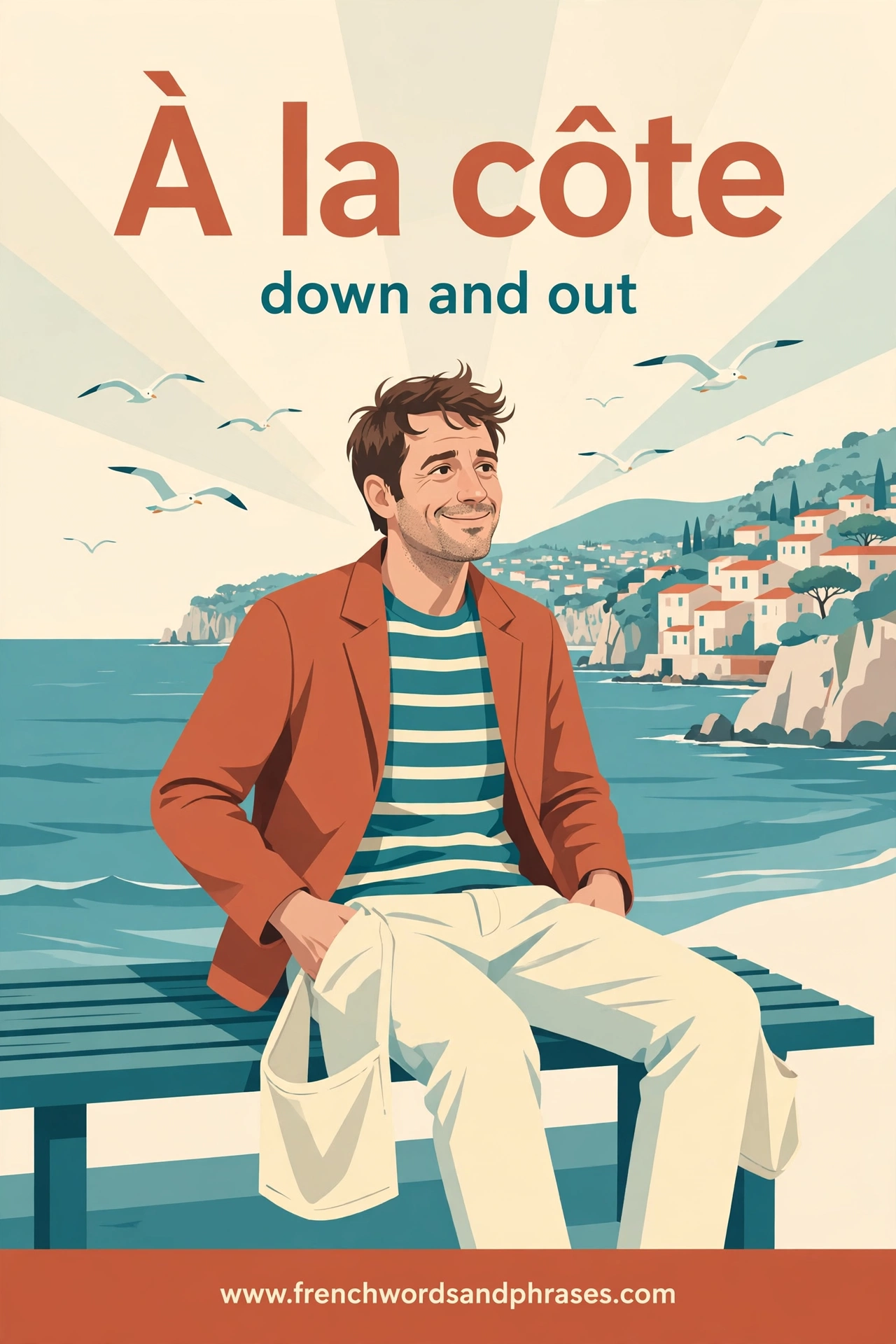
À la côte means down and out — broke, washed up and at rock bottom.
Twenty years ago, Marcel ran the busiest café on the harbour. Tonight he is sitting on the same harbour wall, collar up against the wind, counting coins for a coffee he may not buy. A fisherman passes, shakes his head kindly, and murmurs to his mate: « Le pauvre, il est à la côte. »
Let’s explore how à la côte works in French, beginning with the whole phrase on one card.
Understanding the French Phrase À la côte
À la côte is a French idiomatic expression built from à (at, on) and la côte (the coast, the shore). Its picture comes from the sea: a ship driven onto the shore is finished travelling. A person who is à la côte has run aground in life — no money, no luck, no way forward.
It means to be down and out — broke, ruined, washed up. A gambler after the last bad night, a business that has folded, an artist nobody buys: all of them are à la côte. The phrase carries pity more than mockery; it describes the end of the line, the moment the water runs out and the keel scrapes the sand.
Type: Idiomatic expression — misfortune (être + à la côte)
Answers the need: Saying someone is broke, ruined, completely washed up
Register: Informal — everyday speech; a shade old-fashioned but widely understood
Strength: Heavy — not just short of cash, but at the end of the road
One important usage detail: the phrase is used with être — il est à la côte, elle était à la côte. Do not confuse it with its geographical twin: un bateau à la côte can simply be a boat lying near the shore, or worse, one washed ashore. For people, though, it is always the figurative shipwreck.
Experience the Word
À la côte is the harbour’s verdict on a life — the sea gives, the sea takes back, and some boats never float again.
Imagine the old trawler you pass on the coast road, tilted in the mud at low tide, its name fading on the bow. Nobody hates that boat; everybody understands it. That is the tenderness inside the phrase: it is said with a sigh, not a sneer.
French grew up facing the sea. Its saddest insults are shipwrecks, and its saddest shipwreck is a person.
How to Use À la côte in French: Complete Guide
Let’s explore how à la côte works in French, beginning with the whole phrase on one card.
À la côte at a Glance
The Whole Phrase on One Card
Real meaning, literal picture, English twin and register — à la côte in five lines.
| Point | À la côte |
|---|---|
| What it really means | down and out — broke, ruined, with nothing left |
| Word for word | at the coast, on the shore — like a ship run aground |
| English equivalent | down and out / washed up / on the rocks |
| Register | informal, a little old-fashioned — said with pity |
| Use it for | people who have lost everything — money, luck, standing |
Example
Après la faillite, il est complètement à la côte.
After the bankruptcy, he’s completely down and out.
Word by Word: Building the Shipwreck
Three small pieces — take them one by one and the tide goes out for good.
| Word | Literal meaning | Its job in the phrase |
|---|---|---|
| à | at, on | the position word — stuck at a place you cannot leave |
| la | the | one particular shore: the end of the line |
| côte | the coast, the shore | where ships die — a wreck is driven à la côte by the storm |
Example
Le navire est venu mourir à la côte.
The ship came to die on the shore.
Quick Quiz 1
Where does the picture inside à la côte come from?
Reveal the answer
From the sea — a ship driven onto the shore is wrecked and going nowhere; so is the person.
Sans argent et sans travail, le voilà à la côte.
With no money and no work, there he is, down and out.
When You Say It: The Rock-Bottom Moments
À la côte fires at moments like these — when there is nothing left to lose.
| Situation | Example |
|---|---|
| After a bankruptcy | son entreprise a fermé, il est à la côte — his business closed, he’s down and out |
| A gambler ruined | le jeu l’a mis à la côte en deux ans — gambling put him on the rocks in two years |
| An old star forgotten | la chanteuse d’autrefois est aujourd’hui à la côte — the singer of yesteryear is washed up today |
| With pity, of a friend | le pauvre, il est à la côte depuis son divorce — poor man, he’s been down and out since his divorce |
| Of a whole trade | les petits cafés de village sont à la côte — the little village cafés are on their last legs |
Example
En six mois, il est passé de patron à la côte.
In six months, he went from boss to down and out.
Make It Yours: The Wreck for Every Person
The verb is être, and the shore never changes its name.
| Form | French | In English |
|---|---|---|
| He is down and out | il est à la côte | he’s down and out |
| She ended up washed up | elle a fini à la côte | she ended up on the rocks |
| To put someone on the rocks | mettre quelqu’un à la côte | to ruin someone completely |
| Completely | complètement à la côte | utterly down and out |
| On the way there | être en route pour la côte | to be heading for ruin — a playful extension |
Example
Ce mauvais investissement l’a mis à la côte.
That bad investment ruined him completely.
Quick Quiz 2
Which verb goes with à la côte for a person — être or aller?
Reveal the answer
Être — il est à la côte. Aller à la côte would sound like a trip to the seaside.
Depuis la crise, beaucoup de commerçants sont à la côte.
Since the crisis, many shopkeepers are down and out.
Everyday Expressions: Building on the Shore
À la côte slots into these everyday frames — each one ready to use as it stands.
| Frame | In English |
|---|---|
| être à la côte | to be down and out |
| mettre quelqu’un à la côte | to ruin someone, to put them on the rocks |
| finir à la côte | to end up washed up |
| complètement à la côte | utterly broke, finished |
| être sur la paille | to be broke — the straw-mattress twin, equally pitiful |
Example
Il a tout perdu aux courses : le voilà à la côte.
He lost everything at the races: now he’s down and out.
Close Cousins: The Other Ways to Be Ruined
French has a whole shelf of ruin phrases — à la côte is the shipwreck; its cousins sleep on straw, beg in the street or sink with the ship.
| Expression | The difference |
|---|---|
| à la côte | down and out — the ship aground, finished and pitied |
| être sur la paille | to be broke — reduced to sleeping on straw; about money above all |
| être fauché | to be skint — lighter, everyday, this week’s problem rather than life’s end |
| être à la rue | to be on the street — homeless, the harshest and most literal of the family |
| toucher le fond | to hit rock bottom — the moment of the fall, with a hint that one can bounce back |
Example
Fauché ce mois-ci, d’accord — mais pas encore à la côte.
Skint this month, fine — but not down and out yet.
Quick Quiz 3
Your friend has no cash until payday but his life is fine. Is he à la côte or just fauché?
Reveal the answer
Just fauché — à la côte is the end of the road, not an empty week before payday.
Je suis fauché jusqu’à vendredi, rien de grave.
I’m skint until Friday, nothing serious.
À la côte and Its Neighbours
The misfortune shelf around the phrase — from the empty pocket to the lost home.
| French | In English |
|---|---|
| une faillite | a bankruptcy |
| être fauché | to be skint |
| être sur la paille | to be flat broke |
| toucher le fond | to hit rock bottom |
| un naufrage | a shipwreck — and, figuratively, a total failure |
| s’en sortir | to get back on your feet — the way back from the shore |
Example
Il était à la côte, mais il s’en est sorti avec courage.
He was down and out, but he got back on his feet bravely.
Watch Out: The Traps Around À la côte
The traps: a real beach, a rib that shares the name, and a sadness you should not exaggerate.
| Trap | The truth |
|---|---|
| the beach trap | aller à la côte can be a trip to the coast — only être à la côte, said of a person, is the shipwreck |
| côte is also a rib | une côte de bœuf is a rib of beef, and la côte d’Azur is a coastline — the word wears several hats |
| too strong for small troubles | a missed train or an empty wallet for a day is not la côte — save it for real ruin |
| the accent matters | côte with the circumflex is the shore; côté, with an accent on the e, means ‘side’ — à côté is ‘next door’, a very different address |
Example
Il habite à côté de la côte, mais il n’est pas à la côte.
He lives beside the coast, but he is not down and out.
Quick Quiz 4
True or false: être à la côte and être à côté mean the same thing.
Reveal the answer
False — à la côte is down and out; à côté means next to, beside. One accent changes the address completely.
La pharmacie est à côté, pas à la côte.
The pharmacy is next door, not down and out.
À la côte in Everyday French: Real-Life Examples
Now that you know the word, let’s see how à la côte appears in everyday French.
Example 1 — The closed café
Son café a fermé au printemps ; depuis, il est à la côte.
His café closed in spring; since then, he’s down and out.
Example 2 — The gambler
Le poker l’a mis à la côte en quelques années.
Poker put him on the rocks within a few years.
Example 3 — The forgotten star
Cette actrice célèbre est aujourd’hui complètement à la côte.
That famous actress is completely washed up today.
Example 4 — With pity
Le pauvre homme est à la côte depuis la fermeture de l’usine.
The poor man has been down and out since the factory closed.
Example 5 — Not yet
Je suis fauché, mais je ne suis pas à la côte.
I’m skint, but I’m not down and out.
Example 6 — The way back
Il était à la côte, puis un ami lui a trouvé du travail.
He was down and out, then a friend found him work.
Beyond Translation: The Meaning of À la côte
English puts its ruined people on the rocks — the same sea, the same wreck. French chooses the shore instead: not the moment of impact, but the long afterwards, the boat tilted in the mud while the tide of life goes out without it.
À la côte is not the crash; it is what the crash leaves behind.
That is why the phrase is almost tender. Rocks are an accident. A shore is an address — and addresses, with luck and help, can be left.
How to Remember the French Phrase À la côte
Remember it this way: À la côte is the ship that never sails again — driven onto the shore, tilted in the mud, pitied by everyone who passes.
- You picture the wreck on the beach — a boat à la côte is finished travelling, and so is the person.
- You keep the verb être — il est à la côte; going there would be a holiday, not a ruin.
- You mind the accent — côte is the shore, côté is a side; one letter’s hat changes everything.
The key idea is à la côte means down and out — wrecked on life’s shore like a ship that will never float again.
Test Your Knowledge of À la côte
Let’s see how much you’ve learned. Try answering these questions before revealing the answers.
Question 1
What does être à la côte mean?
Reveal the answer
To be down and out — broke, ruined, washed up, with nothing left.
Question 2
Where does the picture come from?
Reveal the answer
From a shipwreck — a ship driven onto the shore (la côte) is finished; the person has run aground in life.
Question 3
How do you say ‘he is completely down and out’?
Reveal the answer
Il est complètement à la côte — the phrase pairs with être.
Question 4
What is the difference between être fauché and être à la côte?
Reveal the answer
Fauché is skint for now — an empty pocket this week. À la côte is the end of the road: total ruin.
Question 5
Complete the sentence:
Après la faillite, le patron est à la ______. (After the bankruptcy, the boss is down and out.)
Reveal the answer
côte
Après la faillite, le patron est à la côte.
After the bankruptcy, the boss is down and out.
Your Final Challenge
Can You Use It?
How would you say this in French?
“After the factory closed, he was completely down and out.”
Reveal the answer
Après la fermeture de l’usine, il était complètement à la côte.
After the factory closed, he was completely down and out.
A little French. A little curiosity. A richer everyday life.
LEARN FRENCH ONE WORD AT A TIME