A French Word to Live By
Translate À-coup to English
/a.ku/
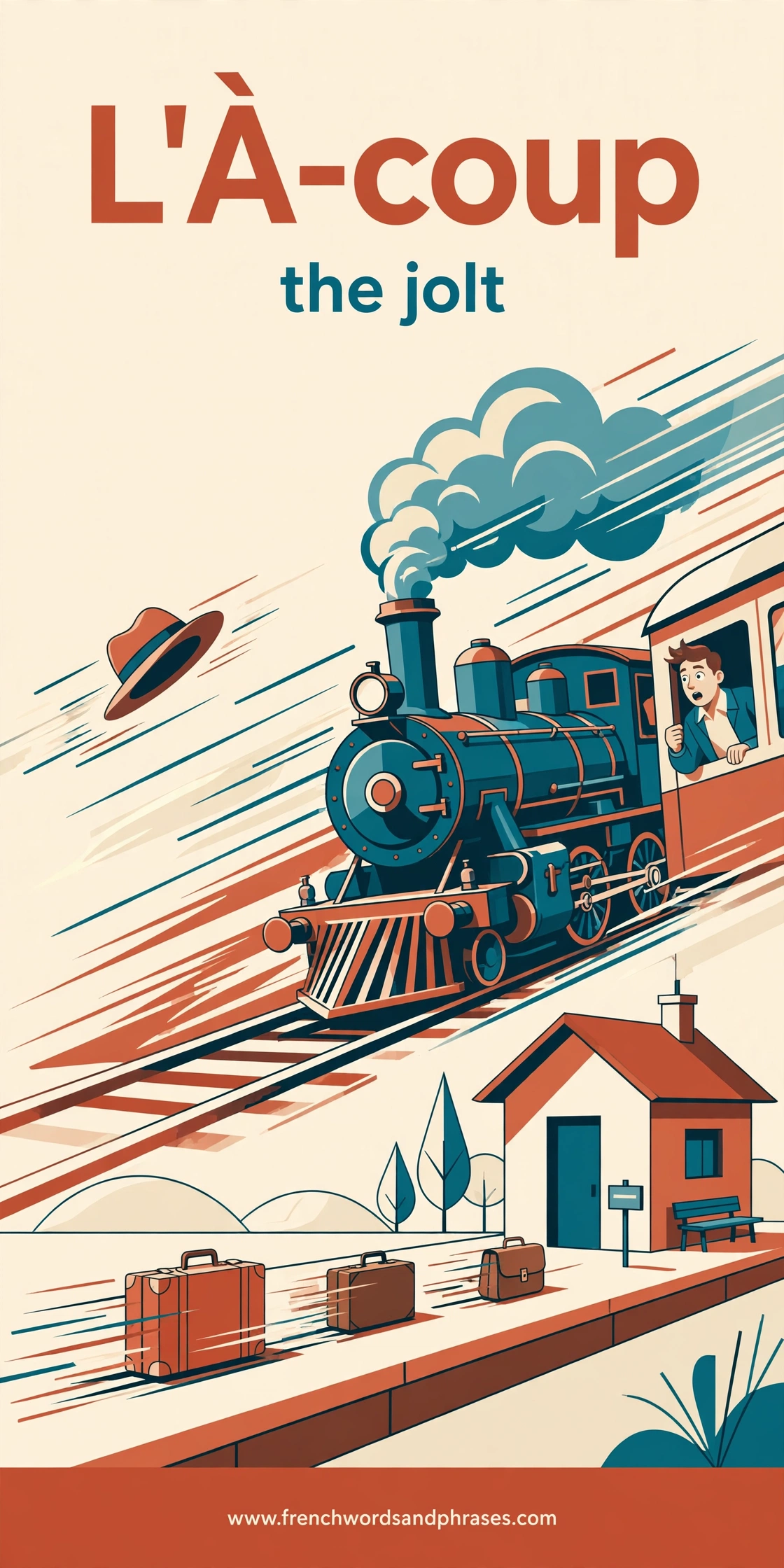
L’à-coup means the jolt.
The old tractor coughs, lurches forward, stops, then lurches again — every movement arrives in a sudden jerk. Each of those jerks has a name: un à-coup.
In this guide, you’ll learn what à-coup means in English, how to use it with its articles, how to form its plural, and how it appears in everyday French. Explore French examples, English translations, and practice quizzes.
Understanding the French Noun À-coup
À-coup is a masculine French noun, learned with its article: l’à-coup, un à-coup — it begins with a vowel, so le shrinks to l’. It is built from the phrase à coups, « by blows », and it keeps that feeling of sudden knocks.
It means a jolt, a jerk — a sudden, uneven movement, especially of a machine or a vehicle: le moteur donne des à-coups, the engine is jerking, coughing. By extension it describes anything that advances unevenly, and the adverbial phrase par à-coups means in fits and starts, jerkily, with stops and starts.
Gender: Masculine
Definite article: l’ — l’à-coup (the jolt)
Indefinite article: un — un à-coup (a jolt)
Plural: les à-coups
Key phrase: par à-coups — in fits and starts
English equivalents: The jolt, a jerk, a lurch.
One important usage detail: you will meet this word most often in the plural and inside the phrase par à-coups — travailler par à-coups, to work in fits and starts. The opposite idea is just as useful: sans à-coups, smoothly, without a hitch.
Experience the Word
À-coup is the word of uneven motion. Nothing glides; everything arrives in knocks — the engine that coughs, the old lift that shudders between floors, the beginner’s car leaping at every green light.
Imagine a country road in an old Citroën: a jolt at every gear change, a lurch at every hill, and the driver apologising to his passengers at each one — « Pardon pour les à-coups ! »
You have not travelled smoothly. You have arrived par à-coups — in fits and starts, but you have arrived.
How to Use À-coup in French: Complete Guide
Let’s explore how à-coup works in French, beginning with its articles — and remember, the vowel at the start means le becomes l’.
À-coup with the Definite Article (L’, Les)
À-coup begins with a vowel, so le shrinks to l’ in the singular.
| Form | French |
|---|---|
| Singular | l’à-coup |
| Plural | les à-coups |
Example
L’à-coup du démarrage a renversé le café.
The jolt of starting off spilled the coffee.
À-coup with the Indefinite Article (Un, Des)
Used for a jolt in general — un à-coup, des à-coups.
| Form | French |
|---|---|
| Singular | un à-coup |
| Plural | des à-coups |
Example
Le moteur donne des à-coups depuis ce matin.
The engine has been jerking since this morning.
Words of Jolts and Jerks
Shudders, bumps and coughing engines — the vocabulary that surrounds the à-coup.
| French | In English |
|---|---|
| la secousse | the shake, the jolt |
| le cahot | the bump, the jolt of a road |
| la saccade | the jerk, the sudden tug |
| caler | to stall (an engine) |
| hoqueter | to hiccup, to cough (an engine) |
| démarrer | to start off, to pull away |
Example
À chaque cahot de la route, la voiture donne un à-coup.
At every bump in the road, the car gives a jolt.
Quick Quiz 1
Complete the sentence:
Le vieux moteur avance ______. (in fits and starts)
Reveal the answer
par à-coups
Le vieux moteur avance par à-coups.
The old engine moves forward in fits and starts.
The Plural of À-coup
À-coup adds an -s in the plural — les à-coups, and the word is very often plural.
| Number | French |
|---|---|
| Singular | l’à-coup |
| Plural | les à-coups |
Example
Les à-coups du train fatiguent les voyageurs.
The train’s jolts tire the passengers.
À-coup with Possessive Adjectives (Mon, Ton, Son…)
Possessives agree with the noun — à-coup is masculine, so it takes mon, ton, son.
| Owner | French |
|---|---|
| my | mon à-coup |
| your (tu) | ton à-coup |
| his / her | son à-coup |
| our | notre à-coup |
| your (vous) | votre à-coup |
| their | leur à-coup |
Example
Son à-coup au démarrage fait peur aux passagers.
His jolt on starting off frightens the passengers.
Quick Quiz 2
Complete the sentence:
La machine fonctionne ______ à-coups. (without)
Reveal the answer
sans
La machine fonctionne sans à-coups.
The machine runs smoothly — without a single jolt.
À-coup with Demonstrative Adjectives (Cet, Ces)
Used to point: cet à-coup — cet, not ce, because à-coup begins with a vowel.
| Form | French |
|---|---|
| Singular | cet à-coup |
| Plural | ces à-coups |
Example
Cet à-coup a réveillé le bébé.
That jolt woke the baby.
À-coup with Adjectives
Adjectives agree with à-coup: masculine, and feminine forms are shown for contrast.
| Adjective | With À-coup |
|---|---|
| brusque (sudden) | un à-coup brusque |
| violent (violent) | un à-coup violent |
| léger (slight) | un léger à-coup |
| doux (gentle) | un à-coup doux |
| inattendu (unexpected) | un à-coup inattendu |
Example
Un à-coup brusque a fait tomber les valises.
A sudden jolt knocked the suitcases over.
Quick Quiz 3
Complete the sentence:
______ à-coup a renversé mon verre. (This)
Reveal the answer
Cet
Cet à-coup a renversé mon verre.
This jolt knocked my glass over — cet, because à-coup starts with a vowel.
Everyday Expressions with À-coup
Fits, starts and smooth running — the à-coup phrases of daily life.
| Expression | In English |
|---|---|
| par à-coups | in fits and starts |
| sans à-coups | smoothly, without a hitch |
| donner des à-coups | to jerk, to judder (an engine) |
| un à-coup du moteur | a cough of the engine |
| travailler par à-coups | to work in fits and starts |
| les à-coups de la vie | the ups and downs, the knocks of life |
Example
Elle a écrit son roman par à-coups, entre deux emplois.
She wrote her novel in fits and starts, between two jobs.
Words from the Same Family as À-coup
The great coup family — blows, knocks and sudden moves of every kind.
| French | In English |
|---|---|
| le coup | the blow, the knock, the shot |
| le contrecoup | the repercussion, the backlash |
| à coup sûr | without fail, for certain |
| un coup de frein | a sudden braking |
| un coup d’œil | a glance |
| saccadé | jerky, in fits and starts |
Example
Le contrecoup de l’à-coup se voit sur la carrosserie.
The backlash of the jolt can be seen on the bodywork.
Quick Quiz 4
What does par à-coups mean?
Reveal the answer
In fits and starts — unevenly, with stops and starts.
Il apprend le français par à-coups.
He is learning French in fits and starts.
À-coup in Everyday French: Real-Life Examples
Now that you know the word, let’s see how à-coup appears in everyday French.
Example 1 — The old car
La voiture donne un à-coup à chaque changement de vitesse.
The car gives a jolt at every gear change.
Example 2 — Working habits
Il travaille par à-coups, puis il se repose.
He works in fits and starts, then he rests.
Example 3 — Smooth running
Le nouveau moteur tourne sans à-coups.
The new engine runs without a jolt.
Example 4 — On the train
Un à-coup brusque a réveillé les voyageurs.
A sudden jolt woke the passengers.
Example 5 — At the garage
Le garagiste cherche la cause des à-coups.
The mechanic is looking for the cause of the jerking.
Example 6 — Life’s knocks
Elle a traversé les à-coups de la vie avec courage.
She went through life’s knocks with courage.
Beyond Translation: The Meaning of À-coup
À-coup is a small word with a whole philosophy inside it: French uses it for engines, for trains, for work habits and for life itself. Progress, in this word’s world, is rarely a smooth glide — it is a series of knocks survived. The phrase par à-coups is almost a national motto for every long project: the novel written between jobs, the house renovated over ten summers.
To say à-coup is to admit that moving forward is not always smooth — and that it counts anyway.
It evokes the coughing engine and the shuddering lift, the lurch that spills the coffee — and the quiet pride of still arriving.
How to Remember the French Noun À-coup
Remember it this way: À-coup is the jolt — the sudden jerk of an engine or a train, and par à-coups is how half of life gets done: in fits and starts.
- You hear the engine cough — le moteur donne des à-coups.
- You work unevenly — travailler par à-coups.
- You run perfectly — sans à-coups, not a single jolt.
The key idea is un à-coup, par à-coups — the jolt, in fits and starts.
Test Your Knowledge of À-coup
Let’s see how much you’ve learned. Try answering these questions before revealing the answers.
Question 1
What does par à-coups mean?
Reveal the answer
In fits and starts — unevenly, stopping and starting.
Question 2
Is à-coup masculine or feminine?
Reveal the answer
Masculine — un à-coup, l’à-coup (l’, because it begins with a vowel).
Question 3
Translate: The engine is jerking.
Reveal the answer
Le moteur donne des à-coups.
Question 4
How do you say smoothly, without a hitch, using à-coup?
Reveal the answer
Sans à-coups — the exact opposite of par à-coups.
Question 5
Complete the sentence:
______ à-coup a fait tomber les livres. (This)
Reveal the answer
Cet
Cet à-coup a fait tomber les livres.
This jolt knocked the books over.
Your Final Challenge
Can You Use It?
How would you say this in French?
“The old engine moves forward in fits and starts.”
Reveal the answer
Le vieux moteur avance par à-coups.
The old engine moves forward in fits and starts.
A little French. A little curiosity. A richer everyday life.
LEARN FRENCH ONE WORD AT A TIME