A French Word to Live By
Translate Haut-parleur to English
/o.paʁ.lœʁ/
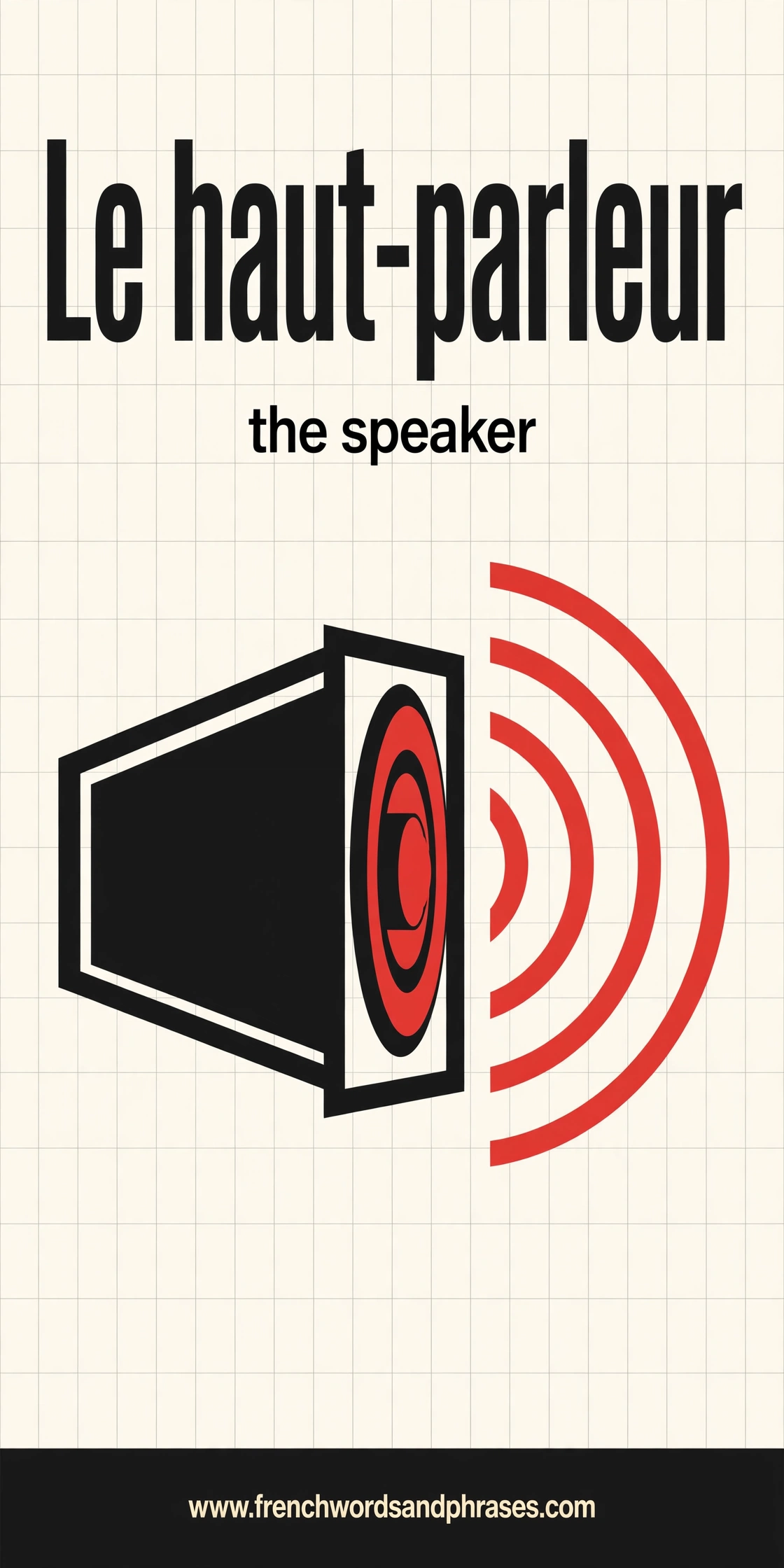
Le haut-parleur means the speaker.
In the station hall, a voice blooms out of nowhere — clear, calm, announcing the train for Marseille. Every head turns towards the same invisible source: le haut-parleur.
In this guide, you’ll learn what haut-parleur means in English, how to use it with its articles, how to form its plural, and how it appears in everyday French. Explore French examples, English translations, and practice quizzes.
Understanding the French Noun Haut-parleur
Haut-parleur is a masculine French compound noun: haut (high, loud) plus parleur (speaker, talker, from parler, to speak). It is learned with its article: le haut-parleur, un haut-parleur. The first element, haut, never changes; parleur carries the plural.
It means the speaker — the loudspeaker: the device that turns electricity into voice and music, in les gares (stations), at concerts, and in the corner of your living room. A phone call en haut-parleur is on speakerphone, and a portable one today is often une enceinte — but haut-parleur remains the classic word.
Gender: Masculine
Composition: haut (loud, high) + parleur (speaker, from parler, to speak)
Definite article: le — le haut-parleur (the speaker, the loudspeaker)
Indefinite article: un — un haut-parleur (a speaker)
Plural: les haut-parleurs — only parleur takes the plural
English equivalents: The speaker; the loudspeaker.
One important usage detail: the phrase en haut-parleur means on speakerphone — « Mets-le en haut-parleur ! », put it on speaker! And remember the plural rule: haut is frozen, so des haut-parleurs, with the -s on parleur alone.
Experience the Word
Haut-parleur is more than a device. It is the voice of public places — the station announcement, the festival stage, the schoolyard call — a voice with no face that everyone obeys.
Imagine the village fête at dusk: the accordion swells from two haut-parleurs on poles, and the whole square begins to dance to a sound that fills the sky.
You have not just heard music. You have been gathered — rassemblé par une voix venue d’en haut.
How to Use Haut-parleur in French: Complete Guide
Let’s explore how haut-parleur works in French, beginning with its articles — and watch haut stay frozen while parleur takes the plural.
Haut-parleur with the Definite Article (Le, Les)
Used for the speaker everyone can hear — the one above the platform.
| Form | French |
|---|---|
| Masculine singular | le haut-parleur |
| Plural | les haut-parleurs |
Example
Le haut-parleur annonce un retard de dix minutes.
The loudspeaker is announcing a ten-minute delay.
Haut-parleur with the Indefinite Article (Un, Des)
Used for a speaker in general — un haut-parleur in every hall and classroom.
| Form | French |
|---|---|
| Masculine singular | un haut-parleur |
| Plural | des haut-parleurs |
Example
Il y a un haut-parleur dans chaque salle de classe.
There is a speaker in every classroom.
Sound and Voice: Words of the Haut-parleur
Announcements, volume and microphones — the vocabulary that surrounds the haut-parleur.
| French | In English |
|---|---|
| le son | the sound |
| le volume | the volume |
| le micro | the microphone |
| l’annonce | the announcement |
| la musique | the music |
| la voix | the voice |
Example
Le son du haut-parleur est clair dans tout le hall.
The sound of the loudspeaker is clear throughout the hall.
Quick Quiz 1
Complete the sentence:
Deux ______ sont installés sur la place du village.
Reveal the answer
haut-parleurs
Deux haut-parleurs sont installés sur la place du village.
Two loudspeakers are installed on the village square — only parleur takes the -s.
The Plural of Haut-parleur
Haut never changes; parleur alone takes the -s: des haut-parleurs.
| Number | French |
|---|---|
| Singular | le haut-parleur / un haut-parleur |
| Plural | les haut-parleurs / des haut-parleurs |
Example
Les haut-parleurs de la salle diffusent la musique.
The speakers in the hall are playing the music.
Haut-parleur with Possessive Adjectives (Mon, Ton, Son…)
Possessives agree with the noun: haut-parleur is masculine, so it takes mon, ton, son.
| Owner | French |
|---|---|
| my | mon haut-parleur |
| your (tu) | ton haut-parleur |
| his / her | son haut-parleur |
| our | notre haut-parleur |
| your (vous) | votre haut-parleur |
| their | leur haut-parleur |
Example
Mon haut-parleur ne fonctionne plus depuis hier.
My speaker has not worked since yesterday.
Quick Quiz 2
Complete the sentence:
______ haut-parleur est trop fort. (Their)
Reveal the answer
Leur
Leur haut-parleur est trop fort.
Their speaker is too loud.
Haut-parleur with Demonstrative Adjectives (Ce, Ces)
Used to point: ce haut-parleur, the one above the door.
| Form | French |
|---|---|
| Masculine singular | ce haut-parleur |
| Plural | ces haut-parleurs |
Example
Ce haut-parleur grésille un peu, il faut le réparer.
This speaker crackles a little; it needs repairing.
Haut-parleur with Adjectives
Adjectives agree with the compound as masculine: un haut-parleur puissant, un haut-parleur portable.
| Adjective | With Haut-parleur |
|---|---|
| puissant (powerful) | un haut-parleur puissant |
| portable (portable) | un haut-parleur portable |
| petit (small) | un petit haut-parleur |
| nouveau (new) | un nouveau haut-parleur |
| cassé (broken) | un haut-parleur cassé |
Example
Il apporte un haut-parleur portable pour la fête.
He is bringing a portable speaker for the party.
Quick Quiz 3
Complete the sentence:
______ haut-parleurs sont pour le concert. (These)
Reveal the answer
Ces
Ces haut-parleurs sont pour le concert.
These speakers are for the concert.
Everyday Expressions with Haut-parleur
Speakerphone and announcements — the haut-parleur phrases of daily life.
| Expression | In English |
|---|---|
| mettre en haut-parleur | to put on speakerphone |
| un appel en haut-parleur | a call on speaker |
| monter le son du haut-parleur | to turn the speaker up |
| une annonce au haut-parleur | an announcement over the loudspeaker |
| brancher un haut-parleur | to plug in a speaker |
Example
Mets le téléphone en haut-parleur, je veux entendre.
Put the phone on speaker; I want to hear.
Words from the Same Family as Haut-parleur
Speaking and sound — the words that travel with haut-parleur.
| French | In English |
|---|---|
| parler | to speak |
| haut | high; loud |
| écouter | to listen |
| entendre | to hear |
| le bruit | the noise |
| une enceinte | a speaker (a cabinet speaker) |
Example
Le parleur du haut-parleur, c’est celui qui parle haut et fort.
The parleur of the haut-parleur is the one who speaks up, loud and clear.
Quick Quiz 4
What does « Mets-le en haut-parleur » mean?
Reveal the answer
Put it on speakerphone — en haut-parleur is the everyday phrase for a call on speaker.
Mets-le en haut-parleur, tout le monde veut écouter.
Put it on speaker; everyone wants to listen.
Haut-parleur in Everyday French: Real-Life Examples
Now that you know the word, let’s see how haut-parleur appears in everyday French.
Example 1 — At the station
Une annonce passe dans le haut-parleur de la gare.
An announcement comes over the station loudspeaker.
Example 2 — On the phone
Elle met son téléphone en haut-parleur.
She puts her phone on speaker.
Example 3 — At a party
Ce haut-parleur portable a un très bon son.
This portable speaker has very good sound.
Example 4 — In the classroom
Le haut-parleur de la classe annonce la récréation.
The classroom speaker announces break time.
Example 5 — Repairing
Son haut-parleur est cassé, il n’y a plus de son.
His speaker is broken; there is no sound any more.
Example 6 — At the concert
Les haut-parleurs du concert sont énormes.
The concert speakers are enormous.
Beyond Translation: The Meaning of Haut-parleur
Haut-parleur is a transparent invention of the electrical age: when the loudspeaker arrived, French simply described it — the thing that speaks loud, haut. Its cousin enceinte, literally an enclosure, took over the living room, but haut-parleur kept the public world: stations, stadiums, schoolyards and every phone call shared around a table.
To say haut-parleur is to give a voice to the room itself.
It evokes the platform announcement and the village fête, the crackle before the music starts — sound, sent up high so that everyone can hear.
How to Remember the French Noun Haut-parleur
Remember it this way: Haut-parleur is the speaker — haut, loud, plus parleur, the talker: the thing that speaks out loud.
- You picture the voice — parler haut, parler fort.
- You share the call — mettre en haut-parleur.
- You pluralise the talker — des haut-parleurs, haut ne bouge pas.
The key idea is haut + parleur — the loud talker.
Test Your Knowledge of Haut-parleur
Let’s see how much you’ve learned. Try answering these questions before revealing the answers.
Question 1
What does haut-parleur literally mean?
Reveal the answer
Loud-speaker — haut (loud, high) plus parleur (speaker, talker), the device that speaks out loud.
Question 2
How do you say speakers in French?
Reveal the answer
Des haut-parleurs — only parleur takes the plural; haut never changes.
Question 3
Translate: Put the phone on speaker.
Reveal the answer
Mets le téléphone en haut-parleur.
Question 4
What is une annonce au haut-parleur?
Reveal the answer
An announcement over the loudspeaker — the station voice everyone listens to.
Question 5
Complete the sentence:
______ haut-parleur annonce le train. (The)
Reveal the answer
Le
Le haut-parleur annonce le train.
The loudspeaker is announcing the train.
Your Final Challenge
Can You Use It?
How would you say this in French?
“The speaker is above the door.”
Reveal the answer
Le haut-parleur est au-dessus de la porte.
The speaker is above the door.
A little French. A little curiosity. A richer everyday life.
LEARN FRENCH ONE WORD AT A TIME