A French Word to Live By
Translate Sentiment to English
/sɑ̃.ti.mɑ̃/
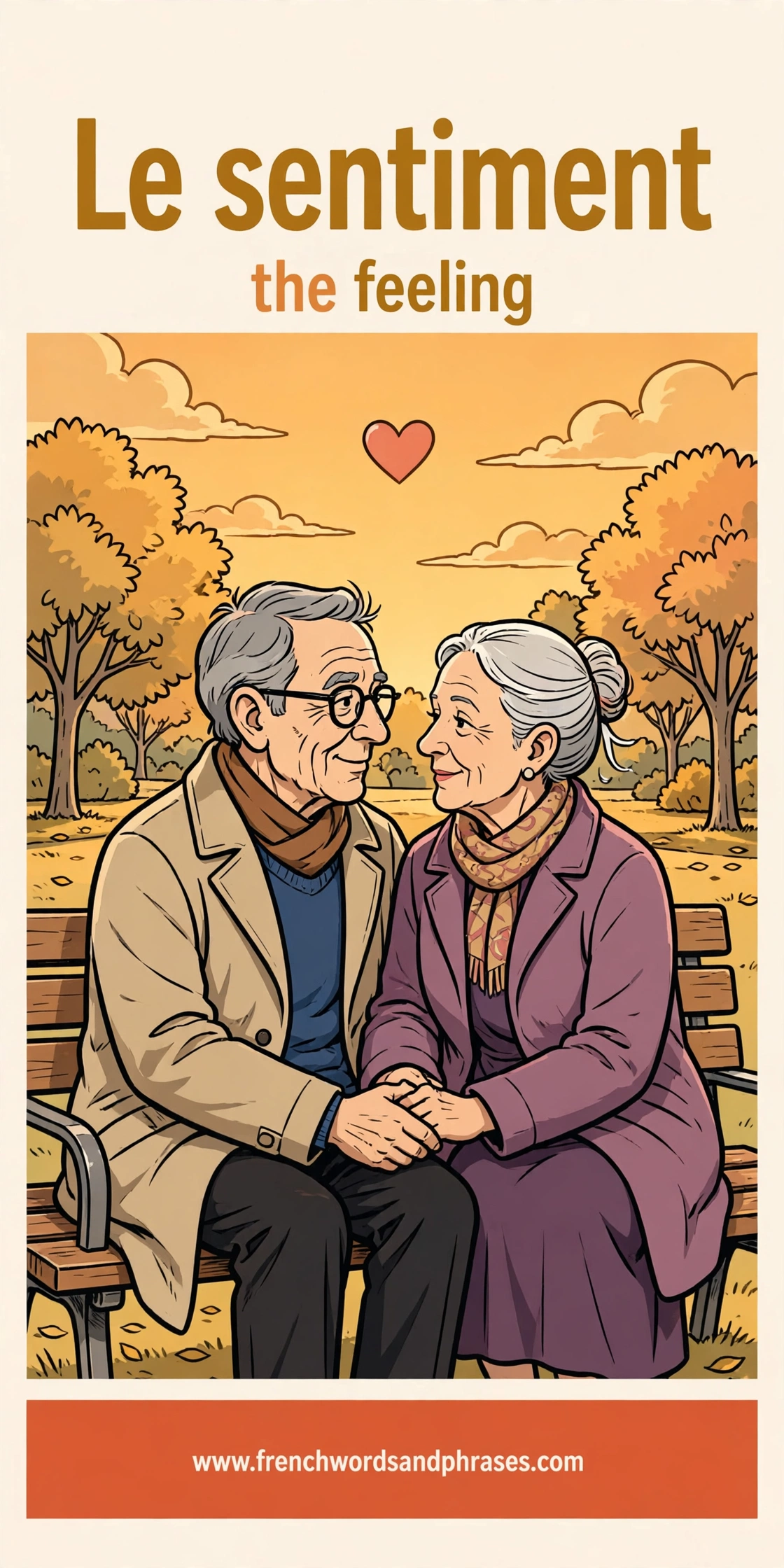
Le sentiment means the feeling.
She closes the old letter, holds it a moment against her chest, and smiles through a sudden tear. No word is spoken, but the room is full of it — le sentiment.
In this guide, you’ll learn what sentiment means in English, how to use it with its articles, how to form its plural, and how it appears in everyday French. Explore French examples, English translations, and practice quizzes.
Understanding the French Noun Sentiment
Sentiment is a masculine French noun, learned with its article: le sentiment, un sentiment. It ends in -ment and is masculine like the whole family. It comes from the verb sentir, to feel — sentiment is what sentir leaves behind in the heart.
It means the feeling — an emotion, a sense, an inner impression: un sentiment de joie (a feeling of joy), un sentiment d’insécurité (a feeling of insecurity). In the plural it often means tender feelings, even love: déclarer ses sentiments, to declare your feelings. And in letter-writing it survives in the old formal close: avec mes meilleurs sentiments.
Gender: Masculine
Definite article: le — le sentiment (the feeling)
Indefinite article: un — un sentiment (a feeling)
Partitive article: du — du sentiment (feeling, sentiment, in set phrases)
Plural: les sentiments
English equivalents: The feeling; a sentiment, an emotion.
One important usage detail: sentiment is deeper and more lasting than a passing émotion. Une émotion strikes; un sentiment stays. French also uses it for a hunch about the world: avoir le sentiment que…, to have the feeling that… — j’ai le sentiment qu’il va pleuvoir, I have a feeling it is going to rain.
Experience the Word
Sentiment is more than an emotion. It is the weather system of the heart — slower than a storm, deeper than a breeze, the climate in which a whole season of life is lived.
Imagine the moment of return: a station platform, a familiar face in the crowd, and a feeling too large for the words waiting on your tongue.
You have not just felt something pass. You have been inhabited by it — un sentiment qui dure.
How to Use Sentiment in French: Complete Guide
Let’s explore how sentiment works in French, beginning with its articles — un sentiment that rises, les sentiments we declare.
Sentiment with the Definite Article (Le, Les)
Used for a feeling already identified — the one you both know is in the room.
| Form | French |
|---|---|
| Masculine singular | le sentiment |
| Plural | les sentiments |
Example
Le sentiment de liberté la saisit en haut de la montagne.
The feeling of freedom seizes her at the top of the mountain.
Sentiment with the Indefinite Article (Un, Des)
Used for a feeling in general — one emotion among the many a day can bring.
| Form | French |
|---|---|
| Masculine singular | un sentiment |
| Plural | des sentiments |
Example
Un sentiment étrange l’envahit devant la maison vide.
A strange feeling comes over him in front of the empty house.
Sentiment with the Partitive Article (Du)
Du sentiment appears in literary phrases — feeling as a substance, something a voice or a letter can be full of.
| Form | French |
|---|---|
| Partitive | du sentiment |
| With a negative | pas de sentiment |
Example
Sa voix est pleine du sentiment de ces années-là.
Her voice is full of the feeling of those years.
Quick Quiz 1
Complete the sentence:
J’ai ______ sentiment que nous nous connaissons déjà.
Reveal the answer
le
J’ai le sentiment que nous nous connaissons déjà.
I have the feeling that we already know each other — the set phrase is avoir le sentiment que.
The Plural of Sentiment
Sentiment adds an -s in the plural — les sentiments, often the tender ones, the feelings of the heart.
| Number | French |
|---|---|
| Singular | le sentiment |
| Plural | les sentiments |
Example
Il lui déclare ses sentiments un soir de printemps.
He declares his feelings to her one spring evening.
Sentiment with Possessive Adjectives (Mon, Ton, Son…)
Possessives agree with the noun: sentiment is masculine, so mon, ton, son — mes sentiments in the plural.
| Owner | French |
|---|---|
| my | mon sentiment / mes sentiments |
| your (tu) | ton sentiment / tes sentiments |
| his / her | son sentiment / ses sentiments |
| our | notre sentiment / nos sentiments |
| your (vous) | votre sentiment / vos sentiments |
| their | leur sentiment / leurs sentiments |
Example
Elle garde ses sentiments pour elle, par pudeur.
She keeps her feelings to herself, out of reserve.
Quick Quiz 2
Complete the sentence:
Il ne parle jamais de ______ sentiments. (his)
Reveal the answer
ses
Il ne parle jamais de ses sentiments.
He never talks about his feelings — ses, the plural of son.
Sentiment with Demonstrative Adjectives (Ce, Ces)
Used to point at one particular feeling: ce sentiment, this feeling.
| Form | French |
|---|---|
| Masculine singular | ce sentiment |
| Plural | ces sentiments |
Example
Ce sentiment de paix ne dure jamais longtemps en ville.
This feeling of peace never lasts long in the city.
Sentiment with Adjectives
Adjectives agree with sentiment — profond and amoureux keep these shapes in the masculine singular.
| Adjective | With Sentiment |
|---|---|
| profond (deep) | un sentiment profond |
| amoureux (of love, loving) | un sentiment amoureux |
| étrange (strange) | un sentiment étrange |
| fort (strong) | un sentiment fort |
| meilleur (best) | mes meilleurs sentiments |
Example
Un sentiment profond les unit depuis l’enfance.
A deep feeling has bound them together since childhood.
Quick Quiz 3
Complete the sentence:
C’est un sentiment très ______. (deep)
Reveal the answer
profond
C’est un sentiment très profond.
It is a very deep feeling.
Everyday Expressions with Sentiment
Confessions and letter endings — the sentiment phrases of daily life.
| Expression | In English |
|---|---|
| avoir le sentiment que… | to have the feeling that… |
| déclarer ses sentiments | to declare your feelings |
| un sentiment de joie | a feeling of joy |
| les sentiments partagés | mutual feelings |
| avec mes meilleurs sentiments | with my warmest regards (formal letter close) |
| blesser les sentiments de quelqu’un | to hurt someone’s feelings |
Example
Après des années, il ose enfin déclarer ses sentiments.
After years, he finally dares to declare his feelings.
Words from the Same Family as Sentiment
Feeling, sensing and consenting — the words that travel with sentiment.
| French | In English |
|---|---|
| sentir | to feel, to smell |
| sensible | sensitive |
| l’émotion | the emotion |
| le ressentiment | resentment |
| consentir | to consent |
| sentimental | sentimental |
Example
Elle sent monter un sentiment de fierté en regardant son fils.
She feels a feeling of pride rising as she watches her son.
Quick Quiz 4
What does avoir le sentiment que mean?
Reveal the answer
To have the feeling that — a hunch, an inner impression.
J’ai le sentiment qu’il cache quelque chose.
I have the feeling he is hiding something.
Sentiment in Everyday French: Real-Life Examples
Now that you know the word, let’s see how sentiment appears in everyday French.
Example 1 — A hunch
J’ai le sentiment que ce projet va réussir.
I have the feeling this project is going to succeed.
Example 2 — Joy
Un sentiment de joie remplit toute la maison.
A feeling of joy fills the whole house.
Example 3 — A confession
Il lui déclare ses sentiments sous les étoiles.
He declares his feelings to her under the stars.
Example 4 — Sensitivity
Attention, tu risques de blesser ses sentiments.
Careful, you might hurt her feelings.
Example 5 — A formal letter
Je vous prie d’accepter mes meilleurs sentiments.
Please accept my warmest regards.
Example 6 — Nostalgia
Ce vieux quartier lui donne un sentiment de tristesse douce.
This old neighbourhood gives him a feeling of gentle sadness.
Beyond Translation: The Meaning of Sentiment
Sentiment is one of the pillars of French inner life — the century of Rousseau and the Romantics built a whole literature on it, and the French still distinguish carefully between the sentiment that endures and the passion that burns. It closes their most formal letters and opens their most intimate confessions: few words travel so far in both directions.
To say sentiment is to name what the heart knows before the head does.
It evokes the letter held against a chest, the platform reunion, the quiet certainty — j’ai le sentiment que… — that something is true long before it can be proved.
How to Remember the French Noun Sentiment
Remember it this way: Sentiment is the feeling — lasting, deep, the heart’s climate rather than its weather. The -ment ending makes it masculine: le sentiment.
- You have a hunch — j’ai le sentiment que…
- You fall in love — tu déclares tes sentiments.
- You sign a letter — avec mes meilleurs sentiments.
The key idea is le sentiment — what sentir leaves in the heart.
Test Your Knowledge of Sentiment
Let’s see how much you’ve learned. Try answering these questions before revealing the answers.
Question 1
Is sentiment masculine or feminine?
Reveal the answer
Masculine — le sentiment, un sentiment.
Question 2
How do you say to declare your feelings?
Reveal the answer
Déclarer ses sentiments — the great romantic phrase.
Question 3
Translate: I have the feeling that it is going to rain.
Reveal the answer
J’ai le sentiment qu’il va pleuvoir.
Question 4
What is the difference between un sentiment and une émotion?
Reveal the answer
Une émotion strikes and passes; un sentiment stays — deeper, more lasting.
Question 5
Complete the sentence:
Elle garde ______ sentiments pour elle.
Reveal the answer
ses
Elle garde ses sentiments pour elle.
She keeps her feelings to herself.
Your Final Challenge
Can You Use It?
How would you say this in French?
“He declares his feelings to her.”
Reveal the answer
Il lui déclare ses sentiments.
He declares his feelings to her.
A little French. A little curiosity. A richer everyday life.
LEARN FRENCH ONE WORD AT A TIME