A French Word to Live By
Translate Pansement to English
/pɑ̃s.mɑ̃/
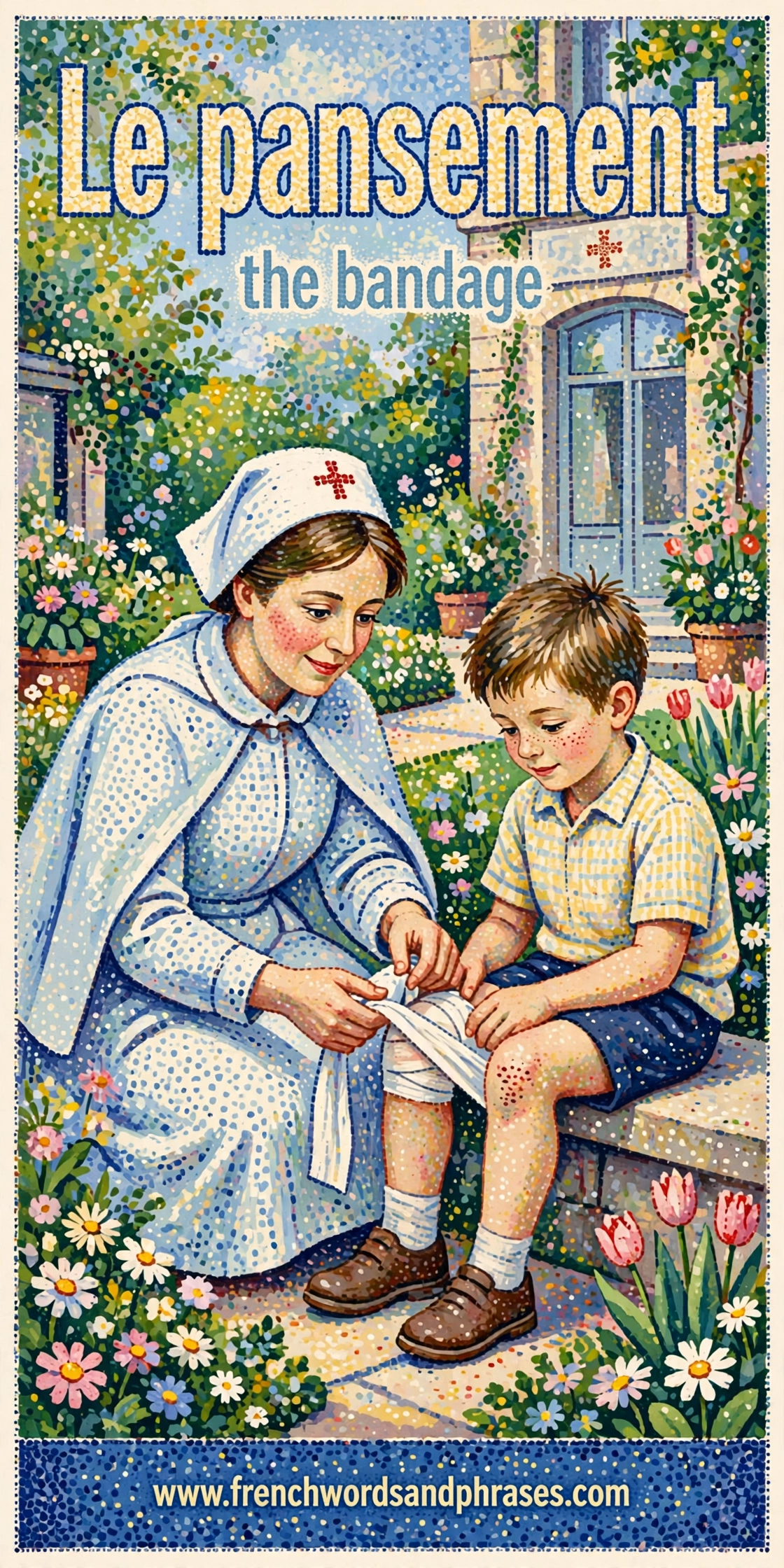
Le pansement means the bandage.
A small fall in the playground, a scraped knee, a few tears — then the nurse’s gentle hands, a square of white gauze, and everything is better: un pansement.
In this guide, you’ll learn what pansement means in English, how to use it with its articles, how to form its plural, and how it appears in everyday French. Explore French examples, English translations, and practice quizzes.
Understanding the French Noun Pansement
Pansement is a masculine French noun, learned with its article: le pansement, un pansement. It ends in -ment, the masculine ending of this family. It comes from the verb panser, an old word for tending and dressing a wound.
It means the bandage — the dressing placed on a wound to protect it while it heals: gauze, cotton and tape, or the simple adhesive strip from the first-aid kit. The nurse fait un pansement (does a dressing) and later change le pansement (changes it). In the plural, les pansements are the contents of every school infirmary cupboard.
Gender: Masculine
Definite article: le — le pansement (the bandage, the dressing)
Indefinite article: un — un pansement (a bandage)
Partitive article: du — du pansement (in set phrases, of the dressing)
Plural: les pansements
English equivalents: The bandage; a dressing, a plaster.
One important usage detail: French makes a small distinction English blurs. The sticky strip you peel from a wrapper is often called un pansement adhésif, while the rolled bandage is une bande. But in everyday speech, pansement covers them all — and the figurative phrase is charming: mettre un pansement sur une douleur, to put a bandage on a sorrow, a small comfort over a hurt.
Experience the Word
Pansement is more than gauze and tape. It is the visible sign that someone has been looked after — the white square that says the healing has officially begun.
Imagine the school nurse’s office: the smell of antiseptic, the brave face of a six-year-old, and the pansement applied like a medal of courage.
You have not just covered a scrape. You have been tended, soothed and sent back to play — pansé, the French way.
How to Use Pansement in French: Complete Guide
Let’s explore how pansement works in French, beginning with its articles — un pansement for the knee, le pansement to change tonight.
Pansement with the Definite Article (Le, Les)
Used for the dressing already on the wound — the one to watch, the one to change.
| Form | French |
|---|---|
| Masculine singular | le pansement |
| Plural | les pansements |
Example
Le pansement doit rester sec pendant deux jours.
The bandage must stay dry for two days.
Pansement with the Indefinite Article (Un, Des)
Used for a dressing in general — the one you ask for, the one from the kit.
| Form | French |
|---|---|
| Masculine singular | un pansement |
| Plural | des pansements |
Example
Mets un pansement sur cette petite coupure.
Put a bandage on that little cut.
Pansement with the Partitive Article (Du)
Du pansement appears in pharmacy phrases — the material itself, bought or asked for by amount.
| Form | French |
|---|---|
| Partitive | du pansement |
| With a negative | pas de pansement |
Example
Il ne reste plus de pansement dans la trousse de secours.
There is no bandage left in the first-aid kit.
Quick Quiz 1
Complete the sentence:
L’infirmière change ______ pansement du patient.
Reveal the answer
le
L’infirmière change le pansement du patient.
The nurse is changing the patient’s bandage — one specific dressing, so le.
The Plural of Pansement
Pansement adds an -s in the plural — les pansements, the stock of every infirmary and bathroom cabinet.
| Number | French |
|---|---|
| Singular | le pansement |
| Plural | les pansements |
Example
Elle achète des pansements de toutes les tailles.
She is buying bandages in all sizes.
Pansement with Possessive Adjectives (Mon, Ton, Son…)
Possessives agree with the noun: pansement is masculine, so mon, ton, son.
| Owner | French |
|---|---|
| my | mon pansement |
| your (tu) | ton pansement |
| his / her | son pansement |
| our | notre pansement |
| your (vous) | votre pansement |
| their | leur pansement |
Example
Son pansement est tombé dans la cour de récréation.
Her bandage came off in the playground.
Quick Quiz 2
Complete the sentence:
Ne touche pas à ______ pansement, il est propre. (your, tu)
Reveal the answer
ton
Ne touche pas à ton pansement, il est propre.
Don’t touch your bandage, it is clean.
Pansement with Demonstrative Adjectives (Ce, Ces)
Used to point at one dressing: ce pansement, this bandage.
| Form | French |
|---|---|
| Masculine singular | ce pansement |
| Plural | ces pansements |
Example
Ce pansement est trop petit pour la plaie.
This bandage is too small for the wound.
Pansement with Adjectives
Adjectives agree with pansement — propre and adhésif keep these shapes in the masculine singular.
| Adjective | With Pansement |
|---|---|
| propre (clean) | un pansement propre |
| adhésif (adhesive) | un pansement adhésif |
| grand (big) | un grand pansement |
| nouveau (new) | un nouveau pansement |
| stérile (sterile) | un pansement stérile |
Example
L’infirmier met un pansement propre et stérile.
The nurse applies a clean, sterile bandage.
Quick Quiz 3
Complete the sentence:
Il lui faut un pansement ______. (clean)
Reveal the answer
propre
Il lui faut un pansement propre.
He needs a clean bandage.
Everyday Expressions with Pansement
Playgrounds and infirmaries — the pansement phrases of daily life.
| Expression | In English |
|---|---|
| mettre un pansement | to put on a bandage |
| changer un pansement | to change a dressing |
| faire un pansement | to dress a wound |
| un pansement adhésif | an adhesive plaster, a sticking plaster |
| la trousse de secours | the first-aid kit |
| retirer le pansement | to take the bandage off |
Example
Le soir, elle retire le pansement pour laisser la plaie respirer.
In the evening, she takes the bandage off to let the wound breathe.
Words from the Same Family as Pansement
Wounds, nurses and healing — the words that travel with pansement.
| French | In English |
|---|---|
| panser | to dress, to tend (a wound) |
| la plaie | the wound |
| la coupure | the cut |
| guérir | to heal, to cure |
| l’infirmier | the nurse (a man) |
| la bande | the bandage (the rolled strip) |
Example
L’infirmier panse la plaie et met un pansement propre.
The nurse dresses the wound and applies a clean bandage.
Quick Quiz 4
What does changer un pansement mean?
Reveal the answer
To change a dressing — to replace the old bandage with a clean one.
Il faut changer le pansement tous les jours.
The bandage must be changed every day.
Pansement in Everyday French: Real-Life Examples
Now that you know the word, let’s see how pansement appears in everyday French.
Example 1 — In the playground
L’institutrice met un pansement sur son genou.
The teacher puts a bandage on his knee.
Example 2 — At the pharmacy
Je voudrais une boîte de pansements, s’il vous plaît.
I would like a box of bandages, please.
Example 3 — At home
Elle change le pansement de son mari après la douche.
She changes her husband’s bandage after his shower.
Example 4 — A small cut
Ce n’est rien, un pansement et ça repart.
It’s nothing — a bandage and off we go again.
Example 5 — Instructions
Gardez le pansement au sec jusqu’à demain.
Keep the bandage dry until tomorrow.
Example 6 — Brave face
Avec son pansement au front, il se sent comme un héros.
With his bandage on his forehead, he feels like a hero.
Beyond Translation: The Meaning of Pansement
The pansement belongs to the gentle mythology of French childhood: the school infirmary, the maîtresse with her little metal box, the scraped knee transformed by a white square into a badge of honour. The word itself keeps an older kindness inside it — panser once meant simply to tend, the same verb used for grooming a horse, care given slowly and by hand.
To say pansement is to name the smallest unit of care.
It evokes antiseptic and bravery, the tears that stop as the strip is smoothed down, and the universal childhood truth: with a pansement, everything is already half healed.
How to Remember the French Noun Pansement
Remember it this way: Pansement is the bandage — the dressing on a wound, from panser, to tend. The -ment ending makes it masculine: le pansement.
- You fall — on te met un pansement.
- You heal — on change le pansement tous les jours.
- You stock up — une boîte de pansements dans la trousse de secours.
The key idea is le pansement — the white square that starts the healing.
Test Your Knowledge of Pansement
Let’s see how much you’ve learned. Try answering these questions before revealing the answers.
Question 1
Is pansement masculine or feminine?
Reveal the answer
Masculine — le pansement, un pansement.
Question 2
How do you say to put on a bandage?
Reveal the answer
Mettre un pansement — and to dress a wound is faire un pansement.
Question 3
Translate: The nurse changes the bandage.
Reveal the answer
L’infirmière change le pansement.
Question 4
What is la trousse de secours?
Reveal the answer
The first-aid kit — the box where the pansements live.
Question 5
Complete the sentence:
Mets ______ pansement sur cette coupure.
Reveal the answer
un
Mets un pansement sur cette coupure.
Put a bandage on that cut.
Your Final Challenge
Can You Use It?
How would you say this in French?
“The nurse puts a bandage on his knee.”
Reveal the answer
L’infirmière met un pansement sur son genou.
The nurse puts a bandage on his knee.
A little French. A little curiosity. A richer everyday life.
LEARN FRENCH ONE WORD AT A TIME