A French Word to Live By
Translate Médicament to English
/me.di.ka.mɑ̃/
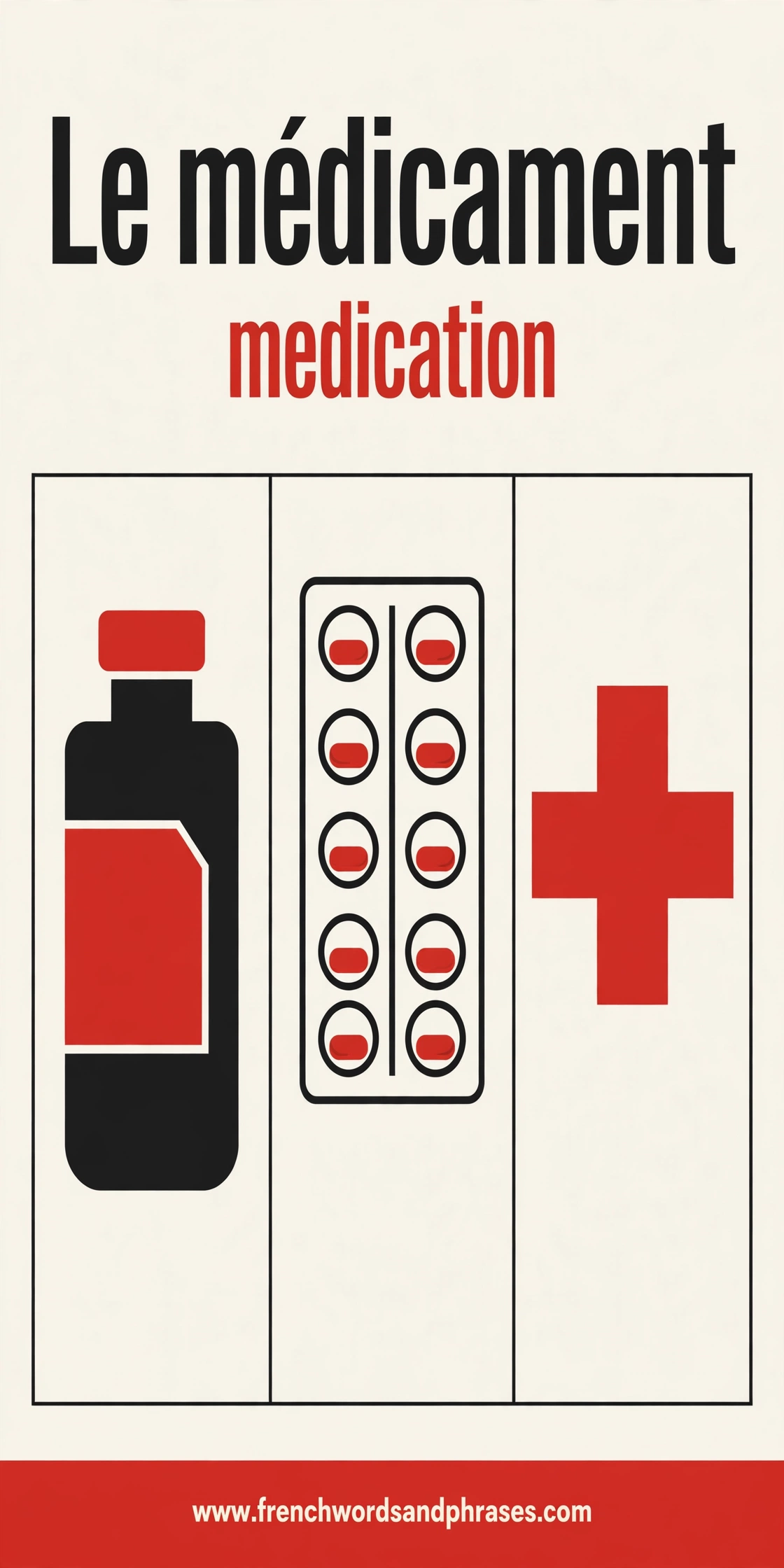
Le médicament means medication.
The pharmacist slides a small white box across the counter with the instructions everyone knows: « Un comprimé matin et soir, pendant sept jours. » Inside the box — le médicament.
In this guide, you’ll learn what médicament means in English, how to use it with its articles, how to form its plural, and how it appears in everyday French. Explore French examples, English translations, and practice quizzes.
Understanding the French Noun Médicament
Médicament is a masculine French noun, learned with its article: le médicament, un médicament. It ends in -ment, the ending that signals masculine nouns again and again. It is the general word for any medicine you take to get better.
It means medication — any medicine, remedy or drug used for treatment: tablets, syrups, drops. The médecin prescribes it on une ordonnance (a prescription), and you collect it at la pharmacie. Some médicaments are en vente libre (available over the counter); others are only given sur ordonnance.
Gender: Masculine
Definite article: le — le médicament (the medication)
Indefinite article: un — un médicament (a medicine, a drug)
Partitive article: du — du médicament (some medication)
Plural: les médicaments
English equivalents: Medication; a medicine, a remedy, a drug.
One important usage detail: médicament is the thing you take, while la médecine is the science and the profession — do not mix them up. You say prendre un médicament (to take a medicine) and étudier la médecine (to study medicine). English uses one word for both; French keeps them apart.
Experience the Word
Médicament is more than a box on a shelf. It is the small ritual of recovery — the glass of water on the bedside table, the blister pack counted day by day.
Imagine the bathroom cabinet of any French home: the familiar boxes, the notice folded into origami, the spare tablets kept « au cas où » — just in case.
You have not just swallowed a tablet. You have started getting better — le médicament fait son travail.
How to Use Médicament in French: Complete Guide
Let’s explore how médicament works in French, beginning with its articles — le médicament at the pharmacy, un médicament on the prescription.
Médicament with the Definite Article (Le, Les)
Used for a specific medicine — the one on the prescription, the one in your hand.
| Form | French |
|---|---|
| Masculine singular | le médicament |
| Plural | les médicaments |
Example
Le médicament se prend avec un grand verre d’eau.
The medication is taken with a large glass of water.
Médicament with the Indefinite Article (Un, Des)
Used for a medicine in general — any remedy the doctor might choose.
| Form | French |
|---|---|
| Masculine singular | un médicament |
| Plural | des médicaments |
Example
Le médecin lui prescrit un médicament contre la douleur.
The doctor prescribes her a medicine for the pain.
Médicament with the Partitive Article (Du)
Du médicament appears when the medicine is treated as an amount — in advice, warnings and quantities.
| Form | French |
|---|---|
| Partitive | du médicament |
| With a negative | pas de médicament |
Example
Il ne reste presque plus du médicament dans la boîte.
There is almost none of the medication left in the box.
Quick Quiz 1
Complete the sentence:
Ce ______ est seulement vendu sur ordonnance.
Reveal the answer
médicament
Ce médicament est seulement vendu sur ordonnance.
This medication is only sold on prescription.
The Plural of Médicament
Médicament adds an -s in the plural — les médicaments, the contents of every pharmacy shelf.
| Number | French |
|---|---|
| Singular | le médicament |
| Plural | les médicaments |
Example
Range les médicaments loin des enfants.
Keep the medicines out of children’s reach.
Médicament with Possessive Adjectives (Mon, Ton, Son…)
Possessives agree with the noun: médicament is masculine, so mon, ton, son.
| Owner | French |
|---|---|
| my | mon médicament |
| your (tu) | ton médicament |
| his / her | son médicament |
| our | notre médicament |
| your (vous) | votre médicament |
| their | leur médicament |
Example
N’oublie pas ton médicament avant le voyage.
Don’t forget your medication before the trip.
Quick Quiz 2
Complete the sentence:
Elle prend ______ médicament tous les matins à huit heures. (her)
Reveal the answer
son
Elle prend son médicament tous les matins à huit heures.
She takes her medication every morning at eight o’clock — son, because médicament is masculine.
Médicament with Demonstrative Adjectives (Ce, Ces)
Used to point at one particular box: ce médicament, this medication.
| Form | French |
|---|---|
| Masculine singular | ce médicament |
| Plural | ces médicaments |
Example
Ce médicament marche très bien contre les migraines.
This medication works very well against migraines.
Médicament with Adjectives
Adjectives agree with médicament — efficace and générique stay the same in the masculine singular.
| Adjective | With Médicament |
|---|---|
| efficace (effective) | un médicament efficace |
| générique (generic) | un médicament générique |
| nouveau (new) | un nouveau médicament |
| cher (expensive) | un médicament cher |
| dangereux (dangerous) | un médicament dangereux |
Example
Le pharmacien propose un médicament générique moins cher.
The pharmacist suggests a cheaper generic medication.
Quick Quiz 3
Complete the sentence:
C’est un médicament très ______. (effective)
Reveal the answer
efficace
C’est un médicament très efficace.
It is a very effective medication.
Everyday Expressions with Médicament
Prescriptions and bedside tables — the médicament phrases of daily life.
| Expression | In English |
|---|---|
| prendre un médicament | to take a medicine |
| un médicament sur ordonnance | a prescription-only medicine |
| un médicament en vente libre | an over-the-counter medicine |
| un médicament générique | a generic medicine |
| la notice du médicament | the medicine’s information leaflet |
| les effets secondaires | the side effects |
Example
Lis toujours la notice du médicament avant de le prendre.
Always read the medicine’s leaflet before taking it.
Words from the Same Family as Médicament
Doctors, pharmacies and prescriptions — the words that travel with médicament.
| French | In English |
|---|---|
| la médecine | medicine, the field of medicine |
| le médecin | the doctor |
| médical | medical |
| l’ordonnance | the prescription |
| la pharmacie | the pharmacy, the chemist’s |
| le comprimé | the tablet |
Example
Le médecin écrit l’ordonnance, le pharmacien prépare le médicament.
The doctor writes the prescription, the pharmacist prepares the medication.
Quick Quiz 4
What is la notice du médicament?
Reveal the answer
The information leaflet inside the box — doses, warnings and side effects.
La notice du médicament explique les effets secondaires.
The medicine’s leaflet explains the side effects.
Médicament in Everyday French: Real-Life Examples
Now that you know the word, let’s see how médicament appears in everyday French.
Example 1 — At the pharmacy
Je viens chercher le médicament de l’ordonnance.
I’ve come to collect the medication on the prescription.
Example 2 — Morning routine
Il prend son médicament avec le petit déjeuner.
He takes his medication with breakfast.
Example 3 — A warning
Ne donne jamais ton médicament à quelqu’un d’autre.
Never give your medication to anyone else.
Example 4 — Good news
Le nouveau médicament marche mieux que l’ancien.
The new medication works better than the old one.
Example 5 — Travelling
Elle garde ses médicaments dans son sac à main.
She keeps her medicines in her handbag.
Example 6 — At the doctor’s
Ce médicament peut donner sommeil, fais attention.
This medication can make you sleepy, be careful.
Beyond Translation: The Meaning of Médicament
The médicament sits at the heart of a very French institution: the pharmacie, with its green cross glowing on every high street, where the pharmacist knows your name and your traitement by heart. France consumes, discusses and debates its médicaments endlessly — which ones are remboursés, which générique to accept, what the notice really says.
To say médicament is to name the small box on which a whole recovery is pinned.
It evokes the white counter and the careful voice — « matin et soir, pendant sept jours » — and the quiet confidence that somewhere in that little box, health is on its way back.
How to Remember the French Noun Médicament
Remember it this way: Médicament is medication — the medicine you take, not the science (that is la médecine). The -ment ending makes it masculine: le médicament.
- You take it — tu prends ton médicament.
- You collect it — le médicament de l’ordonnance, à la pharmacie.
- You choose it — un médicament générique coûte moins cher.
The key idea is le médicament — the medicine you take; la médecine is the science.
Test Your Knowledge of Médicament
Let’s see how much you’ve learned. Try answering these questions before revealing the answers.
Question 1
Is médicament masculine or feminine?
Reveal the answer
Masculine — le médicament, un médicament.
Question 2
What is the difference between le médicament and la médecine?
Reveal the answer
Le médicament is the medicine you take; la médecine is the science and profession — French keeps them separate.
Question 3
Translate: She takes her medication every morning.
Reveal the answer
Elle prend son médicament tous les matins.
Question 4
What is une ordonnance?
Reveal the answer
A prescription — the paper the médecin writes so the pharmacie can give you the médicament.
Question 5
Complete the sentence:
Range ______ médicaments loin des enfants.
Reveal the answer
les
Range les médicaments loin des enfants.
Keep the medicines out of children’s reach.
Your Final Challenge
Can You Use It?
How would you say this in French?
“He takes his medication every morning.”
Reveal the answer
Il prend son médicament tous les matins.
He takes his medication every morning.
A little French. A little curiosity. A richer everyday life.
LEARN FRENCH ONE WORD AT A TIME