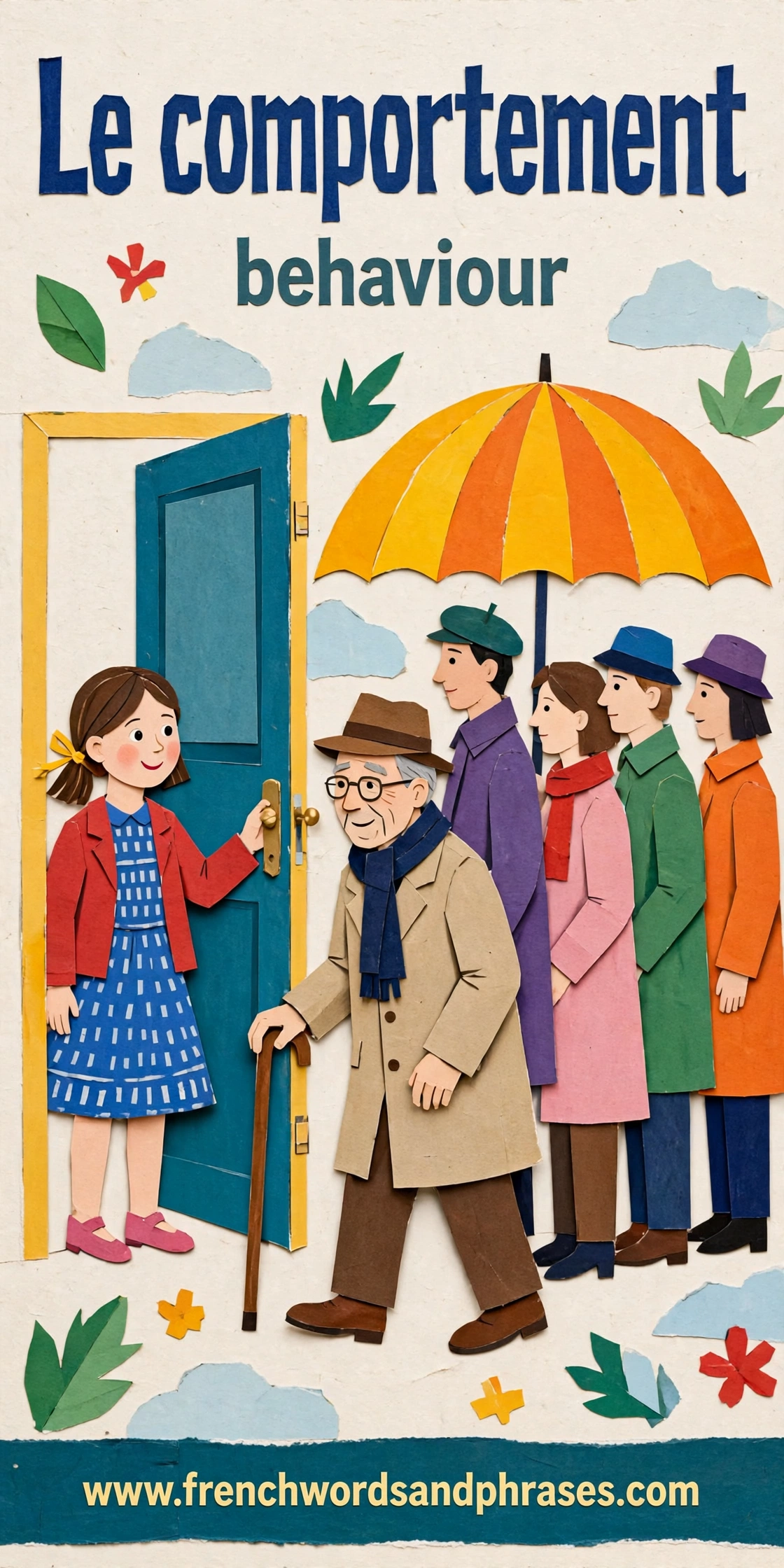
A French Word to Live By
Translate Comportement to English
/kɔ̃.pɔʁ.tə.mɑ̃/
Le comportement means behaviour.
The teacher opens the little notebook and writes three words that every French schoolchild dreads: « comportement à revoir ». Conduct to be reviewed — le comportement is under the microscope.
In this guide, you’ll learn what comportement means in English, how to use it with its articles, how to form its plural, and how it appears in everyday French. Explore French examples, English translations, and practice quizzes.
Understanding the French Noun Comportement
Comportement is a masculine French noun, learned with its article: le comportement, un comportement. It is built from the verb se comporter (to behave) with the ending -ment. As a general quality it is often uncountable — le comportement, behaviour in general.
It means behaviour — the way a person, an animal or even a machine acts. Teachers judge le comportement en classe, scientists observe le comportement animal, and psychologists study le comportement humain. To behave well is bien se comporter; to behave badly, mal se comporter.
Gender: Masculine
Definite article: le — le comportement (behaviour)
Indefinite article: un — un comportement (a behaviour, a pattern of behaviour)
Plural: les comportements
Built from: the verb se comporter (to behave) + -ment
English equivalents: Behaviour (British); behavior (American).
One important usage detail: French spells it with a u — comportement matches British « behaviour », a gift for British learners. For a single act, French often prefers la conduite or l’attitude; comportement is the broader, more scientific word, at home in reports, studies and school bulletins.
Experience the Word
Comportement is more than manners. It is the story a person tells without words — the sum of a thousand small acts, watched, noted and remembered.
Imagine the naturalist in the hide at dawn, notebook open, recording the comportement of the fox family: every gesture observed, nothing judged, everything learned.
You have not just seen someone act. You have read their character — lu leur caractère, in their comportement.
How to Use Comportement in French: Complete Guide
Let’s explore how comportement works in French, beginning with its articles — le in the singular, les in the plural.
Comportement with the Definite Article (Le, Les)
Used for behaviour in general, or the particular behaviour under discussion.
| Form | French |
|---|---|
| Masculine singular | le comportement |
| Plural | les comportements |
Example
Le comportement des élèves s’améliore ce trimestre.
The pupils’ behaviour is improving this term.
Comportement with the Indefinite Article (Un, Des)
Used for one kind of behaviour — un comportement étrange, des comportements différents.
| Form | French |
|---|---|
| Masculine singular | un comportement |
| Plural | des comportements |
Example
C’est un comportement étrange pour un chien si calme.
That’s strange behaviour for such a calm dog.
Around the Comportement: Words of Conduct
Attitudes, politeness and observation — the vocabulary that surrounds the comportement.
| French | In English |
|---|---|
| la conduite | conduct, behaviour |
| l’attitude | the attitude |
| se comporter | to behave |
| poli | polite |
| impoli | rude, impolite |
| observer | to observe |
Example
Les scientifiques observent le comportement des abeilles.
Scientists observe the behaviour of bees.
Quick Quiz 1
Complete the sentence:
______ comportement de cet élève est exemplaire.
Reveal the answer
Le
Le comportement de cet élève est exemplaire.
This pupil’s behaviour is exemplary — le, because comportement is masculine.
The Plural of Comportement
Comportement adds an -s in the plural — les comportements, the patterns researchers compare.
| Number | French |
|---|---|
| Singular | le comportement |
| Plural | les comportements |
Example
Les comportements des deux groupes sont très différents.
The two groups’ behaviour patterns are very different.
Comportement with Possessive Adjectives (Mon, Ton, Son…)
Possessives agree with the noun: comportement is masculine, so it takes mon, ton, son.
| Owner | French |
|---|---|
| my | mon comportement |
| your (tu) | ton comportement |
| his / her | son comportement |
| our | notre comportement |
| your (vous) | votre comportement |
| their | leur comportement |
Example
Son comportement a surpris tout le monde à la réunion.
His behaviour surprised everyone at the meeting.
Quick Quiz 2
Complete the sentence:
______ comportement en classe est bien meilleur ce mois-ci. (Her)
Reveal the answer
Son
Son comportement en classe est bien meilleur ce mois-ci.
Her behaviour in class is much better this month — son, because comportement is masculine.
Comportement with Demonstrative Adjectives (Ce, Ces)
Used to point: ce comportement — ce, because comportement begins with a consonant.
| Form | French |
|---|---|
| Masculine singular | ce comportement |
| Plural | ces comportements |
Example
Ce comportement est inacceptable dans une équipe.
This behaviour is unacceptable in a team.
Comportement with Adjectives
Adjectives agree with comportement: masculine forms, with -s in the plural.
| Adjective | With Comportement |
|---|---|
| étrange (strange) | un comportement étrange |
| exemplaire (exemplary) | un comportement exemplaire |
| animal (animal) | le comportement animal |
| nouveau (new) | un nouveau comportement |
| agressif (aggressive) | des comportements agressifs |
Example
Le chien a un comportement agressif envers les étrangers.
The dog shows aggressive behaviour towards strangers.
Quick Quiz 3
Complete the sentence:
Elle a un comportement ______. (exemplary)
Reveal the answer
exemplaire
Elle a un comportement exemplaire.
Her behaviour is exemplary — exemplaire, the same form for masculine and feminine.
Everyday Expressions with Comportement
Classrooms, laboratories and family life — the comportement phrases of daily life.
| Expression | In English |
|---|---|
| un comportement étrange | strange behaviour |
| le comportement des enfants | children’s behaviour |
| changer de comportement | to change one’s behaviour |
| un bon comportement | good behaviour |
| observer le comportement | to observe behaviour |
| le comportement animal | animal behaviour |
Example
Après l’avertissement, il a changé de comportement.
After the warning, he changed his behaviour.
Words from the Same Family as Comportement
Behaving, conducting and reacting — the words that travel with comportement.
| French | In English |
|---|---|
| se comporter | to behave |
| la conduite | conduct |
| l’attitude | the attitude |
| comportemental | behavioural |
| observer | to observe |
| réagir | to react |
Example
Il se comporte bien chez ses grands-parents.
He behaves well at his grandparents’ house.
Quick Quiz 4
How do you say to behave well?
Reveal the answer
Bien se comporter — the verb se comporter is the living twin of the noun comportement.
Les enfants se comportent bien pendant le voyage.
The children behave well during the trip.
Comportement in Everyday French: Real-Life Examples
Now that you know the word, let’s see how comportement appears in everyday French.
Example 1 — At school
Le comportement de la classe est noté dans le bulletin.
The class’s behaviour is graded in the report.
Example 2 — Animal study
Elle étudie le comportement des loups depuis dix ans.
She has been studying wolf behaviour for ten years.
Example 3 — A surprise
Son comportement étrange inquiète ses amis.
His strange behaviour worries his friends.
Example 4 — Good conduct
Un bon comportement est récompensé à la fin du trimestre.
Good behaviour is rewarded at the end of term.
Example 5 — Changing
Il essaie de changer de comportement depuis janvier.
He has been trying to change his behaviour since January.
Example 6 — At the vet’s
Le vétérinaire observe le comportement du chat.
The vet observes the cat’s behaviour.
Beyond Translation: The Meaning of Comportement
Le comportement sits at the crossroads of French school life and French science: it is the word on every bulletin scolaire, judged term by term, and the word of the great naturalists who built l’éthologie — the science of animal behaviour — by watching rather than judging. One noun, two worlds: the classroom and the fox’s den, both asking the same question — how does this creature act, and why?
To say comportement is to watch before you judge.
It evokes the teacher’s pen over the report, the naturalist’s notebook at dawn, and the quiet truth that character is simply behaviour, repeated.
How to Remember the French Noun Comportement
Remember it this way: Comportement is behaviour — se comporter with the ending -ment, masculine, and spelled the British way with a u.
- You hear the verb inside it — se comporter, to behave.
- You see the ending — -ment, so the noun is masculine.
- You picture its two homes — le bulletin scolaire et le comportement animal.
The key idea is se comporter + -ment = le comportement, behaviour.
Test Your Knowledge of Comportement
Let’s see how much you’ve learned. Try answering these questions before revealing the answers.
Question 1
Is comportement masculine or feminine?
Reveal the answer
Masculine — un comportement, le comportement.
Question 2
What verb is comportement built from?
Reveal the answer
Se comporter — to behave.
Question 3
Translate: The children’s behaviour is exemplary.
Reveal the answer
Le comportement des enfants est exemplaire.
Question 4
What is le comportement animal?
Reveal the answer
Animal behaviour — the field scientists study by observing animals.
Question 5
Complete the sentence:
______ comportement doit changer. (This)
Reveal the answer
Ce
Ce comportement doit changer.
This behaviour must change — ce, because comportement starts with a consonant.
Your Final Challenge
Can You Use It?
How would you say this in French?
“The pupils’ behaviour is improving this term.”
Reveal the answer
Le comportement des élèves s’améliore ce trimestre.
The pupils’ behaviour is improving this term.
A little French. A little curiosity. A richer everyday life.
LEARN FRENCH ONE WORD AT A TIME