A French Word to Live By
Translate Complément to English
/kɔ̃.ple.mɑ̃/
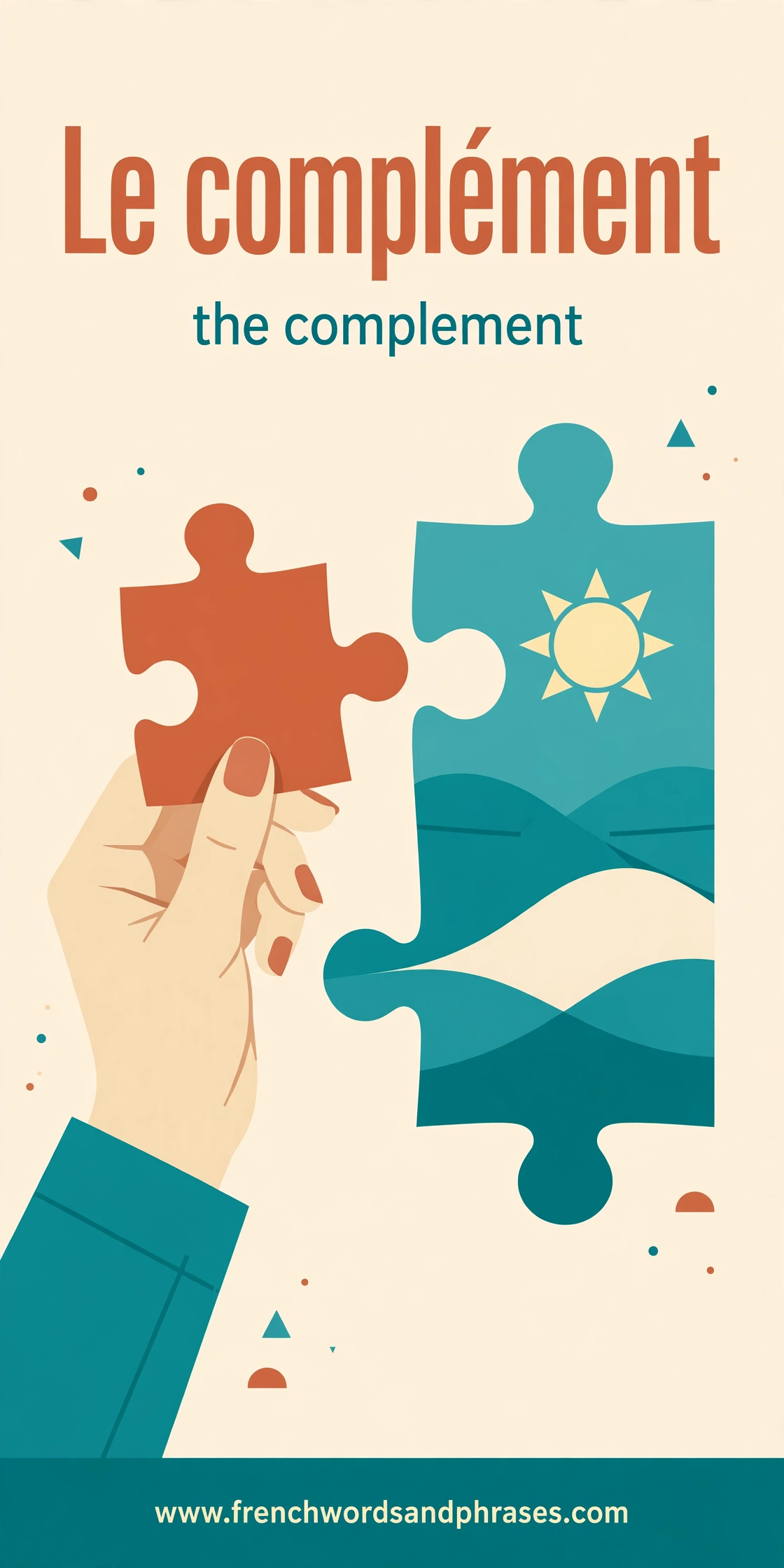
Le complément means the complement.
The soup is good, but something is missing. A handful of herbs, a swirl of cream — and suddenly the dish is whole. That finishing thing, the piece that completes, is le complément.
In this guide, you’ll learn what complément means in English, how to use it with its articles, how to form its plural, and how it appears in everyday French. Explore French examples, English translations, and practice quizzes.
Understanding the French Noun Complément
Complément is a masculine French noun, learned with its article: le complément, un complément. It is built from the verb compléter (to complete) with the ending -ment, and it is masculine like its family. Do not confuse it with le compliment — with an i — which is the kind word you say to someone.
It means the complement — whatever completes or adds to something else. In the kitchen it is the finishing touch; at the pharmacy, un complément alimentaire is a food supplement; and in grammar, le complément is the part of the sentence that completes the verb — every French schoolchild hunts for le complément d’objet direct.
Gender: Masculine
Definite article: le — le complément (the complement)
Indefinite article: un — un complément (a complement)
Plural: les compléments
Built from: the verb compléter (to complete) + -ment
English equivalents: The complement; a supplement (alimentaire).
One important usage detail: watch the famous pair — complément with an é completes a thing, compliment with an i praises a person. And in grammar lessons, le complément d’objet direct (COD) and le complément d’objet indirect (COI) are the two expressions to recognise on sight.
Experience the Word
Complément is more than an extra. It is the philosophy of the finishing touch — the belief that most things are one piece away from being whole.
Imagine the painter’s last stroke of red in a grey seascape, or the second violin entering under the melody: nothing essential has changed, and yet everything has — that is le complément at work.
You have not just added something. You have completed — complété, made whole.
How to Use Complément in French: Complete Guide
Let’s explore how complément works in French, beginning with its articles — le in the singular, les in the plural.
Complément with the Definite Article (Le, Les)
Used for the complement everyone has in mind — the missing piece of the conversation.
| Form | French |
|---|---|
| Masculine singular | le complément |
| Plural | les compléments |
Example
Le complément d’objet se place après le verbe.
The object complement comes after the verb.
Complément with the Indefinite Article (Un, Des)
Used for a complement in general — un complément, des compléments.
| Form | French |
|---|---|
| Masculine singular | un complément |
| Plural | des compléments |
Example
Cette sauce est un complément parfait pour le poisson.
This sauce is a perfect complement to the fish.
Around the Complément: Words of Completing
Verbs, objects and sentences — the vocabulary that surrounds the complément.
| French | In English |
|---|---|
| compléter | to complete |
| le verbe | the verb |
| l’objet | the object |
| la phrase | the sentence |
| ajouter | to add |
| entier | whole, entire |
Example
Le complément complète le sens du verbe dans la phrase.
The complement completes the meaning of the verb in the sentence.
Quick Quiz 1
Complete the sentence:
Dans « Elle mange une pomme », « une pomme » est ______ complément d’objet direct.
Reveal the answer
le
Dans « Elle mange une pomme », « une pomme » est le complément d’objet direct.
In « She is eating an apple », « an apple » is the direct object — le, because complément is masculine.
The Plural of Complément
Complément adds an -s in the plural — les compléments, the supplements on the shelf or the objects in the sentence.
| Number | French |
|---|---|
| Singular | le complément |
| Plural | les compléments |
Example
Les compléments alimentaires se vendent en pharmacie.
Food supplements are sold in pharmacies.
Complément with Possessive Adjectives (Mon, Ton, Son…)
Possessives agree with the noun: complément is masculine, so it takes mon, ton, son.
| Owner | French |
|---|---|
| my | mon complément |
| your (tu) | ton complément |
| his / her | son complément |
| our | notre complément |
| your (vous) | votre complément |
| their | leur complément |
Example
Ce fromage est mon complément préféré pour le pain frais.
This cheese is my favourite complement to fresh bread.
Quick Quiz 2
Complete the sentence:
______ complément alimentaire contient des vitamines. (This)
Reveal the answer
Ce
Ce complément alimentaire contient des vitamines.
This food supplement contains vitamins — ce, because complément starts with a consonant.
Complément with Demonstrative Adjectives (Ce, Ces)
Used to point: ce complément, this complement — the one that finishes the set.
| Form | French |
|---|---|
| Masculine singular | ce complément |
| Plural | ces compléments |
Example
Ce complément apporte exactement ce qui manquait au repas.
This complement provides exactly what the meal was missing.
Complément with Adjectives
Adjectives agree with complément: masculine forms, with -s in the plural.
| Adjective | With Complément |
|---|---|
| alimentaire (food, dietary) | un complément alimentaire |
| parfait (perfect) | un complément parfait |
| utile (useful) | un complément utile |
| nouveau (new) | un nouveau complément |
| naturel (natural) | des compléments naturels |
Example
Un complément alimentaire naturel aide pendant l’hiver.
A natural food supplement helps during the winter.
Quick Quiz 3
Complete the sentence:
Ce vin est un complément ______ pour le fromage. (perfect)
Reveal the answer
parfait
Ce vin est un complément parfait pour le fromage.
This wine is a perfect complement to the cheese — parfait, masculine, to match complément.
Everyday Expressions with Complément
Grammar lessons and pharmacy shelves — the complément phrases of daily life.
| Expression | In English |
|---|---|
| un complément alimentaire | a food supplement |
| le complément d’objet direct | the direct object (grammar) |
| un complément parfait | a perfect complement |
| en complément | in addition, as a supplement |
| servir de complément | to serve as a complement |
| un complément d’information | additional information |
Example
En complément de votre commande, voici un catalogue gratuit.
In addition to your order, here is a free catalogue.
Words from the Same Family as Complément
Completing, adding and finishing — the words that travel with complément.
| French | In English |
|---|---|
| compléter | to complete |
| complet | complete, full |
| complètement | completely |
| complémentaire | complementary |
| l’ajout | the addition |
| achever | to finish, to complete |
Example
Ces deux couleurs sont complémentaires et se complètent bien.
These two colours are complementary and complete each other well.
Quick Quiz 4
What is the difference between un complément and un compliment?
Reveal the answer
Un complément completes a thing; un compliment praises a person — one letter changes everything.
Merci pour le compliment, mais le plat mérite un complément.
Thanks for the compliment, but the dish deserves a complement.
Complément in Everyday French: Real-Life Examples
Now that you know the word, let’s see how complément appears in everyday French.
Example 1 — At the pharmacy
Le pharmacien conseille un complément alimentaire pour l’hiver.
The pharmacist recommends a food supplement for the winter.
Example 2 — Grammar class
Les élèves cherchent le complément d’objet dans la phrase.
The pupils are looking for the object in the sentence.
Example 3 — In the kitchen
Le citron est le complément idéal de ce poisson.
Lemon is the ideal complement to this fish.
Example 4 — Extra information
Je vous envoie un complément d’information par courrier.
I’m sending you additional information by post.
Example 5 — Colours
Le bleu est le complément parfait de cette robe rouge.
Blue is the perfect complement to this red dress.
Example 6 — Work
En complément de son salaire, il reçoit des tickets restaurant.
In addition to his salary, he receives meal vouchers.
Beyond Translation: The Meaning of Complément
Generations of French schoolchildren have met le complément in the grammar lesson, chanting the questions « qui ? quoi ? » to hunt the complément d’objet direct through the sentence. Outside school, the word lives a second life in every pharmacie, where the compléments alimentaires fill a whole wall — vitamins, magnesium and promises, the modern French art of completing oneself.
To say complément is to name the piece that makes the whole.
It evokes the last herb on the soup, the COD underlined in red at school, and the small daily belief that everything — a dish, a sentence, a person — can be completed.
How to Remember the French Noun Complément
Remember it this way: Complément is the complement — compléter with the ending -ment, masculine, and one letter away from a compliment.
- You hear the verb inside it — compléter, to complete.
- You mind the spelling — complément with é completes, compliment with i praises.
- You see the ending — -ment, so the noun is masculine.
The key idea is compléter + -ment = le complément, the complement.
Test Your Knowledge of Complément
Let’s see how much you’ve learned. Try answering these questions before revealing the answers.
Question 1
Is complément masculine or feminine?
Reveal the answer
Masculine — un complément, le complément.
Question 2
What is un complément alimentaire?
Reveal the answer
A food supplement — vitamins or minerals taken in addition to food.
Question 3
Translate: This sauce is a perfect complement to the meat.
Reveal the answer
Cette sauce est un complément parfait pour la viande.
Question 4
In grammar, what does COD stand for?
Reveal the answer
Complément d’objet direct — the direct object of the verb.
Question 5
Complete the sentence:
______ complément manque à la phrase.
Reveal the answer
Le
Le complément manque à la phrase.
The complement is missing from the sentence.
Your Final Challenge
Can You Use It?
How would you say this in French?
“This wine is a perfect complement to the cheese.”
Reveal the answer
Ce vin est un complément parfait pour le fromage.
This wine is a perfect complement to the cheese.
A little French. A little curiosity. A richer everyday life.
LEARN FRENCH ONE WORD AT A TIME