A French Word to Live By
Translate Ça te chauffe to English
/sa tə ʃof/
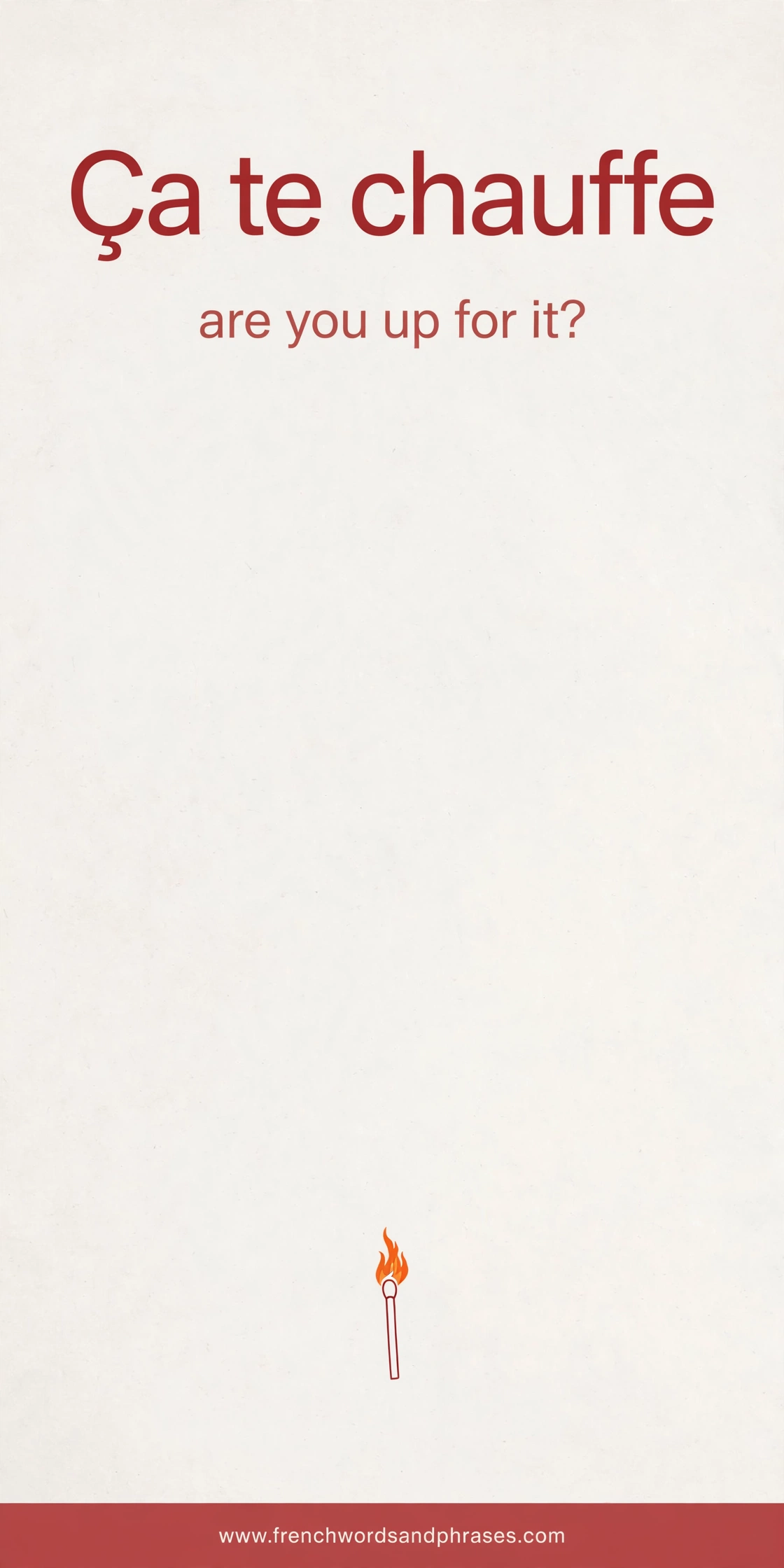
Ça te chauffe means are you up for it — does that tempt you, are you keen.
Friday, six o’clock, and the group chat is buzzing. Someone has found cheap train tickets to the sea, someone else knows a house with a garden, and the plan is growing by the minute. One question decides whether it happens at all, and it is not about money or dates: « On part demain à l’aube. Ça te chauffe ? »
Let’s explore how ça te chauffe works in French, beginning with the whole phrase on one card.
Understanding the French Phrase Ça te chauffe
Ça te chauffe is a French idiomatic expression built from ça (that), te (you) and chauffer (to heat, to warm up). It is the informal French way of asking whether an idea warms someone up — whether they are keen, tempted, up for it.
It means are you up for it — does the plan tempt you, are you in? Nobody is asking about your body temperature: the picture is heat as enthusiasm. A cold idea leaves you cold; a good plan warms you up, like an engine before the road or an athlete before the match. If the idea heats you, you are already halfway there.
Type: Idiomatic question — proposing a plan (ça + te + chauffer)
Answers the need: Checking that someone is keen before you commit to the plan
Register: Informal, youthful slang — friends and messages, not the office or formal writing
Strength: Warm and encouraging — it expects a yes and makes saying yes easy
One important usage detail: the phrase lives as a question, and almost always in the present — ça te chauffe ? The yes sounds like ça me chauffe bien, I’m well up for it. For a group, or for someone you address politely, te becomes vous: ça vous chauffe ? The softer twin is ça te dit ?, which does the same job in slightly less slangy dress.
Experience the Word
Ça te chauffe is the sound of a plan catching fire — one question, and a vague idea becomes Friday night.
Imagine the group chat at six o’clock. Someone types a wild idea — a night train, a lake, a roof terrace. Phones light up one by one, and the whole evening turns on the answers to three small words: ça te chauffe ? The yeses arrive with the heat already in them.
French could ask êtes-vous intéressé, the way a brochure does. Instead it asks whether the idea warms you — because plans, like engines, only move once they are warm.
How to Use Ça te chauffe in French: Complete Guide
Let’s explore how ça te chauffe works in French, beginning with the whole phrase on one card.
Ça te chauffe at a Glance
The Whole Phrase on One Card
Real meaning, literal picture, English twin and register — ça te chauffe in five lines.
| Point | Ça te chauffe |
|---|---|
| What it really means | are you up for it — does the idea tempt you, are you in |
| Word for word | that warms you — does that heat you up |
| English equivalent | are you up for it? / do you fancy it? / are you in? |
| Register | informal slang — friends, messages, young speech |
| Use it for | proposing plans, trips, nights out and challenges — and checking the answer is warm |
Example
On part en randonnée dimanche. Ça te chauffe ?
We’re going hiking on Sunday. Are you up for it?
Word by Word: Building the Warm-Up
Three small pieces — take them one by one and the plan starts to glow.
| Word | Literal meaning | Its job in the phrase |
|---|---|---|
| ça | that, it | the plan itself, pointed at like something sitting on the table |
| te | you (informal) | the person whose enthusiasm is being tested |
| chauffe | warms, heats | from chauffer, to heat — an idea that warms you is an idea you want |
Example
Ça te chauffe, un ciné ce soir ?
Do you fancy a film tonight?
Quick Quiz 1
What does chauffer literally mean?
Reveal the answer
To heat, to warm up — the plan is held against the flame of your enthusiasm to see if it catches.
L’idée me chauffe de plus en plus.
The idea is warming me up more and more.
When You Say It: The Plan-Proposing Moments
Ça te chauffe fires at moments like these — a plan is on the table, and you are testing the temperature.
| Situation | Example |
|---|---|
| Proposing a trip | on part à la mer ce week-end, ça te chauffe ? — we’re off to the seaside this weekend, are you up for it? |
| A night out | ça te chauffe, un resto ce soir ? — do you fancy a restaurant tonight? |
| A challenge | un marathon l’an prochain, ça te chauffe ? — a marathon next year, are you up for it? |
| Between colleagues, informally | ça te chauffe de présenter le projet ? — are you up for presenting the project? |
| Checking the whole group | ça vous chauffe, tout le monde ? — is everyone up for it? |
Example
On loue un van et on traverse la Bretagne. Ça te chauffe ?
We’re hiring a van and crossing Brittany. Are you up for it?
Make It Yours: The Warm-Up for Every Answer
Te for a friend, vous for a group — and the yes and the no have their own warm shapes.
| Form | French | In English |
|---|---|---|
| The question | ça te chauffe ? | are you up for it? |
| To a group, or polite | ça vous chauffe ? | are you (all) up for it? |
| Saying yes for yourself | ça me chauffe bien | I’m well up for it |
| Not keen | ça me chauffe pas trop | I’m not that keen |
| About an idea | l’idée me chauffe | the idea appeals to me, it warms me up |
| Fired up | être chauffé à bloc | to be fired up, raring to go |
Example
Ça me chauffe bien, ce projet de voyage.
I’m really up for this trip plan.
Quick Quiz 2
You are proposing the plan to your teacher. Ça te chauffe or ça vous chauffe?
Reveal the answer
Ça vous chauffe — vous is for groups and for polite address; te is for friends.
Ça vous chauffe, une sortie au musée ?
Are you up for a trip to the museum?
Everyday Expressions: Building on the Warm-Up
Ça te chauffe slots into these everyday frames — each one ready to use as it stands.
| Frame | In English |
|---|---|
| ça te chauffe ? | are you up for it? |
| ça me chauffe bien | I’m well up for it / it really appeals to me |
| ça vous chauffe ? | are you all up for it? (group or polite) |
| être chauffé à bloc | to be fired up, raring to go |
| ça te dit ? | the softer twin — do you fancy it? |
Example
Ça me chauffe bien, moi, ce week-end à la montagne.
I’m well up for this weekend in the mountains, me.
Close Cousins: The Other Ways to Ask
French has a whole shelf of are-you-in questions — ça te chauffe is the warm slangy one; its cousins cool down or smarten up.
| Expression | The difference |
|---|---|
| ça te chauffe ? | are you up for it — warm, slangy, expects enthusiasm |
| ça te dit ? | do you fancy it — the softer, slightly older twin; the safest choice |
| ça te branche ? | are you into it — slang, literally ‘does it plug you in’ |
| tu es partant ? | are you game — clear, and a touch more neutral |
| ça te tente ? | does it tempt you — gentle, works in most registers |
Example
Ça te dit ou ça te chauffe ? Les deux, si c’est un concert.
Do you fancy it or are you up for it? Both, if it’s a concert.
Quick Quiz 3
Which cousin is the safest with someone you do not know well — ça te branche or ça te dit?
Reveal the answer
Ça te dit — the softest and most widespread of the family; branche and chauffe are slang for friends.
Ça te dit, un café après le cours ?
Do you fancy a coffee after class?
Ça te chauffe and Its Neighbours
The enthusiasm shelf around the phrase — from the warm-up itself to the plan it serves.
| French | In English |
|---|---|
| chauffer | to heat, to warm |
| se chauffer | to warm up (before sport) |
| partant | game, up for it |
| motivé | keen, motivated |
| tenter | to tempt — ça me tente, I’m tempted |
| un plan | a plan |
Example
Il est partant et chauffé à bloc pour le départ.
He’s game and fired up for the off.
Watch Out: The Traps Around Ça te chauffe
The traps: a second, hotter meaning, a question that must stay a question, and a thermometer that is not involved.
| Trap | The truth |
|---|---|
| the provocation trap | chauffer quelqu’un also means to wind someone up — il me chauffe, he’s getting on my nerves; tone and context decide whether the heat is enthusiasm or irritation |
| question only | ça te chauffe lives as a question about a plan; pointed at a person as a statement, chauffer slides toward provocation — keep it for proposals |
| te is informal | with a group or someone you vouvoies, switch to ça vous chauffe ? |
| not about temperature | nobody is asking whether you are warm — for that, French says tu as chaud ? |
Example
Attention, il te chauffe depuis dix minutes, ne réponds pas.
Careful, he’s been winding you up for ten minutes, don’t answer him.
Quick Quiz 4
True or false: ça te chauffe ? asks whether you are physically warm.
Reveal the answer
False — it asks whether a plan appeals to you. Physical warmth is tu as chaud ?
— Tu as chaud ? — Non, mais le concert, ça me chauffe !
‘Are you warm?’ ‘No, but the concert — I’m up for it!’
Ça te chauffe in Everyday French: Real-Life Examples
Now that you know the word, let’s see how ça te chauffe appears in everyday French.
Example 1 — The group chat
Concert samedi soir, ça te chauffe ?
Concert on Saturday night, are you up for it?
Example 2 — A road trip
On descend dans le Sud en voiture. Ça te chauffe ?
We’re driving down south. Are you up for it?
Example 3 — Saying yes
Ça me chauffe bien, ce week-end à la mer.
I’m well up for this weekend at the seaside.
Example 4 — A challenge
Courir le semi-marathon en juin, ça te chauffe ?
Running the half-marathon in June — are you up for it?
Example 5 — Not so keen
Franchement, ça me chauffe pas trop, ton plan.
Honestly, I’m not that keen on your plan.
Example 6 — The whole group
Ça vous chauffe, tout le monde, un barbecue dimanche ?
Is everyone up for a barbecue on Sunday?
Beyond Translation: The Meaning of Ça te chauffe
English asks are you up for it — vertical, a challenge to rise to. French asks whether the idea warms you — horizontal, a fire catching in dry wood. The two pictures explain the two invitations: the English one dares you, the French one tempts you.
To ask ça te chauffe is to hold the plan near the flame and watch the other person’s face for the first glow.
That is why the phrase so often gets its yes: nobody likes to admit they stayed cold.
How to Remember the French Phrase Ça te chauffe
Remember it this way: Ça te chauffe is the campfire test of a plan — hold the idea near the flame and see whether you warm to it.
- You picture the warm-up — chauffer is to heat; a plan that heats you is a plan you want to do.
- You ask it, you don’t state it — ça te chauffe ? is a question, and the yes sounds like ça me chauffe bien.
- You mind the other heat — chauffer quelqu’un can mean winding them up, so keep your tone friendly and your plan clear.
The key idea is ça te chauffe means are you up for it — does the idea warm you up.
Test Your Knowledge of Ça te chauffe
Let’s see how much you’ve learned. Try answering these questions before revealing the answers.
Question 1
What does ça te chauffe ? mean?
Reveal the answer
Are you up for it? — does the idea tempt you, are you keen to join in.
Question 2
What does chauffer literally mean?
Reveal the answer
To heat, to warm up — the plan is tested against the flame of your enthusiasm.
Question 3
How do you ask a group, or someone politely?
Reveal the answer
Ça vous chauffe ? — vous replaces te for groups and polite address.
Question 4
What is the softer twin of the phrase?
Reveal the answer
Ça te dit ? — do you fancy it; same job, a little less slangy.
Question 5
Complete the sentence:
On part à la montagne samedi. Ça te ______ ? (We’re off to the mountains on Saturday. Are you up for it?)
Reveal the answer
chauffe
On part à la montagne samedi. Ça te chauffe ?
We’re off to the mountains on Saturday. Are you up for it?
Your Final Challenge
Can You Use It?
How would you say this in French?
“We’re going to the beach tomorrow. Are you up for it?”
Reveal the answer
On va à la plage demain. Ça te chauffe ?
We’re going to the beach tomorrow. Are you up for it?
A little French. A little curiosity. A richer everyday life.
LEARN FRENCH ONE WORD AT A TIME