A French Word to Live By
Translate Vider son sac to English
/vi.de sɔ̃ sak/
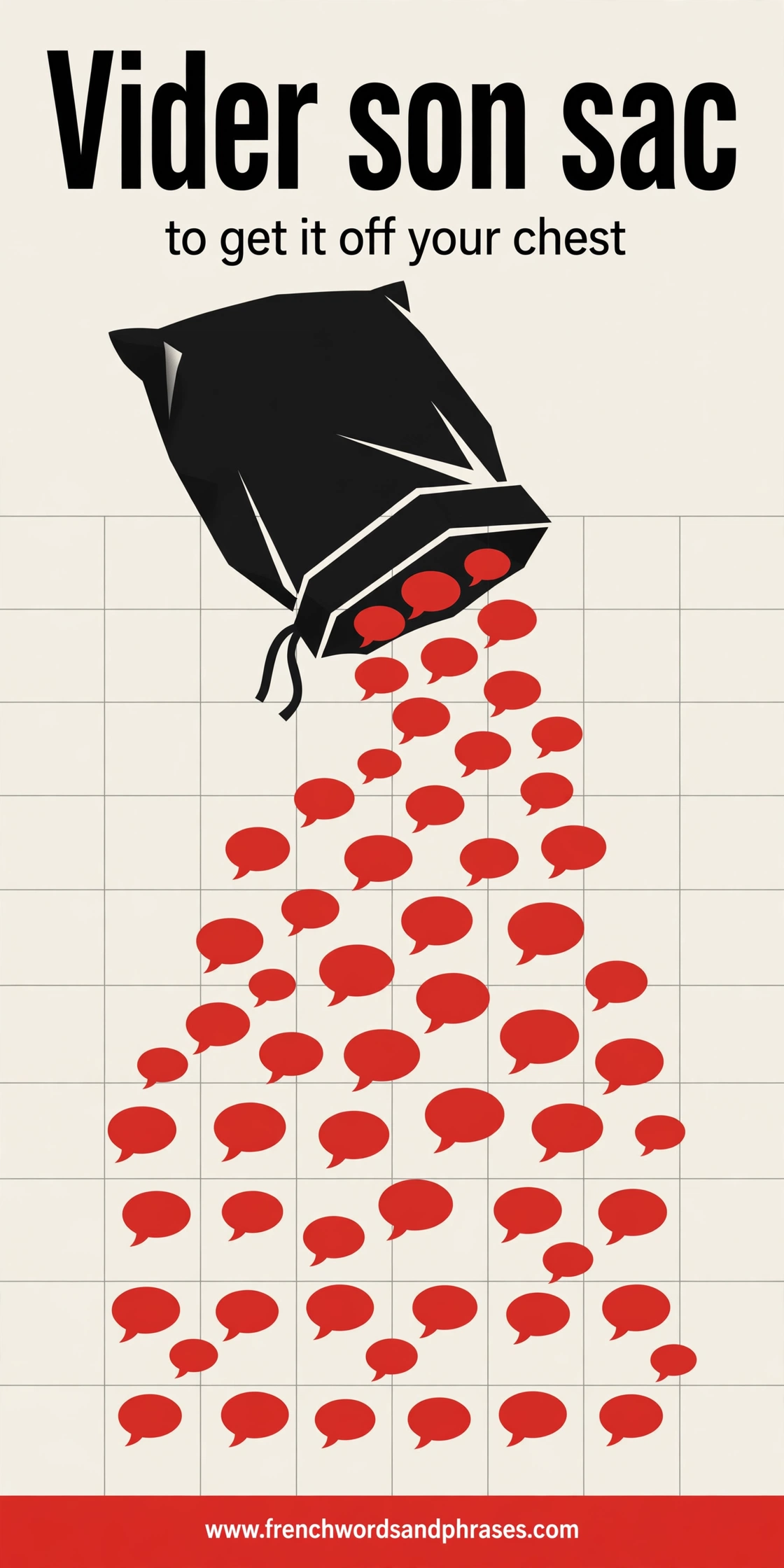
Vider son sac means to get it all off your chest — to say everything you have been holding back.
For three months your colleague has swallowed every remark about the new rota — the extra Saturdays, the changed hours, the meetings about meetings. Today she closes the office door, sits down opposite the manager, and calmly empties three months onto the desk. Afterwards she breathes like a swimmer surfacing: « Ça y est, j’ai vidé mon sac. »
Let’s explore how vider son sac works in French, beginning with the whole phrase on one card.
Understanding the French Phrase Vider son sac
Vider son sac is a French idiomatic expression built from vider (to empty) and son sac (one’s bag). The bag is the one inside you, where unspoken grievances, secrets and reproaches are stored — emptying it means saying, at last, all of it.
It means to get it all off your chest — to say everything you have been holding back, in one go, and feel the relief of the empty bag. The picture is of a sack turned upside down on the table: nothing kept in reserve, nothing saved for later. It can be a confession, a protest or a long-delayed explanation — what matters is that it all comes out.
Type: Idiomatic expression — speaking out (verb + possessive + noun)
Answers the need: Saying someone finally spoke their whole mind, holding nothing back
Register: Familiar to neutral — everyday speech; the relief in it keeps it warm rather than aggressive
Strength: Total — the bag is emptied completely, not opened a crack
One important usage detail: the possessive follows the speaker — je vide mon sac, tu vides ton sac, elle a vidé son sac. The phrase is often an invitation before it is an act: allez, vide ton sac — come on, out with it — said by the friend who can see the bag is full.
Experience the Word
Vider son sac is the sound of a zip opening on three months of silence — everything stored comes out in the order it was swallowed.
Imagine the long car journey home where, somewhere after the second toll, the passenger finally says the thing. Not an accusation, exactly — an inventory. The driver listens, the kilometres pass, and by the time the bag is empty the car feels lighter than any luggage could explain. French families schedule such journeys, half-knowing what they are for.
The metaphor is honest about the cost of silence. What is not said is not gone — it is stored, and storage is heavy.
How to Use Vider son sac in French: Complete Guide
Let’s explore how vider son sac works in French, beginning with the whole phrase on one card.
Vider son sac at a Glance
The Whole Phrase on One Card
Real meaning, literal picture, English twin and register — vider son sac in five lines.
| Point | Vider son sac |
|---|---|
| What it really means | to get it all off your chest — to say everything held back, in one go |
| Word for word | to empty your bag — the inner sack where unspoken things are stored |
| English equivalent | to get it off your chest / to get it all out in the open |
| Register | familiar to neutral — warm with relief, at home in daily speech |
| Use it for | confessions, protests, long-delayed explanations — the full unloading |
Example
Après trois mois de silence, elle a vidé son sac.
After three months of silence, she got it all off her chest.
Word by Word: Building the Unloading
Three small pieces — take them one by one and the bag turns upside down.
| Word | Literal meaning | Its job in the phrase |
|---|---|---|
| vider | to empty | the unloading verb — vider une bouteille, vider les lieux; here, the inner storage |
| son | his, her, one’s | the possessive that follows the speaker — mon sac, ton sac, son sac |
| sac | a bag, a sack | the container of everything unspoken — grievances, secrets, reproaches |
Example
Vide ton sac, je t’écoute, tout doit sortir.
Empty your bag, I am listening, everything must come out.
Quick Quiz 1
What is stored in the sac of vider son sac?
Reveal the answer
Everything unspoken — the grievances, secrets and reproaches you have been carrying silently. Emptying the bag means saying them all.
Son sac était plein depuis des mois.
His bag had been full for months.
When You Say It: The Unloading Moments
Vider son sac fires at moments like these — the silence ends, and the whole inventory comes out.
| Situation | Example |
|---|---|
| At the manager’s office | elle a vidé son sac au sujet des horaires — she got everything off her chest about the schedules |
| Between old friends | allez, vide ton sac, je vois bien que ça ne va pas — come on, out with it, I can see something is wrong |
| After a quarrel | il a vidé son sac et ils se sont réconciliés — he got it all out and they made up |
| In a confession | j’ai vidé mon sac devant mes parents — I got everything off my chest in front of my parents |
| With relief afterwards | ça fait du bien de vider son sac — it feels good to get it off your chest |
Example
Ça fait du bien, je te jure, de vider son sac.
It feels good, I swear, to get it off your chest.
Make It Yours: The Bag for Every Speaker
Vider is a regular -er verb — and the possessive changes with the owner of the bag.
| Form | French | In English |
|---|---|---|
| I empty mine | je vide mon sac | I am getting it off my chest |
| You empty yours | tu vides ton sac | you are getting it off your chest |
| She emptied hers | elle a vidé son sac | she got it all off her chest |
| The invitation | vide ton sac | out with it, empty your bag |
| We emptied ours | nous avons vidé notre sac | we got it all off our chests |
| Afterwards | le sac est vide, ça va mieux | the bag is empty, things are better |
Example
Vide ton sac, après tu dormiras mieux.
Get it off your chest, afterwards you will sleep better.
Quick Quiz 2
She empties hers: elle a vidé mon sac or elle a vidé son sac?
Reveal the answer
Son sac — the possessive follows the owner: mon for je, ton for tu, son for il and elle.
Elle a vidé son sac devant tout le monde.
She got it all off her chest in front of everyone.
Everyday Expressions: Building on the Unloading
Vider son sac slots into these everyday frames — each one ready to use as it stands.
| Frame | In English |
|---|---|
| vider son sac | to get it all off your chest |
| allez, vide ton sac | come on, out with it |
| vider son sac au sujet de quelque chose | to get everything off your chest about something |
| ça fait du bien de vider son sac | it feels good to get it off your chest |
| avoir besoin de vider son sac | to need to get it off your chest |
Example
Elle avait besoin de vider son sac depuis longtemps.
She had needed to get it off her chest for a long time.
Close Cousins: The Other Ways to Speak Out
French has a whole shelf of speaking-out phrases — the bag is the complete one; its cousins say it in pieces, spit it out or wear it on the heart.
| Expression | The difference |
|---|---|
| vider son sac | to get it all off your chest — the complete unloading, everything at once |
| dire ce qu’on a sur le cœur | to say what is on your heart — the gentler, more emotional cousin |
| cracher le morceau | to spit it out — familiar; for a confession finally forced or blurted out |
| tout déballer | to unpack everything — the same unloading, told with the suitcase verb déballer |
| mettre les choses au clair | to clear things up — the calm, organised version, without the emotion |
| garder pour soi | to keep it to yourself — the opposite: the bag stays shut |
Example
Elle a tout déballé, vidé son sac, et dit ce qu’elle avait sur le cœur.
She unpacked everything, emptied her bag, and said what was on her heart.
Quick Quiz 3
Which cousin is about a confession blurted out — vider son sac or cracher le morceau?
Reveal the answer
Cracher le morceau — ‘spit out the piece’: the truth comes out in one reluctant lump. The bag is emptied deliberately and completely.
Après une heure, il a enfin craché le morceau.
After an hour, he finally spat it out.
Vider son sac and Its Neighbours
The speaking-out shelf around the phrase — from the stored silence to the relief.
| French | In English |
|---|---|
| un secret | a secret |
| se taire | to keep silent |
| dire ce qu’on a sur le cœur | to say what is on your heart |
| vider son sac | to get it all off your chest |
| cracher le morceau | to spit it out |
| le soulagement | the relief |
Example
Après des mois de silence, vider son sac fut un soulagement.
After months of silence, getting it off his chest was a relief.
Watch Out: The Traps Around Vider son sac
The traps: a real bag at the door, a possessive that must follow its owner, and an emptying that should not become an attack.
| Trap | The truth |
|---|---|
| the real bag | vider son sac at the door after the market is housework — the idiom’s bag is the invisible one, and its contents are words |
| the possessive follows the owner | je vide mon sac, elle vide son sac — matching the bag to the wrong owner empties someone else’s grievances |
| relief, not revenge | the phrase is about unburdening yourself — used as a licence to wound, it loses the relief that defines it |
| not a single complaint | one grievance is une remarque or une plainte — the sac is for the whole stored collection, emptied at once |
Example
Elle a vidé son sac sans accuser personne, juste pour respirer.
She got it off her chest without accusing anyone, just to breathe.
Quick Quiz 4
True or false: vider son sac means making one small complaint.
Reveal the answer
False — it is the complete unloading: everything stored, said at once. One complaint is just une remarque.
Ce n’était pas une remarque, elle a vidé son sac.
That was not a remark, she got everything off her chest.
Vider son sac in Everyday French: Real-Life Examples
Now that you know the word, let’s see how vider son sac appears in everyday French.
Example 1 — At the office
Elle a vidé son sac au sujet des horaires.
She got everything off her chest about the schedules.
Example 2 — The invitation
Allez, vide ton sac, je t’écoute.
Come on, out with it, I am listening.
Example 3 — After the quarrel
Il a vidé son sac, puis ils se sont réconciliés.
He got it all out, then they made up.
Example 4 — The relief
Ça fait du bien de vider son sac.
It feels good to get it off your chest.
Example 5 — The confession
J’ai vidé mon sac devant mes parents.
I got everything off my chest in front of my parents.
Example 6 — Long overdue
Elle avait besoin de vider son sac depuis des mois.
She had needed to get it off her chest for months.
Beyond Translation: The Meaning of Vider son sac
English stores its unspoken words on the chest, where they weigh on the breathing; French stores them in a bag, where they weigh on the carrier. The two pictures agree on the physics — silence has mass — and on the cure: the load must be set down in words, all of it, in one place.
To vider son sac is to refuse the rent on stored sentences — the bag comes back empty, and so, for a while, does the heart.
That is why the phrase so often ends in sleep, laughter or reconciliation. An emptied bag is the lightest luggage there is.
How to Remember the French Phrase Vider son sac
Remember it this way: Vider son sac is the stored silence turned upside down — everything swallowed, said at last, in one relieving heap.
- You picture the bag — months of grievances, secrets and reproaches, stored because they were never said.
- You match the possessive — mon sac for je, ton sac for tu, son sac for elle: the bag belongs to the speaker.
- You empty it completely — one complaint is a remark; the sac is the whole collection, out in one go.
The key idea is vider son sac means to get it all off your chest — the whole stored bag of unspoken things, emptied at last.
Test Your Knowledge of Vider son sac
Let’s see how much you’ve learned. Try answering these questions before revealing the answers.
Question 1
What does vider son sac mean?
Reveal the answer
To get it all off your chest — to say everything you have been holding back, in one go.
Question 2
What is in the bag?
Reveal the answer
Everything unspoken — grievances, secrets and reproaches stored during a long silence.
Question 3
How do you invite someone to get it off their chest?
Reveal the answer
Vide ton sac — allez, vide ton sac: come on, out with it.
Question 4
What does cracher le morceau add?
Reveal the answer
Reluctance — spitting out the piece is a confession blurted or forced out; the bag is emptied deliberately.
Question 5
Complete the sentence:
Après trois mois de silence, elle a ______ son sac. (After three months of silence, she got it all off her chest.)
Reveal the answer
vidé
Après trois mois de silence, elle a vidé son sac.
After three months of silence, she got it all off her chest.
Your Final Challenge
Can You Use It?
How would you say this in French?
“Come on, get it off your chest.”
Reveal the answer
Allez, vide ton sac.
Come on, get it off your chest.
A little French. A little curiosity. A richer everyday life.
LEARN FRENCH ONE WORD AT A TIME