A French Word to Live By
Translate C’est mort to English
/sɛ mɔʁ/
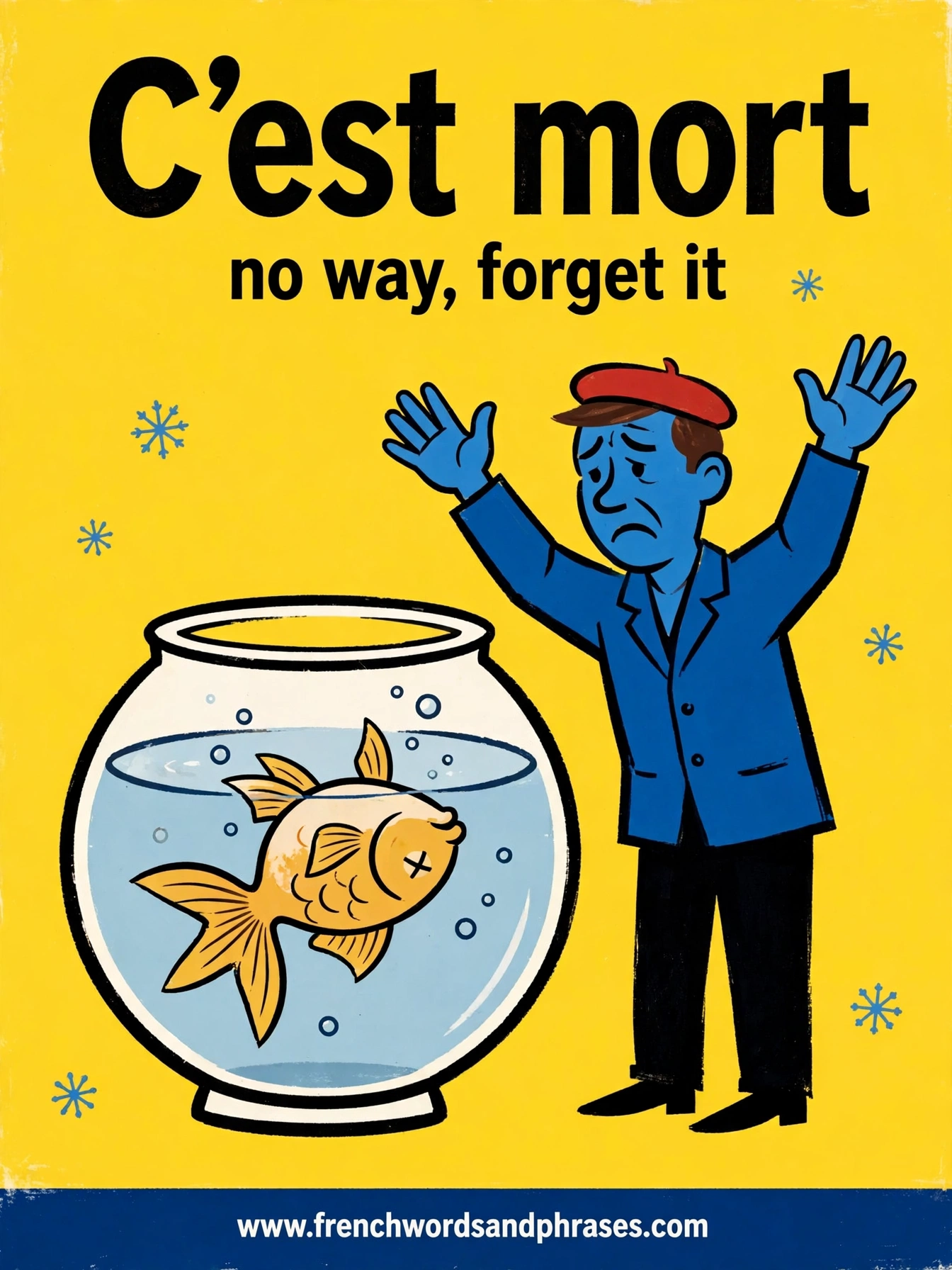
C’est mort means no way, forget it — it’s dead: no chance at all, the plan is off.
The group chat is flying: beach tomorrow, early start, sandwiches. Then the weather alert lands — storms all weekend, red warning. One friend reads it, looks at the picnic basket, and buries the whole plan in two words: « C’est mort. »
Let’s explore how c’est mort works in French, beginning with the whole phrase on one card.
Understanding the French Phrase C’est mort
C’est mort is a French idiomatic expression built from c’est (it is) and mort (dead — the past participle of mourir, to die, used as an adjective). In modern spoken French, whatever is mort has no future: the plan, the request and the hope are all pronounced dead on the spot.
It means no way, forget it — it’s dead. It cancels outings, refuses impossible favours and closes sold-out hopes in two flat words: the concert is full, the last train has gone, the loan of five hundred euros is not happening. It is the everyday French of younger speakers, and it is a verdict, not a discussion.
Type: Idiomatic expression — refusal and cancellation (c’est + adjective)
Answers the need: Saying a plan is off or a request has no chance at all
Register: Informal — young, spoken French; keep it out of formal writing
Strength: Total — not unlikely, not difficult: dead
One important usage detail: the phrase loves a complement that names the corpse — c’est mort pour ce soir, c’est mort pour les billets. The literal sense is alive and well elsewhere: mon téléphone est mort means the phone itself has died, battery and all.
Experience the Word
C’est mort is the shortest obituary in French — two words, and a whole plan is buried without ceremony.
Imagine the last two tickets for the concert, gone one second before your click. Or the lift you ask for, across the whole city, at midnight, from a friend already in pyjamas. French youth looked at all these small deaths and gave them the same flat gravestone: c’est mort.
The phrase is brutal and funny at once. It refuses to negotiate with hope — and that honesty is exactly why friends laugh when they hear it.
How to Use C’est mort in French: Complete Guide
Let’s explore how c’est mort works in French, beginning with the whole phrase on one card.
C’est mort at a Glance
The Whole Phrase on One Card
Real meaning, literal picture, English twin and register — c’est mort in five lines.
| Point | C’est mort |
|---|---|
| What it really means | no way, forget it — it’s dead, there is no chance at all |
| Word for word | it is dead |
| English equivalent | no way / forget it / that’s dead / not a chance |
| Register | informal — young spoken French |
| Use it for | cancelled plans, impossible favours, sold-out hopes, gone chances |
Example
Le concert est complet : c’est mort pour ce soir.
The concert is sold out: tonight is a write-off.
Word by Word: Building the Verdict
Two small pieces — take them one by one and the plan is buried.
| Word | Literal meaning | Its job in the phrase |
|---|---|---|
| c’est | it is, that is | points at the plan, the request, the hope under judgement |
| mort | dead | the verdict itself — mort is the past participle of mourir, to die, standing as an adjective |
Example
Pour les billets, c’est mort, tout est vendu.
For the tickets, it’s dead — everything is sold.
Quick Quiz 1
A friend asks for a lift across town at midnight. You answer « C’est mort ! » — what have you said?
Reveal the answer
No way — the request is dead; there is no chance of it happening. Nothing has actually died.
Un aller-retour à minuit ? C’est mort, je dors déjà.
A round trip at midnight? No way, I’m already asleep.
When You Say It: The Burial Moments
C’est mort fires at moments like these — wherever a hope meets its end and everyone knows it.
| Situation | Example |
|---|---|
| The rained-off picnic | avec cette pluie, le pique-nique, c’est mort — with this rain, the picnic is dead |
| The sold-out concert | plus une place : c’est mort pour le concert — not one seat left: the concert is a write-off |
| The impossible favour | me prêter ta voiture un mois ? c’est mort — lend me your car for a month? no way |
| The last train gone | le dernier train est parti, c’est mort — the last train has left, it’s over |
| The dead phone before the trip | plus de batterie et pas de chargeur : c’est mort — no battery and no charger: hopeless |
Example
Il n’y a plus de trains : pour rentrer ce soir, c’est mort.
There are no more trains: getting home tonight is impossible.
Make It Yours: The Verdict in Every Size
The verdict takes a complement to name what died — and a playful doubling when the death is total.
| Form | French | In English |
|---|---|---|
| The verdict itself | c’est mort | no way, it’s dead |
| For tonight | c’est mort pour ce soir | tonight is off |
| For the tickets | c’est mort pour les billets | the tickets are gone, forget it |
| Completely | c’est complètement mort | it’s completely dead |
| The playful doubling | c’est mort de chez mort | it’s dead as dead can be |
| For tomorrow | pour demain, c’est mort aussi | tomorrow is off too |
Example
C’est mort de chez mort : le restaurant est fermé jusqu’à lundi.
It’s completely dead: the restaurant is closed until Monday.
Quick Quiz 2
How do you bury just tonight’s plan, and not the whole idea?
Reveal the answer
Add pour ce soir — c’est mort pour ce soir. The complement names the corpse; another evening may live.
C’est mort pour ce soir, mais on remet ça samedi.
Tonight is off, but we’ll do it Saturday instead.
Everyday Expressions: Building on the Verdict
C’est mort slots into these everyday frames — each one ready to use as it stands.
| Frame | In English |
|---|---|
| c’est mort | no way, it’s dead |
| c’est mort pour ce soir | tonight is off |
| c’est mort, il n’y a plus de places | it’s dead, there are no seats left |
| laisse, c’est mort | leave it, it’s hopeless |
| c’est mort de chez mort | it’s dead as dead can be — playful total version |
Example
Laisse, c’est mort, le magasin ferme dans deux minutes.
Leave it, it’s hopeless, the shop closes in two minutes.
Close Cousins: The Other Burials
French has a whole shelf of no-hope phrases — c’est mort is the youngest; its cousins are older, cooked, or dreamier.
| Expression | The difference |
|---|---|
| c’est mort | it’s dead — the modern, flat verdict on plans and requests |
| c’est fichu | it’s done for — the same verdict, one generation older |
| c’est cuit | it’s cooked, it’s over — the food twin of the verdict |
| pas question | no way — a firm refusal, at home in every generation |
| même pas en rêve | not even in your dreams — the mocking refusal of an outrageous request |
Example
Un billet gratuit ? Même pas en rêve : c’est mort, c’est cuit, c’est fichu.
A free ticket? Not even in your dreams: it’s dead, it’s cooked, it’s done for.
Quick Quiz 3
Which cousin refuses an outrageous request by sending it to a dream?
Reveal the answer
Même pas en rêve — not even in your dreams. C’est mort buries the plan; même pas en rêve mocks the asking.
Me prêter mille euros ? Même pas en rêve.
Lend me a thousand euros? Not even in your dreams.
C’est mort and Its Neighbours
The cancellation shelf around the phrase — verdicts, refusals and plans that fall through.
| French | In English |
|---|---|
| annulé | cancelled |
| fichu | done for |
| cuit | cooked — over, finished |
| tomber à l’eau | to fall through — of plans, literally to fall in the water |
| un refus | a refusal |
| la batterie est morte | the battery is dead — the literal neighbour |
Example
Le projet est tombé à l’eau : pour cette année, c’est mort.
The project fell through: for this year, it’s dead.
Watch Out: The Traps Around C’est mort
The traps: a death nobody mourns, an agreement that follows real nouns, and a twin adjective that can mean brilliant.
| Trap | The truth |
|---|---|
| nobody has died | il est mort reports a real death; c’est mort about a plan is the figurative verdict — context is everything |
| mort agrees with real nouns | la batterie est morte, les espoirs sont morts — but c’est mort is a fixed masculine phrase |
| not for formal refusals | a formal letter says nous regrettons de ne pouvoir… — c’est mort belongs to the group chat |
| mortel is another country | c’est mortel can mean brilliant (slang) or deadly boring — never confuse it with the flat verdict c’est mort |
Example
Le concert était mortel, mais pour les billets, c’est mort.
The concert was brilliant, but as for tickets, it’s a write-off.
Quick Quiz 4
True or false: c’est mortel ! and c’est mort ! mean the same thing.
Reveal the answer
False — mortel can praise (brilliant!) or complain (deadly boring); mort simply kills the plan.
Le film était mortel ; rentrer à pied, par contre, c’est mort.
The film was brilliant; walking home, though — no way.
C’est mort in Everyday French: Real-Life Examples
Now that you know the word, let’s see how c’est mort appears in everyday French.
Example 1 — The weather
Orage prévu tout le week-end : le camping, c’est mort.
Storms forecast all weekend: the camping trip is dead.
Example 2 — The concert
Complet depuis mardi : pour le concert, c’est mort.
Sold out since Tuesday: the concert is a write-off.
Example 3 — The favour
Te conduire à l’aéroport à quatre heures du matin ? C’est mort.
Drive you to the airport at four in the morning? No way.
Example 4 — The train
Dernier train annulé : c’est mort pour ce soir.
Last train cancelled: tonight is off.
Example 5 — The phone
Plus de batterie, pas de chargeur : c’est mort.
No battery, no charger: it’s hopeless.
Example 6 — The doubling
Le restaurant est fermé, le cinéma aussi : c’est mort de chez mort.
The restaurant is closed, the cinema too: it’s completely dead.
Beyond Translation: The Meaning of C’est mort
English buries plans too — a dead loss, dead in the water — but French made this the default two-word obituary for any hope at all, delivered without a tremor.
C’est mort is refusal as a flat line on a monitor: no negotiation, no appeal, just the honest tone of the end.
And yet it makes people laugh — because a plan pronounced dead in two words can be replaced in two minutes, and everyone in the group chat knows it.
How to Remember the French Phrase C’est mort
Remember it this way: C’est mort is the flat line on the monitor — two words, and the plan is officially buried.
- You name the corpse — c’est mort pour ce soir buries one evening and lets the idea live.
- You keep real deaths apart — il est mort is literal; about a plan, c’est mort is the verdict.
- You avoid the twin — mortel can mean brilliant; mort never does.
The key idea is c’est mort means no way, forget it — the plan is pronounced dead.
Test Your Knowledge of C’est mort
Let’s see how much you’ve learned. Try answering these questions before revealing the answers.
Question 1
What does c’est mort mean?
Reveal the answer
No way, forget it — it’s dead: the plan is off, the request has no chance.
Question 2
Has something actually died when you say it?
Reveal the answer
No — about plans and requests it is a verdict, not a death. A dead battery (la batterie est morte) is the literal neighbour.
Question 3
How do you say tonight’s plan is off?
Reveal the answer
C’est mort pour ce soir — the complement names what died.
Question 4
What is the difference between c’est mort and c’est mortel?
Reveal the answer
C’est mortel can mean brilliant (or deadly boring) in slang. C’est mort only ever buries the plan.
Question 5
Complete the sentence:
Plus un seul billet : c’est ______. (Not a single ticket left: it’s a write-off.)
Reveal the answer
mort
Plus un seul billet : c’est mort.
Not a single ticket left: it’s a write-off.
Your Final Challenge
Can You Use It?
How would you say this in French?
“Forget it — there are no tickets left.”
Reveal the answer
C’est mort — il n’y a plus de billets.
Forget it — there are no tickets left.
A little French. A little curiosity. A richer everyday life.
LEARN FRENCH ONE WORD AT A TIME