A French Word to Live By
Translate C’est le pied to English
/sɛ lə pje/
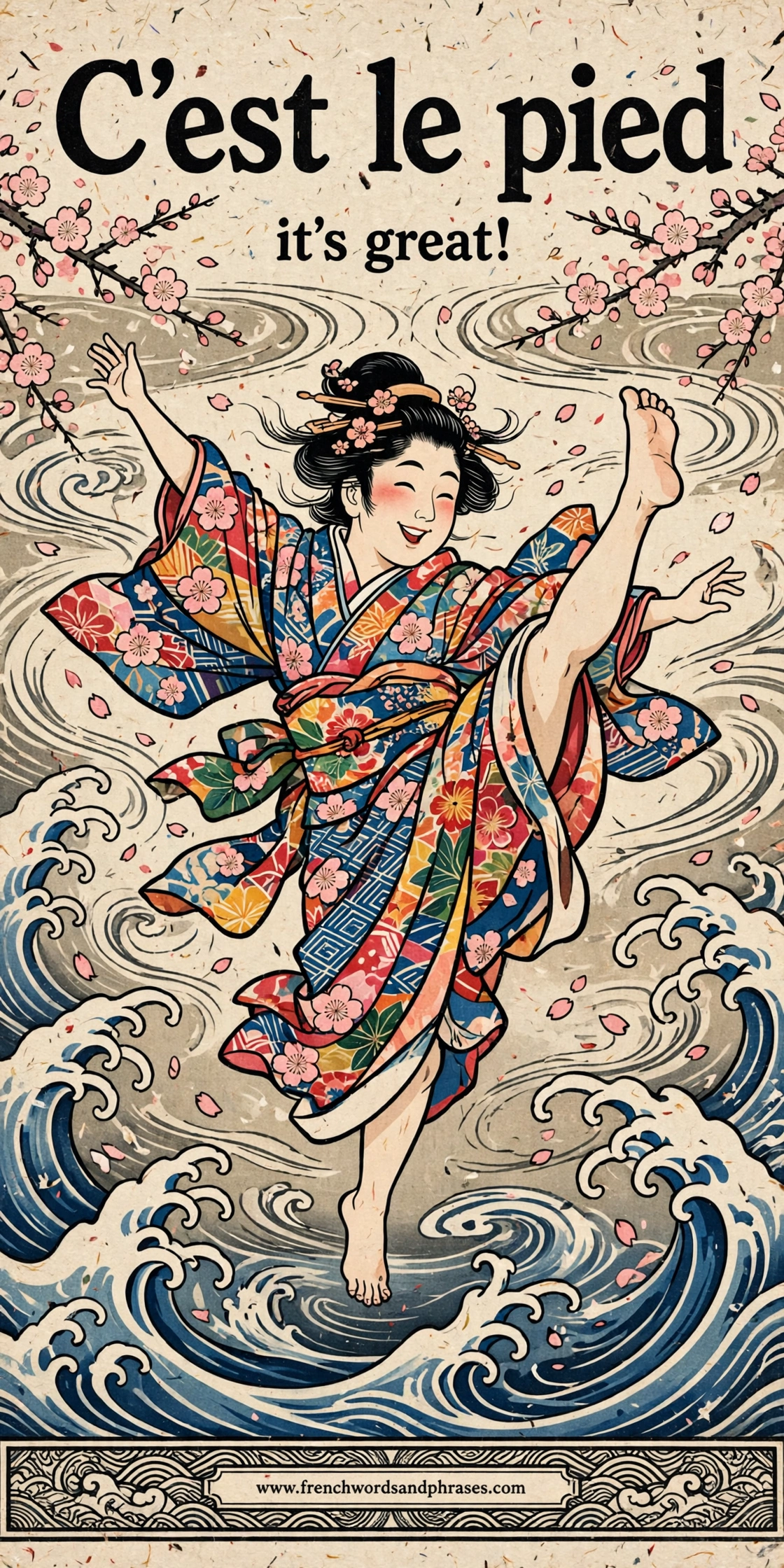
C’est le pied means it’s great — it’s fantastic, pure pleasure from start to finish.
First morning of the holiday: the shutters open on a blue sea, the coffee is strong, the village bakery has sent up warm croissants, and nobody has to be anywhere at all. Your friend takes one long breath of it, stretches like a cat, and gives the day its official rating: « C’est le pied, ici. »
Let’s explore how c’est le pied works in French, beginning with the whole phrase on one card.
Understanding the French Phrase C’est le pied
C’est le pied is a French idiomatic expression built from c’est (it is) and le pied (the foot). In French slang, le pied has long stood for pleasure itself — the same pied as in prendre son pied, to get a real kick out of something. To say c’est le pied is to give a moment the highest mark the slang scale has.
It means it’s great — it’s brilliant, it’s bliss, this is the life. Nobody is talking about feet: the pied is pleasure in its slang uniform, and the phrase is a verdict of pure enjoyment, delivered about holidays, meals, weather, music — anything that makes the speaker glow. It is familiar, cheerful, and a little bit vintage, which is part of its charm.
Type: Idiomatic expression — delight (fixed sentence)
Answers the need: Saying something is fantastic, a pure pleasure
Register: Familiar and cheerful — spoken, warm; a touch old-school
Strength: Maximum enthusiasm — the top of the everyday pleasure scale
One important usage detail: the phrase keeps a twin in the family — prendre son pied, to really enjoy oneself, especially in an activity: il prend son pied à conduire cette voiture. And the negative exists too: c’est pas le pied means it’s no fun at all — the same foot, pointing the other way.
Experience the Word
C’est le pied is delight with its shoes off — the phrase of the deckchair, the long lunch, the sea doing exactly what a sea should do.
Imagine the fisherman who has retired to a small house above the port, who takes his coffee on the terrace every morning of his life and looks at the boats. Asked whether he misses the city, he gestures at the whole shining scene with his cup. Words would be longer. The verdict fits in three: c’est le pied.
Some phrases praise; this one relaxes. Saying it is almost the same as sighing with pleasure — the sentence itself is enjoying the moment.
How to Use C’est le pied in French: Complete Guide
Let’s explore how c’est le pied works in French, beginning with the whole phrase on one card.
C’est le pied at a Glance
The Whole Phrase on One Card
Real meaning, literal picture, English twin and register — c’est le pied in five lines.
| Point | C’est le pied |
|---|---|
| What it really means | it’s great — it’s fantastic, pure pleasure |
| Word for word | it is the foot — pied is slang for pleasure itself |
| English equivalent | it’s great / it’s bliss / this is the life |
| Register | familiar and cheerful — spoken, warm, a little vintage |
| Use it for | holidays, meals, weather, music — any moment that glows |
Example
Une semaine à la mer, sans réveil : c’est le pied.
A week by the sea, with no alarm clock: it’s bliss.
Word by Word: Building the Pleasure
Two small pieces — take them one by one and the moment is already glowing.
| Word | Literal meaning | Its job in the phrase |
|---|---|---|
| c’est | it is, this is | the pointing word — the whole scene gets the verdict |
| le pied | the foot | in slang, pleasure itself — the foot that dances, taps and enjoys |
Example
Ce concert, c’était le pied du début à la fin.
That concert was fantastic from start to finish.
Quick Quiz 1
What does le pied stand for in this phrase — anatomy or pleasure?
Reveal the answer
Pleasure — in slang, le pied is enjoyment itself; the anatomy stays in your shoes.
Danser toute la nuit, quel pied !
Dancing all night — what a pleasure!
When You Say It: The Glowing Moments
C’est le pied fires at moments like these — everything is right, and somebody has to say so.
| Situation | Example |
|---|---|
| The holiday | cette terrasse face à la mer, c’est le pied — this terrace facing the sea is bliss |
| The meal | ce repas, c’est le pied — this meal is fantastic |
| The new job perk | travailler à domicile le vendredi, c’est le pied — working from home on Fridays is great |
| The music | écouter ce disque au soleil, c’est le pied — listening to this record in the sun is bliss |
| The verdict with a sigh | ah, c’est le pied, ce silence — ah, this silence is bliss |
Example
Un bain chaud après la randonnée, c’est le pied.
A hot bath after the hike — it’s bliss.
Make It Yours: The Pleasure for Every Moment
The tense travels — c’était le pied for the remembered glow — and quel pied ! cries the same joy.
| Form | French | In English |
|---|---|---|
| It’s great | c’est le pied | it’s great, it’s bliss |
| It was great | c’était le pied | it was fantastic |
| What a pleasure | quel pied ! | what a pleasure! |
| Really enjoying oneself | prendre son pied | to get a real kick out of it |
| It’s not fun at all | c’est pas le pied | it’s no fun at all |
| Question | c’est le pied, non ? | it’s great, isn’t it? |
Example
Il prend son pied à restaurer de vieilles motos.
He gets a real kick out of restoring old motorbikes.
Quick Quiz 2
How do you say the opposite — ‘it’s no fun at all’?
Reveal the answer
C’est pas le pied — the same phrase negated; the foot points the other way.
Travailler sous la pluie, c’est pas le pied.
Working in the rain is no fun at all.
Everyday Expressions: Building on the Pleasure
C’est le pied slots into these everyday frames — each one ready to use as it stands.
| Frame | In English |
|---|---|
| c’est le pied | it’s great, it’s bliss |
| c’était le pied | it was fantastic |
| quel pied ! | what a pleasure! |
| prendre son pied | to really enjoy oneself |
| c’est le pied, ici | this is the life, here |
Example
Quel pied, cette descente à ski sous le soleil !
What a pleasure, that ski run in the sunshine!
Close Cousins: The Other Delights
French has a whole shelf of delight phrases — the pied is the slang classic; its cousins are plainer, newer or more poetic.
| Expression | The difference |
|---|---|
| c’est le pied | it’s great — familiar, cheerful, a little vintage |
| c’est génial | it’s great — the plain modern verdict, welcome everywhere |
| c’est top | it’s top-notch — newer, breezy, very informal |
| c’est le bonheur | it’s pure happiness — softer and more poetic than the pied |
| prendre son pied | to really enjoy oneself — the active twin, an activity enjoyed from inside |
| être aux anges | to be over the moon — delight about news and people, not moments |
Example
C’est génial, c’est le bonheur, c’est le pied : choisis ton thermomètre.
It’s great, it’s bliss, it’s fantastic: pick your thermometer.
Quick Quiz 3
Which cousin is the safe, all-ages, all-company way to say ‘it’s great’?
Reveal the answer
C’est génial — plain and welcome everywhere; c’est le pied is the familiar, slang-flavoured version.
Votre idée est géniale, a dit le directeur.
Your idea is great, said the director.
C’est le pied and Its Neighbours
The delight shelf around the phrase — the pleasure, the moment, and the sigh that sums them up.
| French | In English |
|---|---|
| le plaisir | pleasure |
| le bonheur | happiness, bliss |
| profiter de | to make the most of, to enjoy |
| un régal | a treat, a delight |
| génial | great, brilliant |
| se détendre | to relax, to unwind |
Example
On profite, on se détend : un vrai régal de journée.
We make the most of it, we relax: a truly delightful day.
Watch Out: The Traps Around C’est le pied
The traps: a real foot nearby, a negative that reverses everything, and a twin with a second sense.
| Trap | The truth |
|---|---|
| the anatomy trap | j’ai mal au pied is a sore foot, pure anatomy — the idiom needs the full verdict c’est le pied |
| the negative reverses all | c’est pas le pied means it’s no fun at all — one small pas turns bliss into drudgery |
| prendre son pied has a second sense | in some contexts the twin phrase is specifically about physical, even sexual, pleasure — the situation decides; c’est le pied itself stays innocent |
| a vintage flavour | the phrase is cheerful but a little old-school; teenagers may reach for c’est top or c’est génial instead |
Example
Ce n’est pas le pied d’avoir mal au pied en vacances.
It’s no fun having a sore foot on holiday.
Quick Quiz 4
True or false: c’est pas le pied is just a casual way of saying the same thing as c’est le pied.
Reveal the answer
False — it is the exact opposite: it’s no fun at all.
Déménager sous la neige, c’est pas le pied du tout.
Moving house in the snow is no fun at all.
C’est le pied in Everyday French: Real-Life Examples
Now that you know the word, let’s see how c’est le pied appears in everyday French.
Example 1 — The holiday morning
Le soleil, la mer, le café : c’est le pied.
The sun, the sea, the coffee: it’s bliss.
Example 2 — The meal
Ce dîner chez ta mère, c’était le pied.
That dinner at your mother’s was fantastic.
Example 3 — Working from home
Le vendredi à la maison, c’est le pied.
Fridays at home — it’s great.
Example 4 — The concert
Quel pied, ce concert en plein air !
What a pleasure, that open-air concert!
Example 5 — The hobby
Il prend son pied à jardiner le dimanche.
He gets a real kick out of gardening on Sundays.
Example 6 — The contrast
Aujourd’hui c’est le pied ; hier, c’était pas le pied du tout.
Today it’s bliss; yesterday was no fun at all.
Beyond Translation: The Meaning of C’est le pied
Of all the body parts French slang could have chosen for pleasure, it chose the foot — the part that taps to music, dances without permission, and walks you towards everything you enjoy. C’est le pied carries that small philosophy inside it: pleasure is not in the head, planned and judged, but down in the feet, moving before you have decided.
C’est le pied is the verdict of the body before the mind has finished its review.
Its slight old-fashionedness only adds to the warmth — it is the phrase of parents and grandparents at the exact moment the holiday begins, and it has been starting holidays for generations.
How to Remember the French Phrase C’est le pied
Remember it this way: C’est le pied is pleasure located in the foot — the part of you that taps, dances and arrives at the good moments first.
- You tap your foot — in slang, le pied is pleasure itself, the foot that dances before the mind approves.
- You fear the pas — c’est pas le pied is the exact opposite: no fun at all.
- You keep the twin active — prendre son pied is to really enjoy yourself, inside an activity.
The key idea is c’est le pied means it’s great — pure pleasure, rated by the foot.
Test Your Knowledge of C’est le pied
Let’s see how much you’ve learned. Try answering these questions before revealing the answers.
Question 1
What does c’est le pied mean?
Reveal the answer
It’s great, it’s fantastic — a verdict of pure pleasure.
Question 2
What does le pied stand for in the phrase?
Reveal the answer
Pleasure itself — in slang, the pied is enjoyment, as in prendre son pied.
Question 3
How do you say ‘it was fantastic’ about last weekend?
Reveal the answer
C’était le pied — the imperfect carries the verdict into the past.
Question 4
What does c’est pas le pied mean?
Reveal the answer
It’s no fun at all — the negated twin, the exact opposite.
Question 5
Complete the sentence:
Cette plage déserte, c’est le ______. (This deserted beach is bliss.)
Reveal the answer
pied
Cette plage déserte, c’est le pied.
This deserted beach is bliss.
Your Final Challenge
Can You Use It?
How would you say this in French?
“This is bliss — it’s great!”
Reveal the answer
C’est le pied, ici !
This is bliss — it’s great!
A little French. A little curiosity. A richer everyday life.
LEARN FRENCH ONE WORD AT A TIME