A French Word to Live By
Translate Coûter bonbon to English
/ku.te bɔ̃.bɔ̃/
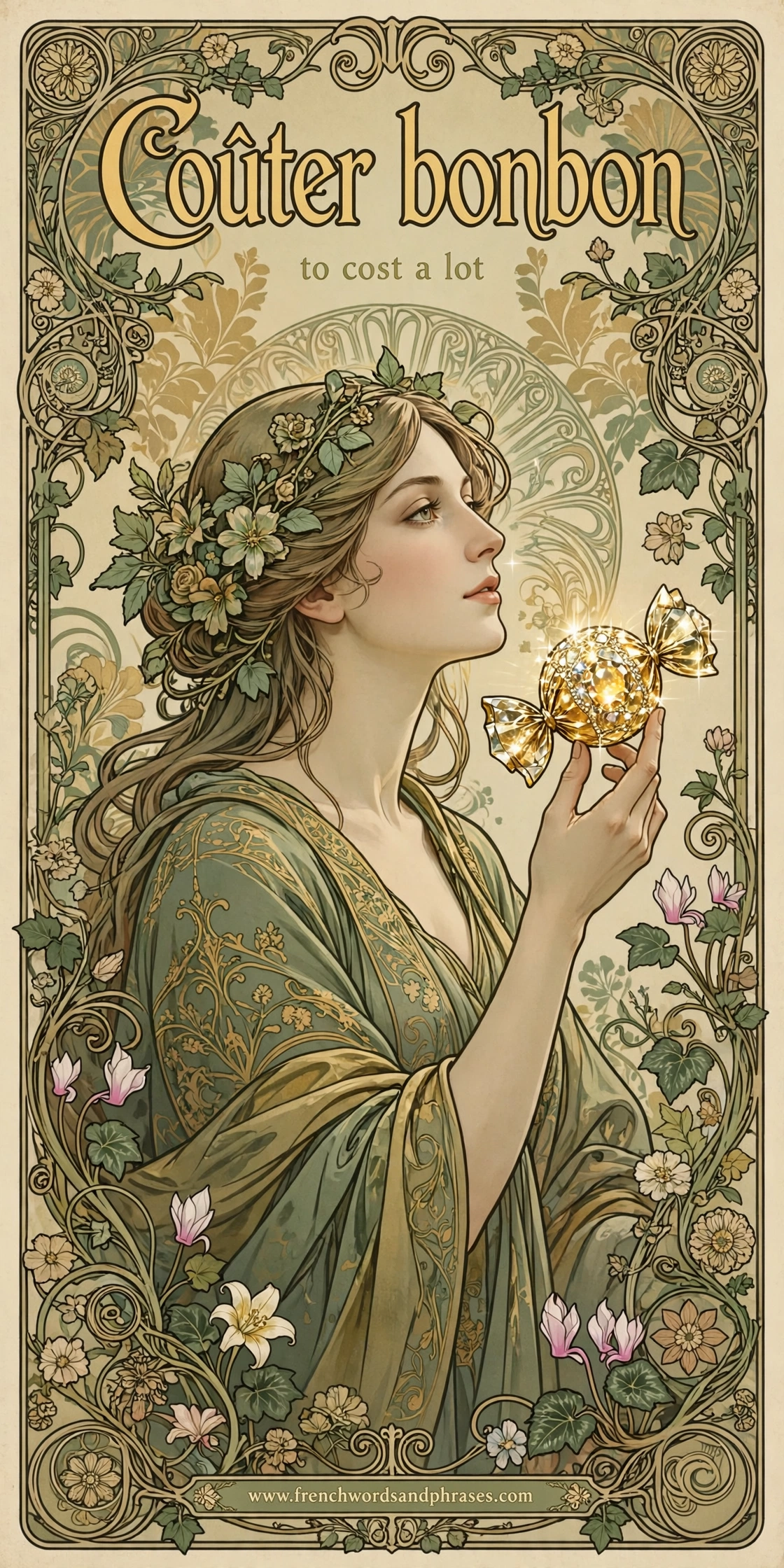
Coûter bonbon means to cost a lot — to be very expensive, far beyond what seems reasonable.
The plumber has finished, the tap no longer drips, and now he is writing the bill on the kitchen table, slowly, in beautiful handwriting. Your neighbour watches the numbers grow, waits for the door to close, and delivers the only possible review: « Ça m’a coûté bonbon, cette histoire. »
Let’s explore how coûter bonbon works in French, beginning with the whole phrase on one card.
Understanding the French Phrase Coûter bonbon
Coûter bonbon is a French idiomatic expression built from coûter (to cost) and bonbon (a sweet, a candy). In old slang, bonbon served as a joking measure of a large amount — so a thing that ‘costs candy’ costs a great deal of money. The phrase survives as a familiar, slightly old-fashioned way to wince at a price.
It means to cost a lot — to be very expensive, usually more than the thing feels worth. Nobody is buying sweets: the bonbon is the slang unit of a painful sum, and the sweetness of the word against the sourness of the bill is exactly the humour. It is said with a wince and a smile, most often just after paying.
Type: Idiomatic expression — price (verb + slang measure)
Answers the need: Saying something was painfully expensive, with a wince and a joke
Register: Familiar, slightly old-fashioned — spoken, warm, never formal
Strength: Strong — not merely dear, but ‘that cost me’ expensive
One important usage detail: bonbon never changes and never takes an article here — ça coûte bonbon, ça m’a coûté bonbon, never des bonbons. The phrase also loves a victim: add the person who pays with me, te, lui — cette réparation m’a coûté bonbon. In careful writing, plain coûter cher does the same job without the slang.
Experience the Word
Coûter bonbon is the sound a wallet makes when it complains in slang — the bill was serious, but the telling of it refuses to be.
Imagine the old car, loved like a family member, coming back from the garage with a list of repairs read out like a poem. The owner pays, sighs, and sums up twenty years of loyalty in three words: elle coûte bonbon. Nobody in the room needs the figures. The bonbon is the figure.
French prices have official language — devis, facture, total. For the price as it is felt in the chest, the language keeps a sweet.
How to Use Coûter bonbon in French: Complete Guide
Let’s explore how coûter bonbon works in French, beginning with the whole phrase on one card.
Coûter bonbon at a Glance
The Whole Phrase on One Card
Real meaning, literal picture, English twin and register — coûter bonbon in five lines.
| Point | Coûter bonbon |
|---|---|
| What it really means | to cost a lot — to be very expensive |
| Word for word | to cost candy — bonbon is old slang for a large amount |
| English equivalent | to cost a fortune / to cost an arm and a leg |
| Register | familiar, slightly old-fashioned — spoken and warm |
| Use it for | repairs, bills, cars, weddings — any price that makes you wince |
Example
La réparation de la toiture a coûté bonbon.
The roof repair cost a fortune.
Word by Word: Building the Painful Price
Two small pieces — take them one by one and the bill is already on the table.
| Word | Literal meaning | Its job in the phrase |
|---|---|---|
| coûter | to cost | the verb of the price — spelled with a circumflex, coûter |
| bonbon | a sweet, a candy | old slang for a big amount — the sweet word that measures a sour bill |
Example
Ce petit appartement coûte bonbon, vu la taille.
This little flat costs a fortune, given its size.
Quick Quiz 1
Does bonbon become plural in ça coûte bonbon?
Reveal the answer
No — bonbon is frozen in the phrase: no article, no plural, ever.
Ces chaussures coûtent bonbon, pas « des bonbons ».
These shoes cost a fortune, not ‘candies’.
When You Say It: The Wincing Moments
Coûter bonbon fires at moments like these — the bill arrives, and the sweet word does the complaining.
| Situation | Example |
|---|---|
| The repair bill | le plombier m’a coûté bonbon — the plumber cost me a fortune |
| The car | cette voiture coûte bonbon en réparations — this car costs a fortune in repairs |
| The wedding | leur mariage a coûté bonbon — their wedding cost a fortune |
| The flat | les loyers ici coûtent bonbon — rents here cost a fortune |
| Warning a friend | attention, ça coûte bonbon, ce restaurant — careful, that restaurant costs a fortune |
Example
Un mariage comme ça, ça coûte bonbon, même en province.
A wedding like that costs a fortune, even in the provinces.
Make It Yours: The Price for Every Payer
Coûter conjugates normally — and the payer slips in as me, te, lui before the verb.
| Form | French | In English |
|---|---|---|
| It costs a fortune | ça coûte bonbon | it costs a fortune |
| It cost me a fortune | ça m’a coûté bonbon | it cost me a fortune |
| It will cost a fortune | ça va coûter bonbon | it’s going to cost a fortune |
| It cost him a fortune | ça lui a coûté bonbon | it cost him a fortune |
| That costs a fortune too | ça coûte bonbon aussi | that costs a fortune too |
| Question | combien ça coûte ? — bonbon | how much does it cost? — a fortune |
Example
La chaudière nous a coûté bonbon cet hiver.
The boiler cost us a fortune this winter.
Quick Quiz 2
Complete the sentence: « Cette réparation m’a ______ bonbon. »
Reveal the answer
coûté — the past participle of coûter, circumflex included.
Cette réparation m’a coûté bonbon.
This repair cost me a fortune.
Everyday Expressions: Building on the Sweet Bill
Coûter bonbon slots into these everyday frames — each one ready to use as it stands.
| Frame | In English |
|---|---|
| coûter bonbon | to cost a fortune |
| ça m’a coûté bonbon | that cost me a fortune |
| coûter bonbon en réparations | to cost a fortune in repairs |
| ça va te coûter bonbon | that’s going to cost you a fortune |
| tout coûte bonbon ici | everything costs a fortune here |
Example
Tout coûte bonbon dans ce quartier, même le parking.
Everything costs a fortune in this neighbourhood, even the parking.
Close Cousins: The Other Painful Prices
French has a whole shelf of expensive phrases — the bonbon is the sweet one; its cousins charge you body parts or your skin.
| Expression | The difference |
|---|---|
| coûter bonbon | to cost a fortune — familiar, sweet-worded, slightly old-fashioned |
| coûter les yeux de la tête | to cost an arm and a leg — the famous one, your eyes as the price |
| coûter un bras | to cost an arm — the modern, shorter body-part version |
| coûter la peau des fesses | to cost a fortune — the vulgar version, your skin as the price |
| coûter cher | to be expensive — the plain phrase, any register, no picture at all |
| ça chiffre | it adds up — familiar, about totals quietly growing |
Example
Les yeux de la tête ou bonbon, la facture fait le même effet.
An arm and a leg or a fortune, the bill has the same effect.
Quick Quiz 3
Which cousin is the vulgar one — coûter bonbon or coûter la peau des fesses?
Reveal the answer
Coûter la peau des fesses — the skin of your backside. Bonbon is merely familiar and sweet.
Devant les enfants, on dit bonbon, pas la peau des fesses.
In front of children, you say bonbon, not the skin version.
Coûter bonbon and Its Neighbours
The money shelf around the phrase — the bill, the price, and the fortune it feels like.
| French | In English |
|---|---|
| une facture | a bill, an invoice |
| un devis | a quote, an estimate |
| cher | expensive, dear |
| une fortune | a fortune — the sum it feels like |
| le prix | the price |
| payer | to pay — the moment of pain |
Example
Le devis annonçait déjà la couleur : ça allait coûter bonbon.
The quote already set the tone: it was going to cost a fortune.
Watch Out: The Traps Around Coûter bonbon
The traps: a sweet that never pluralises, a circumflex that matters, and real bonbons at the till.
| Trap | The truth |
|---|---|
| never plural, never an article | ça coûte bonbon — the moment you write des bonbons you are back in the sweet shop |
| the circumflex stays | coûter keeps its û in every form: il coûte, ça a coûté — dropping it is a spelling fault |
| a real purchase is different | acheter des bonbons is buying sweets; the idiom needs coûter and no article |
| slightly old-fashioned | younger speakers often prefer coûter un bras or ça coûte super cher — bonbon has a warm, parental flavour |
Example
Il a acheté des bonbons pour les enfants ; la réparation, elle, a coûté bonbon.
He bought sweets for the children; the repair, now, cost a fortune.
Quick Quiz 4
True or false: ça coûte des bonbons is the correct plural form of the idiom.
Reveal the answer
False — the idiom is frozen: ça coûte bonbon, with no article and no plural.
Un bonbon se mange ; « coûter bonbon » se paie.
A sweet is eaten; ‘coûter bonbon’ is paid.
Coûter bonbon in Everyday French: Real-Life Examples
Now that you know the word, let’s see how coûter bonbon appears in everyday French.
Example 1 — The plumber
Le plombier est parti, mais il m’a coûté bonbon.
The plumber has left, but he cost me a fortune.
Example 2 — The roof
Refaire la toiture, ça coûte bonbon.
Redoing the roof costs a fortune.
Example 3 — The car
Cette vieille voiture me coûte bonbon en réparations.
This old car costs me a fortune in repairs.
Example 4 — The wedding
Leur mariage a coûté bonbon, mais quelle fête !
Their wedding cost a fortune, but what a party!
Example 5 — The warning
Ne va pas dans ce magasin, tout y coûte bonbon.
Don’t go into that shop, everything there costs a fortune.
Example 6 — The flat
À Paris, même un studio coûte bonbon.
In Paris, even a studio flat costs a fortune.
Beyond Translation: The Meaning of Coûter bonbon
A price, in French, can be paid in many currencies of the imagination: your eyes, your arm, the skin of your backside — or, at the gentlest end of the shelf, a sweet. Coûter bonbon keeps the complaint inside the family: the sum is painful, but the word for it comes from the sweet jar, and the whole sentence lands like a sigh rather than a shout.
Coûter bonbon is the wince with sugar on it — the bill is real, but so is the smile that pays it.
Perhaps that is why the phrase has survived its slang youth: every generation rediscovers that some prices can only be borne by joking about them.
How to Remember the French Phrase Coûter bonbon
Remember it this way: Coûter bonbon is the painful bill described with a sweet — the word from the sweet jar measuring a sum that is anything but sweet.
- You freeze the sweet — bonbon never takes an article or a plural inside the phrase: ça coûte bonbon.
- You keep the circumflex — coûter, il coûte, ça a coûté: the û is part of the word’s uniform.
- You place the payer — ça m’a coûté bonbon: the victim of the price slips in before the verb.
The key idea is coûter bonbon means to cost a lot — a fortune measured in slang sweets.
Test Your Knowledge of Coûter bonbon
Let’s see how much you’ve learned. Try answering these questions before revealing the answers.
Question 1
What does coûter bonbon mean?
Reveal the answer
To cost a lot — to be very expensive, well beyond what feels reasonable.
Question 2
What is bonbon doing in the phrase?
Reveal the answer
It is old slang for a large amount — a sweet used as the joking measure of a painful sum.
Question 3
How do you say ‘it cost me a fortune’?
Reveal the answer
Ça m’a coûté bonbon — the payer, m’, slips in before the verb.
Question 4
Why is ‘ça coûte des bonbons’ wrong?
Reveal the answer
Because the idiom is frozen — bonbon takes no article and no plural; with des bonbons you are simply buying sweets.
Question 5
Complete the sentence:
La voiture nous a coûté ______. (The car cost us a fortune.)
Reveal the answer
bonbon
La voiture nous a coûté bonbon.
The car cost us a fortune.
Your Final Challenge
Can You Use It?
How would you say this in French?
“The repair cost me a fortune.”
Reveal the answer
La réparation m’a coûté bonbon.
The repair cost me a fortune.
A little French. A little curiosity. A richer everyday life.
LEARN FRENCH ONE WORD AT A TIME