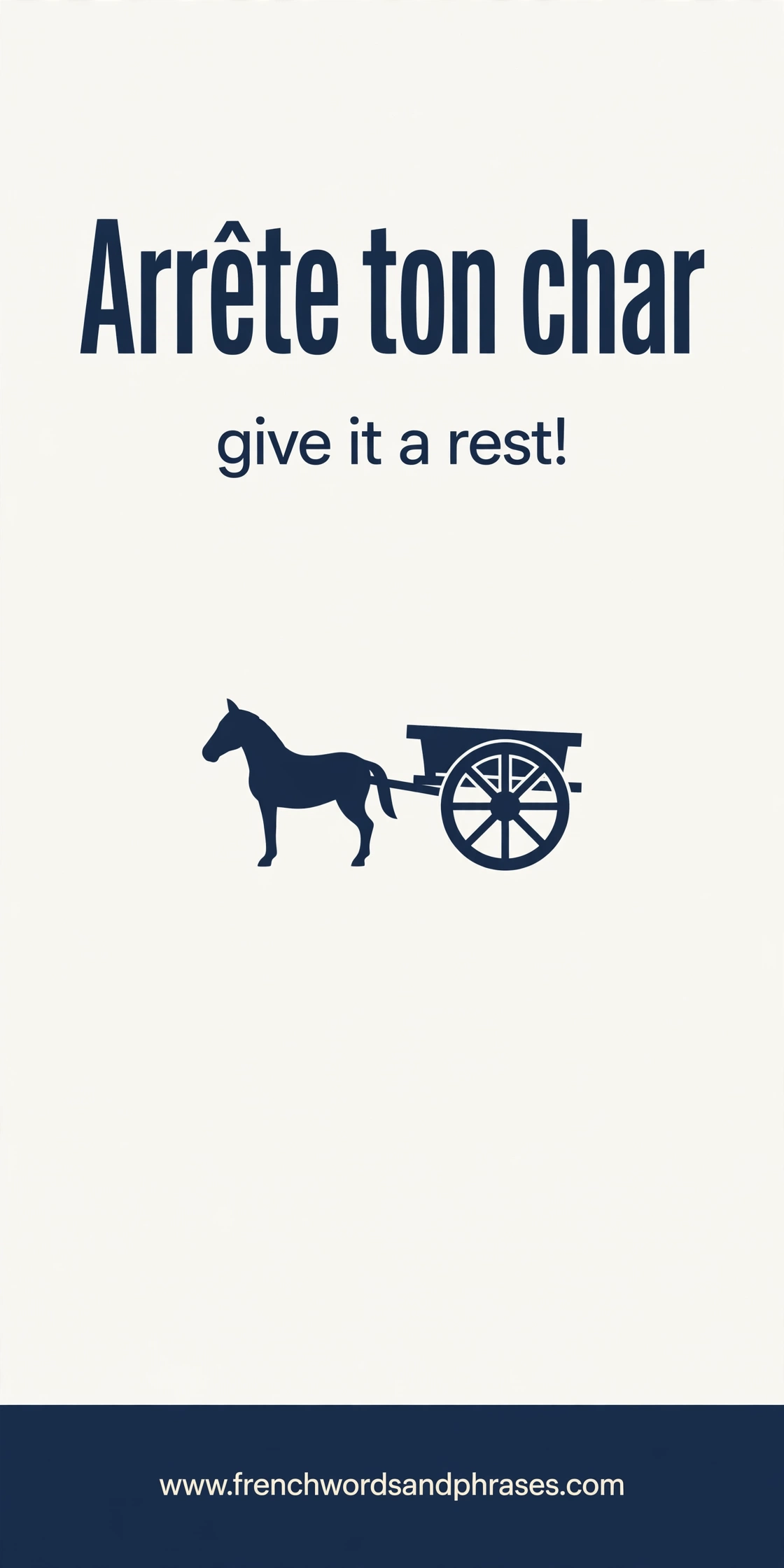
A French Word to Live By
Translate Arrête ton char to English
/a.ʁɛt tɔ̃ ʃaʁ/
Arrête ton char means give it a rest — stop exaggerating, stop the tall tales.
Your cousin is describing the fish he nearly caught. It was this big — no, this big — and by the third telling it needs two men and a trailer. His sister does not even look up from her plate: « Arrête ton char, on l’a tous vu, ton poisson. »
Let’s explore how arrête ton char works in French, beginning with the whole phrase on one card.
Understanding the French Phrase Arrête ton char
Arrête ton char is a French idiomatic expression built from arrête (stop, imperative of arrêter) and ton char — your chariot, in the old slang sense of your line of talk, your spiel. It orders a speaker to stop exaggerating, showing off or spinning tales.
It means give it a rest — stop exaggerating, stop the tall tales. The char is the vehicle of the performance: the speaker has been parading his story round the square like a chariot at a carnival, and the audience is calling for the parade to halt. Said laughing, it is the standard French puncture for a ballooning story.
Type: Idiomatic expression — command (imperative + noun)
Answers the need: Telling someone to stop exaggerating, boasting or spinning a tale
Register: Informal and teasing — a puncture between friends, rude only if the friendship is not there
Strength: Playful to firm — it deflates the story, not the person
One important usage detail: arrête ton char belongs to a famous family of punctures — arrête ton cinéma (stop the drama), arrête ton cirque (stop the circus act), arrête ton baratin (stop the sweet-talk). All four mean give it a rest; the char is the oldest and the one that names the vehicle of the show itself.
Experience the Word
Arrête ton char is the sound of a French audience refusing, collectively and cheerfully, to be taken for a ride.
Imagine the café terrace where the same fisherman has told the same story since spring, the fish growing a centimetre a week. The phrase arrives not as anger but as applause’s naughty twin: everyone loves the story, and everyone loves stopping it. Arrête ton char is how a tall tale receives its medal and its retirement in one breath.
French conversation is a sport with referees. This is the whistle — blown with affection, but blown.
How to Use Arrête ton char in French: Complete Guide
Let’s explore how arrête ton char works in French, beginning with the whole phrase on one card.
Arrête ton char at a Glance
The Whole Phrase on One Card
Real meaning, literal picture, English twin and register — arrête ton char in five lines.
| Point | Arrête ton char |
|---|---|
| What it really means | give it a rest — stop exaggerating, stop the tall tales |
| Word for word | stop your chariot — halt the vehicle your performance is riding on |
| English equivalent | give it a rest / pull the other one / stop showing off |
| Register | informal and teasing — a friend’s whistle, not an enemy’s |
| Use it for | growing fish, heroic anecdotes, excuses with special effects |
Example
Arrête ton char, personne ne croit à cette histoire.
Give it a rest, nobody believes that story.
Word by Word: Building the Whistle
Three small pieces — take them one by one and the parade slows down.
| Word | Literal meaning | Its job in the phrase |
|---|---|---|
| arrête | stop (imperative of arrêter) | the whistle itself — an order to halt |
| ton | your | aims the order at one performer’s vehicle |
| char | chariot, float, tank | in old slang, your spiel, your show — the parade vehicle of the tale |
Example
Arrête ton char, Ben-Hur.
Give it a rest, Ben-Hur.
Quick Quiz 1
What is the char you are asked to stop?
Reveal the answer
Your show — the chariot is the vehicle of the performance: the spiel, the boasting, the tale on parade.
Ton char, c’est ton histoire de poisson, et il roule depuis une heure.
Your ‘char’ is your fish story, and it’s been rolling for an hour.
When You Say It: The Tall-Tale Moments
Arrête ton char fires at moments like these — the story has outgrown the facts, and the audience reaches for the whistle.
| Situation | Example |
|---|---|
| At a growing anecdote | arrête ton char, le poisson faisait vingt centimètres — give it a rest, the fish was twenty centimetres |
| At an excuse | arrête ton char, tu as oublié, c’est tout — give it a rest, you forgot, that’s all |
| At a boast | arrête ton char, champion, on connaît tes exploits — give it a rest, champion, we know your exploits |
| At a sales pitch | arrête ton char, combien ça coûte vraiment ? — give it a rest, what does it really cost? |
| Laughing, to yourself | j’arrête mon char, promis, je raconte les faits — I’ll give it a rest, promise, I’ll stick to the facts |
Example
Arrête ton char, tu n’as jamais rencontré ce chanteur.
Give it a rest, you’ve never met that singer.
Make It Yours: The Whistle in Every Form
The order bends to the person — and the famous family offers three other vehicles to stop.
| Form | French | In English |
|---|---|---|
| The classic | arrête ton char | give it a rest |
| To a group or formally | arrêtez votre char | give it a rest (vous) |
| The drama version | arrête ton cinéma | stop the drama |
| The circus version | arrête ton cirque | stop the circus act |
| The sweet-talk version | arrête ton baratin | stop the smooth talk |
| Reported | elle lui a dit d’arrêter son char | she told him to give it a rest |
Example
Arrête ton cinéma, tout le monde a vu que tu trichais.
Stop the drama, everyone saw you cheating.
Quick Quiz 2
Which family member targets smooth talk and flattery — ton char or ton baratin?
Reveal the answer
Ton baratin — baratin is patter, sweet-talk, the salesman’s music. Arrête ton char stops the show in general.
Arrête ton baratin, je n’achète rien aujourd’hui.
Stop the smooth talk, I’m not buying anything today.
Everyday Expressions: Building on the Whistle
Arrête ton char slots into these everyday frames — each one ready to use as it stands.
| Frame | In English |
|---|---|
| arrête ton char | give it a rest |
| arrête ton char, on te connaît | give it a rest, we know you |
| arrêter son char | to give it a rest — the infinitive form |
| il a fini par arrêter son char | he finally gave it a rest |
| arrête ton char et écoute | give it a rest and listen |
Example
Il a fini par arrêter son char quand on a sorti la photo.
He finally gave it a rest when we got the photo out.
Close Cousins: The Other Punctures
French has a whole shelf of give-it-a-rest phrases — the char is the parade version; its cousins stop different kinds of show.
| Expression | The difference |
|---|---|
| arrête ton char | give it a rest — the general puncture for exaggeration and show |
| arrête ton cinéma | stop the drama — aimed at theatrical emotion and scenes |
| arrête ton cirque | stop the circus — aimed at clowning and commotion |
| arrête ton baratin | stop the sweet-talk — aimed at patter and flattery |
| ça suffit | that’s enough — the plain stop, no vehicle, no joke |
Example
Arrête ton cirque, les enfants, on passe à table.
Stop the circus, children, we’re sitting down to eat.
Quick Quiz 3
A friend is performing outrage at a tiny scratch on his car. Arrête ton char or arrête ton cinéma?
Reveal the answer
Arrête ton cinéma — the drama is theatrical emotion; cinéma names the performance of feelings.
Arrête ton cinéma, c’est une rayure, pas un accident.
Stop the drama, it’s a scratch, not a crash.
Arrête ton char and Its Neighbours
The puncture shelf around the phrase — from the plain order to the full family of vehicles.
| French | In English |
|---|---|
| ça suffit | that’s enough |
| arrête ton char | give it a rest |
| arrête ton cinéma | stop the drama |
| arrête ton cirque | stop the circus |
| arrête ton baratin | stop the smooth talk |
| exagérer | to exaggerate |
Example
Tu exagères, arrête ton char, et dis-nous le vrai prix.
You’re exaggerating, give it a rest, and tell us the real price.
Watch Out: The Traps Around Arrête ton char
The traps: real chariots and real tanks, a whistle that needs the friendship, and an imperative that stays in the tu.
| Trap | The truth |
|---|---|
| the vehicle trap | un char is also a tank and a carnival float — arrête ton char never asks anyone to park anything; the vehicle is the talk |
| the friendship trap | the whistle is affectionate only where the teasing is welcome — to a stranger it lands as pure rudeness |
| welded to the performance | the phrase answers a show in progress; for a simple order to stop an action, French says arrête or ça suffit |
| Ben-Hur is optional | arrête ton char, Ben-Hur is the classic joking extension — the chariot joke, made explicit |
Example
Arrête ton char, Ben-Hur, et aide-moi à porter la table.
Give it a rest, Ben-Hur, and help me carry the table.
Quick Quiz 4
True or false: arrête ton char can be said to a stranger without offence.
Reveal the answer
False — it is a tu-form tease that lives inside friendship. To a stranger, use a plain s’il vous plaît, or silence.
Entre amis on rit ; entre inconnus, on se tait.
Between friends you laugh; between strangers, you say nothing.
Arrête ton char in Everyday French: Real-Life Examples
Now that you know the word, let’s see how arrête ton char appears in everyday French.
Example 1 — At the fish story
Arrête ton char, ce poisson, on l’a tous vu.
Give it a rest, we’ve all seen that fish.
Example 2 — At an excuse
Arrête ton char, tu as oublié ton dossier, c’est tout.
Give it a rest, you forgot your file, that’s all.
Example 3 — At a boast
Arrête ton char, champion du monde de la sieste.
Give it a rest, world champion of the nap.
Example 4 — The drama version
Arrête ton cinéma, ce n’est qu’une petite erreur.
Stop the drama, it’s only a small mistake.
Example 5 — The sweet-talk version
Arrête ton baratin, je connais tes prix.
Stop the smooth talk, I know your prices.
Example 6 — Confessing
Bon, j’arrête mon char, voici la vraie histoire.
OK, I’ll give it a rest, here’s the true story.
Beyond Translation: The Meaning of Arrête ton char
English punctures a tall tale with give it a rest — the tale as a tired labourer, told to sit down. French gives the tale a vehicle and a parade: a chariot rolling through the square, driver standing tall, crowd expected to cheer.
To say arrête ton char is to refuse the ride while applauding the driver.
That double gesture — whistle and smile together — is why the phrase has outlived the chariot by two thousand years, and why its cinema, circus and baratin children thrive beside it.
How to Remember the French Phrase Arrête ton char
Remember it this way: Arrête ton char is the referee’s whistle for conversation — the tale is a chariot on parade, and you are calling the halt.
- You picture the parade — the char is the show itself, rolling; your job is to stop it rolling over the facts.
- You know the family — cinéma for drama, cirque for clowning, baratin for sweet-talk, char for the whole show.
- You blow the whistle kindly — the phrase deflates stories, not people, and only where the teasing is welcome.
The key idea is arrête ton char means give it a rest — stop the chariot of exaggeration.
Test Your Knowledge of Arrête ton char
Let’s see how much you’ve learned. Try answering these questions before revealing the answers.
Question 1
What does arrête ton char mean?
Reveal the answer
Give it a rest — stop exaggerating, stop the tall tales and the show.
Question 2
What is the char in the phrase?
Reveal the answer
The speaker’s show itself — the spiel pictured as a chariot on parade, which the audience orders to halt.
Question 3
Which cousin stops theatrical emotion?
Reveal the answer
Arrête ton cinéma — stop the drama; the cinéma version targets performed feelings.
Question 4
What does arrête ton baratin target?
Reveal the answer
Sweet-talk — patter, flattery and the salesman’s music.
Question 5
Complete the sentence:
Arrête ton ______, personne ne croit à cette histoire. (Give it a rest, nobody believes that story.)
Reveal the answer
char
Arrête ton char, personne ne croit à cette histoire.
Give it a rest, nobody believes that story.
Your Final Challenge
Can You Use It?
How would you say this in French?
“Give it a rest, nobody believes that story.”
Reveal the answer
Arrête ton char, personne ne croit à cette histoire.
Give it a rest, nobody believes that story.
A little French. A little curiosity. A richer everyday life.
LEARN FRENCH ONE WORD AT A TIME