A French Word to Live By
How to Conjugate Dételer in French
/de.tə.le/
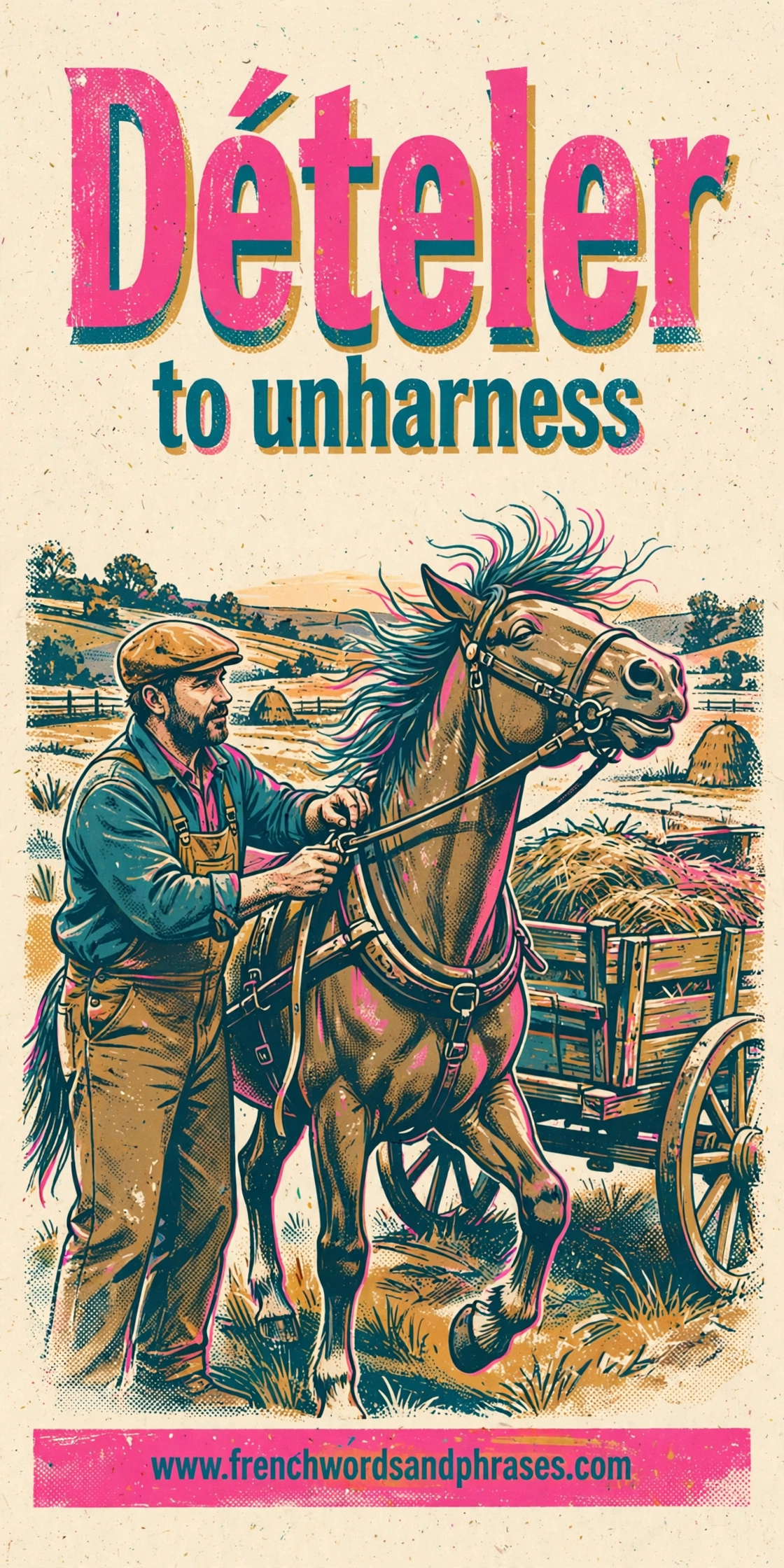
Dételer means to unharness — to free the horse from the shafts, straps and collar that bound it to the cart, the plough or the carriage.
Evening on a farm a century ago: the horse comes home steaming from the fields, and practised hands unbuckle, unhook and lift away the harness piece by piece. Dételer is the verb of that unhitching — the day’s work ends when the horse is dételé.
In this guide, you’ll learn how to conjugate dételer in all the major French tenses and moods. Explore complete conjugation tables, French examples, English translations, and practice quizzes.
Understanding the French Verb Dételer
Dételer is a regular French verb belonging to the first group of verbs, those ending in-er.
It means to unharness. It belongs first to the world of horse-drawn work — carts, ploughs, carriages and artillery — where atteler and dételer frame the working day. Its familiar figurative life is just as common today: dételer, said of a person, means to stop work, to down tools and call it a day, as the horse is freed from the shafts.
Verb classification: First group (-er)
Auxiliary verb: Avoir
Past participle: dételé
Present participle: dételant
English equivalents: To unharness, to unhitch; dételer un cheval — to unharness a horse; dételer une charrette — to unhitch a cart; atteler — to harness (the opposite); (familier) dételer — to knock off work, to call it a day; l’attelage — the harness, the team.
One important detail: dételer doubles its l exactly like appeler wherever the next syllable is mute: je dételle, tu dételles, il dételle, ils détellent, and all through the future and conditional, je détellerai, je détellerais. The single l survives where the ending is sounded: nous dételons, vous dételez, je dételais, en dételant, and in the infinitive and participle, dételer, dételé. The subjunctive splits the same way: que je dételle, but que nous dételions. It is the exact reverse of atteler, to harness — and in familiar French, dételer also means to knock off work for the day, horse or no horse.
Experience the Word
Dételer is the verb of the released horse — straps off, shafts down, and the working day officially over.
Imagine a carter bringing his horse into the yard at dusk, the cart loaded with the last hay of the season. He lifts the shafts, unbuckles the belly strap, slips the collar over the horse’s head and dételle the animal completely. The horse shakes itself from nose to tail, as if shaking off the day, and walks free to its hay and water.
Collar off, shafts down, day done. He has unharnessed — il a dételé — and horse and man are off duty.
How to Conjugate Dételer: Complete French Conjugation Guide
Let’s explore every major conjugation of dételer, beginning with the indicative mood.
How to Conjugate Dételer in the Indicative Mood
The indicative mood is used to express facts, observations, actions, and events.
How to Conjugate Dételer in the Present Tense (Présent)
Used for actions happening now, habitual actions, and general truths.
| Subject | Conjugation |
|---|---|
| je | detelle |
| tu | detelles |
| il / elle | detelle |
| nous | dételons |
| vous | dételez |
| ils / elles | detellent |
Example
Le fermier dételle le cheval dès le retour des champs.
The farmer unharnesses the horse as soon as they return from the fields.
Quick Quiz 1
Complete the sentence:
Nous ______ les chevaux devant l’écurie.
Reveal the answer
dételons
Nous dételons les chevaux devant l’écurie.
We unharness the horses in front of the stable.
How to Conjugate Dételer in the Passé Composé
Used for completed actions in the past. Dételer takes the auxiliary verb avoir.
| Subject | Conjugation |
|---|---|
| j’ | ai dételé |
| tu | as dételé |
| il / elle | a dételé |
| nous | avons dételé |
| vous | avez dételé |
| ils / elles | ont dételé |
Example
Elle a dételé les deux chevaux avant la nuit.
She unharnessed the two horses before nightfall.
How to Conjugate Dételer in the Imparfait (Imperfect Tense)
Used for habitual past actions, descriptions, and ongoing situations in the past.
| Subject | Conjugation |
|---|---|
| je | dételais |
| tu | dételais |
| il / elle | dételait |
| nous | dételions |
| vous | dételiez |
| ils / elles | dételaient |
Example
Chaque soir, le cocher dételait devant l’écurie.
Every evening, the coachman used to unharness in front of the stable.
Quick Quiz 2
Choose the correct form:
He unharnessed the mare.
Il ______ la jument. (a dételé / est dételé)
Reveal the answer
a dételé
Il a dételé la jument.
Dételer takes avoir.
How to Conjugate Dételer in the Plus-que-parfait
Used to describe an action that had already been completed before another past event.
| Subject | Conjugation |
|---|---|
| j’ | avais dételé |
| tu | avais dételé |
| il / elle | avait dételé |
| nous | avions dételé |
| vous | aviez dételé |
| ils / elles | avaient dételé |
Example
Ils avaient dételé les bœufs quand l’orage a éclaté.
They had unharnessed the oxen when the storm broke.
How to Conjugate Dételer in the Passé Simple
Primarily used in formal writing, literature, and historical narratives. It is rarely used in everyday conversation.
| Subject | Conjugation |
|---|---|
| je | dételai |
| tu | dételas |
| il / elle | détela |
| nous | dételâmes |
| vous | dételâtes |
| ils / elles | dételèrent |
Example
Le soldat détela les chevaux de la pièce d’artillerie.
The soldier unharnessed the horses from the artillery piece.
How to Conjugate Dételer in the Passé Antérieur
A literary tense used to express an action completed immediately before another past action, generally in the passé simple.
| Subject | Conjugation |
|---|---|
| j’ | eus dételé |
| tu | eus dételé |
| il / elle | eut dételé |
| nous | eûmes dételé |
| vous | eûtes dételé |
| ils / elles | eurent dételé |
Example
Quand il eut dételé la jument, il la brossa longuement.
When he had unharnessed the mare, he brushed her for a long time.
How to Conjugate Dételer in the Future Tense (Futur Simple)
Used to describe actions that will take place in the future.
| Subject | Conjugation |
|---|---|
| je | detellerai |
| tu | detelleras |
| il / elle | detellera |
| nous | detellerons |
| vous | detellerez |
| ils / elles | detelleront |
Example
Ce soir, je détellerai le cheval plus tôt que d’habitude.
Tonight, I will unharness the horse earlier than usual.
How to Conjugate Dételer in the Futur Antérieur (Future Perfect)
Used for an action that will have been completed before a particular point in the future.
| Subject | Conjugation |
|---|---|
| j’ | aurai dételé |
| tu | auras dételé |
| il / elle | aura dételé |
| nous | aurons dételé |
| vous | aurez dételé |
| ils / elles | auront dételé |
Example
À la tombée du jour, ils auront dételé tout l’attelage.
By nightfall, they will have unharnessed the whole team.
How to Conjugate Dételer in the Near Future (Futur Proche)
Used to describe something that is going to happen soon. Formed with aller + infinitive.
| Subject | Conjugation |
|---|---|
| je | vais dételer |
| tu | vas dételer |
| il / elle | va dételer |
| nous | allons dételer |
| vous | allez dételer |
| ils / elles | vont dételer |
Example
Allez, on va dételer, la journée est finie !
Come on, we are going to knock off, the day is over!
How to Conjugate Dételer in the Conditional Mood
The conditional mood expresses what would happen under certain circumstances. It is also frequently used to make polite requests or express wishes.
How to Conjugate Dételer in the Present Conditional
| Subject | Conjugation |
|---|---|
| je | detellerais |
| tu | detellerais |
| il / elle | detellerait |
| nous | detellerions |
| vous | detelleriez |
| ils / elles | detelleraient |
Example
Sans aide, il détellerait les chevaux en dix minutes.
Without help, he would unharness the horses in ten minutes.
How to Conjugate Dételer in the Past Conditional
| Subject | Conjugation |
|---|---|
| j’ | aurais dételé |
| tu | aurais dételé |
| il / elle | aurait dételé |
| nous | aurions dételé |
| vous | auriez dételé |
| ils / elles | auraient dételé |
Example
Elle aurait dételé plus tôt sans la dernière livraison.
She would have knocked off earlier without the last delivery.
Dételer in the Literary Past Conditional Form
This less common literary form uses the imperfect subjunctive of avoir.
| Subject | Conjugation |
|---|---|
| j’ | eusse dételé |
| tu | eusses dételé |
| il / elle | eût dételé |
| nous | eussions dételé |
| vous | eussiez dételé |
| ils / elles | eussent dételé |
Example
Le cocher eût dételé avant la première neige.
The coachman would have unharnessed before the first snow.
How to Conjugate Dételer in the Subjunctive Mood
The subjunctive is used to express wishes, emotions, doubts, necessity, and uncertainty. It frequently follows expressions such as il faut que (it is necessary that) or bien que (although).
How to Conjugate Dételer in the Present Subjunctive
| Subject | Conjugation |
|---|---|
| que je | detelle |
| que tu | detelles |
| qu’il / qu’elle | detelle |
| que nous | dételions |
| que vous | dételiez |
| qu’ils / qu’elles | detellent |
Example
Il faut que tu dételles le cheval avant de le nourrir.
You must unharness the horse before feeding it.
Quick Quiz 3
Complete the sentence using the subjunctive:
Il faut que vous ______ les bœufs à l’ombre.
Reveal the answer
dételiez
Il faut que vous dételiez les bœufs à l’ombre.
You must unharness the oxen in the shade.
How to Conjugate Dételer in the Imperfect Subjunctive
A literary tense, rarely encountered in modern spoken French.
| Subject | Conjugation |
|---|---|
| que je | dételasse |
| que tu | dételasses |
| qu’il / qu’elle | dételât |
| que nous | dételassions |
| que vous | dételassiez |
| qu’ils / qu’elles | dételassent |
Example
Je voulais qu’il dételât les bœufs à l’ombre.
I wanted him to unharness the oxen in the shade.
How to Conjugate Dételer in the Pluperfect Subjunctive
A literary construction used to express an action completed before another past action.
| Subject | Conjugation |
|---|---|
| que j’ | eusse dételé |
| que tu | eusses dételé |
| qu’il / qu’elle | eût dételé |
| que nous | eussions dételé |
| que vous | eussiez dételé |
| ils / elles | eussent dételé |
Example
On racontait qu’ils eussent dételé en pleine route.
People said they had unharnessed in the middle of the road.
How to Conjugate Dételer in the Past Subjunctive
| Subject | Conjugation |
|---|---|
| que j’ | aie dételé |
| que tu | aies dételé |
| qu’il / qu’elle | ait dételé |
| que nous | ayons dételé |
| que vous | ayez dételé |
| qu’ils / qu’elles | aient dételé |
Example
Je suis content que vous ayez dételé les chevaux à temps.
I am glad you unharnessed the horses in time.
How to Conjugate Dételer in the Imperative
The imperative is used to give commands, instructions, invitations, or suggestions. Subject pronouns are omitted.
How to Conjugate Dételer in the Present Imperative
| Person | Conjugation |
|---|---|
| (tu) | detelle |
| (nous) | dételons |
| (vous) | dételez |
Example
Dételle le cheval et mène-le à l’écurie !
Unharness the horse and lead it to the stable!
Quick Quiz 4
How would you say Unharness the horse (tu form)?
Reveal the answer
Dételle le cheval !
French Participles of Dételer
Participles are verb forms that can be used in compound tenses and other grammatical constructions.
Present Participle of Dételer
dételant
En dételant la jument, il chantait doucement.
While unharnessing the mare, he sang softly.
Past Participle of Dételer
dételé
Dételés à la nuit tombante, les chevaux ont bu longuement.
Unharnessed at nightfall, the horses drank at length.
Dételer in Everyday French: Real-Life Examples
Now that you know the conjugations, let’s see how dételer appears in everyday French.
Example 1 — Present
Le fermier dételle le cheval le soir.
The farmer unharnesses the horse in the evening.
Example 2 — Passé composé
Elle a dételé les deux chevaux.
She unharnessed the two horses.
Example 3 — Imparfait
Le cocher dételait devant l’écurie.
The coachman used to unharness in front of the stable.
Example 4 — Future
Je détellerai le cheval plus tôt ce soir.
I will unharness the horse earlier tonight.
Example 5 — Conditional
Il détellerait les chevaux en dix minutes.
He would unharness the horses in ten minutes.
Example 6 — Imperative
Dételle le cheval et mène-le à l’écurie !
Unharness the horse and lead it to the stable!
Beyond Translation: The Meaning of Dételer
English unharness does the stable work, but French dételer has escaped the stable: said of a worker at six o’clock, it means the day is done.
To dételer is to be freed from the shafts.
The image carries the whole philosophy of the verb: work is a harness, honestly worn all day, and dételer is the moment it comes off — for the horse with a shake of the whole body, and for the rest of us with a sigh. Its twin atteler starts the day; between the two verbs lies the entire working life of the horse age.
How to Remember the French Verb Dételer
Remember it this way: Dételer is about the collar lifted off at dusk, and the horse shaking off the day.
- Appeler-type doubling: je dételle with two l’s, nous dételons with one.
- Atteler harnesses the horse in the morning; dételer frees it — and, familiarly, frees you from work too.
- Future keeps the double l: je détellerai; past participle dételé.
The key idea is the collar lifted off at dusk, and the horse shaking off the day.
Test Your Knowledge of Dételer
Let’s see how much you’ve learned. Try answering these questions before revealing the answers.
Question 1
Why does je dételle have two l’s but nous dételons only one?
Reveal the answer
The appeler-type rule — the l doubles before a mute syllable (je dételle, je détellerai) and stays single where the ending is sounded (nous dételons).
Question 2
How do you say She unharnessed the two horses in French?
Reveal the answer
Elle a dételé les deux chevaux.
Question 3
Translate: The farmer unharnesses the horse in the evening.
Reveal the answer
Le fermier dételle le cheval le soir.
Question 4
What is the past participle of dételer?
Reveal the answer
Dételé.
Question 5
Complete the sentence:
Il faut que tu ______ le cheval avant de le nourrir.
Reveal the answer
dételles
Il faut que tu dételles le cheval avant de le nourrir.
You must unharness the horse before feeding it.
Your Final Challenge
Can You Use It?
How would you say this in French?
The farmer unharnesses his horse in the darkening yard, and the working day fades with the daylight.
Reveal the answer
Le fermier dételle son cheval dans la cour sombre, et la journée de travail s’éteint avec le jour.
The farmer unharnesses his horse in the darkening yard, and the working day fades with the daylight.
A little French. A little curiosity. A richer everyday life.
LEARN FRENCH ONE WORD AT A TIME