A French Word to Live By
How to Conjugate Détendre in French
/de.tɑ̃dʁ/
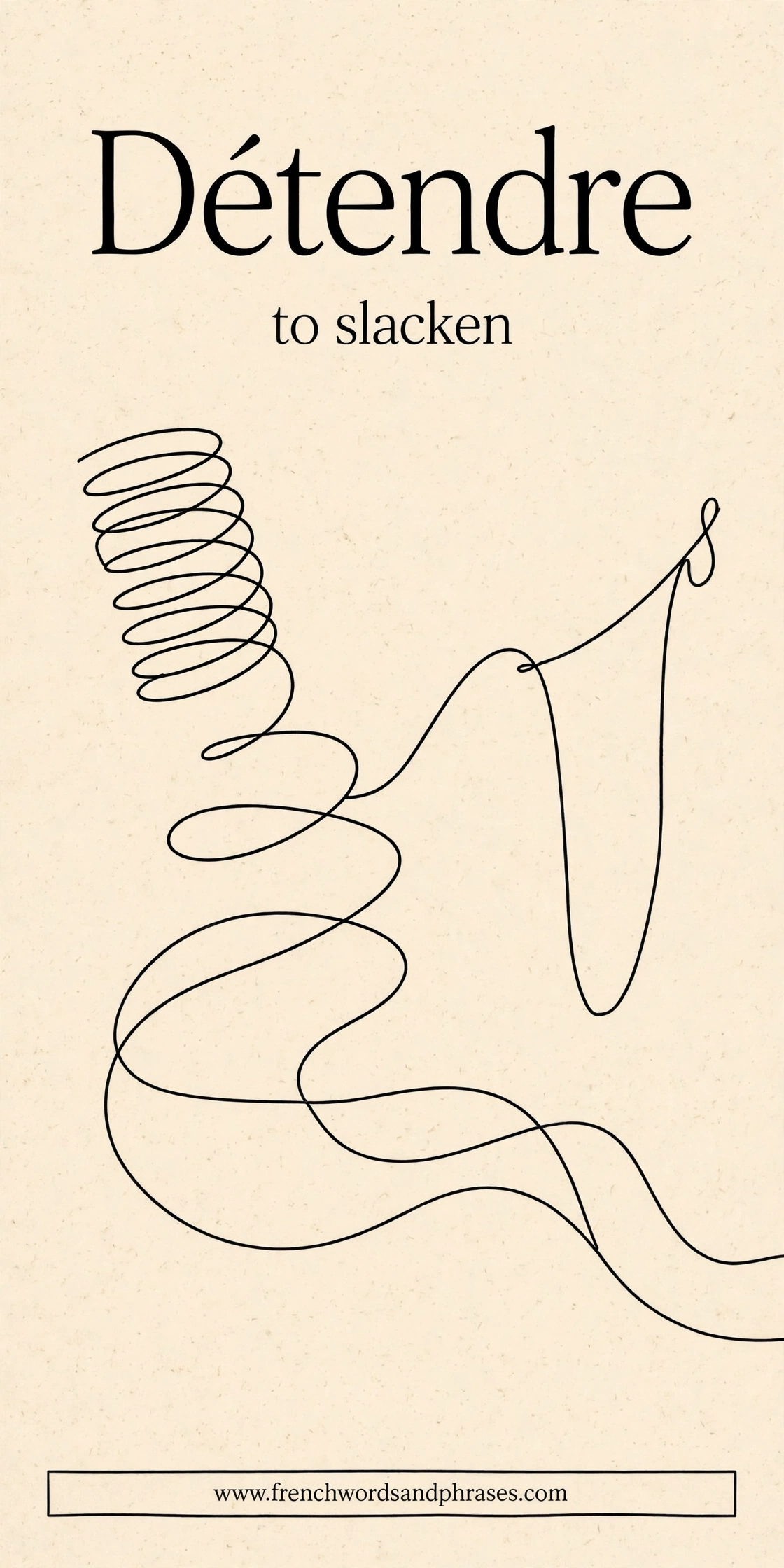
Détendre means to slacken — to ease the tension of something stretched tight: a rope, a spring, a bowstring, or an atmosphere thick with strain.
A sailor easing a rope that sings with strain, an archer letting his bowstring rest, a diplomat softening a room where every word has been weighed — détendre is the verb of released tension: what was stretched to its limit is allowed, carefully, to slacken.
In this guide, you’ll learn how to conjugate détendre in all the major French tenses and moods. Explore complete conjugation tables, French examples, English translations, and practice quizzes.
Understanding the French Verb Détendre
Détendre is a regular French verb belonging to the third group of verbs, those ending in -re.
It means to slacken. It is commonly used for ropes, springs, strings and muscles whose tension is deliberately eased, and figuratively for situations: détendre l’atmosphère or détendre les relations is to thaw a strained room or a strained diplomacy — the noun la détente names exactly that thaw, in a body, in a household, or between two superpowers.
Verb classification: Third group (-re)
Auxiliary verb: Avoir
Past participle: détendu
Present participle: détendant
English equivalents: To slacken, to relax, to ease; détendre une corde — to slacken a rope; détendre un ressort — to relax a spring; détendre l’atmosphère — to ease the atmosphere; détendre ses muscles — to relax one’s muscles; la détente — relaxation, release, (politics) détente.
One important detail: détendre is a regular third-group verb on the model of attendre: je détends, tu détends, il détend, nous détendons, vous détendez, ils détendent, past participle détendu. It is the dé- of tendre, to stretch tight — everything tendre tightens, détendre lets go. Do not confuse it with its reflexive twin se détendre, the everyday verb for a person relaxing, nor with déteindre, to fade, which sounds close but belongs to the dye-pot, not the rope.
Experience the Word
Détendre is the verb of the exhaled breath — tension does not vanish, it is let out, hand over hand, like a rope.
Imagine a small boat straining at its mooring in a rising wind. The rope is bar-taut, humming. The harbour master steps down, takes the line, and détend the rope by a careful metre, giving the boat room to ride the gusts instead of fighting them. The wind is the same; the strain is gone.
Nothing was untied, only eased. He has slackened — détendu — the rope, and the boat breathes.
How to Conjugate Détendre: Complete French Conjugation Guide
Let’s explore every major conjugation of détendre, beginning with the indicative mood.
How to Conjugate Détendre in the Indicative Mood
The indicative mood is used to express facts, observations, actions, and events.
How to Conjugate Détendre in the Present Tense (Présent)
Used for actions happening now, habitual actions, and general truths.
| Subject | Conjugation |
|---|---|
| je | détends |
| tu | détends |
| il / elle | détend |
| nous | détendons |
| vous | détendez |
| ils / elles | détendent |
Example
Le marin détend la corde avant la tempête.
The sailor slackens the rope before the storm.
Quick Quiz 1
Complete the sentence:
Nous ______ les cordes de la guitare le soir.
Reveal the answer
détendons
Nous détendons les cordes de la guitare le soir.
We slacken the guitar strings in the evening.
How to Conjugate Détendre in the Passé Composé
Used for completed actions in the past. Détendre takes the auxiliary verb avoir.
| Subject | Conjugation |
|---|---|
| j’ | ai détendu |
| tu | as détendu |
| il / elle | a détendu |
| nous | avons détendu |
| vous | avez détendu |
| ils / elles | ont détendu |
Example
Son sourire a détendu l’atmosphère de la réunion.
Her smile eased the atmosphere of the meeting.
How to Conjugate Détendre in the Imparfait (Imperfect Tense)
Used for habitual past actions, descriptions, and ongoing situations in the past.
| Subject | Conjugation |
|---|---|
| je | détendais |
| tu | détendais |
| il / elle | détendait |
| nous | détendions |
| vous | détendiez |
| ils / elles | détendaient |
Example
Le soir, il détendait les cordes de sa guitare.
In the evening, he used to slacken the strings of his guitar.
Quick Quiz 2
Choose the correct form:
She eased the spring.
Elle ______ le ressort. (a détendu / est détendue)
Reveal the answer
a détendu
Elle a détendu le ressort.
Détendre takes avoir.
How to Conjugate Détendre in the Plus-que-parfait
Used to describe an action that had already been completed before another past event.
| Subject | Conjugation |
|---|---|
| j’ | avais détendu |
| tu | avais détendu |
| il / elle | avait détendu |
| nous | avions détendu |
| vous | aviez détendu |
| ils / elles | avaient détendu |
Example
Ils avaient détendu le ressort avant de démonter la machine.
They had relaxed the spring before taking the machine apart.
How to Conjugate Détendre in the Passé Simple
Primarily used in formal writing, literature, and historical narratives. It is rarely used in everyday conversation.
| Subject | Conjugation |
|---|---|
| je | détendis |
| tu | détendis |
| il / elle | détendit |
| nous | détendîmes |
| vous | détendîtes |
| ils / elles | détendirent |
Example
Le capitaine détendit les voiles au coucher du soleil.
The captain eased the sails at sunset.
How to Conjugate Détendre in the Passé Antérieur
A literary tense used to express an action completed immediately before another past action, generally in the passé simple.
| Subject | Conjugation |
|---|---|
| j’ | eus détendu |
| tu | eus détendu |
| il / elle | eut détendu |
| nous | eûmes détendu |
| vous | eûtes détendu |
| ils / elles | eurent détendu |
Example
Quand il eut détendu la corde, le bateau cessa de tirer.
When he had slackened the rope, the boat stopped pulling.
How to Conjugate Détendre in the Future Tense (Futur Simple)
Used to describe actions that will take place in the future.
| Subject | Conjugation |
|---|---|
| je | détendrai |
| tu | détendras |
| il / elle | détendra |
| nous | détendrons |
| vous | détendrez |
| ils / elles | détendront |
Example
Cette nouvelle détendra les relations entre les deux pays.
This news will ease relations between the two countries.
How to Conjugate Détendre in the Futur Antérieur (Future Perfect)
Used for an action that will have been completed before a particular point in the future.
| Subject | Conjugation |
|---|---|
| j’ | aurai détendu |
| tu | auras détendu |
| il / elle | aura détendu |
| nous | aurons détendu |
| vous | aurez détendu |
| ils / elles | auront détendu |
Example
À la fin du cours, le professeur aura détendu tous les élèves.
By the end of the lesson, the teacher will have relaxed all the pupils.
How to Conjugate Détendre in the Near Future (Futur Proche)
Used to describe something that is going to happen soon. Formed with aller + infinitive.
| Subject | Conjugation |
|---|---|
| je | vais détendre |
| tu | vas détendre |
| il / elle | va détendre |
| nous | allons détendre |
| vous | allez détendre |
| ils / elles | vont détendre |
Example
Je vais détendre un peu la ceinture, elle me serre.
I am going to loosen the belt a little, it is tight on me.
How to Conjugate Détendre in the Conditional Mood
The conditional mood expresses what would happen under certain circumstances. It is also frequently used to make polite requests or express wishes.
How to Conjugate Détendre in the Present Conditional
| Subject | Conjugation |
|---|---|
| je | détendrais |
| tu | détendrais |
| il / elle | détendrait |
| nous | détendrions |
| vous | détendriez |
| ils / elles | détendraient |
Example
Un peu d’humour détendrait l’ambiance de ce bureau.
A little humour would ease the atmosphere in this office.
How to Conjugate Détendre in the Past Conditional
| Subject | Conjugation |
|---|---|
| j’ | aurais détendu |
| tu | aurais détendu |
| il / elle | aurait détendu |
| nous | aurions détendu |
| vous | auriez détendu |
| ils / elles | auraient détendu |
Example
Elle aurait détendu le ressort si elle avait eu l’outil.
She would have relaxed the spring if she had had the tool.
Détendre in the Literary Past Conditional Form
This less common literary form uses the imperfect subjunctive of avoir.
| Subject | Conjugation |
|---|---|
| j’ | eusse détendu |
| tu | eusses détendu |
| il / elle | eût détendu |
| nous | eussions détendu |
| vous | eussiez détendu |
| ils / elles | eussent détendu |
Example
Sa parole eût détendu la salle entière en un instant.
His words would have eased the whole room in an instant.
How to Conjugate Détendre in the Subjunctive Mood
The subjunctive is used to express wishes, emotions, doubts, necessity, and uncertainty. It frequently follows expressions such as il faut que (it is necessary that) or bien que (although).
How to Conjugate Détendre in the Present Subjunctive
| Subject | Conjugation |
|---|---|
| que je | détende |
| que tu | détendes |
| qu’il / qu’elle | détende |
| que nous | détendions |
| que vous | détendiez |
| qu’ils / qu’elles | détendent |
Example
Il faut que tu détendes la corde avant de tirer.
You must slacken the rope before pulling.
Quick Quiz 3
Complete the sentence using the subjunctive:
Il faut que vous ______ l’atmosphère par une plaisanterie.
Reveal the answer
détendiez
Il faut que vous détendiez l’atmosphère par une plaisanterie.
You must ease the atmosphere with a joke.
How to Conjugate Détendre in the Imperfect Subjunctive
A literary tense, rarely encountered in modern spoken French.
| Subject | Conjugation |
|---|---|
| que je | détendisse |
| que tu | détendisses |
| qu’il / qu’elle | détendît |
| que nous | détendissions |
| que vous | détendissiez |
| qu’ils / qu’elles | détendissent |
Example
Je voulais qu’il détendît l’atmosphère par une plaisanterie.
I wanted him to ease the atmosphere with a joke.
How to Conjugate Détendre in the Pluperfect Subjunctive
A literary construction used to express an action completed before another past action.
| Subject | Conjugation |
|---|---|
| que j’ | eusse détendu |
| que tu | eusses détendu |
| qu’il / qu’elle | eût détendu |
| que nous | eussions détendu |
| vous | eussiez détendu |
| qu’ils / qu’elles | eussent détendu |
Example
On racontait qu’elle eût détendu les négociations par sa patience.
People said she had eased the negotiations by her patience.
How to Conjugate Détendre in the Past Subjunctive
| Subject | Conjugation |
|---|---|
| que j’ | aie détendu |
| que tu | aies détendu |
| qu’il / qu’elle | ait détendu |
| que nous | ayons détendu |
| que vous | ayez détendu |
| qu’ils / qu’elles | aient détendu |
Example
Je suis content que la musique ait détendu les invités.
I am glad the music relaxed the guests.
How to Conjugate Détendre in the Imperative
The imperative is used to give commands, instructions, invitations, or suggestions. Subject pronouns are omitted.
How to Conjugate Détendre in the Present Imperative
| Person | Conjugation |
|---|---|
| (tu) | détends |
| (nous) | détendons |
| (vous) | détendez |
Example
Détends la corde, elle va casser !
Slacken the rope, it is going to snap!
Quick Quiz 4
How would you say Slacken the rope (tu form)?
Reveal the answer
Détends la corde !
French Participles of Détendre
Participles are verb forms that can be used in compound tenses and other grammatical constructions.
Present Participle of Détendre
détendant
En détendant le ressort, il a évité la casse.
By relaxing the spring, he avoided a breakage.
Past Participle of Détendre
détendu
Détendue par ses soins, la corde a tenu toute la nuit.
Slackened by his care, the rope held all night.
Détendre in Everyday French: Real-Life Examples
Now that you know the conjugations, let’s see how détendre appears in everyday French.
Example 1 — Present
Le marin détend la corde.
The sailor slackens the rope.
Example 2 — Passé composé
Son sourire a détendu l’atmosphère.
Her smile eased the atmosphere.
Example 3 — Imparfait
Il détendait les cordes de sa guitare.
He used to slacken his guitar strings.
Example 4 — Future
Cette nouvelle détendra les relations.
This news will ease relations.
Example 5 — Conditional
Un peu d’humour détendrait l’ambiance.
A little humour would ease the atmosphere.
Example 6 — Imperative
Détends la corde, elle va casser !
Slacken the rope, it is going to snap!
Beyond Translation: The Meaning of Détendre
English borrowed the noun and made history with it — détente, the thawing of the Cold War — while the verb détendre stayed at home, easing ropes and rooms in French.
Tension is a rope; détendre is the hand that eases it.
The family is built on tendre, stretched tight: a muscle tendu, an atmosphere tendue, a situation tendue — and détendre is always the way back down, for a spring, for a meeting, or for two countries watching each other across a border.
How to Remember the French Verb Détendre
Remember it this way: Détendre is about the harbour master easing the humming rope by one careful metre.
- Tendre stretches tight; détendre lets the tension out — rope, spring or atmosphere.
- Attendre-type -re: je détends, il détend, nous détendons; past participle détendu.
- Its noun made history: la détente, the great thaw — in a room or between nations.
The key idea is the harbour master easing the humming rope by one careful metre.
Test Your Knowledge of Détendre
Let’s see how much you’ve learned. Try answering these questions before revealing the answers.
Question 1
On which verb is détendre modelled, and what is its past participle?
Reveal the answer
Attendre — je détends, nous détendons; past participle détendu.
Question 2
How do you say Her smile eased the atmosphere in French?
Reveal the answer
Son sourire a détendu l’atmosphère.
Question 3
Translate: The sailor slackens the rope before the storm.
Reveal the answer
Le marin détend la corde avant la tempête.
Question 4
What is the past participle of détendre?
Reveal the answer
Détendu.
Question 5
Complete the sentence:
Il faut que tu ______ la corde avant de tirer.
Reveal the answer
détendes
Il faut que tu détendes la corde avant de tirer.
You must slacken the rope before pulling.
Your Final Challenge
Can You Use It?
How would you say this in French?
The old sailor slackens the tired rope, and the boat, at last, breathes with the tide.
Reveal the answer
Le vieux marin détend la corde fatiguée, et le bateau, enfin, respire avec la marée.
The old sailor slackens the tired rope, and the boat, at last, breathes with the tide.
A little French. A little curiosity. A richer everyday life.
LEARN FRENCH ONE WORD AT A TIME