A French Word to Live By
How to Conjugate Se détacher in French
/sə de.ta.ʃe/
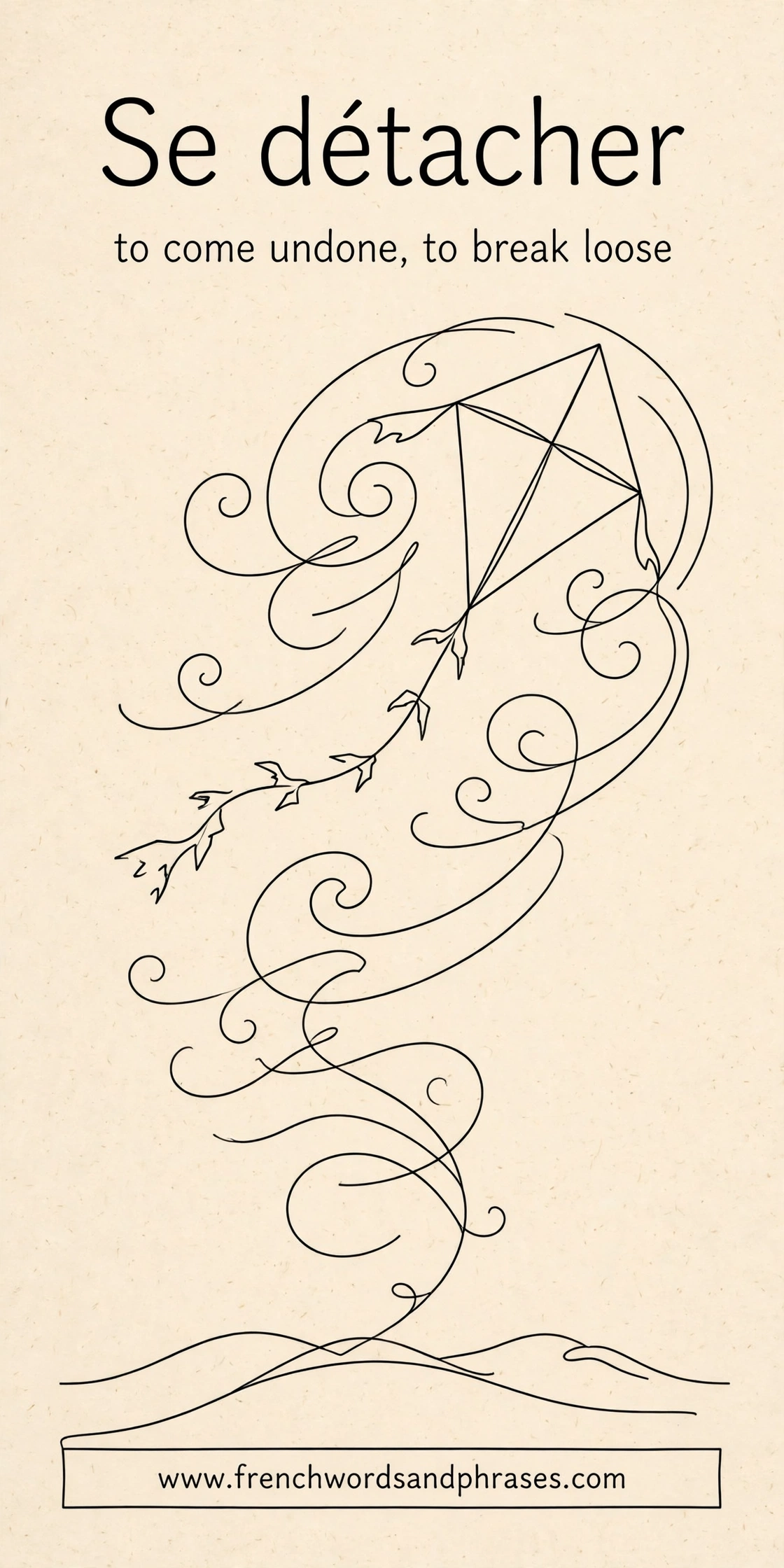
Se détacher means to come undone, to break loose — for a fastening to give way by itself, and, with de, for someone to break away from a group or a habit.
A poster peeling off a damp wall, a button hanging by a thread, a climber’s rope slipping its knot — se détacher is what fastenings do when they give way on their own; and when a cyclist leaves the pack or a smoker leaves his habit behind, French reaches for the same verb, followed by de.
In this guide, you’ll learn how to conjugate se détacher in all the major French tenses and moods. Explore complete conjugation tables, French examples, English translations, and practice quizzes.
Understanding the French Verb Se détacher
Se détacher is a regular French verb belonging to the first group of verbs, those ending in-er.
It means to come undone, to break loose. It is commonly used for things that come loose or peel away by themselves — posters, soles, labels, wallpaper — and, with de, for people breaking away from a group, a tradition, an addiction or the leading pack in a race. The figurative use is everywhere in sports reporting: se détacher du peloton is the classic breakaway of cycling.
Verb classification: First group (-er), reflexive
Auxiliary verb: Être
Past participle: détaché
Present participle: détachant
English equivalents: To come undone, to break loose, to come away; se détacher de — to break away from, to detach oneself from; se détacher du peloton — to break away from the pack (cycling); se détacher de ses habitudes — to break with one’s habits; une affiche qui se détache — a poster coming off the wall.
One important detail: se détacher is the reflexive of détacher, and its government changes its meaning. Alone, it says the fastening itself gave way: le bouton s’est détaché, the button came off. Followed by de, it says someone deliberately breaks away: elle s’est détachée du groupe, le coureur s’est détaché du peloton. Being reflexive, it takes être throughout, with the participle agreeing: elle s’est détachée, ils se sont détachés. The tu imperative tucks the pronoun behind the verb: détache-toi de cette habitude !
Experience the Word
Se détacher is the verb of the giving-way fastening — and of the person who finally walks away from what held them.
Imagine the last climb of a mountain stage. For an hour the riders have climbed as one body; then, in a hairpin bend, the young champion rises from the saddle and accelerates. Mètre après mètre, il se détache du peloton — the pack stays behind, and the road ahead is his alone.
No hand untied him from the group. He broke loose — il s’est détaché — by his own strength.
How to Conjugate Se détacher: Complete French Conjugation Guide
Let’s explore every major conjugation of se détacher, beginning with the indicative mood.
How to Conjugate Se détacher in the Indicative Mood
The indicative mood is used to express facts, observations, actions, and events.
How to Conjugate Se détacher in the Present Tense (Présent)
Used for actions happening now, habitual actions, and general truths.
| Subject | Conjugation |
|---|---|
| je | me détache |
| tu | te détaches |
| il / elle | se détache |
| nous | nous détachons |
| vous | vous détachez |
| ils / elles | se détachent |
Example
Le coureur se détache du peloton dans la dernière montée.
The rider is breaking away from the pack on the last climb.
Quick Quiz 1
Complete the sentence:
Nous nous ______ du groupe à la sortie du village.
Reveal the answer
détachons
Nous nous détachons du groupe à la sortie du village.
We break away from the group at the edge of the village.
How to Conjugate Se détacher in the Passé Composé
Used for completed actions in the past. Se détacher takes the auxiliary verb être.
| Subject | Conjugation |
|---|---|
| je | me suis détaché / me suis détachée |
| tu | t’es détaché / t’es détachée |
| il / elle | s’est détaché / s’est détachée |
| nous | nous sommes détachés / nous sommes détachées |
| vous | vous êtes détachés / vous êtes détachées / vous êtes détaché / vous êtes détachée |
| ils / elles | se sont détachés / se sont détachées |
Example
L’affiche s’est détachée du mur pendant la nuit.
The poster came off the wall during the night.
How to Conjugate Se détacher in the Imparfait (Imperfect Tense)
Used for habitual past actions, descriptions, and ongoing situations in the past.
| Subject | Conjugation |
|---|---|
| je | me détachais |
| tu | te détachais |
| il / elle | se détachait |
| nous | nous détachions |
| vous | vous détachiez |
| ils / elles | se détachaient |
Example
La semelle se détachait un peu plus chaque jour.
The sole was coming away a little more each day.
Quick Quiz 2
Choose the correct form:
The poster came off the wall.
L’affiche ______ du mur. (s’est détachée / a détaché)
Reveal the answer
s’est détachée
L’affiche s’est détachée du mur.
Se détacher is reflexive, takes être, and the participle agrees: détachée.
How to Conjugate Se détacher in the Plus-que-parfait
Used to describe an action that had already been completed before another past event.
| Subject | Conjugation |
|---|---|
| je | m’étais détaché / m’étais détachée |
| tu | t’étais détaché / t’étais détachée |
| il / elle | s’était détaché / s’était détachée |
| nous | nous étions détachés / nous étions détachées |
| vous | vous étiez détachés / vous étiez détachées / vous étiez détaché / vous étiez détachée |
| ils / elles | s’étaient détachés / s’étaient détachées |
Example
Elle s’était détachée du groupe bien avant la dispute.
She had broken away from the group long before the argument.
How to Conjugate Se détacher in the Passé Simple
Primarily used in formal writing, literature, and historical narratives. It is rarely used in everyday conversation.
| Subject | Conjugation |
|---|---|
| je | me détachai |
| tu | te détachas |
| il / elle | se détacha |
| nous | nous détachâmes |
| vous | vous détachâtes |
| ils / elles | se détachèrent |
Example
Le bateau se détacha du quai sous l’effet du courant.
The boat broke loose from the quay in the current.
How to Conjugate Se détacher in the Passé Antérieur
A literary tense used to express an action completed immediately before another past action, generally in the passé simple.
| Subject | Conjugation |
|---|---|
| je | me fus détaché / me fus détachée |
| tu | te fus détaché / te fus détachée |
| il / elle | se fut détaché / se fut détachée |
| nous | nous fûmes détachés / nous fûmes détachées |
| vous | vous fûtes détachés / vous fûtes détachées / vous fûtes détaché / vous fûtes détachée |
| ils / elles | se furent détachés / se furent détachées |
Example
Dès que le favori se fut détaché, la course fut jouée.
As soon as the favourite had broken away, the race was decided.
How to Conjugate Se détacher in the Future Tense (Futur Simple)
Used to describe actions that will take place in the future.
| Subject | Conjugation |
|---|---|
| je | me détacherai |
| tu | te détacheras |
| il / elle | se détachera |
| nous | nous détacherons |
| vous | vous détacherez |
| ils / elles | se détacheront |
Example
Ces étiquettes se détacheront à la première lessive.
These labels will come off at the first wash.
How to Conjugate Se détacher in the Futur Antérieur (Future Perfect)
Used for an action that will have been completed before a particular point in the future.
| Subject | Conjugation |
|---|---|
| je | me serai détaché / me serai détachée |
| tu | te seras détaché / te seras détachée |
| il / elle | se sera détaché / se sera détachée |
| nous | nous serons détachés / nous serons détachées |
| vous | vous serez détachés / vous serez détachées / vous serez détaché / vous serez détachée |
| ils / elles | se seront détachés / se seront détachées |
Example
À l’arrivée, il se sera détaché de tous ses rivaux.
By the finish, he will have broken away from all his rivals.
How to Conjugate Se détacher in the Near Future (Futur Proche)
Used to describe something that is going to happen soon. Formed with aller + infinitive.
| Subject | Conjugation |
|---|---|
| je | vais me détacher |
| tu | vas te détacher |
| il / elle | va se détacher |
| nous | allons nous détacher |
| vous | allez vous détacher |
| ils / elles | vont se détacher |
Example
Attention, ton lacet va se détacher !
Careful, your lace is going to come undone!
How to Conjugate Se détacher in the Conditional Mood
The conditional mood expresses what would happen under certain circumstances. It is also frequently used to make polite requests or express wishes.
How to Conjugate Se détacher in the Present Conditional
| Subject | Conjugation |
|---|---|
| je | me détacherais |
| tu | te détacherais |
| il / elle | se détacherait |
| nous | nous détacherions |
| vous | vous détacheriez |
| ils / elles | se détacheraient |
Example
Sans colle forte, le papier peint se détacherait en un hiver.
Without strong paste, the wallpaper would come off within one winter.
How to Conjugate Se détacher in the Past Conditional
| Subject | Conjugation |
|---|---|
| je | me serais détaché / me serais détachée |
| tu | te serais détaché / te serais détachée |
| il / elle | se serait détaché / se serait détachée |
| nous | nous serions détachés / nous serions détachées |
| vous | vous seriez détachés / vous seriez détachées / vous seriez détaché / vous seriez détachée |
| ils / elles | se seraient détachés / se seraient détachées |
Example
Elle se serait détachée du groupe si elle avait osé.
She would have broken away from the group if she had dared.
Se détacher in the Literary Past Conditional Form
This less common literary form uses the imperfect subjunctive of être.
| Subject | Conjugation |
|---|---|
| je | me fusse détaché / me fusse détachée |
| tu | te fusses détaché / te fusses détachée |
| il / elle | se fût détaché / se fût détachée |
| nous | nous fussions détachés / nous fussions détachées |
| vous | vous fussiez détachés / vous fussiez détachées / vous fussiez détaché / vous fussiez détachée |
| ils / elles | se fussent détachés / se fussent détachées |
Example
Le navire se fût détaché du quai sans les amarres.
The ship would have broken loose from the quay without the moorings.
How to Conjugate Se détacher in the Subjunctive Mood
The subjunctive is used to express wishes, emotions, doubts, necessity, and uncertainty. It frequently follows expressions such as il faut que (it is necessary that) or bien que (although).
How to Conjugate Se détacher in the Present Subjunctive
| Subject | Conjugation |
|---|---|
| que je | me détache |
| que tu | te détaches |
| qu’il / qu’elle | se détache |
| que nous | nous détachions |
| que vous | vous détachiez |
| qu’ils / qu’elles | se détachent |
Example
Je ne veux pas que le bouton se détache.
I do not want the button to come off.
Quick Quiz 3
Complete the sentence using the subjunctive:
Il faut que tu te ______ de cette habitude.
Reveal the answer
détaches
Il faut que tu te détaches de cette habitude.
You must break away from that habit.
How to Conjugate Se détacher in the Imperfect Subjunctive
A literary tense, rarely encountered in modern spoken French.
| Subject | Conjugation |
|---|---|
| que je | me détachasse |
| que tu | te détachasses |
| qu’il / qu’elle | se détachât |
| que nous | nous détachassions |
| que vous | vous détachassiez |
| qu’ils / qu’elles | se détachassent |
Example
Il fallait que le coureur se détachât avant la descente.
The rider had to break away before the descent.
How to Conjugate Se détacher in the Pluperfect Subjunctive
A literary construction used to express an action completed before another past action.
| Subject | Conjugation |
|---|---|
| que je | me fusse détaché / me fusse détachée |
| que tu | te fusses détaché / te fusses détachée |
| qu’il / qu’elle | se fût détaché / se fût détachée |
| que nous | nous fussions détachés / nous fussions détachées |
| que vous | vous fussiez détachés / vous fussiez détachées / vous fussiez détaché / vous fussiez détachée |
| qu’ils / qu’elles | se fussent détachés / se fussent détachées |
Example
On disait que l’affiche se fût détachée toute seule.
People said the poster had come off all by itself.
How to Conjugate Se détacher in the Past Subjunctive
| Subject | Conjugation |
|---|---|
| que je | me sois détaché / me sois détachée |
| que tu | te sois détaché / te sois détachée |
| qu’il / qu’elle | se soit détaché / se soit détachée |
| que nous | nous soyons détachés / nous soyons détachées |
| que vous | vous soyez détachés / vous soyez détachées / vous soyez détaché / vous soyez détachée |
| qu’ils / qu’elles | se soient détachés / se soient détachées |
Example
Je suis étonné que la semelle se soit détachée si vite.
I am surprised the sole came away so quickly.
How to Conjugate Se détacher in the Imperative
The imperative is used to give commands, instructions, invitations, or suggestions. Subject pronouns are omitted.
How to Conjugate Se détacher in the Present Imperative
| Person | Conjugation |
|---|---|
| (tu) | détache-toi |
| (nous) | détachons-nous |
| (vous) | détachez-vous |
Example
Détache-toi de cette mauvaise habitude, enfin !
Break away from that bad habit, at last!
Quick Quiz 4
How would you say Break away from that bad habit (tu form)?
Reveal the answer
Détache-toi de cette mauvaise habitude !
French Participles of Se détacher
Participles are verb forms that can be used in compound tenses and other grammatical constructions.
Present Participle of Se détacher
détachant
En se détachant du peloton, il prend dix secondes d’avance.
By breaking away from the pack, he gains ten seconds.
Past Participle of Se détacher
détaché
Détachée du mur, l’affiche est tombée sur le trottoir.
Come off the wall, the poster fell onto the pavement.
Se détacher in Everyday French: Real-Life Examples
Now that you know the conjugations, let’s see how se détacher appears in everyday French.
Example 1 — Present
Le coureur se détache du peloton.
The rider is breaking away from the pack.
Example 2 — Passé composé
L’affiche s’est détachée du mur.
The poster came off the wall.
Example 3 — Imparfait
La semelle se détachait un peu plus chaque jour.
The sole was coming away a little more each day.
Example 4 — Future
Ces étiquettes se détacheront à la lessive.
These labels will come off in the wash.
Example 5 — Conditional
Le papier peint se détacherait sans bonne colle.
The wallpaper would come off without good paste.
Example 6 — Imperative
Détache-toi de cette mauvaise habitude !
Break away from that bad habit!
Beyond Translation: The Meaning of Se détacher
English splits this verb in two — things come off or come undone, people break away — while French se détacher holds both in one reflexive.
The little word de does the steering.
Without it, the fastening fails on its own: le bouton se détache. With it, a will is at work: se détacher du groupe, se détacher d’une habitude, se détacher du peloton. Learn the pair together — détacher undoes a fastening by hand, se détacher is the fastening, or the person, coming free.
How to Remember the French Verb Se détacher
Remember it this way: Se détacher is about the rider rising from the saddle and leaving the pack behind.
- Reflexive and être, always: l’affiche s’est détachée — the participle agrees with the subject.
- With de, it is a breakaway: se détacher du peloton, se détacher d’une habitude.
- Regular -er under the pronoun: je me détache, nous nous détachons, past participle détaché.
The key idea is the rider rising from the saddle and leaving the pack behind.
Test Your Knowledge of Se détacher
Let’s see how much you’ve learned. Try answering these questions before revealing the answers.
Question 1
Which auxiliary does se détacher use, and why?
Reveal the answer
Être — it is a reflexive verb: l’affiche s’est détachée du mur.
Question 2
How do you say The poster came off the wall in French?
Reveal the answer
L’affiche s’est détachée du mur.
Question 3
Translate: The rider is breaking away from the pack.
Reveal the answer
Le coureur se détache du peloton.
Question 4
What is the past participle of se détacher?
Reveal the answer
Détaché — agreeing: détachée, détachés, détachées.
Question 5
Complete the sentence:
Je ne veux pas que le bouton se ______.
Reveal the answer
détache
Je ne veux pas que le bouton se détache.
I do not want the button to come off.
Your Final Challenge
Can You Use It?
How would you say this in French?
On the last climb, the champion breaks away from the pack, and the road opens before him.
Reveal the answer
Dans la dernière montée, le champion se détache du peloton, et la route s’ouvre devant lui.
On the last climb, the champion breaks away from the pack, and the road opens before him.
A little French. A little curiosity. A richer everyday life.
LEARN FRENCH ONE WORD AT A TIME