A French Word to Live By
How to Conjugate Détacher in French
/de.ta.ʃe/
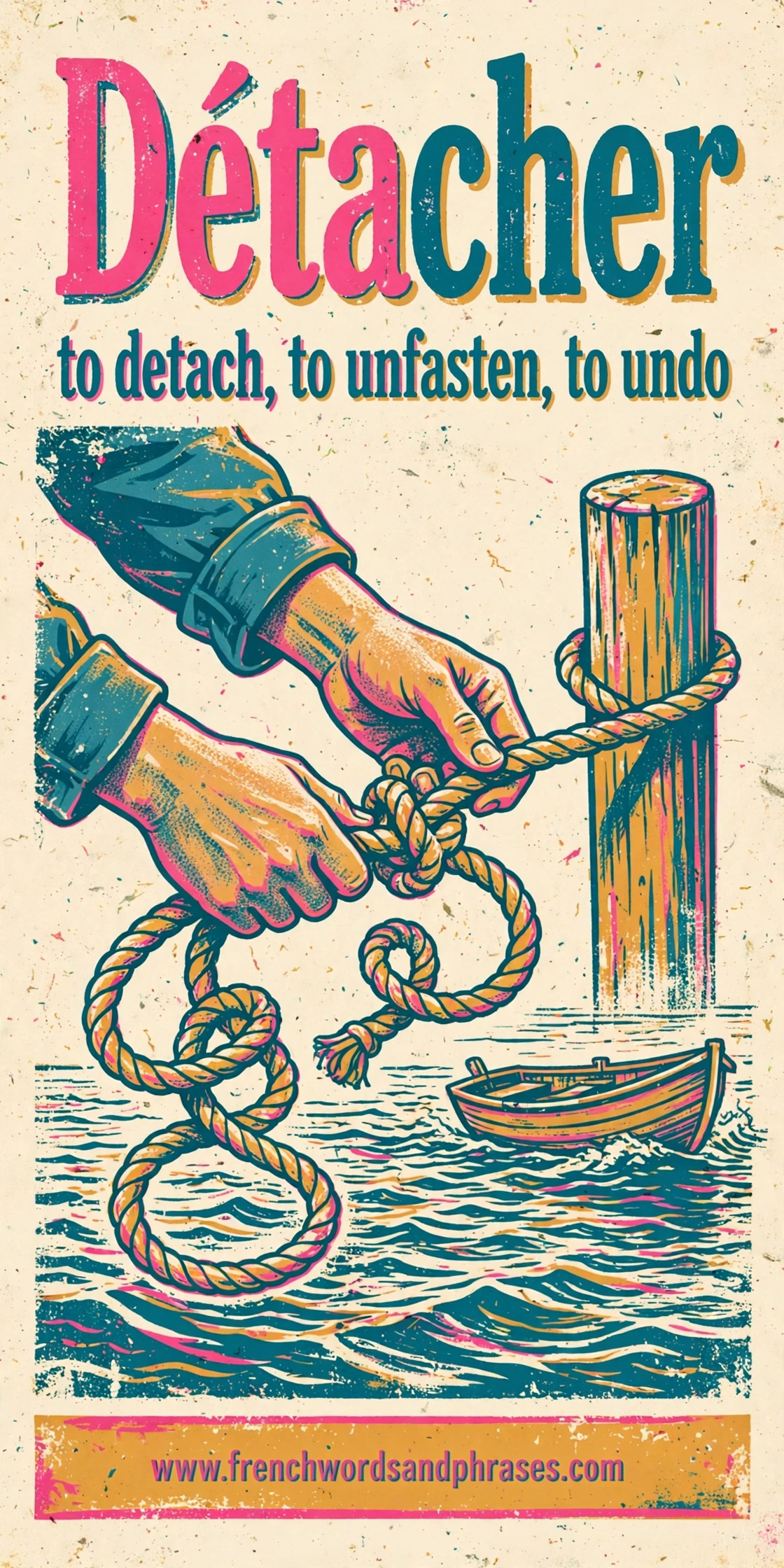
Détacher means to detach, to unfasten, to undo — to free something from whatever holds it: a button from a coat, a boat from its mooring, a page from a notebook.
A mother unfastening a child’s coat, a sailor freeing a boat from the quay, a clerk tearing a form along its dotted line — détacher is the verb of unfastening: whatever was attached, tied or fixed is set loose, cleanly and on purpose.
In this guide, you’ll learn how to conjugate détacher in all the major French tenses and moods. Explore complete conjugation tables, French examples, English translations, and practice quizzes.
Understanding the French Verb Détacher
Détacher is a regular French verb belonging to the first group of verbs, those ending in-er.
It means to detach, to unfasten, to undo. It is commonly used for unfastening clothes and undoing knots, for tearing pages and coupons along perforations, for uncoupling vehicles, and in the set phrase détacher les yeux (or le regard) de quelqu’un — to take one’s eyes off someone, usually in the negative: elle ne détachait pas les yeux de la porte.
Verb classification: First group (-er)
Auxiliary verb: Avoir
Past participle: détaché
Present participle: détachant
English equivalents: To detach, to unfasten, to undo, to untie; détacher un bouton — to unfasten a button; détacher ses lacets — to undo one’s laces; détacher une page — to tear out a page; détacher un wagon — to uncouple a carriage; détacher les yeux de — to take one’s eyes off.
One important detail: détacher is the dé- of attacher, to attach — everything attacher fastens, détacher frees. It is a perfectly regular -er verb: je détache, nous détachons, ils détachent. Its objects are the small fastenings of daily life: buttons, belts, laces, hair, pages, carriages, boats. Do not confuse it with its reflexive twin se détacher, which means to come undone by itself — and note that the same spelling, from une tache, a stain, also serves for removing stains from cloth: détacher un napperon, to take the stains out of a cloth.
Experience the Word
Détacher is the verb of the loosened knot — the deliberate undoing of a fastening, one loop at a time.
Imagine a small harbour at dawn. The fisherman unties the rope from the iron ring, coil by coil, and détache his boat from the quay. The boat drifts a hand’s width from the stone, free but still close — attached to nothing, ready for the open water.
One rope, patiently undone. He has detached — détaché — the boat, and the day can begin.
How to Conjugate Détacher: Complete French Conjugation Guide
Let’s explore every major conjugation of détacher, beginning with the indicative mood.
How to Conjugate Détacher in the Indicative Mood
The indicative mood is used to express facts, observations, actions, and events.
How to Conjugate Détacher in the Present Tense (Présent)
Used for actions happening now, habitual actions, and general truths.
| Subject | Conjugation |
|---|---|
| je | détache |
| tu | détaches |
| il / elle | détache |
| nous | détachons |
| vous | détachez |
| ils / elles | détachent |
Example
Elle détache les boutons de son manteau en entrant.
She unfastens the buttons of her coat as she comes in.
Quick Quiz 1
Complete the sentence:
Nous ______ les affiches du panneau demain.
Reveal the answer
détacherons
Nous détacherons les affiches du panneau demain.
We will take the posters down from the board tomorrow.
How to Conjugate Détacher in the Passé Composé
Used for completed actions in the past. Détacher takes the auxiliary verb avoir.
| Subject | Conjugation |
|---|---|
| j’ | ai détaché |
| tu | as détaché |
| il / elle | a détaché |
| nous | avons détaché |
| vous | avez détaché |
| ils / elles | ont détaché |
Example
Le marin a détaché le bateau du quai à l’aube.
The sailor untied the boat from the quay at dawn.
How to Conjugate Détacher in the Imparfait (Imperfect Tense)
Used for habitual past actions, descriptions, and ongoing situations in the past.
| Subject | Conjugation |
|---|---|
| je | détachais |
| tu | détachais |
| il / elle | détachait |
| nous | détachions |
| vous | détachiez |
| ils / elles | détachaient |
Example
Il détachait toujours ses lacets avant de monter l’escalier.
He always used to undo his laces before climbing the stairs.
Quick Quiz 2
Choose the correct form:
She tore the page out of the notebook.
Elle ______ la page du carnet. (a détaché / est détachée)
Reveal the answer
a détaché
Elle a détaché la page du carnet.
Détacher takes avoir.
How to Conjugate Détacher in the Plus-que-parfait
Used to describe an action that had already been completed before another past event.
| Subject | Conjugation |
|---|---|
| j’ | avais détaché |
| tu | avais détaché |
| il / elle | avait détaché |
| nous | avions détaché |
| vous | aviez détaché |
| ils / elles | avaient détaché |
Example
Elle avait détaché la page du carnet avant de partir.
She had torn the page out of the notebook before leaving.
How to Conjugate Détacher in the Passé Simple
Primarily used in formal writing, literature, and historical narratives. It is rarely used in everyday conversation.
| Subject | Conjugation |
|---|---|
| je | détachai |
| tu | détachas |
| il / elle | détacha |
| nous | détachâmes |
| vous | détachâtes |
| ils / elles | détachèrent |
Example
Le conducteur détacha le dernier wagon en gare de Lyon.
The driver uncoupled the last carriage at Lyon station.
How to Conjugate Détacher in the Passé Antérieur
A literary tense used to express an action completed immediately before another past action, generally in the passé simple.
| Subject | Conjugation |
|---|---|
| j’ | eus détaché |
| tu | eus détaché |
| il / elle | eut détaché |
| nous | eûmes détaché |
| vous | eûtes détaché |
| ils / elles | eurent détaché |
Example
Quand il eut détaché le cheval, il le mena à l’écurie.
When he had untied the horse, he led it to the stable.
How to Conjugate Détacher in the Future Tense (Futur Simple)
Used to describe actions that will take place in the future.
| Subject | Conjugation |
|---|---|
| je | détacherai |
| tu | détacheras |
| il / elle | détachera |
| nous | détacherons |
| vous | détacherez |
| ils / elles | détacheront |
Example
Demain, on détachera les affiches du panneau.
Tomorrow, they will take the posters down from the board.
How to Conjugate Détacher in the Futur Antérieur (Future Perfect)
Used for an action that will have been completed before a particular point in the future.
| Subject | Conjugation |
|---|---|
| j’ | aurai détaché |
| tu | auras détaché |
| il / elle | aura détaché |
| nous | aurons détaché |
| vous | aurez détaché |
| ils / elles | auront détaché |
Example
À midi, ils auront détaché tous les bateaux du port.
By noon, they will have untied all the boats in the harbour.
How to Conjugate Détacher in the Near Future (Futur Proche)
Used to describe something that is going to happen soon. Formed with aller + infinitive.
| Subject | Conjugation |
|---|---|
| je | vais détacher |
| tu | vas détacher |
| il / elle | va détacher |
| nous | allons détacher |
| vous | allez détacher |
| ils / elles | vont détacher |
Example
Attends, je vais détacher tes lacets, ils sont emmêlés.
Wait, I am going to undo your laces, they are tangled.
How to Conjugate Détacher in the Conditional Mood
The conditional mood expresses what would happen under certain circumstances. It is also frequently used to make polite requests or express wishes.
How to Conjugate Détacher in the Present Conditional
| Subject | Conjugation |
|---|---|
| je | détacherais |
| tu | détacherais |
| il / elle | détacherait |
| nous | détacherions |
| vous | détacheriez |
| ils / elles | détacheraient |
Example
Avec un couteau, tu détacherais la page sans la déchirer.
With a knife, you would detach the page without tearing it.
How to Conjugate Détacher in the Past Conditional
| Subject | Conjugation |
|---|---|
| j’ | aurais détaché |
| tu | aurais détaché |
| il / elle | aurait détaché |
| nous | aurions détaché |
| vous | auriez détaché |
| ils / elles | auraient détaché |
Example
Elle aurait détaché le tableau si le cadre n’avait pas été scellé.
She would have taken the picture down if the frame had not been sealed.
Détacher in the Literary Past Conditional Form
This less common literary form uses the imperfect subjunctive of avoir.
| Subject | Conjugation |
|---|---|
| j’ | eusse détaché |
| tu | eusses détaché |
| il / elle | eût détaché |
| nous | eussions détaché |
| vous | eussiez détaché |
| ils / elles | eussent détaché |
Example
Le marin eût détaché la barque avant la tempête.
The sailor would have untied the boat before the storm.
How to Conjugate Détacher in the Subjunctive Mood
The subjunctive is used to express wishes, emotions, doubts, necessity, and uncertainty. It frequently follows expressions such as il faut que (it is necessary that) or bien que (although).
How to Conjugate Détacher in the Present Subjunctive
| Subject | Conjugation |
|---|---|
| que je | détache |
| que tu | détaches |
| qu’il / qu’elle | détache |
| que nous | détachions |
| que vous | détachiez |
| qu’ils / qu’elles | détachent |
Example
Il faut que tu détaches cette étiquette avant de laver le pull.
You must remove this label before washing the jumper.
Quick Quiz 3
Complete the sentence using the subjunctive:
Il faut que vous ______ le wagon en gare.
Reveal the answer
détachiez
Il faut que vous détachiez le wagon en gare.
You must uncouple the carriage at the station.
How to Conjugate Détacher in the Imperfect Subjunctive
A literary tense, rarely encountered in modern spoken French.
| Subject | Conjugation |
|---|---|
| que je | détachasse |
| que tu | détachasses |
| qu’il / qu’elle | détachât |
| que nous | détachassions |
| que vous | détachassiez |
| qu’ils / qu’elles | détachassent |
Example
Je voulais qu’il détachât le wagon sans bruit.
I wanted him to uncouple the carriage quietly.
How to Conjugate Détacher in the Pluperfect Subjunctive
A literary construction used to express an action completed before another past action.
| Subject | Conjugation |
|---|---|
| que j’ | eusse détaché |
| que tu | eusses détaché |
| qu’il / qu’elle | eût détaché |
| que nous | eussions détaché |
| que vous | eussiez détaché |
| qu’ils / qu’elles | eussent détaché |
Example
On racontait qu’elle eût détaché la lettre du paquet.
People said she had detached the letter from the parcel.
How to Conjugate Détacher in the Past Subjunctive
| Subject | Conjugation |
|---|---|
| que j’ | aie détaché |
| que tu | aies détaché |
| qu’il / qu’elle | ait détaché |
| que nous | ayons détaché |
| que vous | ayez détaché |
| qu’ils / qu’elles | aient détaché |
Example
Je suis content que vous ayez détaché les bateaux à temps.
I am glad you untied the boats in time.
How to Conjugate Détacher in the Imperative
The imperative is used to give commands, instructions, invitations, or suggestions. Subject pronouns are omitted.
How to Conjugate Détacher in the Present Imperative
| Person | Conjugation |
|---|---|
| (tu) | détache |
| (nous) | détachons |
| (vous) | détachez |
Example
Détache tes lacets avant d’entrer !
Undo your laces before coming in!
Quick Quiz 4
How would you say Undo your laces (tu form)?
Reveal the answer
Détache tes lacets !
French Participles of Détacher
Participles are verb forms that can be used in compound tenses and other grammatical constructions.
Present Participle of Détacher
détachant
En détachant la page, il a déchiré le coin du carnet.
By tearing out the page, he tore the corner of the notebook.
Past Participle of Détacher
détaché
Détachée du carnet, la page a disparu dans le vent.
Detached from the notebook, the page vanished in the wind.
Détacher in Everyday French: Real-Life Examples
Now that you know the conjugations, let’s see how détacher appears in everyday French.
Example 1 — Present
Elle détache les boutons de son manteau.
She unfastens the buttons of her coat.
Example 2 — Passé composé
Le marin a détaché le bateau du quai.
The sailor untied the boat from the quay.
Example 3 — Imparfait
Il détachait toujours ses lacets d’abord.
He always used to undo his laces first.
Example 4 — Future
On détachera les affiches demain.
They will take the posters down tomorrow.
Example 5 — Conditional
Tu détacherais la page avec un couteau.
You would detach the page with a knife.
Example 6 — Imperative
Détache tes lacets avant d’entrer !
Undo your laces before coming in!
Beyond Translation: The Meaning of Détacher
English detach is the same word wearing a uniform — soldiers are detached, carriages detached, feelings detached. French détacher keeps all of that but starts at home, with buttons and laces.
Every fastening implies its undoing.
The pair attacher / détacher runs through French daily life: one ties, fastens, attaches; the other unties, unfastens, detaches. And the fixed phrase ne pas détacher les yeux de — not to take one’s eyes off — shows the verb at its most figurative: a gaze, too, can be fastened to something.
How to Remember the French Verb Détacher
Remember it this way: Détacher is about the boat untied at dawn, drifting a hand’s width from the quay.
- Attacher fastens, détacher unfastens — the dé- simply reverses the knot.
- Picture the fisherman at dawn, untying coil after coil until the boat floats free.
- Regular -er: je détache, nous détachons, past participle détaché.
The key idea is the boat untied at dawn, drifting a hand’s width from the quay.
Test Your Knowledge of Détacher
Let’s see how much you’ve learned. Try answering these questions before revealing the answers.
Question 1
What is the opposite verb of détacher?
Reveal the answer
Attacher — to attach, to fasten, to tie.
Question 2
How do you say The sailor untied the boat from the quay in French?
Reveal the answer
Le marin a détaché le bateau du quai.
Question 3
Translate: She unfastens the buttons of her coat.
Reveal the answer
Elle détache les boutons de son manteau.
Question 4
What is the past participle of détacher?
Reveal the answer
Détaché.
Question 5
Complete the sentence:
Il faut que tu ______ cette étiquette avant de laver le pull.
Reveal the answer
détaches
Il faut que tu détaches cette étiquette avant de laver le pull.
You must remove this label before washing the jumper.
Your Final Challenge
Can You Use It?
How would you say this in French?
The sailor unties his boat in the grey dawn, and the whole harbour seems to breathe.
Reveal the answer
Le marin détache sa barque dans l’aube grise, et le port entier semble respirer.
The sailor unties his boat in the grey dawn, and the whole harbour seems to breathe.
A little French. A little curiosity. A richer everyday life.
LEARN FRENCH ONE WORD AT A TIME