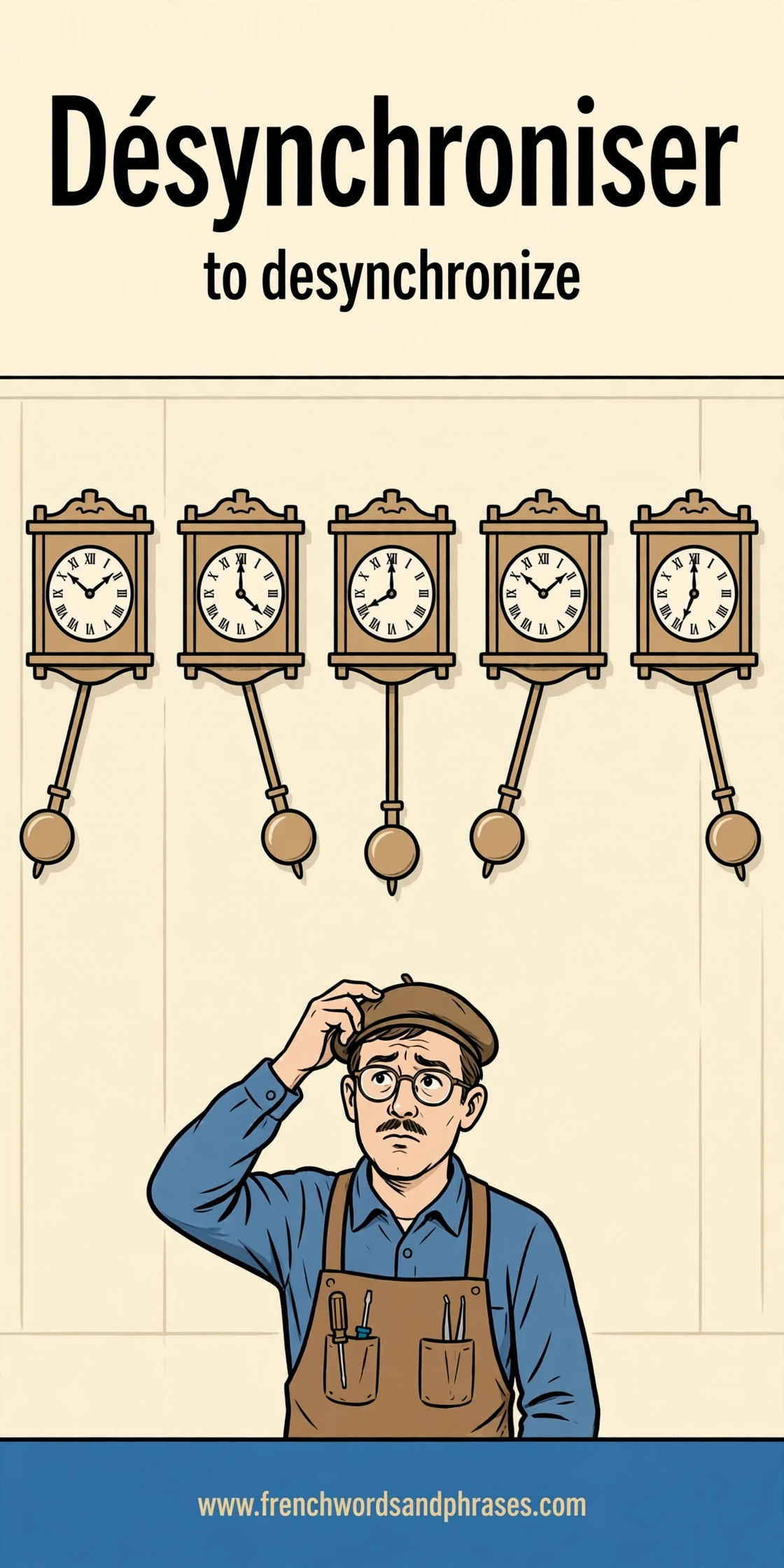
A French Word to Live By
How to Conjugate Désynchroniser in French
/de.sɛ̃.kʁɔ.ni.ze/
Désynchroniser means to desynchronize — to knock things that should move together out of step with each other.
A dubbed film where the lips move a second before the words arrive, two clocks on the same wall telling different times, dancers a half-beat apart — désynchroniser is the verb for things that were meant to move as one and no longer do.
In this guide, you’ll learn how to conjugate désynchroniser in all the major French tenses and moods. Explore complete conjugation tables, French examples, English translations, and practice quizzes.
Understanding the French Verb Désynchroniser
Désynchroniser is a regular French verb belonging to the first group of verbs, those ending in-er.
It means to desynchronize. It is commonly used in technology and media for sound and image falling out of step, in computing for data or clocks that no longer agree, and in physiology for rhythms — sleep, heart, breathing — that lose their common beat. The adjective désynchronisé describes anything visibly or audibly out of sync.
Verb classification: First group (-er)
Auxiliary verb: Avoir
Past participle: désynchronisé
Present participle: désynchronisant
English equivalents: To desynchronize, to put out of sync; désynchroniser le son et l’image — to put sound and picture out of sync; désynchroniser des montres — to desynchronize watches; désynchroniser le trafic — to throw traffic out of rhythm; la désynchronisation — desynchronization.
One important detail: désynchroniser is the undoing of synchroniser, and it keeps the Greek machinery intact: syn- (together) + chronos (time). Watch the middle of the word: -chron- with ch pronounced like a k, and the nasal syn- written with a y: dé-syn-chron-iser. The verb itself is a perfectly regular -er: je désynchronise, nous désynchronisons, ils désynchronisent. Its home ground is technical — clocks, signals, swimmers, traffic lights, and the sound of a badly dubbed film.
Experience the Word
Désynchroniser is the verb of the broken beat — everything still moves, but nothing moves together any more.
Imagine a small cinema on a rainy evening. Halfway through the film, the sound slips: the actor’s lips close, and the sentence arrives a heartbeat later. The whole room laughs at the wrong moments. Someone has désynchronisé the copy — image and voice, divorced by half a second.
The film is complete, frame and word. It has been desynchronized — désynchronisé — and half a second is an ocean.
How to Conjugate Désynchroniser: Complete French Conjugation Guide
Let’s explore every major conjugation of désynchroniser, beginning with the indicative mood.
How to Conjugate Désynchroniser in the Indicative Mood
The indicative mood is used to express facts, observations, actions, and events.
How to Conjugate Désynchroniser in the Present Tense (Présent)
Used for actions happening now, habitual actions, and general truths.
| Subject | Conjugation |
|---|---|
| je | désynchronise |
| tu | désynchronises |
| il / elle | désynchronise |
| nous | désynchronisons |
| vous | désynchronisez |
| ils / elles | désynchronisent |
Example
Ce logiciel désynchronise parfois le son et l’image.
This software sometimes puts sound and picture out of sync.
Quick Quiz 1
Complete the sentence:
Nous ne ______ jamais les horloges du laboratoire.
Reveal the answer
désynchronisons
Nous ne désynchronisons jamais les horloges du laboratoire.
We never desynchronize the laboratory clocks.
How to Conjugate Désynchroniser in the Passé Composé
Used for completed actions in the past. Désynchroniser takes the auxiliary verb avoir.
| Subject | Conjugation |
|---|---|
| j’ | ai désynchronisé |
| tu | as désynchronisé |
| il / elle | a désynchronisé |
| nous | avons désynchronisé |
| vous | avez désynchronisé |
| ils / elles | ont désynchronisé |
Example
La panne a désynchronisé toutes les horloges de la gare.
The breakdown desynchronized all the station clocks.
How to Conjugate Désynchroniser in the Imparfait (Imperfect Tense)
Used for habitual past actions, descriptions, and ongoing situations in the past.
| Subject | Conjugation |
|---|---|
| je | désynchronisais |
| tu | désynchronisais |
| il / elle | désynchronisait |
| nous | désynchronisions |
| vous | désynchronisiez |
| ils / elles | désynchronisaient |
Example
Le vieux projecteur désynchronisait le film à chaque bobine.
The old projector used to throw the film out of sync at every reel.
Quick Quiz 2
Choose the correct form:
The storm desynchronized the watches.
L’orage ______ les montres. (a désynchronisé / est désynchronisé)
Reveal the answer
a désynchronisé
L’orage a désynchronisé les montres.
Désynchroniser takes avoir.
How to Conjugate Désynchroniser in the Plus-que-parfait
Used to describe an action that had already been completed before another past event.
| Subject | Conjugation |
|---|---|
| j’ | avais désynchronisé |
| tu | avais désynchronisé |
| il / elle | avait désynchronisé |
| nous | avions désynchronisé |
| vous | aviez désynchronisé |
| ils / elles | avaient désynchronisé |
Example
Ils avaient désynchronisé les feux en changeant les réglages.
They had thrown the traffic lights out of rhythm by changing the settings.
How to Conjugate Désynchroniser in the Passé Simple
Primarily used in formal writing, literature, and historical narratives. It is rarely used in everyday conversation.
| Subject | Conjugation |
|---|---|
| je | désynchronisai |
| tu | désynchronisas |
| il / elle | désynchronisa |
| nous | désynchronisâmes |
| vous | désynchronisâtes |
| ils / elles | désynchronisèrent |
Example
Un orage désynchronisa les montres du village entier.
A storm desynchronized the watches of the whole village.
How to Conjugate Désynchroniser in the Passé Antérieur
A literary tense used to express an action completed immediately before another past action, generally in the passé simple.
| Subject | Conjugation |
|---|---|
| j’ | eus désynchronisé |
| tu | eus désynchronisé |
| il / elle | eut désynchronisé |
| nous | eûmes désynchronisé |
| vous | eûtes désynchronisé |
| ils / elles | eurent désynchronisé |
Example
Quand le signal eut désynchronisé les deux machines, tout s’arrêta.
When the signal had desynchronized the two machines, everything stopped.
How to Conjugate Désynchroniser in the Future Tense (Futur Simple)
Used to describe actions that will take place in the future.
| Subject | Conjugation |
|---|---|
| je | désynchroniserai |
| tu | désynchroniseras |
| il / elle | désynchronisera |
| nous | désynchroniserons |
| vous | désynchroniserez |
| ils / elles | désynchroniseront |
Example
Ce décalage désynchronisera les deux enregistrements.
This lag will put the two recordings out of sync.
How to Conjugate Désynchroniser in the Futur Antérieur (Future Perfect)
Used for an action that will have been completed before a particular point in the future.
| Subject | Conjugation |
|---|---|
| j’ | aurai désynchronisé |
| tu | auras désynchronisé |
| il / elle | aura désynchronisé |
| nous | aurons désynchronisé |
| vous | aurez désynchronisé |
| ils / elles | auront désynchronisé |
Example
À la fin du vol, le décalage horaire aura désynchronisé son sommeil.
By the end of the flight, jet lag will have desynchronized his sleep.
How to Conjugate Désynchroniser in the Near Future (Futur Proche)
Used to describe something that is going to happen soon. Formed with aller + infinitive.
| Subject | Conjugation |
|---|---|
| je | vais désynchroniser |
| tu | vas désynchroniser |
| il / elle | va désynchroniser |
| nous | allons désynchroniser |
| vous | allez désynchroniser |
| ils / elles | vont désynchroniser |
Example
Ne touche pas ce câble, tu vas désynchroniser le son.
Do not touch that cable, you are going to put the sound out of sync.
How to Conjugate Désynchroniser in the Conditional Mood
The conditional mood expresses what would happen under certain circumstances. It is also frequently used to make polite requests or express wishes.
How to Conjugate Désynchroniser in the Present Conditional
| Subject | Conjugation |
|---|---|
| je | désynchroniserais |
| tu | désynchroniserais |
| il / elle | désynchroniserait |
| nous | désynchroniserions |
| vous | désynchroniseriez |
| ils / elles | désynchroniseraient |
Example
Un mauvais réseau désynchroniserait les données en quelques secondes.
A bad network would desynchronize the data within seconds.
How to Conjugate Désynchroniser in the Past Conditional
| Subject | Conjugation |
|---|---|
| j’ | aurais désynchronisé |
| tu | aurais désynchronisé |
| il / elle | aurait désynchronisé |
| nous | aurions désynchronisé |
| vous | auriez désynchronisé |
| ils / elles | auraient désynchronisé |
Example
La coupure aurait désynchronisé les serveurs sans le générateur.
The power cut would have desynchronized the servers without the generator.
Désynchroniser in the Literary Past Conditional Form
This less common literary form uses the imperfect subjunctive of avoir.
| Subject | Conjugation |
|---|---|
| j’ | eusse désynchronisé |
| tu | eusses désynchronisé |
| il / elle | eût désynchronisé |
| nous | eussions désynchronisé |
| vous | eussiez désynchronisé |
| ils / elles | eussent désynchronisé |
Example
Le brouillard eût désynchronisé toute la flotte ce soir-là.
The fog would have desynchronized the whole fleet that evening.
How to Conjugate Désynchroniser in the Subjunctive Mood
The subjunctive is used to express wishes, emotions, doubts, necessity, and uncertainty. It frequently follows expressions such as il faut que (it is necessary that) or bien que (although).
How to Conjugate Désynchroniser in the Present Subjunctive
| Subject | Conjugation |
|---|---|
| que je | désynchronise |
| que tu | désynchronises |
| qu’il / qu’elle | désynchronise |
| que nous | désynchronisions |
| que vous | désynchronisiez |
| qu’ils / qu’elles | désynchronisent |
Example
Il ne faut pas que ce retard désynchronise les trains.
This delay must not throw the trains out of sync.
Quick Quiz 3
Complete the sentence using the subjunctive:
Il ne faut pas que vous ______ le son et l’image.
Reveal the answer
désynchronisiez
Il ne faut pas que vous désynchronisiez le son et l’image.
You must not put sound and picture out of sync.
How to Conjugate Désynchroniser in the Imperfect Subjunctive
A literary tense, rarely encountered in modern spoken French.
| Subject | Conjugation |
|---|---|
| que je | désynchronisasse |
| que tu | désynchronisasses |
| qu’il / qu’elle | désynchronisât |
| que nous | désynchronisassions |
| que vous | désynchronisassiez |
| qu’ils / qu’elles | désynchronisassent |
Example
Je craignais que le montage désynchronisât la bande-son.
I feared the editing might put the soundtrack out of sync.
How to Conjugate Désynchroniser in the Pluperfect Subjunctive
A literary construction used to express an action completed before another past action.
| Subject | Conjugation |
|---|---|
| que j’ | eusse désynchronisé |
| que tu | eusses désynchronisé |
| qu’il / qu’elle | eût désynchronisé |
| que nous | eussions désynchronisé |
| que vous | eussiez désynchronisé |
| qu’ils / qu’elles | eussent désynchronisé |
Example
On disait que la panne eût désynchronisé tout le réseau.
People said the breakdown had desynchronized the whole network.
How to Conjugate Désynchroniser in the Past Subjunctive
| Subject | Conjugation |
|---|---|
| que j’ | aie désynchronisé |
| que tu | aies désynchronisé |
| qu’il / qu’elle | ait désynchronisé |
| que nous | ayons désynchronisé |
| que vous | ayez désynchronisé |
| qu’ils / qu’elles | aient désynchronisé |
Example
Je suis surpris que le logiciel ait désynchronisé l’image.
I am surprised the software put the picture out of sync.
How to Conjugate Désynchroniser in the Imperative
The imperative is used to give commands, instructions, invitations, or suggestions. Subject pronouns are omitted.
How to Conjugate Désynchroniser in the Present Imperative
| Person | Conjugation |
|---|---|
| (tu) | désynchronise |
| (nous) | désynchronisons |
| (vous) | désynchronisez |
Example
Ne désynchronisez pas les horloges du laboratoire !
Do not desynchronize the laboratory clocks!
Quick Quiz 4
How would you say Do not desynchronize the watches (tu form)?
Reveal the answer
Ne désynchronise pas les montres !
French Participles of Désynchroniser
Participles are verb forms that can be used in compound tenses and other grammatical constructions.
Present Participle of Désynchroniser
désynchronisant
En désynchronisant les feux, il a créé un embouteillage énorme.
By throwing the lights out of rhythm, he created an enormous traffic jam.
Past Participle of Désynchroniser
désynchronisé
Désynchronisé par la panne, le film est devenu comique.
Thrown out of sync by the breakdown, the film became comic.
Désynchroniser in Everyday French: Real-Life Examples
Now that you know the conjugations, let’s see how désynchroniser appears in everyday French.
Example 1 — Present
Ce logiciel désynchronise le son et l’image.
This software puts sound and picture out of sync.
Example 2 — Passé composé
La panne a désynchronisé les horloges de la gare.
The breakdown desynchronized the station clocks.
Example 3 — Imparfait
Le projecteur désynchronisait le film à chaque bobine.
The projector used to throw the film out of sync at every reel.
Example 4 — Future
Ce décalage désynchronisera les enregistrements.
This lag will put the recordings out of sync.
Example 5 — Conditional
Un mauvais réseau désynchroniserait les données.
A bad network would desynchronize the data.
Example 6 — Imperative
Ne désynchronise pas les montres !
Do not desynchronize the watches!
Beyond Translation: The Meaning of Désynchroniser
English desynchronize is a laboratory word; French désynchroniser escapes the lab more easily, because so much of modern life is synchronised — films, phones, traffic, sleep.
Half a second is all it takes.
The verb is built like its meaning: syn, together, chronos, time — and the prefix dés- pulls the togetherness out of the timing. Whenever French speakers grumble about a dubbed film, le son est désynchronisé is the complaint.
How to Remember the French Verb Désynchroniser
Remember it this way: Désynchroniser is about the dubbed film, out of sync by half a second.
- Syn-chron: together in time. Désynchroniser pulls the together out of the timing.
- Picture the dubbed film: lips closed, sentence arriving a heartbeat late.
- Regular -er: je désynchronise, nous désynchronisons, past participle désynchronisé.
The key idea is the dubbed film, out of sync by half a second.
Test Your Knowledge of Désynchroniser
Let’s see how much you’ve learned. Try answering these questions before revealing the answers.
Question 1
What two Greek pieces make up désynchroniser?
Reveal the answer
Syn (together) and chronos (time) — désynchroniser undoes moving together in time.
Question 2
How do you say The breakdown desynchronized all the station clocks in French?
Reveal the answer
La panne a désynchronisé toutes les horloges.
Question 3
Translate: This software puts sound and picture out of sync.
Reveal the answer
Ce logiciel désynchronise le son et l’image.
Question 4
What is the past participle of désynchroniser?
Reveal the answer
Désynchronisé.
Question 5
Complete the sentence:
Il ne faut pas que ce retard ______ les trains.
Reveal the answer
désynchronise
Il ne faut pas que ce retard désynchronise les trains.
This delay must not throw the trains out of sync.
Your Final Challenge
Can You Use It?
How would you say this in French?
The old projector desynchronizes the voices, and the audience laughs a second too late.
Reveal the answer
Le vieux projecteur désynchronise les voix, et la salle rit une seconde trop tard.
The old projector desynchronizes the voices, and the audience laughs a second too late.
A little French. A little curiosity. A richer everyday life.
LEARN FRENCH ONE WORD AT A TIME