A French Word to Live By
How to Conjugate Désherber in French
/de.zɛʁ.be/
Désherber means to weed — to pull the unwanted plants out of a garden, a path or a flower bed so the chosen ones can grow.
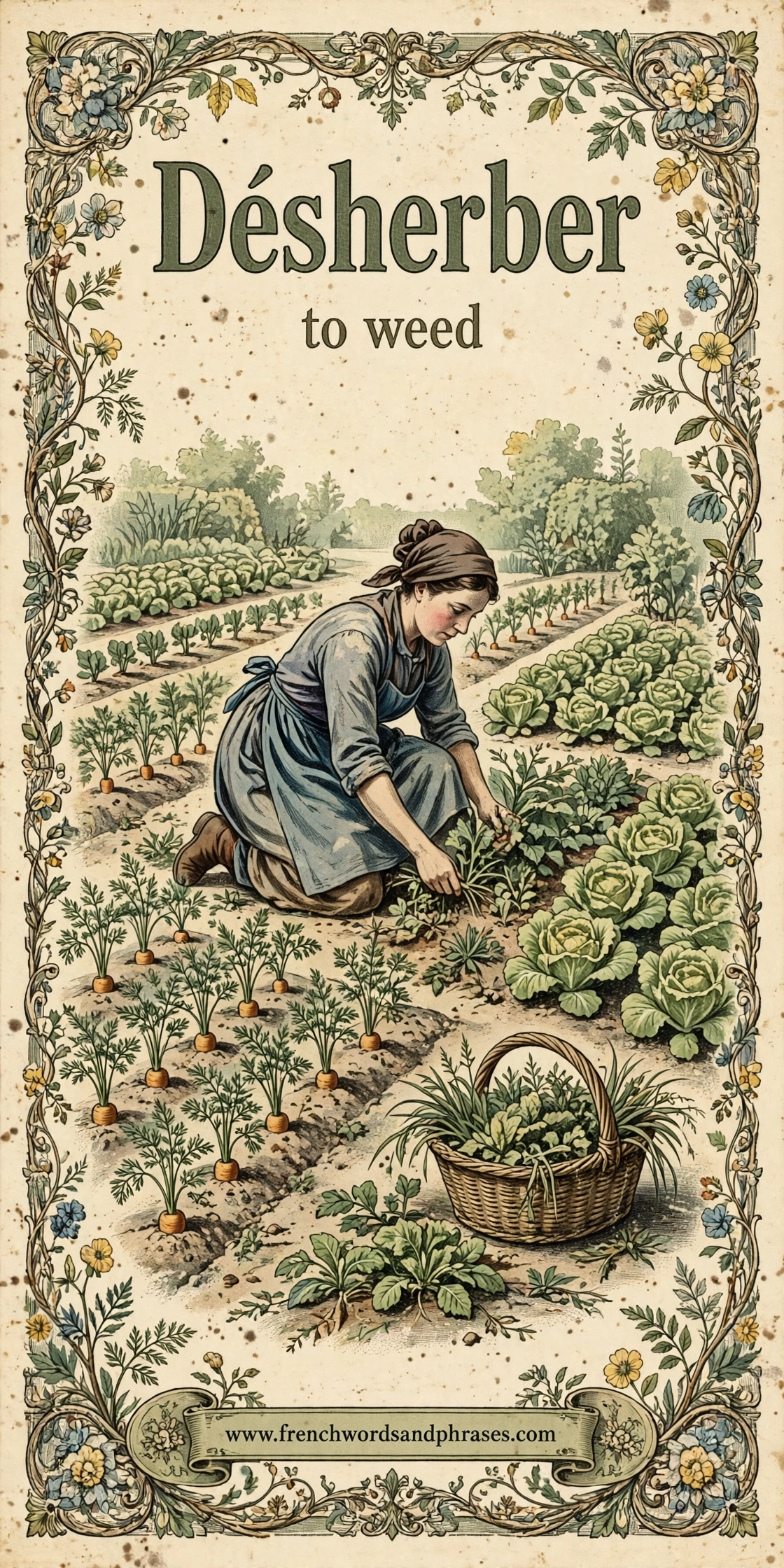
A gardener on her knees among the lettuces, a bucket of dandelions growing beside her, the smell of warm earth rising — désherber is the verb of weeding: the patient, endless removal of everything that grows where it was not invited, from vegetable rows, gravel paths and rose beds.
In this guide, you’ll learn how to conjugate désherber in all the major French tenses and moods. Explore complete conjugation tables, French examples, English translations, and practice quizzes.
Understanding the French Verb Désherber
Désherber is a regular French verb belonging to the first group of verbs, those ending in-er.
It means to weed. It is the gardener’s weekly verb from March to October: beds, rows, paths and courtyards all need désherber, and the work is famously never finished. In town halls it now means clearing pavements and squares without chemicals, by hand, by hoe or by flame.
Verb classification: First group (-er)
Auxiliary verb: Avoir
Past participle: désherbé
Present participle: désherbant
English equivalents: To weed; désherber un jardin — to weed a garden; désherber une allée — to weed a path; désherber à la main — to weed by hand; un désherbant — a weedkiller; les mauvaises herbes — the weeds.
One important detail: désherber is l’herbe with the undoing prefix dés- — literally to un-grass — and the weeds themselves are les mauvaises herbes, the bad grasses. The verb is perfectly regular: je désherbe, nous désherbons, ils désherbent, past participle désherbé, and the h is silent. Its chemical cousin is a noun, un désherbant, a weedkiller — gardeners who refuse it désherbent à la main, by hand.
Experience the Word
Désherber is the verb of the gardener’s patience — the war against the uninvited, fought on one’s knees and never finally won.
Imagine a kitchen garden in June, an hour after rain. Madame Fabre moves along the carrot row with her bucket, two fingers at each green impostor, a small twist, a small tug. The dandelions surrender one by one — elle désherbe, humming, while the blackbird waits behind her for the worms.
By evening the row is clean enough to frame. It is désherbé — until next week’s rain calls the weeds back.
How to Conjugate Désherber: Complete French Conjugation Guide
Let’s explore every major conjugation of désherber, beginning with the indicative mood.
How to Conjugate Désherber in the Indicative Mood
The indicative mood is used to express facts, observations, actions, and events.
How to Conjugate Désherber in the Present Tense (Présent)
Used for actions happening now, habitual actions, and general truths.
| Subject | Conjugation |
|---|---|
| je | désherbe |
| tu | désherbes |
| il / elle | désherbe |
| nous | désherbons |
| vous | désherbez |
| ils / elles | désherbent |
Example
Elle désherbe le potager chaque semaine.
She weeds the vegetable garden every week.
Quick Quiz 1
Complete the sentence:
Nous ______ l’allée chaque printemps.
Reveal the answer
désherbons
Nous désherbons l’allée chaque printemps.
We weed the path every spring.
How to Conjugate Désherber in the Passé Composé
Used for completed actions in the past. Désherber takes the auxiliary verb avoir.
| Subject | Conjugation |
|---|---|
| j’ | ai désherbé |
| tu | as désherbé |
| il / elle | a désherbé |
| nous | avons désherbé |
| vous | avez désherbé |
| ils / elles | ont désherbé |
Example
Nous avons désherbé l’allée ce matin.
We weeded the path this morning.
How to Conjugate Désherber in the Imparfait (Imperfect Tense)
Used for habitual past actions, descriptions, and ongoing situations in the past.
| Subject | Conjugation |
|---|---|
| je | désherbais |
| tu | désherbais |
| il / elle | désherbait |
| nous | désherbions |
| vous | désherbiez |
| ils / elles | désherbaient |
Example
Mon grand-père désherbait ses tomates à la main.
My grandfather used to weed his tomatoes by hand.
Quick Quiz 2
Choose the correct form:
We weeded the garden.
Nous ______ le jardin. (avons désherbé / sommes désherbés)
Reveal the answer
avons désherbé
Nous avons désherbé le jardin.
Désherber takes avoir.
How to Conjugate Désherber in the Plus-que-parfait
Used to describe an action that had already been completed before another past event.
| Subject | Conjugation |
|---|---|
| j’ | avais désherbé |
| tu | avais désherbé |
| il / elle | avait désherbé |
| nous | avions désherbé |
| vous | aviez désherbé |
| ils / elles | avaient désherbé |
Example
Ils avaient désherbé les rosiers avant la fête.
They had weeded the rose bushes before the party.
How to Conjugate Désherber in the Passé Simple
Primarily used in formal writing, literature, and historical narratives. It is rarely used in everyday conversation.
| Subject | Conjugation |
|---|---|
| je | désherbai |
| tu | désherbas |
| il / elle | désherba |
| nous | désherbâmes |
| vous | désherbâtes |
| ils / elles | désherbèrent |
Example
Dès l’aube, elle désherba tout le jardin.
From dawn, she weeded the whole garden.
How to Conjugate Désherber in the Passé Antérieur
A literary tense used to express an action completed immediately before another past action, generally in the passé simple.
| Subject | Conjugation |
|---|---|
| j’ | eus désherbé |
| tu | eus désherbé |
| il / elle | eut désherbé |
| nous | eûmes désherbé |
| vous | eûtes désherbé |
| ils / elles | eurent désherbé |
Example
Quand il eut désherbé le carré de salades, il sema les radis.
When he had weeded the lettuce bed, he sowed the radishes.
How to Conjugate Désherber in the Future Tense (Futur Simple)
Used to describe actions that will take place in the future.
| Subject | Conjugation |
|---|---|
| je | désherberai |
| tu | désherberas |
| il / elle | désherbera |
| nous | désherberons |
| vous | désherberez |
| ils / elles | désherberont |
Example
Demain, je désherberai les fraisiers.
Tomorrow, I will weed the strawberry plants.
How to Conjugate Désherber in the Futur Antérieur (Future Perfect)
Used for an action that will have been completed before a particular point in the future.
| Subject | Conjugation |
|---|---|
| j’ | aurai désherbé |
| tu | auras désherbé |
| il / elle | aura désherbé |
| nous | aurons désherbé |
| vous | aurez désherbé |
| ils / elles | auront désherbé |
Example
À la fin du week-end, nous aurons désherbé tout le potager.
By the end of the weekend, we will have weeded the whole vegetable garden.
How to Conjugate Désherber in the Near Future (Futur Proche)
Used to describe something that is going to happen soon. Formed with aller + infinitive.
| Subject | Conjugation |
|---|---|
| je | vais désherber |
| tu | vas désherber |
| il / elle | va désherber |
| nous | allons désherber |
| vous | allez désherber |
| ils / elles | vont désherber |
Example
Il fait beau ; on va désherber le jardin.
The weather is fine; we are going to weed the garden.
How to Conjugate Désherber in the Conditional Mood
The conditional mood expresses what would happen under certain circumstances. It is also frequently used to make polite requests or express wishes.
How to Conjugate Désherber in the Present Conditional
| Subject | Conjugation |
|---|---|
| je | désherberais |
| tu | désherberais |
| il / elle | désherberait |
| nous | désherberions |
| vous | désherberiez |
| ils / elles | désherberaient |
Example
Avec une binette, tu désherberais plus vite.
With a hoe, you would weed faster.
How to Conjugate Désherber in the Past Conditional
| Subject | Conjugation |
|---|---|
| j’ | aurais désherbé |
| tu | aurais désherbé |
| il / elle | aurait désherbé |
| nous | aurions désherbé |
| vous | auriez désherbé |
| ils / elles | auraient désherbé |
Example
Elle aurait désherbé l’allée s’il n’avait pas plu.
She would have weeded the path if it had not rained.
Désherber in the Literary Past Conditional Form
This less common literary form uses the imperfect subjunctive of avoir.
| Subject | Conjugation |
|---|---|
| j’ | eusse désherbé |
| tu | eusses désherbé |
| il / elle | eût désherbé |
| nous | eussions désherbé |
| vous | eussiez désherbé |
| ils / elles | eussent désherbé |
Example
La jardinière eût désherbé ses rosiers avant même le petit déjeuner.
The gardener would have weeded her rose bushes before breakfast itself.
How to Conjugate Désherber in the Subjunctive Mood
The subjunctive is used to express wishes, emotions, doubts, necessity, and uncertainty. It frequently follows expressions such as il faut que (it is necessary that) or bien que (although).
How to Conjugate Désherber in the Present Subjunctive
| Subject | Conjugation |
|---|---|
| que je | désherbe |
| que tu | désherbes |
| qu’il / qu’elle | désherbe |
| que nous | désherbions |
| que vous | désherbiez |
| qu’ils / qu’elles | désherbent |
Example
Il faut que tu désherbes les carottes cette semaine.
You must weed the carrots this week.
Quick Quiz 3
Complete the sentence using the subjunctive:
Il faut que vous ______ les rosiers.
Reveal the answer
désherbiez
Il faut que vous désherbiez les rosiers.
You must weed around the rose bushes.
How to Conjugate Désherber in the Imperfect Subjunctive
A literary tense, rarely encountered in modern spoken French.
| Subject | Conjugation |
|---|---|
| que je | désherbasse |
| que tu | désherbasses |
| qu’il / qu’elle | désherbât |
| que nous | désherbassions |
| que vous | désherbassiez |
| qu’ils / qu’elles | désherbassent |
Example
Elle voulait que je désherbasse le potager entier.
She wanted me to weed the entire vegetable garden.
How to Conjugate Désherber in the Pluperfect Subjunctive
A literary construction used to express an action completed before another past action.
| Subject | Conjugation |
|---|---|
| que j’ | eusse désherbé |
| que tu | eusses désherbé |
| qu’il / qu’elle | eût désherbé |
| que nous | eussions désherbé |
| que vous | eussiez désherbé |
| qu’ils / qu’elles | eussent désherbé |
Example
On racontait qu’ils eussent désherbé tout le parc en un jour.
People said they had weeded the whole park in one day.
How to Conjugate Désherber in the Past Subjunctive
| Subject | Conjugation |
|---|---|
| que j’ | aie désherbé |
| que tu | aies désherbé |
| qu’il / qu’elle | ait désherbé |
| que nous | ayons désherbé |
| que vous | ayez désherbé |
| qu’ils / qu’elles | aient désherbé |
Example
Je suis content que vous ayez désherbé l’allée.
I am glad you weeded the path.
How to Conjugate Désherber in the Imperative
The imperative is used to give commands, instructions, invitations, or suggestions. Subject pronouns are omitted.
How to Conjugate Désherber in the Present Imperative
| Person | Conjugation |
|---|---|
| (tu) | désherbe |
| (nous) | désherbons |
| (vous) | désherbez |
Example
Désherbe les fraisiers avant la pluie !
Weed the strawberry plants before the rain!
Quick Quiz 4
How would you say Weed the carrots (tu form)?
Reveal the answer
Désherbe les carottes !
French Participles of Désherber
Participles are verb forms that can be used in compound tenses and other grammatical constructions.
Present Participle of Désherber
désherbant
En désherbant à la main, on protège les vers de terre.
By weeding by hand, you protect the earthworms.
Past Participle of Désherber
désherbé
Désherbé de frais, le jardin semble deux fois plus grand.
Freshly weeded, the garden seems twice as big.
Désherber in Everyday French: Real-Life Examples
Now that you know the conjugations, let’s see how désherber appears in everyday French.
Example 1 — Present
Elle désherbe le potager chaque semaine.
She weeds the vegetable garden every week.
Example 2 — Passé composé
Nous avons désherbé l’allée ce matin.
We weeded the path this morning.
Example 3 — Imparfait
Mon grand-père désherbait à la main.
My grandfather used to weed by hand.
Example 4 — Future
Je désherberai les fraisiers demain.
I will weed the strawberry plants tomorrow.
Example 5 — Conditional
Tu désherberais plus vite avec une binette.
You would weed faster with a hoe.
Example 6 — Imperative
Désherbe les carottes !
Weed the carrots!
Beyond Translation: The Meaning of Désherber
English weed is both the plant and the verb; French désherber is more logical — the enemy is les mauvaises herbes, the bad grasses, and the verb simply un-grasses the ground.
It is the verb of chosen growth.
A garden is nothing but a decision about what may stay, renewed weekly: désherber is that decision at work, bucket by bucket, row by row.
How to Remember the French Verb Désherber
Remember it this way: Désherber is about the gardener on her knees, bucket of dandelions, blackbird waiting behind.
- Les mauvaises herbes are the weeds; désherber un-grasses the garden, the path, the bed.
- Désherber à la main is by hand; un désherbant is the chemical shortcut, a weedkiller.
- Regular -er with silent h: je désherbe, nous désherbons, past participle désherbé.
The key idea is the gardener on her knees, bucket of dandelions, blackbird waiting behind.
Test Your Knowledge of Désherber
Let’s see how much you’ve learned. Try answering these questions before revealing the answers.
Question 1
What are les mauvaises herbes?
Reveal the answer
The weeds — literally the bad grasses, everything that grows where it was not invited.
Question 2
How do you say She weeds the vegetable garden every week in French?
Reveal the answer
Elle désherbe le potager chaque semaine.
Question 3
Translate: We weeded the path this morning.
Reveal the answer
Nous avons désherbé l’allée ce matin.
Question 4
What is the past participle of désherber?
Reveal the answer
Désherbé.
Question 5
Complete the sentence:
Il faut que tu ______ les carottes cette semaine.
Reveal the answer
désherbes
Il faut que tu désherbes les carottes cette semaine.
You must weed the carrots this week.
Your Final Challenge
Can You Use It?
How would you say this in French?
She weeds her vegetable garden on her knees, and the garden finally breathes.
Reveal the answer
Elle désherbe son potager à genoux, et le jardin respire enfin.
She weeds her vegetable garden on her knees, and the garden finally breathes.
A little French. A little curiosity. A richer everyday life.
LEARN FRENCH ONE WORD AT A TIME