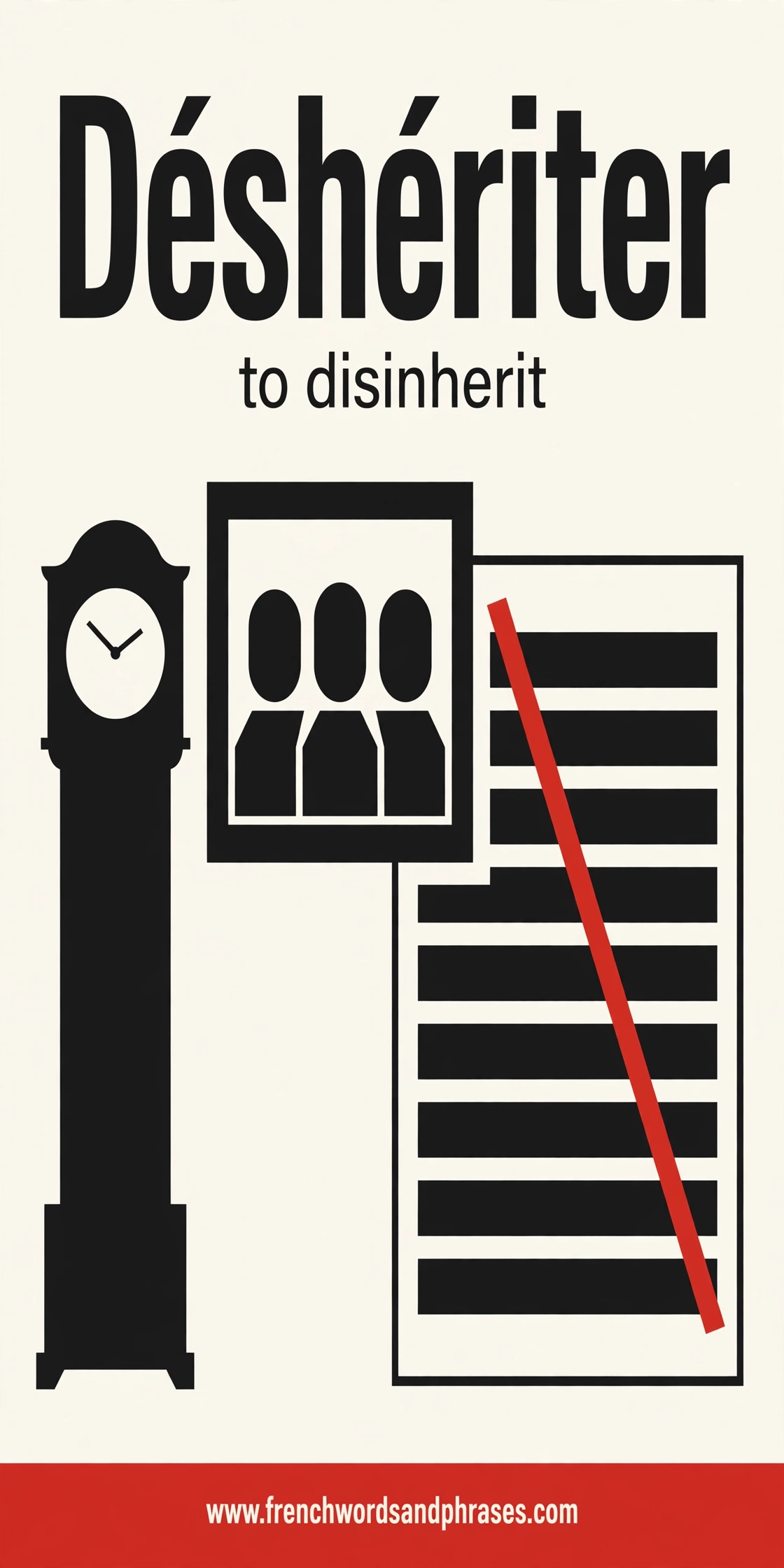
A French Word to Live By
How to Conjugate Déshériter in French
/de.ze.ʁi.te/
Déshériter means to disinherit — to cut an heir out of a will, to strike a name from the inheritance it expected.
A notary’s office, thick with silence, a will being rewritten line by line; a great house whose eldest son learns that the estate will pass him by — déshériter is the lawyer’s verb of disinheritance: the deliberate, documented removal of an heir from what would have been theirs.
In this guide, you’ll learn how to conjugate déshériter in all the major French tenses and moods. Explore complete conjugation tables, French examples, English translations, and practice quizzes.
Understanding the French Verb Déshériter
Déshériter is a regular French verb belonging to the first group of verbs, those ending in-er.
It means to disinherit. It lives in wills, family quarrels and novels: the disinherited son is a stock figure of French literature. Beyond the family it can strike institutions and causes left out of an estate, and figuratively whole regions speak of being les déshérités — the disinherited — those left with nothing.
Verb classification: First group (-er)
Auxiliary verb: Avoir
Past participle: déshérité
Present participle: déshéritant
English equivalents: To disinherit; déshériter un fils — to disinherit a son; déshériter un héritier — to cut out an heir; être déshérité — to be disinherited; le contraire : hériter — to inherit; un héritage — an inheritance.
One important detail: déshériter is hériter, to inherit, with the undoing prefix dés- — and it hides a famous French legal trap: under French law, children are héritiers réservataires, protected heirs, so a parent cannot fully déshériter them; a part of the estate, la réserve, is theirs by right whatever the will says. The verb itself is regular: je déshérite, nous déshéritons, ils déshéritent, past participle déshérité, the h silent throughout.
Experience the Word
Déshériter is the verb of the crossed-out name — the coldest sentence a will can contain.
Imagine a study in a Bordeaux wine château, rain on the windows. The old proprietor dictates to his notary, slowly, without anger: the vineyard to his daughter, the house to his niece — et pour mon fils, rien. He has déshérité his own son with a fountain pen, and the only sound is the scratching of the nib.
No door was slammed, no voice raised. A name was simply removed — déshérité — and the estate flowed around him like a river around a stone.
How to Conjugate Déshériter: Complete French Conjugation Guide
Let’s explore every major conjugation of déshériter, beginning with the indicative mood.
How to Conjugate Déshériter in the Indicative Mood
The indicative mood is used to express facts, observations, actions, and events.
How to Conjugate Déshériter in the Present Tense (Présent)
Used for actions happening now, habitual actions, and general truths.
| Subject | Conjugation |
|---|---|
| je | déshérite |
| tu | déshérites |
| il / elle | déshérite |
| nous | déshéritons |
| vous | déshéritez |
| ils / elles | déshéritent |
Example
Le vieil homme déshérite son fils dans son testament.
The old man is disinheriting his son in his will.
Quick Quiz 1
Complete the sentence:
Nous ne ______ jamais nos enfants.
Reveal the answer
déshéritons
Nous ne déshéritons jamais nos enfants.
We never disinherit our children.
How to Conjugate Déshériter in the Passé Composé
Used for completed actions in the past. Déshériter takes the auxiliary verb avoir.
| Subject | Conjugation |
|---|---|
| j’ | ai déshérité |
| tu | as déshérité |
| il / elle | a déshérité |
| nous | avons déshérité |
| vous | avez déshérité |
| ils / elles | ont déshérité |
Example
Elle a déshérité son neveu après la dispute.
She disinherited her nephew after the quarrel.
How to Conjugate Déshériter in the Imparfait (Imperfect Tense)
Used for habitual past actions, descriptions, and ongoing situations in the past.
| Subject | Conjugation |
|---|---|
| je | déshéritais |
| tu | déshéritais |
| il / elle | déshéritait |
| nous | déshéritions |
| vous | déshéritiez |
| ils / elles | déshéritaient |
Example
Autrefois, les pères déshéritaient les fils rebelles.
In the old days, fathers used to disinherit rebellious sons.
Quick Quiz 2
Choose the correct form:
She disinherited her nephew.
Elle ______ son neveu. (a déshérité / est déshéritée)
Reveal the answer
a déshérité
Elle a déshérité son neveu.
Déshériter takes avoir.
How to Conjugate Déshériter in the Plus-que-parfait
Used to describe an action that had already been completed before another past event.
| Subject | Conjugation |
|---|---|
| j’ | avais déshérité |
| tu | avais déshérité |
| il / elle | avait déshérité |
| nous | avions déshérité |
| vous | aviez déshérité |
| ils / elles | avaient déshérité |
Example
Il avait déshérité sa fille avant même le mariage.
He had disinherited his daughter even before the wedding.
How to Conjugate Déshériter in the Passé Simple
Primarily used in formal writing, literature, and historical narratives. It is rarely used in everyday conversation.
| Subject | Conjugation |
|---|---|
| je | déshéritai |
| tu | déshéritas |
| il / elle | déshérita |
| nous | déshéritâmes |
| vous | déshéritâtes |
| ils / elles | déshéritèrent |
Example
Le duc déshérita son héritier en une signature.
The duke disinherited his heir with a single signature.
How to Conjugate Déshériter in the Passé Antérieur
A literary tense used to express an action completed immediately before another past action, generally in the passé simple.
| Subject | Conjugation |
|---|---|
| j’ | eus déshérité |
| tu | eus déshérité |
| il / elle | eut déshérité |
| nous | eûmes déshérité |
| vous | eûtes déshérité |
| ils / elles | eurent déshérité |
Example
Quand elle eut déshérité son fils, elle quitta la région.
When she had disinherited her son, she left the region.
How to Conjugate Déshériter in the Future Tense (Futur Simple)
Used to describe actions that will take place in the future.
| Subject | Conjugation |
|---|---|
| je | déshériterai |
| tu | déshériteras |
| il / elle | déshéritera |
| nous | déshériterons |
| vous | déshériterez |
| ils / elles | déshériteront |
Example
Si tu continues, ton père te déshéritera.
If you go on like this, your father will disinherit you.
How to Conjugate Déshériter in the Futur Antérieur (Future Perfect)
Used for an action that will have been completed before a particular point in the future.
| Subject | Conjugation |
|---|---|
| j’ | aurai déshérité |
| tu | auras déshérité |
| il / elle | aura déshérité |
| nous | aurons déshérité |
| vous | aurez déshérité |
| ils / elles | auront déshérité |
Example
À sa mort, il aura déshérité deux de ses enfants.
By his death, he will have disinherited two of his children.
How to Conjugate Déshériter in the Near Future (Futur Proche)
Used to describe something that is going to happen soon. Formed with aller + infinitive.
| Subject | Conjugation |
|---|---|
| je | vais déshériter |
| tu | vas déshériter |
| il / elle | va déshériter |
| nous | allons déshériter |
| vous | allez déshériter |
| ils / elles | vont déshériter |
Example
On raconte qu’elle va déshériter son neveu.
They say she is going to disinherit her nephew.
How to Conjugate Déshériter in the Conditional Mood
The conditional mood expresses what would happen under certain circumstances. It is also frequently used to make polite requests or express wishes.
How to Conjugate Déshériter in the Present Conditional
| Subject | Conjugation |
|---|---|
| je | déshériterais |
| tu | déshériterais |
| il / elle | déshériterait |
| nous | déshériterions |
| vous | déshériteriez |
| ils / elles | déshériteraient |
Example
Aucun notaire ne le déshériterait sans une raison grave.
No notary would disinherit him without a grave reason.
How to Conjugate Déshériter in the Past Conditional
| Subject | Conjugation |
|---|---|
| j’ | aurais déshérité |
| tu | aurais déshérité |
| il / elle | aurait déshérité |
| nous | aurions déshérité |
| vous | auriez déshérité |
| ils / elles | auraient déshérité |
Example
Il aurait déshérité son fils sans l’intervention de sa femme.
He would have disinherited his son without his wife’s intervention.
Déshériter in the Literary Past Conditional Form
This less common literary form uses the imperfect subjunctive of avoir.
| Subject | Conjugation |
|---|---|
| j’ | eusse déshérité |
| tu | eusses déshérité |
| il / elle | eût déshérité |
| nous | eussions déshérité |
| vous | eussiez déshérité |
| ils / elles | eussent déshérité |
Example
Le vieillard eût déshérité jusqu’à son ombre, tant sa colère était grande.
The old man would have disinherited even his own shadow, so great was his anger.
How to Conjugate Déshériter in the Subjunctive Mood
The subjunctive is used to express wishes, emotions, doubts, necessity, and uncertainty. It frequently follows expressions such as il faut que (it is necessary that) or bien que (although).
How to Conjugate Déshériter in the Present Subjunctive
| Subject | Conjugation |
|---|---|
| que je | déshérite |
| que tu | déshérites |
| qu’il / qu’elle | déshérite |
| que nous | déshéritions |
| que vous | déshéritiez |
| qu’ils / qu’elles | déshéritent |
Example
Je doute qu’elle déshérite vraiment sa fille.
I doubt she will really disinherit her daughter.
Quick Quiz 3
Complete the sentence using the subjunctive:
Je doute que vous ______ votre fille.
Reveal the answer
déshéritiez
Je doute que vous déshéritiez votre fille.
I doubt you would disinherit your daughter.
How to Conjugate Déshériter in the Imperfect Subjunctive
A literary tense, rarely encountered in modern spoken French.
| Subject | Conjugation |
|---|---|
| que je | déshéritasse |
| que tu | déshéritasses |
| qu’il / qu’elle | déshéritât |
| que nous | déshéritassions |
| que vous | déshéritassiez |
| qu’ils / qu’elles | déshéritassent |
Example
On craignait que le père ne déshéritât ses enfants.
People feared the father might disinherit his children.
How to Conjugate Déshériter in the Pluperfect Subjunctive
A literary construction used to express an action completed before another past action.
| Subject | Conjugation |
|---|---|
| que j’ | eusse déshérité |
| que tu | eusses déshérité |
| qu’il / qu’elle | eût déshérité |
| que nous | eussions déshérité |
| que vous | eussiez déshérité |
| qu’ils / qu’elles | eussent déshérité |
Example
Les romanciers racontent qu’il eût déshérité toute sa famille.
Novelists tell that he had disinherited his whole family.
How to Conjugate Déshériter in the Past Subjunctive
| Subject | Conjugation |
|---|---|
| que j’ | aie déshérité |
| que tu | aies déshérité |
| qu’il / qu’elle | ait déshérité |
| que nous | ayons déshérité |
| que vous | ayez déshérité |
| qu’ils / qu’elles | aient déshérité |
Example
Il est triste qu’elle ait déshérité son neveu pour si peu.
It is sad she disinherited her nephew over so little.
How to Conjugate Déshériter in the Imperative
The imperative is used to give commands, instructions, invitations, or suggestions. Subject pronouns are omitted.
How to Conjugate Déshériter in the Present Imperative
| Person | Conjugation |
|---|---|
| (tu) | déshérite |
| (nous) | déshéritons |
| (vous) | déshéritez |
Example
Ne déshérite pas ton fils pour une querelle !
Do not disinherit your son over a quarrel!
Quick Quiz 4
How would you say Do not disinherit your son (tu form)?
Reveal the answer
Ne déshérite pas ton fils !
French Participles of Déshériter
Participles are verb forms that can be used in compound tenses and other grammatical constructions.
Present Participle of Déshériter
déshéritant
En déshéritant son fils, il a brisé la famille pour toujours.
By disinheriting his son, he broke the family forever.
Past Participle of Déshériter
déshérité
Déshérité par son père, le jeune homme partit pour l’Amérique.
Disinherited by his father, the young man left for America.
Déshériter in Everyday French: Real-Life Examples
Now that you know the conjugations, let’s see how déshériter appears in everyday French.
Example 1 — Present
Il déshérite son fils dans son testament.
He is disinheriting his son in his will.
Example 2 — Passé composé
Elle a déshérité son neveu.
She disinherited her nephew.
Example 3 — Imparfait
Les pères déshéritaient les fils rebelles.
Fathers used to disinherit rebellious sons.
Example 4 — Future
Ton père te déshéritera si tu continues.
Your father will disinherit you if you go on.
Example 5 — Conditional
Il déshériterait son fils sans sa femme.
He would disinherit his son if not for his wife.
Example 6 — Imperative
Ne déshérite pas ton fils !
Do not disinherit your son!
Beyond Translation: The Meaning of Déshériter
English disinherit is the twin, but French déshériter carries its legal booby trap: the réserve héréditaire means a French parent can reduce a child to the legal minimum but never to zero — total disinheritance is an Anglo-Saxon idea that French law quietly refuses.
The word escaped the notary’s office.
Les déshérités — the disinherited — is now the poetic name for all those the world has left with nothing: the will, in their case, was written by history.
How to Remember the French Verb Déshériter
Remember it this way: Déshériter is about the notary’s pen — one name quietly removed from the will.
- Hériter inherits; déshériter strikes the heir out of the will.
- The French trap: children are héritiers réservataires — the réserve is theirs by law, whatever the will says.
- Regular -er with silent h: je déshérite, nous déshéritons, past participle déshérité.
The key idea is the notary’s pen — one name quietly removed from the will.
Test Your Knowledge of Déshériter
Let’s see how much you’ve learned. Try answering these questions before revealing the answers.
Question 1
Why can a French parent never completely déshériter a child?
Reveal the answer
The réserve héréditaire — children are protected heirs (héritiers réservataires) and a legal share is theirs whatever the will says.
Question 2
How do you say She disinherited her nephew in French?
Reveal the answer
Elle a déshérité son neveu.
Question 3
Translate: The old man is disinheriting his son in his will.
Reveal the answer
Le vieil homme déshérite son fils dans son testament.
Question 4
What is the past participle of déshériter?
Reveal the answer
Déshérité.
Question 5
Complete the sentence:
Je doute qu’elle ______ vraiment sa fille.
Reveal the answer
déshérite
Je doute qu’elle déshérite vraiment sa fille.
I doubt she will really disinherit her daughter.
Your Final Challenge
Can You Use It?
How would you say this in French?
He disinherited his son with one signature, but the law keeps children their share.
Reveal the answer
Il a déshérité son fils d’une signature, mais la loi garde aux enfants leur part.
He disinherited his son with one signature, but the law keeps children their share.
A little French. A little curiosity. A richer everyday life.
LEARN FRENCH ONE WORD AT A TIME