A French Word to Live By
How to Conjugate Se déshabituer in French
/sə de.za.bi.tɥe/
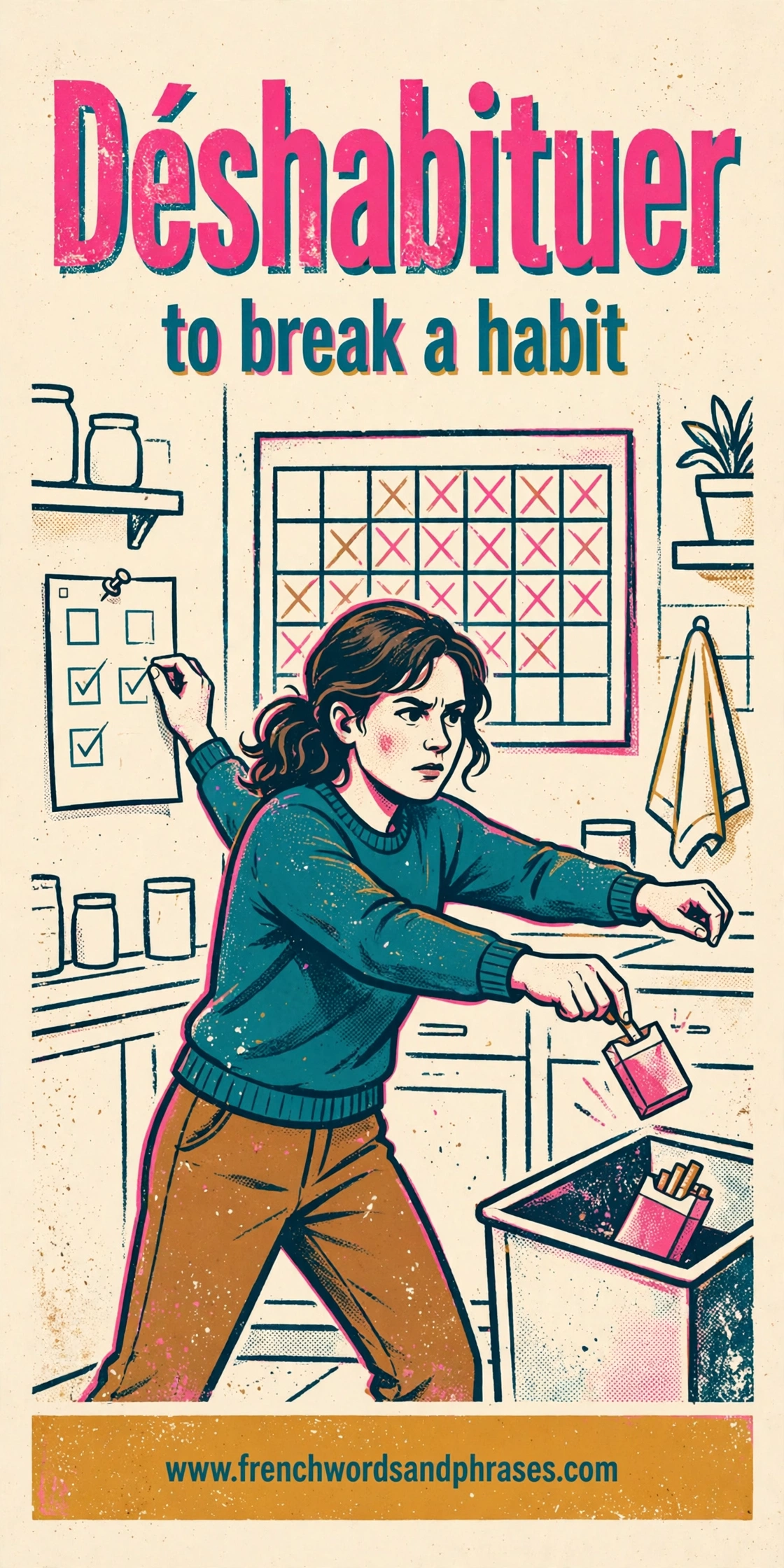
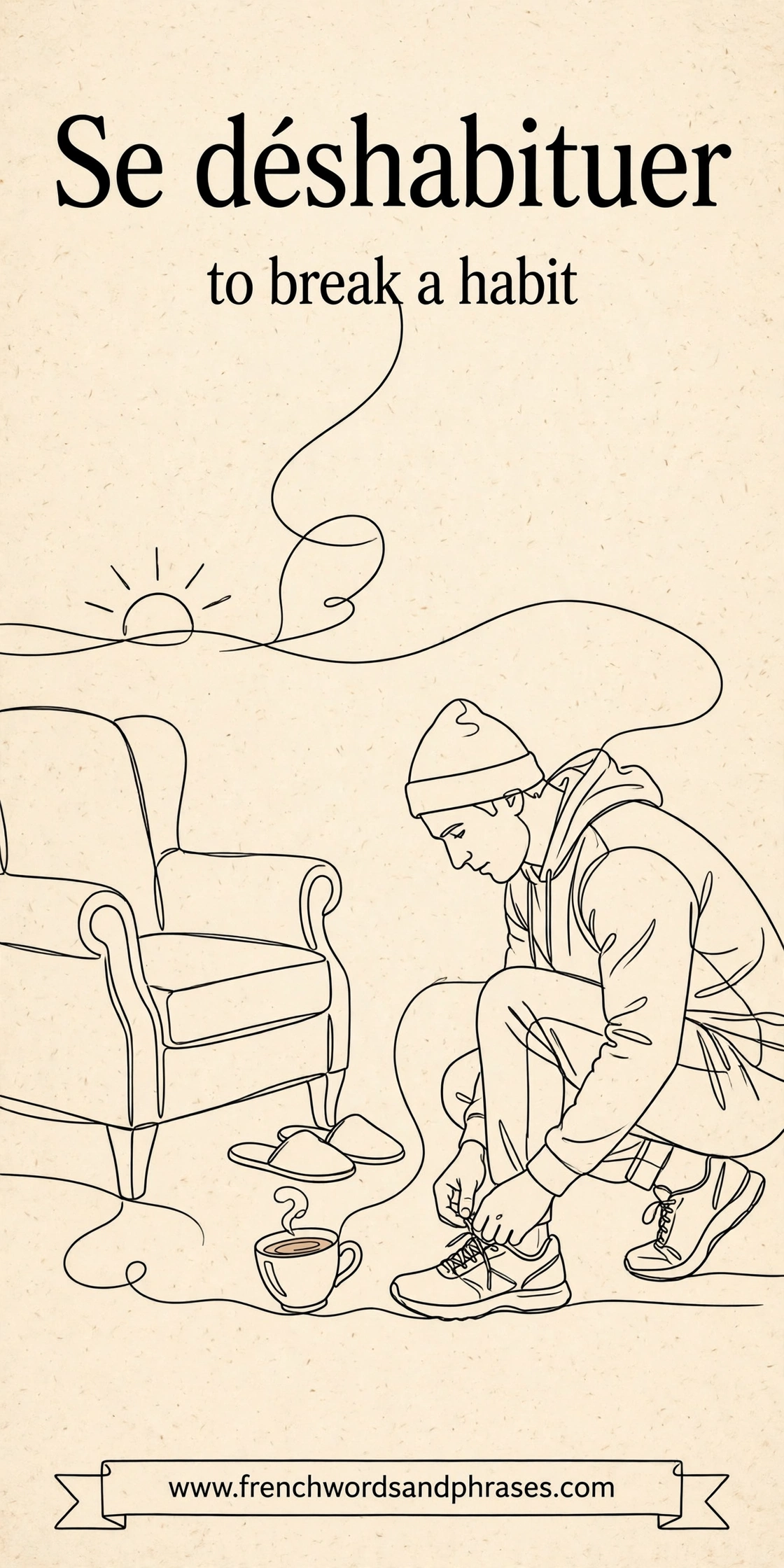
Se déshabituer means to break a habit — to get yourself out of a habit, unlearning day by day what habit taught you.
A smoker counting the days since his last cigarette, a student who has stopped checking her phone at midnight, a village that has forgotten its siesta — se déshabituer is the verb of breaking your own habit: the slow, private work of becoming someone who no longer does what they always did.
In this guide, you’ll learn how to conjugate se déshabituer in all the major French tenses and moods. Explore complete conjugation tables, French examples, English translations, and practice quizzes.
Understanding the French Verb Se déshabituer
Se déshabituer is a regular French verb belonging to the first group of verbs, those ending in-er.
It means to break a habit. It is the verb of January resolutions and Lent, of giving up smoking, sugar, screens and siestas. Where déshabituer is done to someone else — a parent to a child, a doctor to a patient — se déshabituer is the solitary version, willpower against routine, and French speakers reach for it whenever a habit is being shed.
Verb classification: First group (-er), reflexive
Auxiliary verb: Être
Past participle: déshabitué
Present participle: déshabituant
English equivalents: To break a habit, to get out of the habit; se déshabituer de fumer — to break the smoking habit; se déshabituer du sucre — to get out of the sugar habit; se déshabituer de regarder son téléphone — to break the habit of checking one’s phone; le contraire : s’habituer — to get used to.
One important detail: se déshabituer takes its habit with de: se déshabituer de fumer, se déshabituer du café. Being reflexive, it uses être in every compound tense and the participle agrees: elle s’est déshabituée du sucre, ils se sont déshabitués de fumer. The forms themselves are regular: je me déshabitue, nous nous déshabituons, ils se déshabituent. Its mirror is s’habituer à — habits go in with à and come out with de.
Experience the Word
Se déshabituer is the verb of the empty slot in the day — the cigarette not smoked, the phone not checked, the habit quietly starving.
Imagine a postman in a small town who has smoked at the same café terrace for twenty years. In January he stops. The first week is a war; the second, a negotiation. By spring he drinks his coffee and simply watches the square — il s’est déshabitué de fumer, and the terrace has lost its power over him.
Nothing announces the victory. One morning the craving is just gone — il s’est déshabitué, and the habit is history.
How to Conjugate Se déshabituer: Complete French Conjugation Guide
Let’s explore every major conjugation of se déshabituer, beginning with the indicative mood.
How to Conjugate Se déshabituer in the Indicative Mood
The indicative mood is used to express facts, observations, actions, and events.
How to Conjugate Se déshabituer in the Present Tense (Présent)
Used for actions happening now, habitual actions, and general truths.
| Subject | Conjugation |
|---|---|
| je | me déshabitue |
| tu | te déshabitues |
| il / elle | se déshabitue |
| nous | nous déshabituons |
| vous | vous déshabituez |
| ils / elles | se déshabituent |
Example
Il se déshabitue peu à peu du sucre.
He is gradually breaking the sugar habit.
Quick Quiz 1
Complete the sentence:
Nous nous ______ lentement du café.
Reveal the answer
déshabituons
Nous nous déshabituons lentement du café.
We are slowly breaking the coffee habit.
How to Conjugate Se déshabituer in the Passé Composé
Used for completed actions in the past. Se déshabituer takes the auxiliary verb être.
| Subject | Conjugation |
|---|---|
| je | me suis déshabitué / me suis déshabituée |
| tu | t’es déshabitué / t’es déshabituée |
| il / elle | s’est déshabitué / s’est déshabituée |
| nous | nous sommes déshabitués / nous sommes déshabituées |
| vous | vous êtes déshabitués / vous êtes déshabituées / vous êtes déshabitué / vous êtes déshabituée |
| ils / elles | se sont déshabitués / se sont déshabituées |
Example
Elle s’est déshabituée de fumer en deux mois.
She broke the smoking habit in two months.
How to Conjugate Se déshabituer in the Imparfait (Imperfect Tense)
Used for habitual past actions, descriptions, and ongoing situations in the past.
| Subject | Conjugation |
|---|---|
| je | me déshabituais |
| tu | te déshabituais |
| il / elle | se déshabituait |
| nous | nous déshabituions |
| vous | vous déshabituiez |
| ils / elles | se déshabituaient |
Example
Nous nous déshabituions lentement de la sieste.
We were slowly getting out of the siesta habit.
Quick Quiz 2
Choose the correct form:
She broke the smoking habit.
Elle ______ de fumer. (s’est déshabituée / a déshabitué)
Reveal the answer
s’est déshabituée
Elle s’est déshabituée de fumer.
Se déshabituer is reflexive, takes être, and the participle agrees: déshabituée.
How to Conjugate Se déshabituer in the Plus-que-parfait
Used to describe an action that had already been completed before another past event.
| Subject | Conjugation |
|---|---|
| je | m’étais déshabitué / m’étais déshabituée |
| tu | t’étais déshabitué / t’étais déshabituée |
| il / elle | s’était déshabitué / s’était déshabituée |
| nous | nous étions déshabitués / nous étions déshabituées |
| vous | vous étiez déshabitués / vous étiez déshabituées / vous étiez déshabitué / vous étiez déshabituée |
| ils / elles | s’étaient déshabitués / s’étaient déshabituées |
Example
Ils s’étaient déshabitués du café avant l’hiver.
They had broken the coffee habit before winter.
How to Conjugate Se déshabituer in the Passé Simple
Primarily used in formal writing, literature, and historical narratives. It is rarely used in everyday conversation.
| Subject | Conjugation |
|---|---|
| je | me déshabituai |
| tu | te déshabituas |
| il / elle | se déshabitua |
| nous | nous déshabituâmes |
| vous | vous déshabituâtes |
| ils / elles | se déshabituèrent |
Example
En un été, il se déshabitua de la cigarette.
In one summer, he broke the cigarette habit.
How to Conjugate Se déshabituer in the Passé Antérieur
A literary tense used to express an action completed immediately before another past action, generally in the passé simple.
| Subject | Conjugation |
|---|---|
| je | me fus déshabitué / me fus déshabituée |
| tu | te fus déshabitué / te fus déshabituée |
| il / elle | se fut déshabitué / se fut déshabituée |
| nous | nous fûmes déshabitués / nous fûmes déshabituées |
| vous | vous fûtes déshabitués / vous fûtes déshabituées / vous fûtes déshabitué / vous fûtes déshabituée |
| ils / elles | se furent déshabitués / se furent déshabituées |
Example
Dès qu’elle se fut déshabituée des écrans, elle dormit mieux.
As soon as she had broken the screen habit, she slept better.
How to Conjugate Se déshabituer in the Future Tense (Futur Simple)
Used to describe actions that will take place in the future.
| Subject | Conjugation |
|---|---|
| je | me déshabituerai |
| tu | te déshabitueras |
| il / elle | se déshabituera |
| nous | nous déshabituerons |
| vous | vous déshabituerez |
| ils / elles | se déshabitueront |
Example
Tu te déshabitueras de ce réflexe avec le temps.
You will break this reflex with time.
How to Conjugate Se déshabituer in the Futur Antérieur (Future Perfect)
Used for an action that will have been completed before a particular point in the future.
| Subject | Conjugation |
|---|---|
| je | me serai déshabitué / me serai déshabituée |
| tu | te seras déshabitué / te seras déshabituée |
| il / elle | se sera déshabitué / se sera déshabituée |
| nous | nous serons déshabitués / nous serons déshabituées |
| vous | vous serez déshabitués / vous serez déshabituées / vous serez déshabitué / vous serez déshabituée |
| ils / elles | se seront déshabitués / se seront déshabituées |
Example
À la fin de l’année, vous vous serez déshabitués du grignotage.
By the end of the year, you will have broken the snacking habit.
How to Conjugate Se déshabituer in the Near Future (Futur Proche)
Used to describe something that is going to happen soon. Formed with aller + infinitive.
| Subject | Conjugation |
|---|---|
| je | vais me déshabituer |
| tu | vas te déshabituer |
| il / elle | va se déshabituer |
| nous | allons nous déshabituer |
| vous | allez vous déshabituer |
| ils / elles | vont se déshabituer |
Example
Cette fois, je vais me déshabituer du téléphone le soir.
This time, I am going to break the evening phone habit.
How to Conjugate Se déshabituer in the Conditional Mood
The conditional mood expresses what would happen under certain circumstances. It is also frequently used to make polite requests or express wishes.
How to Conjugate Se déshabituer in the Present Conditional
| Subject | Conjugation |
|---|---|
| je | me déshabituerais |
| tu | te déshabituerais |
| il / elle | se déshabituerait |
| nous | nous déshabituerions |
| vous | vous déshabitueriez |
| ils / elles | se déshabitueraient |
Example
Sans l’aide de ses amis, elle ne se déshabituerait jamais de fumer.
Without her friends’ help, she would never break the smoking habit.
How to Conjugate Se déshabituer in the Past Conditional
| Subject | Conjugation |
|---|---|
| je | me serais déshabitué / me serais déshabituée |
| tu | te serais déshabitué / te serais déshabituée |
| il / elle | se serait déshabitué / se serait déshabituée |
| nous | nous serions déshabitués / nous serions déshabituées |
| vous | vous seriez déshabitués / vous seriez déshabituées / vous seriez déshabitué / vous seriez déshabituée |
| ils / elles | se seraient déshabitués / se seraient déshabituées |
Example
Il se serait déshabitué plus tôt avec un peu de soutien.
He would have broken the habit earlier with a little support.
Se déshabituer in the Literary Past Conditional Form
This less common literary form uses the imperfect subjunctive of être.
| Subject | Conjugation |
|---|---|
| je | me fusse déshabitué / me fusse déshabituée |
| tu | te fusses déshabitué / te fusses déshabituée |
| il / elle | se fût déshabitué / se fût déshabituée |
| nous | nous fussions déshabitués / nous fussions déshabituées |
| vous | vous fussiez déshabitués / vous fussiez déshabituées / vous fussiez déshabitué / vous fussiez déshabituée |
| ils / elles | se fussent déshabitués / se fussent déshabituées |
Example
Elle se fût déshabituée du sucre sans les fêtes de famille.
She would have broken the sugar habit if not for the family feasts.
How to Conjugate Se déshabituer in the Subjunctive Mood
The subjunctive is used to express wishes, emotions, doubts, necessity, and uncertainty. It frequently follows expressions such as il faut que (it is necessary that) or bien que (although).
How to Conjugate Se déshabituer in the Present Subjunctive
| Subject | Conjugation |
|---|---|
| que je | me déshabitue |
| que tu | te déshabitues |
| qu’il / qu’elle | se déshabitue |
| que nous | nous déshabituions |
| que vous | vous déshabituiez |
| qu’ils / qu’elles | se déshabituent |
Example
Il faut que tu te déshabitues de regarder ton téléphone la nuit.
You must break the habit of checking your phone at night.
Quick Quiz 3
Complete the sentence using the subjunctive:
Il faut que vous vous ______ du grignotage.
Reveal the answer
déshabituiez
Il faut que vous vous déshabituiez du grignotage.
You must break the snacking habit.
How to Conjugate Se déshabituer in the Imperfect Subjunctive
A literary tense, rarely encountered in modern spoken French.
| Subject | Conjugation |
|---|---|
| que je | me déshabituasse |
| que tu | te déshabituasses |
| qu’il / qu’elle | se déshabituât |
| que nous | nous déshabituassions |
| que vous | vous déshabituassiez |
| qu’ils / qu’elles | se déshabituassent |
Example
On souhaitait qu’il se déshabituât de la cigarette avant l’opération.
People hoped he would break the cigarette habit before the operation.
How to Conjugate Se déshabituer in the Pluperfect Subjunctive
A literary construction used to express an action completed before another past action.
| Subject | Conjugation |
|---|---|
| que je | me fusse déshabitué / me fusse déshabituée |
| que tu | te fusses déshabitué / te fusses déshabituée |
| qu’il / qu’elle | se fût déshabitué / se fût déshabituée |
| que nous | nous fussions déshabitués / nous fussions déshabituées |
| que vous | vous fussiez déshabitués / vous fussiez déshabituées / vous fussiez déshabitué / vous fussiez déshabituée |
| qu’ils / qu’elles | se fussent déshabitués / se fussent déshabituées |
Example
On admirait qu’elle se fût déshabituée de tout en un an.
People admired that she had broken every habit within a year.
How to Conjugate Se déshabituer in the Past Subjunctive
| Subject | Conjugation |
|---|---|
| que je | me sois déshabitué / me sois déshabituée |
| que tu | te sois déshabitué / te sois déshabituée |
| qu’il / qu’elle | se soit déshabitué / se soit déshabituée |
| que nous | nous soyons déshabitués / nous soyons déshabituées |
| que vous | vous soyez déshabitués / vous soyez déshabituées / vous soyez déshabitué / vous soyez déshabituée |
| qu’ils / qu’elles | se soient déshabitués / se soient déshabituées |
Example
Je suis fier qu’il se soit déshabitué de fumer.
I am proud he broke the smoking habit.
How to Conjugate Se déshabituer in the Imperative
The imperative is used to give commands, instructions, invitations, or suggestions. Subject pronouns are omitted.
How to Conjugate Se déshabituer in the Present Imperative
| Person | Conjugation |
|---|---|
| (tu) | déshabitue-toi |
| (nous) | déshabituons-nous |
| (vous) | déshabituez-vous |
Example
Déshabitue-toi de ce réflexe, tu respireras mieux !
Break yourself of this reflex, you will breathe better!
Quick Quiz 4
How would you say Break yourself of this reflex (tu form)?
Reveal the answer
Déshabitue-toi de ce réflexe !
French Participles of Se déshabituer
Participles are verb forms that can be used in compound tenses and other grammatical constructions.
Present Participle of Se déshabituer
déshabituant
En se déshabituant du café, elle a retrouvé le sommeil.
By breaking the coffee habit, she got her sleep back.
Past Participle of Se déshabituer
déshabitué
Déshabituée de la cigarette, elle monte les escaliers sans souffler.
Broken of cigarettes, she climbs the stairs without panting.
Se déshabituer in Everyday French: Real-Life Examples
Now that you know the conjugations, let’s see how se déshabituer appears in everyday French.
Example 1 — Present
Il se déshabitue peu à peu du sucre.
He is gradually breaking the sugar habit.
Example 2 — Passé composé
Elle s’est déshabituée de fumer.
She broke the smoking habit.
Example 3 — Imparfait
Nous nous déshabituions de la sieste.
We were getting out of the siesta habit.
Example 4 — Future
Tu te déshabitueras de ce réflexe.
You will break this reflex.
Example 5 — Conditional
Je me déshabituerais du café si je dormais mieux.
I would break the coffee habit if I slept better.
Example 6 — Imperative
Déshabitue-toi de ce réflexe !
Break yourself of this reflex!
Beyond Translation: The Meaning of Se déshabituer
English needs a phrase — to break a habit, to get out of the habit; French se déshabituer does it in one reflexive verb, built openly on une habitude.
Its mirror is a whole philosophy.
S’habituer à is how habits arrive — gently, unnoticed; se déshabituer de is how they leave — slowly, deliberately, and always with the little word de carrying the thing away.
How to Remember the French Verb Se déshabituer
Remember it this way: Se déshabituer is about the postman’s empty terrace slot — the cigarette simply not smoked.
- Reflexive and être: elle s’est déshabituée de fumer — the participle agrees.
- The habit follows de: se déshabituer de fumer, du sucre, du café. In with à (s’habituer à), out with de.
- Regular -uer forms: je me déshabitue, nous nous déshabituons, past participle déshabitué.
The key idea is the postman’s empty terrace slot — the cigarette simply not smoked.
Test Your Knowledge of Se déshabituer
Let’s see how much you’ve learned. Try answering these questions before revealing the answers.
Question 1
Which auxiliary does se déshabituer use, and why?
Reveal the answer
Être — it is a reflexive verb: elle s’est déshabituée de fumer.
Question 2
How do you say She broke the smoking habit in French?
Reveal the answer
Elle s’est déshabituée de fumer.
Question 3
Translate: He is gradually breaking the sugar habit.
Reveal the answer
Il se déshabitue peu à peu du sucre.
Question 4
What is the past participle of se déshabituer?
Reveal the answer
Déshabitué — agreeing: déshabituée, déshabitués, déshabituées.
Question 5
Complete the sentence:
Il faut que tu te ______ de regarder ton téléphone la nuit.
Reveal the answer
déshabitues
Il faut que tu te déshabitues de regarder ton téléphone la nuit.
You must break the habit of checking your phone at night.
Your Final Challenge
Can You Use It?
How would you say this in French?
She broke the smoking habit in one spring, and the morning air changed its taste.
Reveal the answer
Elle s’est déshabituée de fumer en un printemps, et l’air du matin a changé de goût.
She broke the smoking habit in one spring, and the morning air changed its taste.
A little French. A little curiosity. A richer everyday life.
LEARN FRENCH ONE WORD AT A TIME