A French Word to Live By
How to Conjugate Désavouer in French
/de.za.vwe/
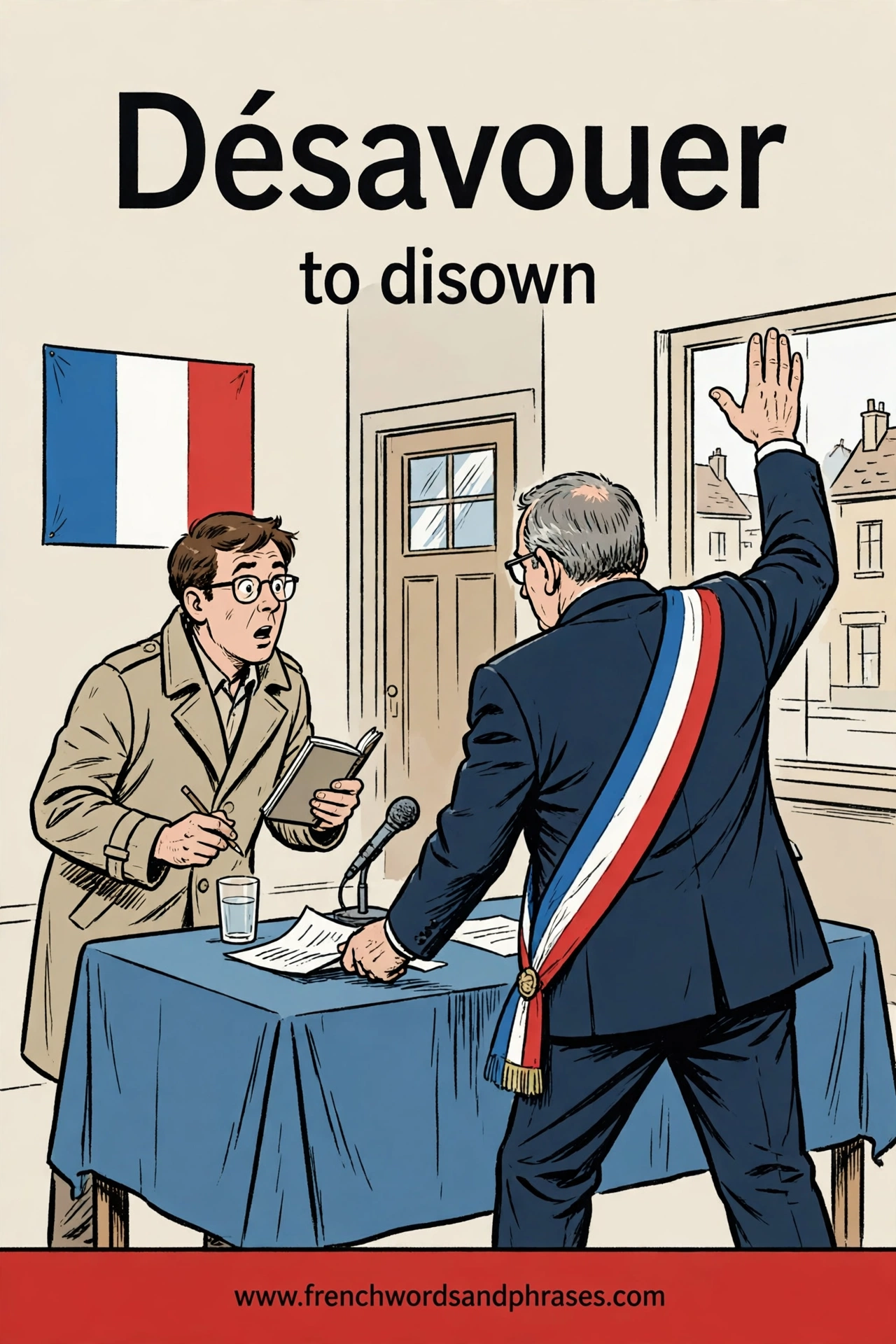
Désavouer means to disown — to refuse to stand behind words, acts or even a person, and to declare publicly: this is not mine.
A spokesman disowning a minister’s remark, a father disowning his son, a party disowning its own candidate — désavouer is the verb of the public severance: what was claimed as one’s own is cast off, in front of witnesses.
In this guide, you’ll learn how to conjugate désavouer in all the major French tenses and moods. Explore complete conjugation tables, French examples, English translations, and practice quizzes.
Understanding the French Verb Désavouer
Désavouer is a regular French verb belonging to the first group of verbs, those ending in-er.
It means to disown. It ranges from the negotiating table to the family: states désavouent treaties signed by predecessors, parties désavouent embarrassing allies, and in older novels fathers désavouent sons who marry beneath them — the gravest social sentence the verb can pronounce.
Verb classification: First group (-er)
Auxiliary verb: Avoir
Past participle: désavoué
Present participle: désavouant
English equivalents: To disown, to disavow, to repudiate; désavouer des propos — to disown remarks; désavouer un ministre — to disavow a minister; désavouer son fils — to disown one’s son; un désaveu — a disavowal, a repudiation.
One important detail: désavouer is avouer, to admit or avow, struck through by the prefix dés-: where avouer owns up, désavouer disowns. It is fully regular: je désavoue, nous désavouons, ils désavouent, past participle désavoué. The noun un désaveu is a favourite of political journalism — un désaveu cinglant, a stinging repudiation — and governments désavouent their ambassadors, their statements and, when necessary, their own past.
Experience the Word
Désavouer is the verb of the signature withdrawn — the public moment when support becomes abandonment.
Imagine a ministry press room at midnight. A junior minister has said too much on television; by morning, the communiqué is three lines long and ice-cold: le gouvernement désavoue ses propos. Nothing is explained and nothing is forgiven — the words have been disowned, and so, quietly, has the man.
The remarks were spoken and cannot be unspoken. They have simply been disowned — désavoués — left standing alone without an owner.
How to Conjugate Désavouer: Complete French Conjugation Guide
Let’s explore every major conjugation of désavouer, beginning with the indicative mood.
How to Conjugate Désavouer in the Indicative Mood
The indicative mood is used to express facts, observations, actions, and events.
How to Conjugate Désavouer in the Present Tense (Présent)
Used for actions happening now, habitual actions, and general truths.
| Subject | Conjugation |
|---|---|
| je | désavoue |
| tu | désavoues |
| il / elle | désavoue |
| nous | désavouons |
| vous | désavouez |
| ils / elles | désavouent |
Example
Le parti désavoue les propos de son candidat.
The party disowns its candidate’s remarks.
Quick Quiz 1
Complete the sentence:
Nous ne ______ jamais nos alliés.
Reveal the answer
désavouons
Nous ne désavouons jamais nos alliés.
We never disown our allies.
How to Conjugate Désavouer in the Passé Composé
Used for completed actions in the past. Désavouer takes the auxiliary verb avoir.
| Subject | Conjugation |
|---|---|
| j’ | ai désavoué |
| tu | as désavoué |
| il / elle | a désavoué |
| nous | avons désavoué |
| vous | avez désavoué |
| ils / elles | ont désavoué |
Example
Le ministre a désavoué son porte-parole en direct.
The minister disavowed his spokesman live on air.
How to Conjugate Désavouer in the Imparfait (Imperfect Tense)
Used for habitual past actions, descriptions, and ongoing situations in the past.
| Subject | Conjugation |
|---|---|
| je | désavouais |
| tu | désavouais |
| il / elle | désavouait |
| nous | désavouions |
| vous | désavouiez |
| ils / elles | désavouaient |
Example
Autrefois, les pères désavouaient les fils désobéissants.
In the old days, fathers used to disown disobedient sons.
Quick Quiz 2
Choose the correct form:
The king disavowed his ambassador.
Le roi ______ son ambassadeur. (a désavoué / est désavoué)
Reveal the answer
a désavoué
Le roi a désavoué son ambassadeur.
Désavouer takes avoir.
How to Conjugate Désavouer in the Plus-que-parfait
Used to describe an action that had already been completed before another past event.
| Subject | Conjugation |
|---|---|
| j’ | avais désavoué |
| tu | avais désavoué |
| il / elle | avait désavoué |
| nous | avions désavoué |
| vous | aviez désavoué |
| ils / elles | avaient désavoué |
Example
Elle avait désavoué l’accord avant même sa signature.
She had repudiated the agreement even before it was signed.
How to Conjugate Désavouer in the Passé Simple
Primarily used in formal writing, literature, and historical narratives. It is rarely used in everyday conversation.
| Subject | Conjugation |
|---|---|
| je | désavouai |
| tu | désavouas |
| il / elle | désavoua |
| nous | désavouâmes |
| vous | désavouâtes |
| ils / elles | désavouèrent |
Example
Le roi désavoua son ambassadeur dès son retour.
The king disavowed his ambassador as soon as he returned.
How to Conjugate Désavouer in the Passé Antérieur
A literary tense used to express an action completed immediately before another past action, generally in the passé simple.
| Subject | Conjugation |
|---|---|
| j’ | eus désavoué |
| tu | eus désavoué |
| il / elle | eut désavoué |
| nous | eûmes désavoué |
| vous | eûtes désavoué |
| ils / elles | eurent désavoué |
Example
Quand le parti eut désavoué son candidat, il se retira de la course.
When the party had disowned its candidate, he withdrew from the race.
How to Conjugate Désavouer in the Future Tense (Futur Simple)
Used to describe actions that will take place in the future.
| Subject | Conjugation |
|---|---|
| je | désavouerai |
| tu | désavoueras |
| il / elle | désavouera |
| nous | désavouerons |
| vous | désavouerez |
| ils / elles | désavoueront |
Example
Le gouvernement désavouera ces déclarations dès demain.
The government will disown these statements tomorrow.
How to Conjugate Désavouer in the Futur Antérieur (Future Perfect)
Used for an action that will have been completed before a particular point in the future.
| Subject | Conjugation |
|---|---|
| j’ | aurai désavoué |
| tu | auras désavoué |
| il / elle | aura désavoué |
| nous | aurons désavoué |
| vous | aurez désavoué |
| ils / elles | auront désavoué |
Example
À la fin de la semaine, ils auront désavoué trois de leurs alliés.
By the end of the week, they will have disowned three of their allies.
How to Conjugate Désavouer in the Near Future (Futur Proche)
Used to describe something that is going to happen soon. Formed with aller + infinitive.
| Subject | Conjugation |
|---|---|
| je | vais désavouer |
| tu | vas désavouer |
| il / elle | va désavouer |
| nous | allons désavouer |
| vous | allez désavouer |
| ils / elles | vont désavouer |
Example
Tu vas désavouer ton propre frère pour une histoire d’héritage ?
You are going to disown your own brother over an inheritance?
How to Conjugate Désavouer in the Conditional Mood
The conditional mood expresses what would happen under certain circumstances. It is also frequently used to make polite requests or express wishes.
How to Conjugate Désavouer in the Present Conditional
| Subject | Conjugation |
|---|---|
| je | désavouerais |
| tu | désavouerais |
| il / elle | désavouerait |
| nous | désavouerions |
| vous | désavoueriez |
| ils / elles | désavoueraient |
Example
Un vrai ami ne désavouerait jamais les siens en public.
A true friend would never disown his own people in public.
How to Conjugate Désavouer in the Past Conditional
| Subject | Conjugation |
|---|---|
| j’ | aurais désavoué |
| tu | aurais désavoué |
| il / elle | aurait désavoué |
| nous | aurions désavoué |
| vous | auriez désavoué |
| ils / elles | auraient désavoué |
Example
Elle aurait désavoué ce texte si elle l’avait lu avant publication.
She would have disowned that text if she had read it before publication.
Désavouer in the Literary Past Conditional Form
This less common literary form uses the imperfect subjunctive of avoir.
| Subject | Conjugation |
|---|---|
| j’ | eusse désavoué |
| tu | eusses désavoué |
| il / elle | eût désavoué |
| nous | eussions désavoué |
| vous | eussiez désavoué |
| ils / elles | eussent désavoué |
Example
Le prince eût désavoué son ministre sans l’intervention de la reine.
The prince would have disavowed his minister without the queen’s intervention.
How to Conjugate Désavouer in the Subjunctive Mood
The subjunctive is used to express wishes, emotions, doubts, necessity, and uncertainty. It frequently follows expressions such as il faut que (it is necessary that) or bien que (although).
How to Conjugate Désavouer in the Present Subjunctive
| Subject | Conjugation |
|---|---|
| que je | désavoue |
| que tu | désavoues |
| qu’il / qu’elle | désavoue |
| que nous | désavouions |
| que vous | désavouiez |
| qu’ils / qu’elles | désavouent |
Example
Il est rare qu’un père désavoue son enfant pour si peu.
It is rare for a father to disown his child for so little.
Quick Quiz 3
Complete the sentence using the subjunctive:
Je crains que vous ______ votre candidat avant le vote.
Reveal the answer
désavouiez
Je crains que vous désavouiez votre candidat avant le vote.
I fear you may disown your candidate before the vote.
How to Conjugate Désavouer in the Imperfect Subjunctive
A literary tense, rarely encountered in modern spoken French.
| Subject | Conjugation |
|---|---|
| que je | désavouasse |
| que tu | désavouasses |
| qu’il / qu’elle | désavouât |
| que nous | désavouassions |
| que vous | désavouassiez |
| qu’ils / qu’elles | désavouassent |
Example
Je craignais que le parti désavouât son candidat avant le vote.
I feared the party might disown its candidate before the vote.
How to Conjugate Désavouer in the Pluperfect Subjunctive
A literary construction used to express an action completed before another past action.
| Subject | Conjugation |
|---|---|
| que j’ | eusse désavoué |
| que tu | eusses désavoué |
| qu’il / qu’elle | eût désavoué |
| que nous | eussions désavoué |
| que vous | eussiez désavoué |
| qu’ils / qu’elles | eussent désavoué |
Example
Les journaux racontaient que le roi eût désavoué son propre édit.
The papers related that the king had disowned his own edict.
How to Conjugate Désavouer in the Past Subjunctive
| Subject | Conjugation |
|---|---|
| que j’ | aie désavoué |
| que tu | aies désavoué |
| qu’il / qu’elle | ait désavoué |
| que nous | ayons désavoué |
| que vous | ayez désavoué |
| qu’ils / qu’elles | aient désavoué |
Example
Je suis surpris que le ministre ait désavoué son équipe.
I am surprised the minister disavowed his own team.
How to Conjugate Désavouer in the Imperative
The imperative is used to give commands, instructions, invitations, or suggestions. Subject pronouns are omitted.
How to Conjugate Désavouer in the Present Imperative
| Person | Conjugation |
|---|---|
| (tu) | désavoue |
| (nous) | désavouons |
| (vous) | désavouez |
Example
Ne désavoue jamais tes amis pour plaire à la foule !
Never disown your friends to please the crowd!
Quick Quiz 4
How would you say Never disown your friends (tu form)?
Reveal the answer
Ne désavoue jamais tes amis !
French Participles of Désavouer
Participles are verb forms that can be used in compound tenses and other grammatical constructions.
Present Participle of Désavouer
désavouant
En désavouant son porte-parole, le ministre a perdu la confiance de tous.
By disavowing his spokesman, the minister lost everyone’s trust.
Past Participle of Désavouer
désavoué
Désavoué par son parti, le candidat a démissionné le soir même.
Disowned by his party, the candidate resigned that very evening.
Désavouer in Everyday French: Real-Life Examples
Now that you know the conjugations, let’s see how désavouer appears in everyday French.
Example 1 — Present
Le parti désavoue ces propos.
The party disowns these remarks.
Example 2 — Passé composé
Le ministre a désavoué son porte-parole.
The minister disavowed his spokesman.
Example 3 — Imparfait
Les pères désavouaient autrefois leurs fils.
Fathers used to disown their sons.
Example 4 — Future
Le gouvernement désavouera ces déclarations.
The government will disown these statements.
Example 5 — Conditional
Un ami ne désavouerait jamais les siens.
A friend would never disown his own.
Example 6 — Imperative
Ne désavoue jamais tes amis !
Never disown your friends!
Beyond Translation: The Meaning of Désavouer
English disavow is the same word — avow with its prefix reversed — and désavouer keeps exactly that cold, official temperature: communiqués, courts and family councils.
Its noun, un désaveu, is a political weapon.
A minister can survive criticism, ridicule, even defeat — but un désaveu from his own government is the end, because désavouer does not argue: it withdraws ownership, and what is ownerless falls.
How to Remember the French Verb Désavouer
Remember it this way: Désavouer is about the midnight communiqué — three cold lines withdrawing a man’s words.
- Avouer owns up; désavouer disowns — the same root, the opposite direction.
- Its noun is un désaveu, the press’s word for a stinging official repudiation.
- Regular -er: je désavoue, nous désavouons, past participle désavoué.
The key idea is the midnight communiqué — three cold lines withdrawing a man’s words.
Test Your Knowledge of Désavouer
Let’s see how much you’ve learned. Try answering these questions before revealing the answers.
Question 1
What is the noun formed from désavouer, and where do you meet it?
Reveal the answer
Un désaveu — a disavowal; political journalism loves it: un désaveu cinglant, a stinging repudiation.
Question 2
How do you say The party disowns these remarks in French?
Reveal the answer
Le parti désavoue ces propos.
Question 3
Translate: The minister disavowed his spokesman.
Reveal the answer
Le ministre a désavoué son porte-parole.
Question 4
What is the past participle of désavouer?
Reveal the answer
Désavoué.
Question 5
Complete the sentence:
Il est rare qu’un père ______ son enfant pour si peu.
Reveal the answer
désavoue
Il est rare qu’un père désavoue son enfant pour si peu.
It is rare for a father to disown his child for so little.
Your Final Challenge
Can You Use It?
How would you say this in French?
He disowns neither his words nor his friends, and that is why people have followed him for thirty years.
Reveal the answer
Il ne désavoue ni ses paroles ni ses amis, et c’est pour cela qu’on le suit depuis trente ans.
He disowns neither his words nor his friends, and that is why people have followed him for thirty years.
A little French. A little curiosity. A richer everyday life.
LEARN FRENCH ONE WORD AT A TIME