A French Word to Live By
How to Conjugate Désaxer in French
/de.ɡzak.se/
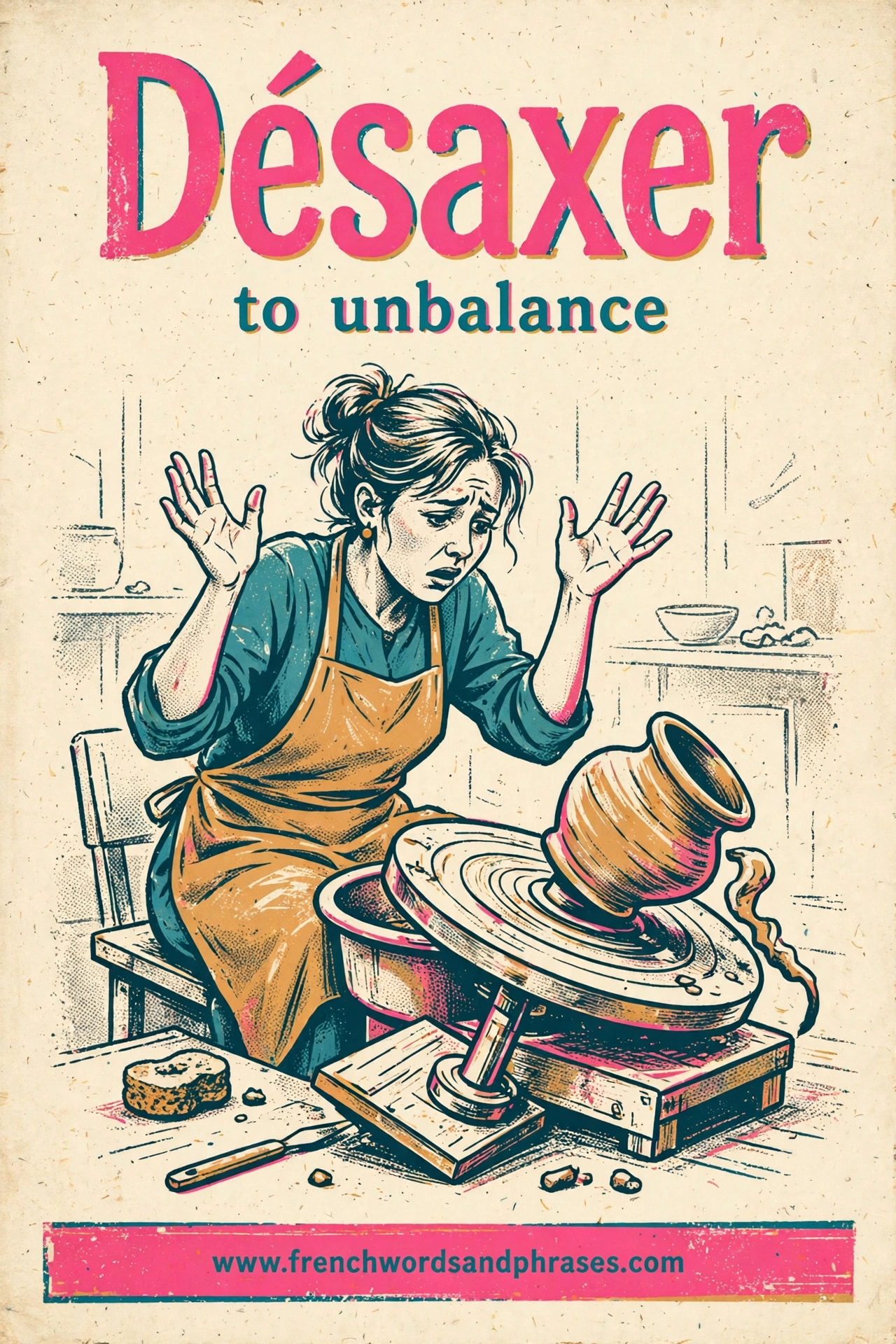
Désaxer means to unbalance — to knock a wheel, a mechanism or a mind off its axis, so that everything afterwards turns crooked.
A bicycle wheel knocked sideways in its frame, a spinning top wobbling to a fall, a quiet mind thrown off centre by one shock — désaxer is the verb of the axis lost: what once turned true now turns wrong.
In this guide, you’ll learn how to conjugate désaxer in all the major French tenses and moods. Explore complete conjugation tables, French examples, English translations, and practice quizzes.
Understanding the French Verb Désaxer
Désaxer is a regular French verb belonging to the first group of verbs, those ending in-er.
It means to unbalance. Mechanics désaxent wheels, shafts and tools that no longer turn true; psychologists and novelists use the figurative sense for minds knocked off balance by shock, grief or obsession — un esprit désaxé is a mind whose axis is gone.
Verb classification: First group (-er)
Auxiliary verb: Avoir
Past participle: désaxé
Present participle: désaxant
English equivalents: To put out of true, to throw off centre, to unbalance; désaxer une roue — to knock a wheel out of true; désaxer un mécanisme — to throw a mechanism off its axis; désaxer quelqu’un — to unsettle, to unbalance someone (figurative).
One important detail: désaxer is built on un axe, an axle or axis, with the undoing prefix dés- — to désaxer is to knock something off its axis. The x is pronounced /gz/ at the start of the word’s second syllable: dé-za-xer. The verb is fully regular: je désaxe, nous désaxons, ils désaxent, past participle désaxé. A person described as désaxé is unbalanced in the mental sense — the adjective has wandered far from the workshop, like English ‘unhinged’.
Experience the Word
Désaxer is the verb of the wobble — the instant true rotation becomes a limp, in a wheel or in a life.
Imagine a cyclist who clips a kerb on a quiet street. He stays upright, nothing breaks — but the front wheel now rubs the fork at every turn, whirr, whirr, whirr. Le choc a désaxé la roue: three millimetres of crookedness, and the whole ride home is an argument with the machine.
The wheel still turns and the bike still rides. It has only been knocked off its axis — désaxée — and everything true about it is slightly wrong.
How to Conjugate Désaxer: Complete French Conjugation Guide
Let’s explore every major conjugation of désaxer, beginning with the indicative mood.
How to Conjugate Désaxer in the Indicative Mood
The indicative mood is used to express facts, observations, actions, and events.
How to Conjugate Désaxer in the Present Tense (Présent)
Used for actions happening now, habitual actions, and general truths.
| Subject | Conjugation |
|---|---|
| je | désaxe |
| tu | désaxes |
| il / elle | désaxe |
| nous | désaxons |
| vous | désaxez |
| ils / elles | désaxent |
Example
Ce choc désaxe la roue avant du vélo.
This impact knocks the bike’s front wheel out of true.
Quick Quiz 1
Complete the sentence:
Nous ______ les roues sur ces mauvais chemins.
Reveal the answer
désaxons
Nous désaxons les roues sur ces mauvais chemins.
We knock the wheels out of true on these bad roads.
How to Conjugate Désaxer in the Passé Composé
Used for completed actions in the past. Désaxer takes the auxiliary verb avoir.
| Subject | Conjugation |
|---|---|
| j’ | ai désaxé |
| tu | as désaxé |
| il / elle | a désaxé |
| nous | avons désaxé |
| vous | avez désaxé |
| ils / elles | ont désaxé |
Example
La chute a désaxé le mécanisme de la pendule.
The fall threw the clock’s mechanism off its axis.
How to Conjugate Désaxer in the Imparfait (Imperfect Tense)
Used for habitual past actions, descriptions, and ongoing situations in the past.
| Subject | Conjugation |
|---|---|
| je | désaxais |
| tu | désaxais |
| il / elle | désaxait |
| nous | désaxions |
| vous | désaxiez |
| ils / elles | désaxaient |
Example
Les nids-de-poule désaxaient les roues des vieilles voitures.
Potholes used to knock the wheels of old cars out of true.
Quick Quiz 2
Choose the correct form:
The scandal threw his life off balance.
Le scandale ______ sa vie. (a désaxé / est désaxé)
Reveal the answer
a désaxé
Le scandale a désaxé sa vie.
Désaxer takes avoir.
How to Conjugate Désaxer in the Plus-que-parfait
Used to describe an action that had already been completed before another past event.
| Subject | Conjugation |
|---|---|
| j’ | avais désaxé |
| tu | avais désaxé |
| il / elle | avait désaxé |
| nous | avions désaxé |
| vous | aviez désaxé |
| ils / elles | avaient désaxé |
Example
Le scandale avait désaxé toute sa vie tranquille.
The scandal had thrown his whole quiet life off balance.
How to Conjugate Désaxer in the Passé Simple
Primarily used in formal writing, literature, and historical narratives. It is rarely used in everyday conversation.
| Subject | Conjugation |
|---|---|
| je | désaxai |
| tu | désaxas |
| il / elle | désaxa |
| nous | désaxâmes |
| vous | désaxâtes |
| ils / elles | désaxèrent |
Example
Un seul coup désaxa l’arbre de la machine.
A single blow knocked the machine’s shaft off its axis.
How to Conjugate Désaxer in the Passé Antérieur
A literary tense used to express an action completed immediately before another past action, generally in the passé simple.
| Subject | Conjugation |
|---|---|
| j’ | eus désaxé |
| tu | eus désaxé |
| il / elle | eut désaxé |
| nous | eûmes désaxé |
| vous | eûtes désaxé |
| ils / elles | eurent désaxé |
Example
Quand le choc eut désaxé la toupie, elle tomba en tournoyant.
When the knock had thrown the top off its axis, it fell spinning.
How to Conjugate Désaxer in the Future Tense (Futur Simple)
Used to describe actions that will take place in the future.
| Subject | Conjugation |
|---|---|
| je | désaxerai |
| tu | désaxeras |
| il / elle | désaxera |
| nous | désaxerons |
| vous | désaxerez |
| ils / elles | désaxeront |
Example
Ce trou dans la route désaxera encore bien des roues.
That hole in the road will knock many more wheels out of true.
How to Conjugate Désaxer in the Futur Antérieur (Future Perfect)
Used for an action that will have been completed before a particular point in the future.
| Subject | Conjugation |
|---|---|
| j’ | aurai désaxé |
| tu | auras désaxé |
| il / elle | aura désaxé |
| nous | aurons désaxé |
| vous | aurez désaxé |
| ils / elles | auront désaxé |
Example
À force de chocs, ils auront désaxé tout le mécanisme.
With so many knocks, they will have thrown the whole mechanism off centre.
How to Conjugate Désaxer in the Near Future (Futur Proche)
Used to describe something that is going to happen soon. Formed with aller + infinitive.
| Subject | Conjugation |
|---|---|
| je | vais désaxer |
| tu | vas désaxer |
| il / elle | va désaxer |
| nous | allons désaxer |
| vous | allez désaxer |
| ils / elles | vont désaxer |
Example
Tu vas désaxer ta roue si tu sautes les trottoirs ainsi.
You are going to knock your wheel out of true if you jump kerbs like that.
How to Conjugate Désaxer in the Conditional Mood
The conditional mood expresses what would happen under certain circumstances. It is also frequently used to make polite requests or express wishes.
How to Conjugate Désaxer in the Present Conditional
| Subject | Conjugation |
|---|---|
| je | désaxerais |
| tu | désaxerais |
| il / elle | désaxerait |
| nous | désaxerions |
| vous | désaxeriez |
| ils / elles | désaxeraient |
Example
Un choc plus fort désaxerait complètement l’essieu.
A harder impact would throw the axle completely off centre.
How to Conjugate Désaxer in the Past Conditional
| Subject | Conjugation |
|---|---|
| j’ | aurais désaxé |
| tu | aurais désaxé |
| il / elle | aurait désaxé |
| nous | aurions désaxé |
| vous | auriez désaxé |
| ils / elles | auraient désaxé |
Example
Elle aurait désaxé le mécanisme avec un marteau si lourd.
She would have knocked the mechanism off its axis with such a heavy hammer.
Désaxer in the Literary Past Conditional Form
This less common literary form uses the imperfect subjunctive of avoir.
| Subject | Conjugation |
|---|---|
| j’ | eusse désaxé |
| tu | eusses désaxé |
| il / elle | eût désaxé |
| nous | eussions désaxé |
| vous | eussiez désaxé |
| ils / elles | eussent désaxé |
Example
Le malheur eût désaxé les esprits les plus fermes.
Misfortune would have unbalanced the firmest minds.
How to Conjugate Désaxer in the Subjunctive Mood
The subjunctive is used to express wishes, emotions, doubts, necessity, and uncertainty. It frequently follows expressions such as il faut que (it is necessary that) or bien que (although).
How to Conjugate Désaxer in the Present Subjunctive
| Subject | Conjugation |
|---|---|
| que je | désaxe |
| que tu | désaxes |
| qu’il / qu’elle | désaxe |
| que nous | désaxions |
| que vous | désaxiez |
| qu’ils / qu’elles | désaxent |
Example
Il est possible que ce choc désaxe la roue arrière.
It is possible this impact may knock the rear wheel out of true.
Quick Quiz 3
Complete the sentence using the subjunctive:
Je crains que vous ______ le mécanisme en le transportant.
Reveal the answer
désaxiez
Je crains que vous désaxiez le mécanisme en le transportant.
I fear you may throw the mechanism off its axis carrying it.
How to Conjugate Désaxer in the Imperfect Subjunctive
A literary tense, rarely encountered in modern spoken French.
| Subject | Conjugation |
|---|---|
| que je | désaxasse |
| que tu | désaxasses |
| qu’il / qu’elle | désaxât |
| que nous | désaxassions |
| que vous | désaxassiez |
| qu’ils / qu’elles | désaxassent |
Example
Je craignais qu’il désaxât la machine en la transportant.
I feared he might throw the machine off its axis carrying it.
How to Conjugate Désaxer in the Pluperfect Subjunctive
A literary construction used to express an action completed before another past action.
| Subject | Conjugation |
|---|---|
| que j’ | eusse désaxé |
| que tu | eusses désaxé |
| qu’il / qu’elle | eût désaxé |
| que nous | eussions désaxé |
| que vous | eussiez désaxé |
| qu’ils / qu’elles | eussent désaxé |
Example
On racontait que la guerre eût désaxé toute une génération.
People said the war had unbalanced a whole generation.
How to Conjugate Désaxer in the Past Subjunctive
| Subject | Conjugation |
|---|---|
| que j’ | aie désaxé |
| que tu | aies désaxé |
| qu’il / qu’elle | ait désaxé |
| que nous | ayons désaxé |
| que vous | ayez désaxé |
| qu’ils / qu’elles | aient désaxé |
Example
Je regrette que l’accident ait désaxé son existence entière.
I regret that the accident threw his whole existence off balance.
How to Conjugate Désaxer in the Imperative
The imperative is used to give commands, instructions, invitations, or suggestions. Subject pronouns are omitted.
How to Conjugate Désaxer in the Present Imperative
| Person | Conjugation |
|---|---|
| (tu) | désaxe |
| (nous) | désaxons |
| (vous) | désaxez |
Example
Ne désaxe pas la roue, descends du vélo pour les trottoirs !
Do not knock the wheel out of true; get off the bike for kerbs!
Quick Quiz 4
How would you say Do not knock your wheel out of true (tu form)?
Reveal the answer
Ne désaxe pas ta roue !
French Participles of Désaxer
Participles are verb forms that can be used in compound tenses and other grammatical constructions.
Present Participle of Désaxer
désaxant
En désaxant la toupie, l’enfant l’a fait tomber aussitôt.
By knocking the top off its axis, the child made it fall at once.
Past Participle of Désaxer
désaxé
Désaxée par le choc, la roue frotte contre la fourche.
Knocked out of true by the impact, the wheel rubs against the fork.
Désaxer in Everyday French: Real-Life Examples
Now that you know the conjugations, let’s see how désaxer appears in everyday French.
Example 1 — Present
Ce choc désaxe la roue du vélo.
This impact knocks the bike wheel out of true.
Example 2 — Passé composé
La chute a désaxé le mécanisme.
The fall threw the mechanism off its axis.
Example 3 — Imparfait
Les nids-de-poule désaxaient les roues.
Potholes used to knock wheels out of true.
Example 4 — Future
Ce trou désaxera encore des roues.
That hole will knock more wheels out of true.
Example 5 — Conditional
Un choc plus fort désaxerait l’essieu.
A harder blow would throw the axle off centre.
Example 6 — Imperative
Ne désaxe pas ta roue sur les trottoirs !
Do not knock your wheel out of true on the kerbs!
Beyond Translation: The Meaning of Désaxer
English unbalance covers the mind better than the machine; French désaxer starts in the workshop, with un axe — the axle everything turns on — and carries the picture into psychology intact.
A désaxé mind is a wheel off its axis.
That is the metaphor’s quiet precision: the désaxé person still turns, still functions — but everything rubs, everything wobbles, because the centre no longer holds the rim true.
How to Remember the French Verb Désaxer
Remember it this way: Désaxer is about the bicycle wheel rubbing the fork, whirr, whirr, all the way home.
- Un axe is an axle: désaxer knocks a thing off its axis — wheel first, mind second.
- The x sounds /gz/: dé-gza-xer, and the adjective désaxé means mentally unbalanced.
- Regular -er: je désaxe, nous désaxons, past participle désaxé.
The key idea is the bicycle wheel rubbing the fork, whirr, whirr, all the way home.
Test Your Knowledge of Désaxer
Let’s see how much you’ve learned. Try answering these questions before revealing the answers.
Question 1
What object sits at the heart of désaxer?
Reveal the answer
Un axe — an axle or axis; to désaxer is to knock something off its axis.
Question 2
How do you say This impact knocks the wheel out of true in French?
Reveal the answer
Ce choc désaxe la roue.
Question 3
Translate: The fall threw the clock’s mechanism off its axis.
Reveal the answer
La chute a désaxé le mécanisme de la pendule.
Question 4
What is the past participle of désaxer?
Reveal the answer
Désaxé — also the adjective for a mentally unbalanced person.
Question 5
Complete the sentence:
Il est possible que ce choc ______ la roue arrière.
Reveal the answer
désaxe
Il est possible que ce choc désaxe la roue arrière.
It is possible this impact may knock the rear wheel out of true.
Your Final Challenge
Can You Use It?
How would you say this in French?
A trifle knocks a wheel or a life off its axis; the whole art lies in finding one’s centre again.
Reveal the answer
Un rien désaxe une roue ou une vie ; tout l’art est de retrouver son centre.
A trifle knocks a wheel or a life off its axis; the whole art lies in finding one’s centre again.
A little French. A little curiosity. A richer everyday life.
LEARN FRENCH ONE WORD AT A TIME