A French Word to Live By
Translate Immense to English
/imɑ̃s/
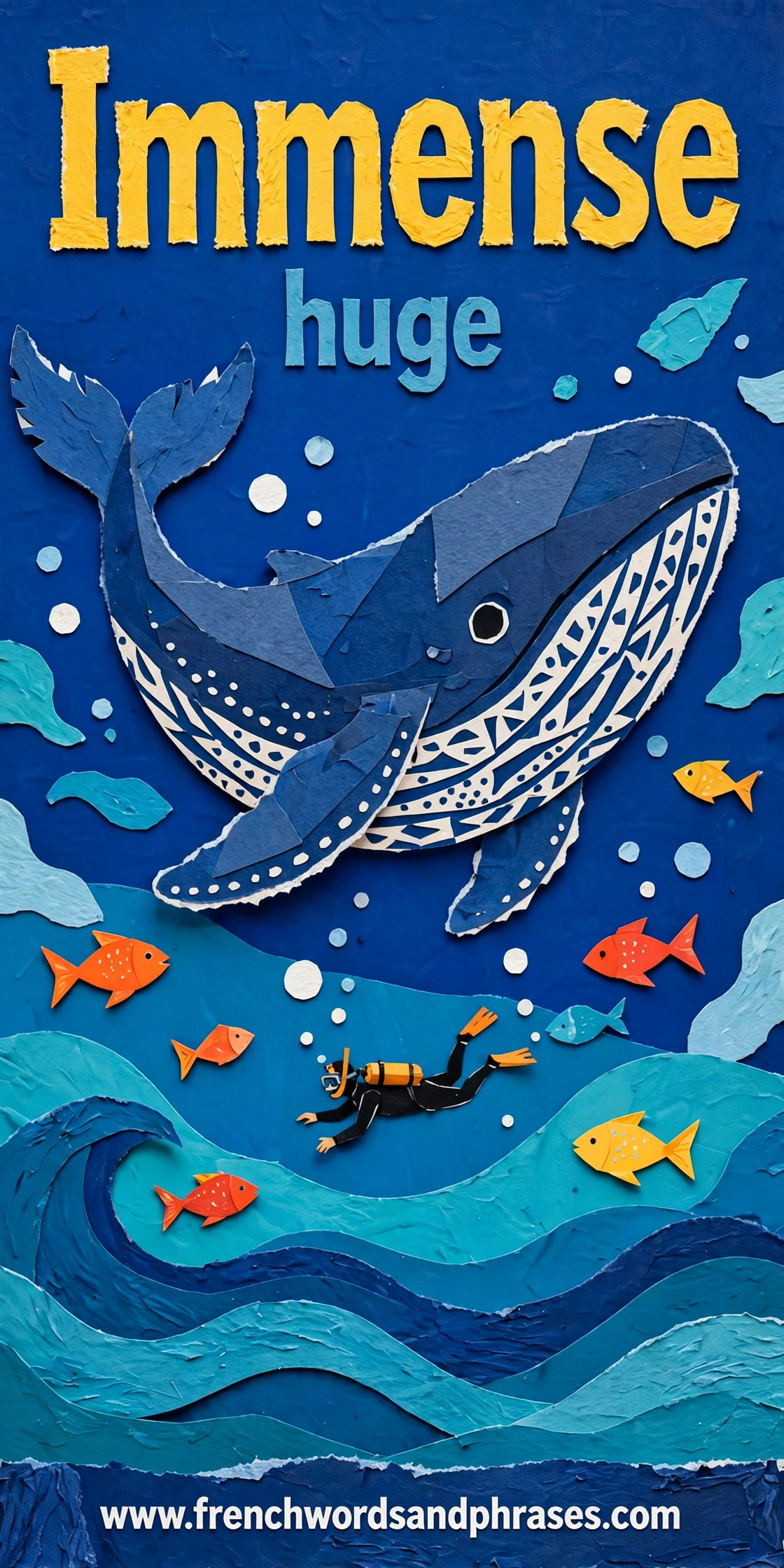
Immense means huge.
Stand at the entrance of a cathedral on a winter morning and the word comes to your lips unbidden — not big, not large, but immense: the vault lost above you, the windows taller than houses, the whole stone ship of the place sailing in silence. Some towns are built around one such word.
In this guide, you’ll learn what immense means in English, why it never changes between masculine and feminine, where it stands in the sentence, and how it differs from grand, its everyday rival for describing big things. Explore French examples, English translations, and practice quizzes.
Understanding the French Adjective Immense
Immense is a French adjective of quality — the adjective of very great size. It already ends in -e, so masculine and feminine are identical: only the plural adds an s. Un parc immense, une place immense, des espaces immenses — one form does almost all the work.
It means huge — immense, enormous. It describes places (une place immense, a huge square; un parc immense, a huge park; une ville immense, a huge city) and things (un immeuble immense, a huge building). Grand means big or tall; immense means so big it surprises — the word for cathedrals, harbours and squares that swallow the crowd.
Type: Adjective of quality — great size
Answers the question: What is it like? — huge
Changes form: Only in the plural — immense / immenses, the same for masculine and feminine
Feminine: immense — identical
English equivalents: Huge; immense, enormous.
One important usage detail: immense stands AFTER the noun — une place immense — and it is the word French reaches for when grand is not enough. A grand immeuble is a big building; un immeuble immense is a building that makes you look up twice.
Experience the Word
Immense is the adjective of the intake of breath — the first sight of a harbour full of cranes, a desert of a square in an old town, a market hall whose roof you cannot see the end of.
Imagine a child arriving in Paris and looking up at the dome of a great church: neck craned, mouth open, the whole building refusing to fit inside one glance. Nothing in the child’s village was ever immense. From today, immense has a size, and a memory.
You have not just described something big. You have said it stops you and makes you look.
How to Use Immense in French: Complete Guide
Let’s explore how immense works in French, beginning with the whole word on one card.
Immense at a Glance
Before the details, here is the whole word on one card.
The Whole Word on One Card
Meaning, type, position and forms — immense in four lines.
| Point | Immense |
|---|---|
| Meaning | huge |
| Type | adjective of quality — great size |
| Usual position | after the noun — une place immense |
| Form | immense for everyone — immenses in the plural |
Example
C’est une place immense.
It’s a huge square.
The Four Forms of Immense
Here is one of the easiest agreements in French: immense already ends in -e, so the feminine changes nothing. Only the plural adds an s.
| Form | Immense | Example |
|---|---|---|
| Masculine singular | immense | un parc immense — a huge park |
| Feminine singular | immense | une place immense — a huge square |
| Masculine plural | immenses | des parcs immenses — huge parks |
| Feminine plural | immenses | des places immenses — huge squares |
Example
Un parc immense et une place immense : la ville est immense.
A huge park and a huge square: the town is huge.
Quick Quiz 1
Does immense change for a feminine noun?
Reveal the answer
No
Un parc immense, une place immense — the form is identical.
A huge park, a huge square.
The Feminine of Immense: Nothing Changes
Most adjectives build their feminine by adding an e. Immense was born with one, so the feminine has nothing to add — a small holiday for learners.
| Situation | Example |
|---|---|
| Masculine | un immeuble immense — a huge building |
| Feminine | une place immense — identical |
| Why | immense already ends in -e, so the feminine adds nothing |
| The plural | add s — des espaces immenses, huge spaces |
Example
La place est immense, on s’y perd presque.
The square is huge, you almost get lost on it.
Where Immense Goes: After the Noun
Immense follows the noun it describes, like most French adjectives, and it sits comfortably after être. Adverbs slide in front of it without moving it.
| Pattern | Example |
|---|---|
| After the noun | une ville immense — a huge city |
| After être | ce parc est immense — this park is huge |
| With an adverb | une ville vraiment immense — a truly huge city |
| Before the noun | une immense ville — poetic only, not everyday French |
Example
C’est une cathédrale immense, on ne voit pas le plafond.
It’s a huge cathedral, you can’t see the ceiling.
Quick Quiz 2
How do you say ‘a huge park’ — un immense parc or un parc immense?
Reveal the answer
un parc immense
Immense stands after the noun.
A huge park.
Even More Immense: Comparing with Immense
Immense compares the regular way, with plus, moins and aussi — and the superlative keeps the same single form: le plus immense, la plus immense.
| Degree | Example |
|---|---|
| As huge as | aussi immense que — as huge as |
| More huge | plus immense — huger, more enormous |
| Less huge | moins immense — less huge |
| The most huge (masc.) | le plus immense — le plus immense des parcs |
| The most huge (fem.) | la plus immense — la plus immense des places |
Example
Cette place est plus immense que l’ancienne.
This square is huger than the old one.
Everyday Expressions with Immense
Immense lives in guidebooks and in the mouths of visitors who have just turned a corner and lost their breath — it is the word for the places that surprise by size.
| Expression | In English |
|---|---|
| une place immense | a huge square |
| un parc immense | a huge park |
| un immeuble immense | a huge building |
| un immense plaisir | an immense pleasure — the figurative use |
| une immense foule | a huge crowd |
| une immense différence | a huge difference |
Example
Quelle immense différence entre les deux quartiers !
What a huge difference between the two neighbourhoods!
Quick Quiz 3
What does un immense plaisir mean?
Reveal the answer
An immense pleasure
C’est un immense plaisir de te revoir.
It’s an immense pleasure to see you again.
Immense and Its Neighbours
Immense shares the scale with énorme and gigantesque; at the other end, petit and minuscule are where huge goes to shrink.
| French | In English |
|---|---|
| énorme | enormous, huge — the everyday twin |
| gigantesque | gigantic — one step beyond immense |
| grand | big, tall — the ordinary word |
| vaste | vast, extensive — of spaces and regions |
| petit | small — the direct opposite |
| minuscule | tiny — the far opposite |
Example
Un parc immense, presque gigantesque, dans une petite ville.
A huge, almost gigantic park in a small town.
Watch Out: The Traps Around Immense
The traps here are the cousin grand, and the English word ‘immense’ tempting you to pronounce the French ending the English way.
| Trap | The truth |
|---|---|
| grand vs immense | grand is big; immense is huge, astonishingly big — a matter of scale |
| Saying it | immense is pronounced /imɑ̃s/ — one syllable of vowel, ending in a clear s |
| Agreement | do not add a second e — une femme immense is wrong; immense never takes one |
| Figurative | immense also measures feelings: un immense plaisir, une immense joie |
Example
Le jardin est grand, mais le parc de la ville est immense.
The garden is big, but the town park is huge.
Quick Quiz 4
How do you say ‘a huge city’?
Reveal the answer
une ville immense
Immense follows the noun and does not change.
A huge city.
Immense in Everyday French: Real-Life Examples
Now that you know the word, let’s see how immense appears in everyday French.
Example 1 — A square
La place immense est le cœur de la vieille ville.
The huge square is the heart of the old town.
Example 2 — A park
Nous avons passé l’après-midi dans le parc immense.
We spent the afternoon in the huge park.
Example 3 — A city
C’est une ville immense, on ne peut pas tout voir en un jour.
It’s a huge city, you can’t see everything in one day.
Example 4 — A cathedral
La cathédrale est immense, avec des vitraux magnifiques.
The cathedral is huge, with magnificent stained-glass windows.
Example 5 — A building
L’immeuble immense domine tout le quartier.
The huge building towers over the whole neighbourhood.
Example 6 — A crowd
Une foule immense se pressait sur la place.
A huge crowd pressed onto the square.
Beyond Translation: The Meaning of Immense
English says huge for the meaning of immense — and French keeps the Latin mensura, measure, inside the word: im-mense is un-measured, beyond measure. A place immense is a place no measure has yet managed to hold.
To call a square immense is to admit that the tape measure has given up.
And the word is equally at home with the invisible: un immense plaisir, une immense joie — joy and pleasure, too, can be too big to measure, and French lets them borrow the same adjective.
How to Remember the French Adjective Immense
Remember it this way: Immense is the beyond-measure adjective — one form for him and her, an s for the plural, and its place quietly behind the noun.
- You see one form for everyone — un parc immense, une place immense.
- You add only an s in the plural — des parcs immenses, des places immenses.
- You use it when grand is not enough — immense is the size that surprises.
The key idea is immense means huge, beyond measure, and it never changes except in the plural.
Test Your Knowledge of Immense
Let’s see how much you’ve learned. Try answering these questions before revealing the answers.
Question 1
What does immense mean?
Reveal the answer
Huge — immense, enormous, beyond measure.
Question 2
What is the feminine of immense?
Reveal the answer
immense — identical. The word already ends in -e.
Question 3
Translate: a huge square.
Reveal the answer
Une place immense.
Question 4
Complete the sentence:
C’est une ville ______ , on ne peut pas tout voir en un jour.
Reveal the answer
immense
C’est une ville immense, on ne peut pas tout voir en un jour.
It’s a huge city, you can’t see everything in one day.
Question 5
How does immense differ from grand?
Reveal the answer
Immense is bigger — grand means big; immense means so big it surprises.
Your Final Challenge
Can You Use It?
How would you say this in French?
“The huge square is the heart of the old town.”
Reveal the answer
La place immense est le cœur de la vieille ville.
The huge square is the heart of the old town.
A little French. A little curiosity. A richer everyday life.
LEARN FRENCH ONE WORD AT A TIME