A French Word to Live By
Translate Vexé to English
/vɛkse/
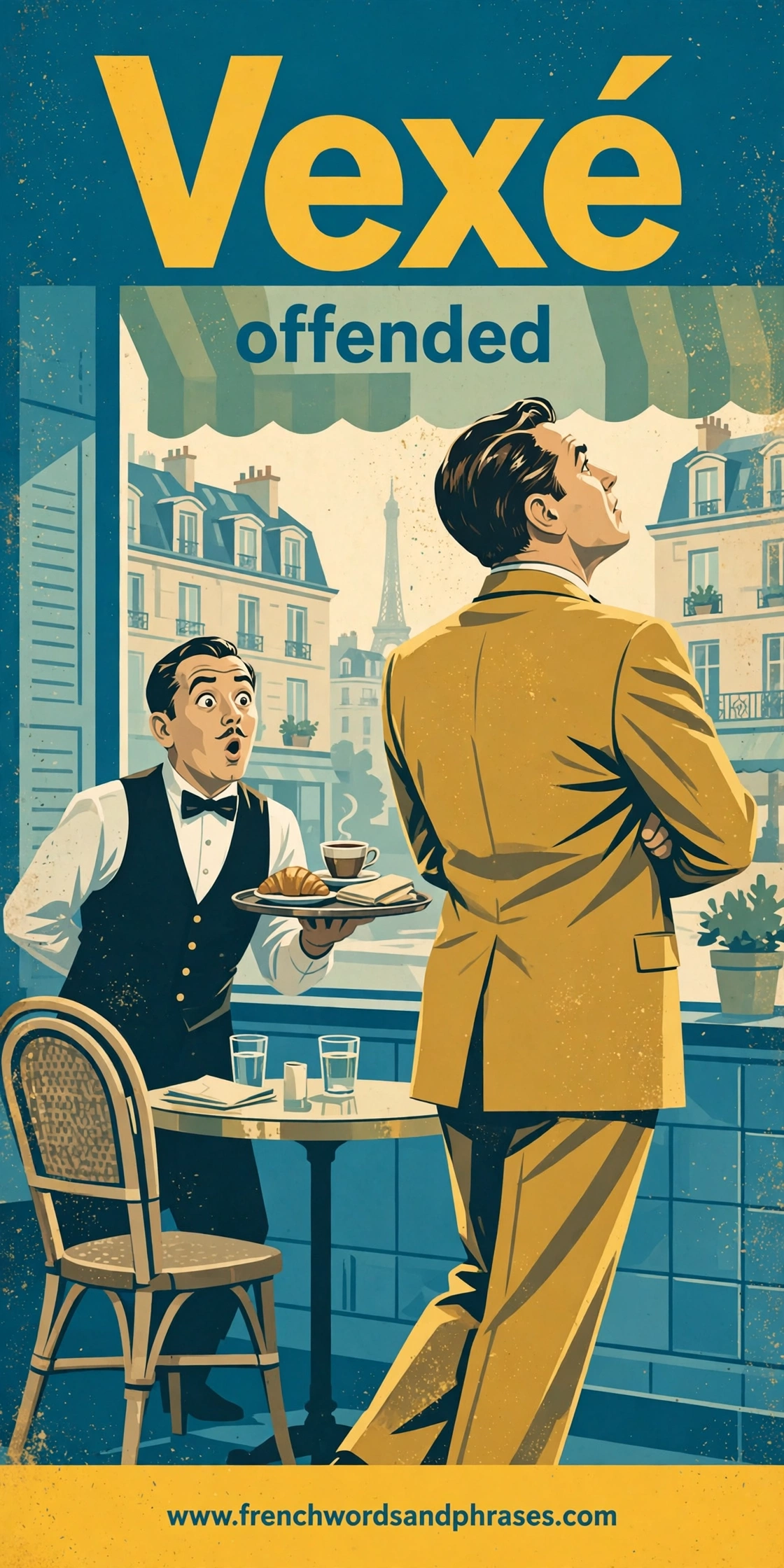
Vexé means offended.
A dinner party, a joke told a little too loudly, and one guest who has suddenly gone quiet. He smiles when spoken to, but the smile does not reach his eyes, and his glass stays exactly where he put it down. Nobody else noticed the joke land. He did. He is vexé.
In this guide, you’ll learn what vexé means in English, how its regular feminine is formed, why it is a smaller, touchier feeling than furious, and how French asks the delicate question — tu es vexé ? Explore French examples, English translations, and practice quizzes.
Understanding the French Adjective Vexé
Vexé is a French adjective of quality — the adjective of pricked pride. It is the past participle of vexer, to offend or annoy, and it agrees in the regular -é way: vexé, vexée, vexés, vexées.
It means offended — hurt or annoyed because something said or done has stung your pride. It describes guests after a clumsy joke (il est vexé, he is offended), children after a tease, and colleagues after a careless remark. Vexé is not fury: it is the smaller, quieter wound — the crossed arms and the short answers that say a remark has landed badly.
Type: Adjective of quality — feelings and pride
Answers the question: What is he or she like? — offended
Changes form: Yes — vexé, vexée, vexés, vexées
Feminine: vexée
English equivalents: Offended; annoyed; put out.
One important usage detail: vexé lives after être — elle est vexée — and the cause arrives with par or contre: vexé par sa remarque (offended by his remark), vexé contre moi (offended with me). And French asks it gently, half-smiling: Tu ne vas pas te vexer ? — you’re not going to take offence, are you?
Experience the Word
Vexé is the adjective of the suddenly quiet guest — the feeling is real, but it is pride that is bruised, not the heart that is broken.
Imagine a little brother who has been teased about his new haircut at lunch. He eats in silence, pushes his peas around the plate, and answers every question with a shrug. By dessert he will have forgiven everyone — but the peas have had a difficult afternoon.
You have not just described anger. You have described pride asking to be apologised to.
How to Use Vexé in French: Complete Guide
Let’s explore how vexé works in French, beginning with the whole word on one card.
Vexé at a Glance
Before the details, here is the whole word on one card.
The Whole Word on One Card
Meaning, type, position and forms — vexé in four lines.
| Point | Vexé |
|---|---|
| Meaning | offended |
| Type | adjective of quality — feelings and pride |
| Usual position | after être — il est vexé par la remarque |
| Form | vexé / vexée / vexés / vexées |
Example
Il est vexé par ta remarque.
He is offended by your remark.
The Four Forms of Vexé
Vexé agrees with the person who is offended, following the regular pattern of adjectives in -é: the feminine adds an e, the plurals add an s.
| Form | Vexé | Example |
|---|---|---|
| Masculine singular | vexé | un invité vexé — an offended guest |
| Feminine singular | vexée | une invitée vexée — an offended guest |
| Masculine plural | vexés | des invités vexés — offended guests |
| Feminine plural | vexées | des invitées vexées — offended guests |
Example
Il est vexé et elle est vexée par la même remarque.
He is offended and she is offended by the same remark.
Quick Quiz 1
Which form of vexé goes with invitée (feminine)?
Reveal the answer
vexée
Une invitée vexée.
An offended guest.
Vexée: The Regular Feminine in -ée
The feminine of vexé is formed by adding a single e. It changes the spelling only — vexé and vexée sound exactly alike.
| Situation | Example |
|---|---|
| The rule | just add -e — vexé → vexée |
| The sound | vexé and vexée sound exactly the same: /vɛkse/ |
| Masculine plural | vexés — des collègues vexés |
| Feminine plural | vexées — des collègues vexées |
Example
Elle est vexée, elle ne répond plus aux messages.
She is offended, she no longer answers the messages.
Where Vexé Goes: After Être, with the Cause Behind It
Vexé follows être and the verbs of feeling, and the cause of the offence follows behind: par for the thing that stung, contre for the person it is aimed at.
| Pattern | Example |
|---|---|
| After être | il est vexé — he is offended |
| With par (the cause) | vexée par sa blague — offended by his joke |
| With contre (the person) | vexé contre moi — offended with me |
| Before the noun | un vexé invité — not in everyday French |
Example
Ne sois pas vexé, c’était une plaisanterie.
Don’t be offended, it was a joke.
Quick Quiz 2
How do you say ‘offended by his joke’?
Reveal the answer
vexé par sa blague
The cause of the offence follows vexé with par.
Offended by his joke.
More Offended: Comparing with Vexé
Vexé compares the regular way, with plus, moins and aussi — though in real life très vexé and un peu vexé do most of the measuring.
| Degree | Example |
|---|---|
| As offended as | aussi vexé que — as offended as |
| More offended | plus vexé — more offended |
| Less offended | moins vexé — less offended |
| The most offended (masc.) | le plus vexé — le plus vexé des invités |
| The most offended (fem.) | la plus vexée — la plus vexée des invitées |
Example
Elle est plus vexée que lui, c’est évident.
She is more offended than him, that’s obvious.
Everyday Expressions with Vexé
Around vexé gathers the delicate diplomacy of hurt pride — the questions that check, and the apologies that repair.
| Expression | In English |
|---|---|
| tu es vexé ? | are you offended? — asked gently, half-smiling |
| ne te vexe pas | don’t take offence |
| se vexer pour un rien | to take offence at the slightest thing |
| vexé comme un pou | deeply offended (literally, offended like a louse) — the comic old expression |
| sans vouloir te vexer | no offence intended, without wanting to offend you |
| un ton vexé | an offended tone of voice |
Example
Sans vouloir te vexer, ton texte a besoin d’être relu.
No offence intended, but your text needs rereading.
Quick Quiz 3
What does ne te vexe pas mean?
Reveal the answer
Don’t take offence
Ne te vexe pas, je plaisante.
Don’t take offence, I’m joking.
Vexé and Its Neighbours
Vexé sits in the middle of the scale of displeasure — above agacé, below furieux — with offensé as its formal twin and susceptible as the character trait behind it.
| French | In English |
|---|---|
| offensé | offended — the formal twin of vexé |
| agacé | annoyed, irritated — a step below vexé |
| blessé | hurt — deeper than vexé, of feelings |
| susceptible | touchy — quick to take offence |
| furieux | furious — far above vexé |
| indifférent | indifferent — the opposite: nothing lands |
Example
Il est susceptible et souvent vexé pour un rien.
He is touchy and often offended by the slightest thing.
Watch Out: The Traps Around Vexé
The traps here are scale and spelling: vexé is a bruise, not a battle, and its x is part of the word’s bones.
| Trap | The truth |
|---|---|
| Too strong? | vexé is mild — a stung pride, not rage; for rage, French says furieux |
| The x | vexé keeps its x in every form — vexée, vexés, vexées |
| se vexer | the reflexive verb se vexer means to take offence — il se vexe facilement |
| English ‘vexed’ | a false friend in tone: English vexed is bookish, French vexé is everyday |
Example
Il se vexe facilement, alors choisis tes mots.
He takes offence easily, so choose your words.
Quick Quiz 4
Is vexé a strong word like ‘furious’, or a milder one?
Reveal the answer
Milder
Vexé is a bruised pride — crossed arms, not shouting.
Il est vexé, pas furieux — he is offended, not furious.
Vexé in Everyday French: Real-Life Examples
Now that you know the word, let’s see how vexé appears in everyday French.
Example 1 — At dinner
Il est vexé parce qu’on a ri de sa blague.
He is offended because people laughed at his joke.
Example 2 — Between friends
Ne te vexe pas, je te taquine.
Don’t take offence, I’m teasing you.
Example 3 — At work
Elle est vexée par la remarque de son chef.
She is offended by her boss’s remark.
Example 4 — Family
Mon frère se vexe pour un rien.
My brother takes offence at the slightest thing.
Example 5 — An apology
Je suis désolé, je ne voulais pas te vexer.
I’m sorry, I didn’t mean to offend you.
Example 6 — Children
L’enfant est vexé, il boude dans son coin.
The child is offended, he’s sulking in his corner.
Beyond Translation: The Meaning of Vexé
English says offended for the meaning of vexé — but the French word keeps the scale honest: vexé is the small change of wounded feelings, the offence that an apology and a coffee can usually repair.
To be vexé is to wait, arms crossed, for the excuse you deserve.
French even keeps a comic old measure for it — vexé comme un pou, offended like a louse — because a feeling this common, and this curable, has earned the right to be smiled at.
How to Remember the French Adjective Vexé
Remember it this way: Vexé is the offended adjective — a bruise to pride rather than a storm, regular in -ée, and followed by par for the cause.
- You keep the scale small — vexé is crossed arms, furieux is the storm.
- You add only an e for the feminine — vexé, vexée, same sound.
- You name the cause with par — vexée par sa remarque.
The key idea is vexé means mildly offended, its feminine vexée sounds identical, and the cause follows with par.
Test Your Knowledge of Vexé
Let’s see how much you’ve learned. Try answering these questions before revealing the answers.
Question 1
What does vexé mean?
Reveal the answer
Offended — hurt or annoyed by something that stung your pride.
Question 2
What is the feminine of vexé?
Reveal the answer
vexée — just add an e; the sound does not change.
Question 3
Translate: don’t take offence.
Reveal the answer
Ne te vexe pas.
Question 4
Complete the sentence:
Elle est ______ par sa remarque.
Reveal the answer
vexée
Elle est vexée par sa remarque.
She is offended by his remark.
Question 5
What does se vexer pour un rien mean?
Reveal the answer
To take offence at the slightest thing — literally, to get offended over nothing.
Your Final Challenge
Can You Use It?
How would you say this in French?
“He is offended, but a simple apology will be enough.”
Reveal the answer
Il est vexé, mais un simple pardon suffira.
He is offended, but a simple apology will be enough.
A little French. A little curiosity. A richer everyday life.
LEARN FRENCH ONE WORD AT A TIME