A French Word to Live By
Translate Bord to English
/bɔʁ/
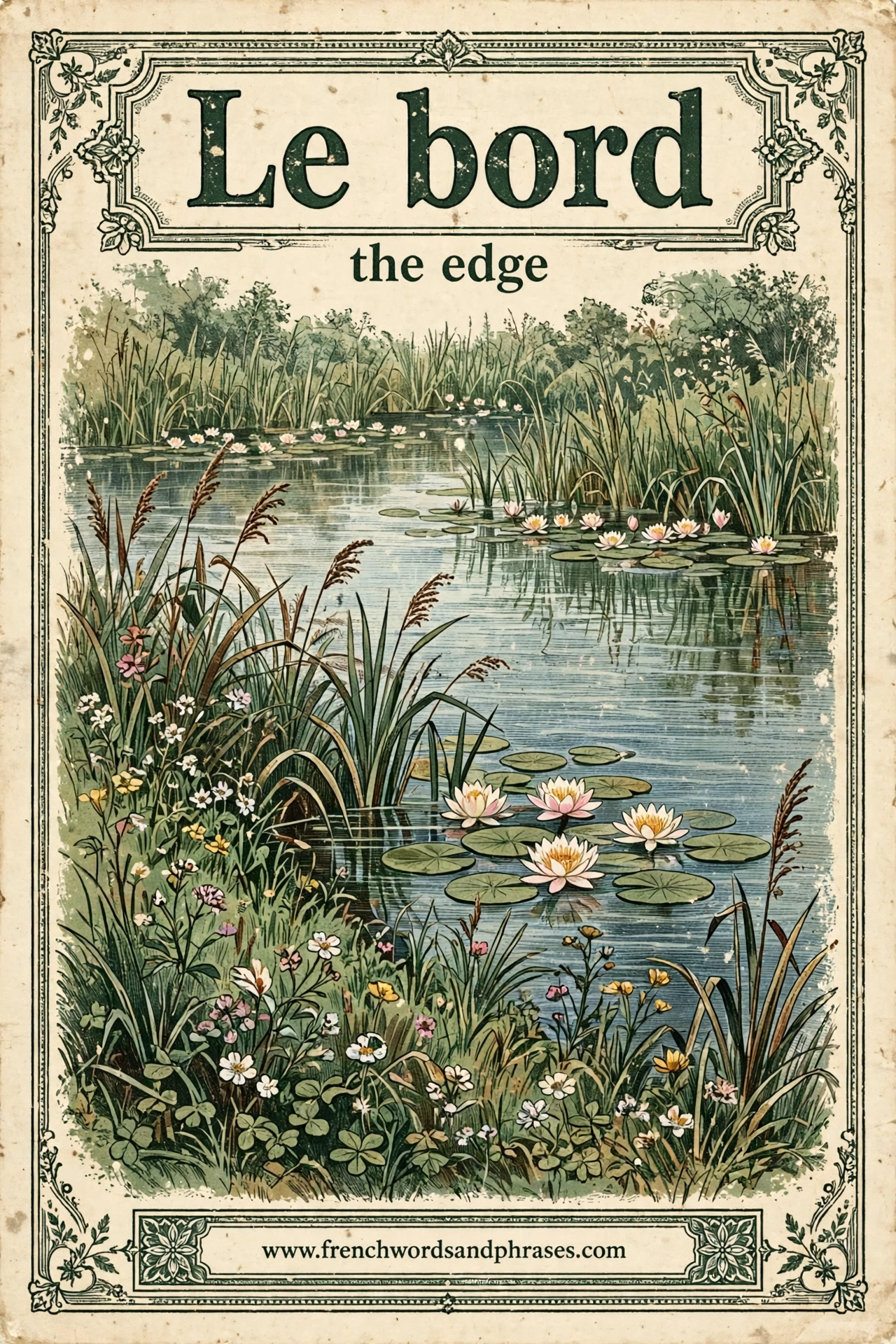
Le bord means the edge.
The boat slows, the harbour lights come closer, and the captain calls out the order everyone was waiting for: « Tout le monde à bord ! » But before anyone boards, look down — the water is lapping at le bord, the edge of the quay.
In this guide, you’ll learn what bord means in English, how to use it with its articles, how to form its plural, and how it appears in everyday French. Explore French examples, English translations, and practice quizzes.
Understanding the French Noun Bord
Bord is a masculine French noun, learned with its article: le bord, un bord. It names the edge of something — the rim of a plate, the side of a road, the bank of a river — and, by extension, the side of a ship, which is why à bord means on board.
It means the edge — the outer limit where a surface stops. Le bord de la table is the edge of the table, le bord de la mer is the seashore, and au bord de la route is at the side of the road. With the preposition au it also means on the verge of: au bord des larmes, on the verge of tears.
Gender: Masculine
Definite article: le — le bord (the edge)
Indefinite article: un — un bord (an edge)
Plural: les bords
English equivalents: The edge, the rim, the side, the bank; à bord — on board.
One important usage detail: à bord is the French for on board — à bord du train, à bord de l’avion, even à bord de la voiture. And the little word hides inside a word you already know: d’abord (first) is literally « of approach », from the old sense of bord as a coming alongside.
Experience the Word
Bord is the line where one world ends and another begins — the exact place where the land gives up and the sea takes over.
Imagine standing at the edge of a cliff path in Brittany: the grass stops, the rock drops away, and the Atlantic does the rest. You are standing au bord de la falaise, and French puts the thrill into two small words.
You have not just reached a limit. You are standing on the edge of things — au bord, where the view begins.
How to Use Bord in French: Complete Guide
Let’s explore how bord works in French, beginning with its articles — le bord, un bord — and the golden expression à bord.
Bord with the Definite Article (Le, Les)
Used for the edge everyone in the conversation can see — the rim of this table, the side of that road.
| Form | French |
|---|---|
| Masculine singular | le bord |
| Plural | les bords |
Example
Ne mets pas ton verre sur le bord de la table.
Don’t put your glass on the edge of the table.
Bord with the Indefinite Article (Un, Des)
Used for an edge in general — un bord, any edge at all.
| Form | French |
|---|---|
| Masculine singular | un bord |
| Plural | des bords |
Example
Ce vase a un bord très fin, presque coupant.
This vase has a very thin, almost sharp edge.
Around the Bord: Edges of Everyday Things
Tables, plates and roads — the bords you meet every day.
| French | In English |
|---|---|
| le bord de la table | the edge of the table |
| le bord de l’assiette | the rim of the plate |
| le bord de la route | the side of the road |
| le bord de la rivière | the bank of the river |
| le bord de la mer | the seashore, the seaside |
| le bord de la falaise | the edge of the cliff |
Example
Nous marchons le long du bord de la rivière.
We are walking along the bank of the river.
Quick Quiz 1
Complete the sentence:
Les enfants jouent sur ______ de la mer. (the edge)
Reveal the answer
le bord
Les enfants jouent sur le bord de la mer.
The children are playing at the seashore — le bord de la mer, the edge of the sea.
The Plural of Bord
Bord adds an -s in the plural — les bords, the edges or banks of something.
| Number | French |
|---|---|
| Singular | le bord |
| Plural | les bords |
Example
Les bords de la Seine sont parfaits pour se promener.
The banks of the Seine are perfect for a walk.
Bord with Possessive Adjectives (Mon, Ton, Son…)
Possessives agree with the noun — bord is masculine, so it takes mon, ton, son.
| Owner | French |
|---|---|
| my | mon bord |
| your (tu) | ton bord |
| his / her | son bord |
| our | notre bord |
| your (vous) | votre bord |
| their | leur bord |
Example
De mon bord de la table, je vois toute la pièce.
From my side of the table, I can see the whole room.
Quick Quiz 2
Complete the sentence:
______ bord de la route est dangereux pour les piétons. (This)
Reveal the answer
Ce
Ce bord de la route est dangereux pour les piétons.
This side of the road is dangerous for pedestrians.
Bord with Demonstrative Adjectives (Ce, Ces)
Used to point at one edge rather than another: ce bord-ci, this edge here.
| Form | French |
|---|---|
| Masculine singular | ce bord |
| Plural | ces bords |
Example
Tiens la planche par ce bord, il est plus solide.
Hold the plank by this edge, it is stronger.
Bord with Adjectives
Adjectives agree with bord — masculine forms, with the plural in -s.
| Adjective | With Bord |
|---|---|
| autre (other) | l’autre bord |
| premier (first) | le premier bord |
| droit (straight, right) | le bord droit |
| large (wide) | un bord large |
| mince (thin) | un bord mince |
Example
La voiture est garée sur l’autre bord de la route.
The car is parked on the other side of the road.
Quick Quiz 3
How do you say « on board the plane » in French?
Reveal the answer
À bord de l’avion
Bienvenue à bord de l’avion !
Welcome on board the plane — à bord is always the expression, for ships, trains and planes alike.
Everyday Expressions with Bord
Verge, seaside and shipboard — the bord phrases of daily life.
| Expression | In English |
|---|---|
| à bord | on board |
| au bord de la mer | at the seaside |
| au bord des larmes | on the verge of tears |
| au bord de la route | at the side of the road |
| de bord | ship’s, log — le journal de bord, the logbook |
| monter à bord | to go on board, to board |
Example
Après la longue marche, elle était au bord des larmes.
After the long walk, she was on the verge of tears.
Words from the Same Family as Bord
Edges, borders and overflows — the words that travel with bord.
| French | In English |
|---|---|
| border | to border, to edge, to tuck in |
| la bordure | the edging, the border, the kerb |
| déborder | to overflow, to spill over |
| d’abord | first, first of all |
| aborder | to approach, to tackle (a subject) |
| le débordement | the overflow, the overflowing |
Example
Attention, le lait va déborder !
Careful, the milk is about to boil over!
Quick Quiz 4
What does au bord des larmes mean?
Reveal the answer
On the verge of tears — au bord de places you right at the edge of a feeling.
En entendant la nouvelle, il était au bord des larmes.
On hearing the news, he was on the verge of tears.
Bord in Everyday French: Real-Life Examples
Now that you know the word, let’s see how bord appears in everyday French.
Example 1 — At the table
Ne laisse pas l’assiette sur le bord de la table.
Don’t leave the plate on the edge of the table.
Example 2 — By the sea
Nous passons nos vacances au bord de la mer.
We spend our holidays at the seaside.
Example 3 — On a journey
Les passagers montent à bord du train.
The passengers are boarding the train.
Example 4 — A near miss
La voiture s’arrête juste au bord de la falaise.
The car stops right at the edge of the cliff.
Example 5 — Strong feelings
Elle rit au bord des larmes de joie.
She is laughing on the verge of tears of joy.
Example 6 — A river walk
Un petit chemin suit les bords de la rivière.
A little path follows the banks of the river.
Beyond Translation: The Meaning of Bord
Bord began its life on ships: the bord was the side of the vessel, the planking between the deck and the water. From there it walked inland and became every edge in the language — of tables, of roads, of tears. French still smells the sea in it: the capitaine keeps his journal de bord, and every traveller, even in a car on the motorway, is à bord.
To say bord is to stand exactly where one thing finishes and another begins.
It evokes the white line of foam at the water’s edge, the rim of a grandmother’s plate, the last step before the drop — and the small daily drama of being au bord, right on the edge, of almost everything.
How to Remember the French Noun Bord
Remember it this way: Bord is the edge — the rim of a plate, the bank of a river, and the side of a ship, which is why à bord means on board.
- You look at a table — le bord de la table, the edge you must not put your glass on.
- You board anything — à bord : à bord du bateau, à bord de l’avion.
- You feel a feeling coming — au bord des larmes, on the verge of tears.
The key idea is le bord — the edge; à bord — on board.
Test Your Knowledge of Bord
Let’s see how much you’ve learned. Try answering these questions before revealing the answers.
Question 1
Is bord masculine or feminine?
Reveal the answer
Masculine — le bord, un bord.
Question 2
How do you say « on board » in French?
Reveal the answer
À bord — à bord du train, à bord de la voiture.
Question 3
Translate: The edge of the plate.
Reveal the answer
Le bord de l’assiette.
Question 4
What is la bordure?
Reveal the answer
The edging, the border — the strip that finishes an edge, from the same family as bord.
Question 5
Complete the sentence:
Nous dînons au ______ de la mer ce soir.
Reveal the answer
bord
Nous dînons au bord de la mer ce soir.
We are having dinner at the seaside this evening.
Your Final Challenge
Can You Use It?
How would you say this in French?
“The children play at the edge of the water.”
Reveal the answer
Les enfants jouent au bord de l’eau.
The children play at the edge of the water.
A little French. A little curiosity. A richer everyday life.
LEARN FRENCH ONE WORD AT A TIME