A French Word to Live By
Translate Cœur to English
/kœʁ/
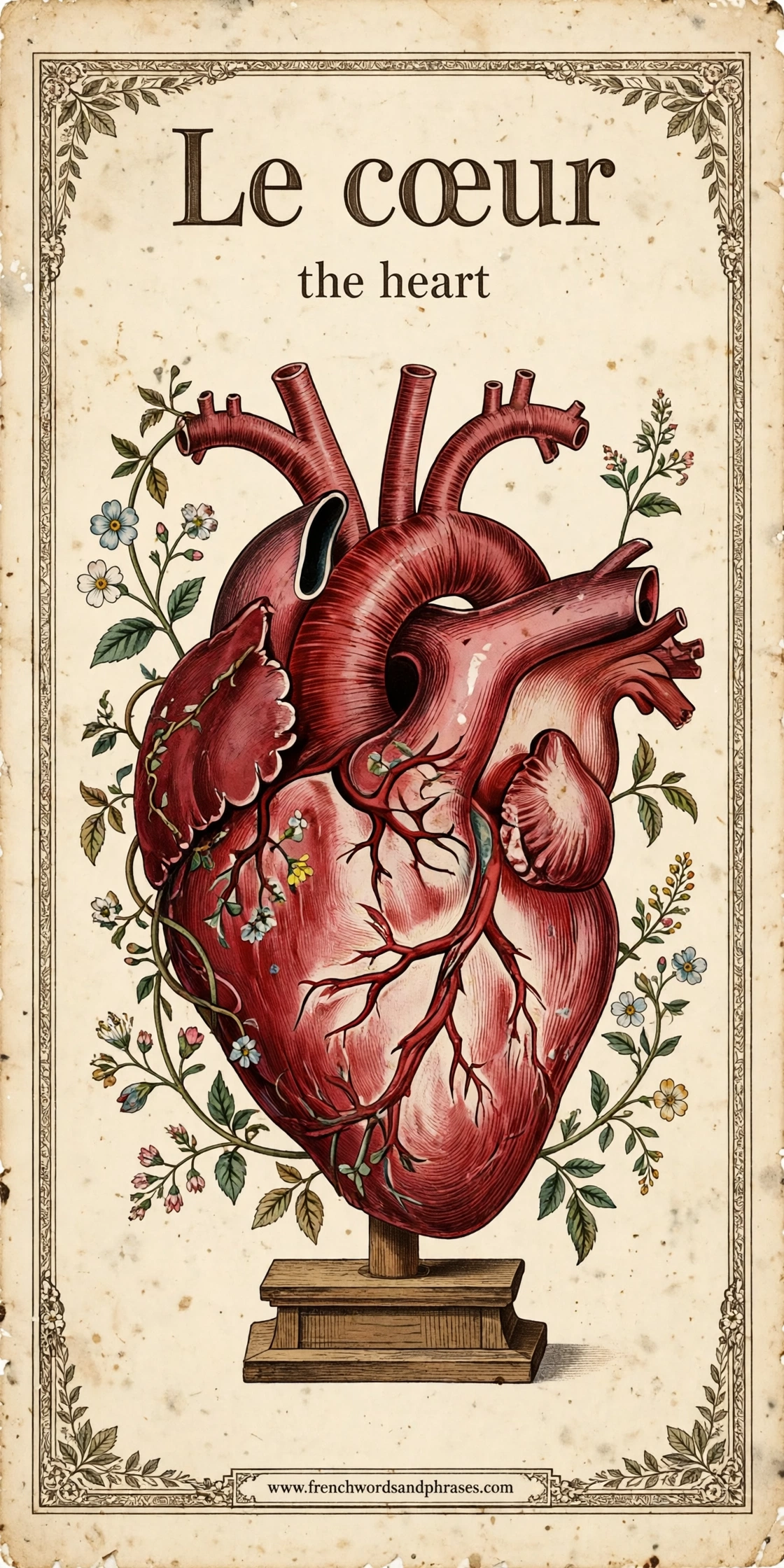
Le cœur means the heart.
A small hand grips a red crayon and draws, very carefully, the shape everyone recognises at once — two round shoulders and a point at the bottom: un cœur.
In this guide, you’ll learn what cœur means in English, how to use it with its articles, how to form its plural, and how it appears in everyday French. Explore French examples, English translations, and practice quizzes.
Understanding the French Noun Cœur
Cœur is a masculine French noun, learned with its article: le cœur, un cœur. Notice the spelling: the œ is a single letter, a ligature where o and e are written together — you will find it in every form of the word.
It means the heart — the organ that beats in your chest, and the shape that stands for love, courage and kindness. Cœur also names the middle of things: au cœur de la ville is right in the middle of the town, and apprendre par cœur is to learn something by heart.
Gender: Masculine
Definite article: le — le cœur (the heart)
Indefinite article: un — un cœur (a heart)
Plural: les cœurs
English equivalents: The heart; the core, the middle (au cœur de).
One important usage detail: par cœur means by heart — elle connaît la chanson par cœur, she knows the song by heart. And a generous person a le cœur sur la main, literally has their heart on their hand, ready to give.
Experience the Word
Cœur is the hardest-working shape in French. It beats, it loves, it breaks, it learns — and it sits in the middle of the town, the forest and the problem.
Imagine the classroom in February: red paper, scissors, glue, and thirty crooked paper hearts pinned to the wall, each one a little declaration.
You have not just drawn a shape. You have drawn the word French reaches for whenever feelings are involved.
How to Use Cœur in French: Complete Guide
Let’s explore how cœur works in French, beginning with its articles — and watch how one little word covers the organ, the shape and the centre of everything.
Cœur with the Definite Article (Le, Les)
Cœur is masculine: le cœur for one, les cœurs for several.
| Form | French |
|---|---|
| Singular | le cœur |
| Plural | les cœurs |
Example
Le cœur bat plus vite quand elle court.
The heart beats faster when she runs.
Cœur with the Indefinite Article (Un, Des)
Used for a heart in general — the shape you draw, or the heart someone has.
| Form | French |
|---|---|
| Singular | un cœur |
| Plural | des cœurs |
Example
Il a dessiné un cœur sur la carte.
He drew a heart on the card.
Around the Cœur: Words of the Heart
Beats, blood and doctors — the vocabulary that surrounds le cœur.
| French | In English |
|---|---|
| le battement | the beat, the heartbeat |
| le sang | the blood |
| la poitrine | the chest |
| battre | to beat |
| le cardiologue | the cardiologist, the heart doctor |
| amoureux | in love |
Example
Le médecin écoute les battements du cœur.
The doctor listens to the beats of the heart.
Quick Quiz 1
Complete the sentence:
Elle apprend le poème par ______.
Reveal the answer
cœur
Elle apprend le poème par cœur.
She is learning the poem by heart.
The Plural of Cœur
Cœur adds an -s in the plural — and the œ stays in every form.
| Number | French |
|---|---|
| Singular | le cœur |
| Plural | les cœurs |
Example
Les enfants découpent des cœurs en papier rouge.
The children are cutting out hearts from red paper.
Cœur with Possessive Adjectives (Mon, Ton, Son…)
Cœur is masculine, so it takes mon, ton, son — whatever the owner.
| Owner | French |
|---|---|
| my | mon cœur |
| your (tu) | ton cœur |
| his / her | son cœur |
| our | notre cœur |
| your (vous) | votre cœur |
| their | leur cœur |
Example
Mon cœur bat la chamade quand je la vois.
My heart pounds when I see her.
Quick Quiz 2
Complete the sentence:
Écoute ______ cœur avant de décider. (your, tu)
Reveal the answer
ton
Écoute ton cœur avant de décider.
Listen to your heart before deciding.
Cœur with Demonstrative Adjectives (Ce, Ces)
Used to point at one heart in particular: ce cœur, this heart.
| Form | French |
|---|---|
| Singular | ce cœur |
| Plural | ces cœurs |
Example
Ce cœur en chocolat est pour toi.
This chocolate heart is for you.
Cœur with Adjectives
Adjectives agree with cœur — masculine, so brisé, grand, généreux keep their masculine forms.
| Adjective | With Cœur |
|---|---|
| brisé (broken) | un cœur brisé |
| grand (big) | un grand cœur |
| généreux (generous) | un cœur généreux |
| de pierre (of stone) | un cœur de pierre |
| pur (pure) | un cœur pur |
Example
C’est une femme au grand cœur, toujours prête à aider.
She is a big-hearted woman, always ready to help.
Quick Quiz 3
What does « un cœur de pierre » describe?
Reveal the answer
A heart of stone — a person who feels nothing and shows no pity.
Rien ne le touche, il a un cœur de pierre.
Nothing moves him, he has a heart of stone.
Everyday Expressions with Cœur
The heart is everywhere in spoken French — learning, giving, and standing in the middle.
| Expression | In English |
|---|---|
| par cœur | by heart |
| au cœur de | in the middle of, in the heart of |
| avoir le cœur sur la main | to be generous, open-handed |
| de bon cœur | willingly, gladly |
| briser le cœur de quelqu’un | to break someone’s heart |
| à cœur ouvert | open-heart (surgery); frankly, openly |
Example
Le village se trouve au cœur de la forêt.
The village stands in the heart of the forest.
Words from the Same Family as Cœur
Latin cor, the heart, beats inside a whole family of French words.
| French | In English |
|---|---|
| cardiaque | cardiac, heart-related |
| le cardiologue | the cardiologist |
| cordial | cordial, warm and friendly |
| le courage | courage — bravery of the heart |
| encourager | to encourage |
| décourager | to discourage |
Example
Il faut du courage pour parler en public.
It takes courage to speak in public.
Quick Quiz 4
How do you say « to learn by heart » in French?
Reveal the answer
Apprendre par cœur.
Les acteurs apprennent leur texte par cœur.
Actors learn their lines by heart.
Cœur in Everyday French: Real-Life Examples
Now that you know the word, let’s see how cœur appears in everyday French.
Example 1 — A drawing
L’enfant dessine un cœur rouge sur sa carte.
The child is drawing a red heart on his card.
Example 2 — At the doctor’s
Le médecin écoute le cœur du patient.
The doctor is listening to the patient’s heart.
Example 3 — Learning
Elle connaît la chanson par cœur.
She knows the song by heart.
Example 4 — Feelings
Ce film triste lui a brisé le cœur.
That sad film broke her heart.
Example 5 — In the middle
L’hôtel se trouve au cœur du vieux quartier.
The hotel stands in the heart of the old quarter.
Example 6 — Kindness
C’est un homme au grand cœur.
He is a big-hearted man.
Beyond Translation: The Meaning of Cœur
Cœur comes from the Latin cor, and French never let the heart rest: it is the seat of love (un coup de cœur, a sudden crush on a thing or a place), of memory (par cœur), of courage (le courage is literally heart-ness) and of geography (au cœur de).
To learn cœur is to hold the key to a dozen French expressions at once.
It evokes Valentine cards and hospital monitors, village squares at the heart of the valley, and the quiet pride of knowing a poem par cœur — by heart, where French keeps everything that matters.
How to Remember the French Noun Cœur
Remember it this way: Cœur is the heart — and in French the heart is also the middle of things, and the home of courage.
- You feel it beat — le cœur bat.
- You learn it by heart — apprendre par cœur.
- You stand in the middle — au cœur de la ville.
The key idea is le cœur — it beats, it loves, it is the middle.
Test Your Knowledge of Cœur
Let’s see how much you’ve learned. Try answering these questions before revealing the answers.
Question 1
Is cœur masculine or feminine?
Reveal the answer
Masculine — le cœur, un cœur.
Question 2
Translate: She knows the song by heart.
Reveal the answer
Elle connaît la chanson par cœur.
Question 3
What does « au cœur de la forêt » mean?
Reveal the answer
In the middle of the forest — right at its heart.
Question 4
Complete the sentence:
Il a un grand ______.
Reveal the answer
cœur
Il a un grand cœur.
He has a big heart — he is generous.
Question 5
What does « avoir le cœur sur la main » mean?
Reveal the answer
To be generous — literally, to have your heart on your hand, ready to give.
Your Final Challenge
Can You Use It?
How would you say this in French?
“The child draws a heart on the card.”
Reveal the answer
L’enfant dessine un cœur sur la carte.
The child draws a heart on the card.
A little French. A little curiosity. A richer everyday life.
LEARN FRENCH ONE WORD AT A TIME