A French Word to Live By
Translate Belge to English
/bɛlʒ/
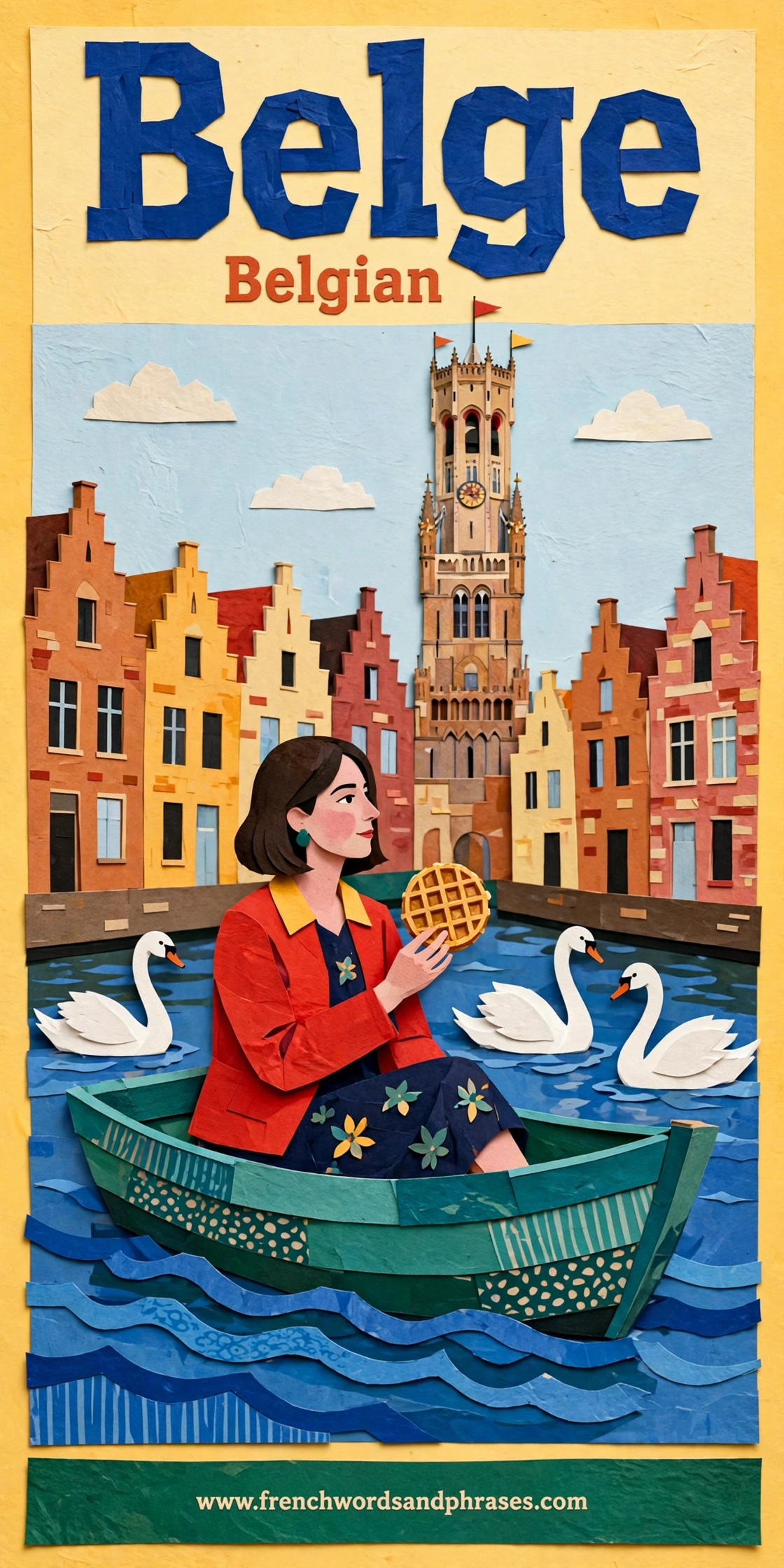
Belge means Belgian.
A café terrace in Brussels, rain threatening, nobody hurrying: a plate of frites with mayonnaise, a glass of dark beer, and at the next table a conversation that drifts from French into Dutch and back without anyone noticing. Small country, many worlds — French calls it all belge.
In this guide, you’ll learn what belge means in English, why its masculine and feminine forms are gloriously identical, why Belgian people take a capital letter but the adjective never does, and why there is no such language as ‘Belgian’. Explore French examples, English translations, and practice quizzes.
Understanding the French Adjective Belge
Belge is a French nationality adjective — it says where someone or something comes from: Belgium. Its forms could not be simpler: masculine belge, feminine belge — identical — and one plural for everyone, belges.
It means Belgian — from Belgium, or in the Belgian way. It describes people (un peintre belge, a Belgian painter; une actrice belge, a Belgian actress) and things (la bière belge, Belgian beer; le chocolat belge, Belgian chocolate). Unlike most nationalities here, it never names a language: Belgium speaks French, Dutch and German.
Type: Nationality adjective — origin
Answers the question: Where is it from? — Belgian, from Belgium
Feminine: belge — identical to the masculine; the word already ends in -e
Changes form: Only in the plural — belge, belge, belges, belges
English equivalents: Belgian.
One important usage detail: as a noun naming a person, belge takes a capital letter — un Belge, une Belge. But the adjective stays lower-case — une bière belge. And there is no language called ‘belge’: a Belgian speaks le français, le néerlandais or l’allemand depending on the region.
Experience the Word
Belge is the adjective of the small country that punches far above its weight — of surrealist painters, comic strips, cycling in the rain and chocolate made like jewellery.
Imagine a praline shop in Bruges where each chocolate is laid in its box with tweezers. A hundred years of craft in a single mouthful — and the queue outside speaks four languages before breakfast. Tout cela est très belge: all of that is very Belgian.
You have not just named a country of origin. You have pointed at a modest country with an outsized imagination.
How to Use Belge in French: Complete Guide
Let’s explore how belge works in French, beginning with the whole word on one card.
Belge at a Glance
Before the details, here is the whole word on one card.
The Whole Word on One Card
Meaning, type, position and forms — belge in four lines.
| Point | Belge |
|---|---|
| Meaning | Belgian |
| Type | nationality adjective — Belgium |
| Usual position | after the noun — une bière belge |
| Form | belge for everyone — belges in the plural |
Example
C’est une bière belge.
It’s a Belgian beer.
The Four Forms of Belge
Here is the easiest agreement in this whole family: belge already ends in -e, so masculine and feminine are identical. Only the plural adds an s.
| Form | Belge | Example |
|---|---|---|
| Masculine singular | belge | un peintre belge — a Belgian painter |
| Feminine singular | belge | une actrice belge — a Belgian actress |
| Masculine plural | belges | des peintres belges — Belgian painters |
| Feminine plural | belges | des actrices belges — Belgian actresses |
Example
Un peintre belge et une actrice belge exposent à Bruxelles.
A Belgian painter and a Belgian actress are exhibiting in Brussels.
Quick Quiz 1
Does belge change for a feminine noun?
Reveal the answer
No
Un peintre belge, une actrice belge — the form is identical.
A Belgian painter, a Belgian actress.
The Feminine of Belge: Nothing Changes
Most adjectives build their feminine by adding an e. Belge was born with one, so the feminine has nothing to add — the same holiday for learners as suisse and russe.
| Situation | Example |
|---|---|
| Masculine | un chocolat belge — a Belgian chocolate |
| Feminine | une gaufre belge — identical |
| Why | belge already ends in -e, so the feminine adds nothing |
| The plural | add s — des frites belges, Belgian fries |
Example
Elle est belge, elle vient de Liège.
She is Belgian, she comes from Liège.
Where Belge Goes: After the Noun
Nationality adjectives follow the noun they describe, and belge sits comfortably after être.
| Pattern | Example |
|---|---|
| After the noun | une bande dessinée belge — a Belgian comic |
| After être | il est belge — he is Belgian |
| With an adverb | un humour très belge — a very Belgian humour |
| Before the noun | une belge bière — not in French |
Example
Nous buvons une bière belge dans ce café.
We’re drinking a Belgian beer in this café.
Quick Quiz 2
How do you say ‘a Belgian beer’ — une belge bière or une bière belge?
Reveal the answer
une bière belge
The nationality adjective stands after the noun — and belge never changes anyway.
A Belgian beer.
Belge as a Noun: People Take a Capital
The same word works as a noun for people — with a capital letter. But belge never names a language: Belgium has three, and none of them is called belge.
| Use | Example |
|---|---|
| A man | un Belge — a Belgian (man) |
| A woman | une Belge — a Belgian (woman) |
| People | les Belges — the Belgians |
| The languages | le français, le néerlandais, l’allemand — French, Dutch, German |
Example
Les Belges parlent français, néerlandais ou allemand selon leur région.
Belgians speak French, Dutch or German depending on their region.
Everyday Expressions with Belge
Belge is famous at the table and in the bookshop — frites, chocolate, beer and the bande dessinée.
| Expression | In English |
|---|---|
| les frites belges | Belgian fries — twice-cooked, with mayonnaise |
| le chocolat belge | Belgian chocolate |
| la bière belge | Belgian beer |
| la bande dessinée belge | Belgian comics — Tintin’s homeland |
| une gaufre belge | a Belgian waffle |
| l’humour belge | Belgian humour — dry, surreal, self-mocking |
Example
Les frites belges sont cuites deux fois, c’est le secret.
Belgian fries are cooked twice, that’s the secret.
Quick Quiz 3
Is there a language called ‘belge’?
Reveal the answer
No
Belgium speaks French, Dutch and German — there is no language named belge.
Un Belge de Gand parle néerlandais — a Belgian from Ghent speaks Dutch.
Belge and Its Neighbours
Around belge stand the country noun la Belgique and the nationalities of its neighbours, France and the Netherlands.
| French | In English |
|---|---|
| la Belgique | Belgium — the country |
| français | French — the southern neighbour |
| néerlandais | Dutch — the northern neighbour |
| luxembourgeois | Luxembourgish — the small eastern neighbour |
| bruxellois | of Brussels — un Bruxellois, a Brussels resident |
| flamand | Flemish — of Flanders, Belgium’s Dutch-speaking north |
Example
La Belgique est entre la France, les Pays-Bas et l’Allemagne.
Belgium is between France, the Netherlands and Germany.
Watch Out: The Traps Around Belge
The traps here are the phantom language and the capital letter — the agreement itself could not be kinder.
| Trap | The truth |
|---|---|
| The language | there is no language ‘belge’ — Belgians speak French, Dutch or German |
| The capital | people take a capital — un Belge; the adjective does not — une bière belge |
| The country | Belgium is la Belgique — feminine: en Belgique, to/in Belgium |
| Agreement | belge never changes in the singular — un roi belge, une reine belge |
Example
Une Belge de Namur m’a offert un chocolat belge.
A Belgian woman from Namur gave me a Belgian chocolate.
Quick Quiz 4
Which sentence is right: Elle est Belge or Elle est belge?
Reveal the answer
Elle est belge
After être it is the adjective, lower-case; the capital is for the noun: une Belge.
She is Belgian.
Belge in Everyday French: Real-Life Examples
Now that you know the word, let’s see how belge appears in everyday French.
Example 1 — Food
Les frites belges sont les meilleures du monde, dit-on.
Belgian fries are the best in the world, they say.
Example 2 — Drink
Cette bière belge est forte et parfumée.
This Belgian beer is strong and full of flavour.
Example 3 — People
Mon professeur de dessin est belge.
My art teacher is Belgian.
Example 4 — Travel
Nous visitons une petite ville belge, Bruges.
We’re visiting a small Belgian town, Bruges.
Example 5 — Comics
La bande dessinée belge est célèbre dans le monde entier.
Belgian comics are famous all over the world.
Example 6 — Sweets
Elle m’a offert une boîte de chocolats belges.
She gave me a box of Belgian chocolates.
Beyond Translation: The Meaning of Belge
English says Belgian for the meaning of belge — a name that goes back to the Belgae, the tribes Julius Caesar called the bravest in Gaul. Two thousand years later the bravery has become quieter: it shows up as endurance on a bicycle in the rain and patience with a complicated country.
Belge is the adjective of a country that runs on compromise — three languages, one kingdom, and frites above all disputes.
For the learner it is pure gift: one form for him, one form for her, an s for the plural, and nothing else to remember but the capital on the people.
How to Remember the French Adjective Belge
Remember it this way: Belge is the easy nationality — one form for everyone, a capital only for the people, and no language to learn because there isn’t one.
- You never change it in the singular — un peintre belge, une actrice belge.
- You give the person a capital — un Belge, une Belge — but never the adjective.
- You never say ‘je parle belge’ — a Belge speaks français, néerlandais or allemand.
The key idea is belge is identical for masculine and feminine, and there is no language called belge.
Test Your Knowledge of Belge
Let’s see how much you’ve learned. Try answering these questions before revealing the answers.
Question 1
What does belge mean?
Reveal the answer
Belgian — from Belgium.
Question 2
What is the feminine of belge?
Reveal the answer
belge — identical. The word already ends in -e.
Question 3
Translate: a Belgian beer.
Reveal the answer
Une bière belge.
Question 4
Complete the sentence:
Elle est ______ , elle vient d’Anvers.
Reveal the answer
belge
Elle est belge, elle vient d’Anvers.
She is Belgian, she comes from Antwerp.
Question 5
Which languages are spoken in Belgium?
Reveal the answer
French, Dutch and German — there is no language called ‘belge’.
Your Final Challenge
Can You Use It?
How would you say this in French?
“My teacher is Belgian and she loves Belgian chocolate.”
Reveal the answer
Ma professeure est belge et elle adore le chocolat belge.
My teacher is Belgian and she loves Belgian chocolate.
A little French. A little curiosity. A richer everyday life.
LEARN FRENCH ONE WORD AT A TIME