A French Word to Live By
Translate Espagnol to English
/ɛs.pa.ɲɔl/
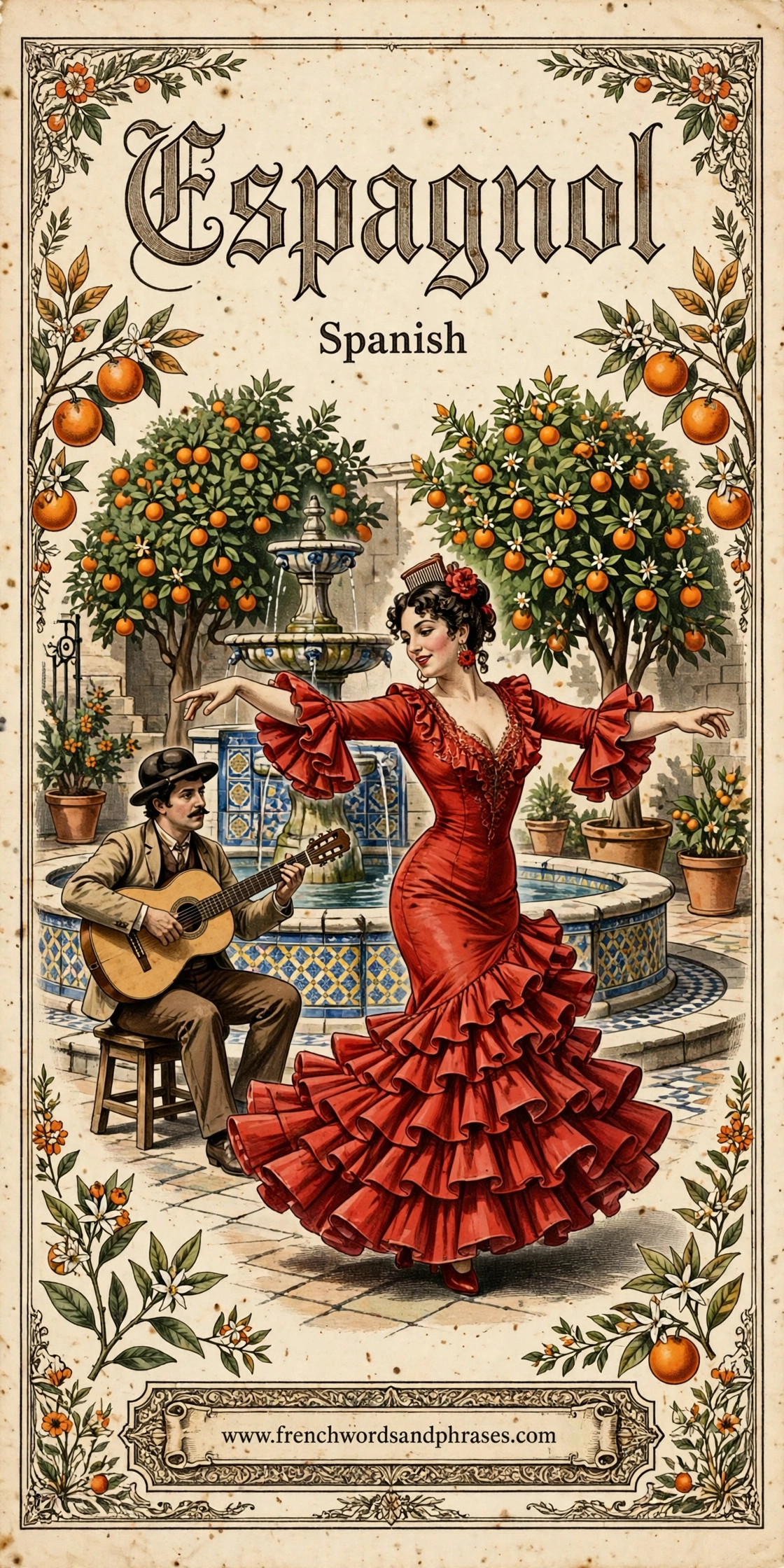
Espagnol means Spanish.
A terrace in Barcelona at ten in the evening — because dinner in Spain starts when other countries are going to bed. Tapas arrive, guitars appear, and the French visitors agree that everything here has a warmth summed up by one word: espagnol.
In this guide, you’ll learn what espagnol means in English, how its feminine espagnole is formed, where it stands in the sentence, and when French gives the word a capital letter. Explore French examples, English translations, and practice quizzes.
Understanding the French Adjective Espagnol
Espagnol is a French nationality adjective — masculine espagnol, feminine espagnole. Its feminine is one of the small irregulars: the -ol ending becomes -ole, espagnole, with the sound staying exactly the same. In the plural, add s to both: espagnols, espagnoles.
It means Spanish — of Spain, its people, its language and its culture. It describes people (un peintre espagnol, a Spanish painter), things (une guitare espagnole, a Spanish guitar) and the language itself (l’espagnol, Spanish — one of the world’s most spoken languages). With a capital letter it becomes a person — un Espagnol.
Type: Nationality adjective
Masculine: espagnol
Feminine: espagnole
English equivalents: Spanish.
One important usage detail: the capital letter. A Spanish person takes one — un Espagnol, une Espagnole — but the adjective and the language never do: un film espagnol, elle parle espagnol. Like most adjectives, espagnol also stands after the noun it describes.
Experience the Word
Espagnol is the adjective of the late dinner and the long evening — France’s great southern neighbour, close enough to visit and different enough to fascinate.
Imagine a French schoolchild on her first trip across the Pyrenees, discovering that lunch happens at three and the whole town naps afterwards. Espagnol, in her postcard home, means a whole new rhythm of life.
You have not just named a nationality. You have named the second most learned language on Earth — from the French side of the mountains.
How to Use Espagnol in French: Complete Guide
Let’s explore how espagnol works in French, beginning with the whole word on one card.
Espagnol at a Glance
Before the details, here is the whole word on one card.
The Whole Word on One Card
Meaning, type, position and forms — espagnol in four lines.
| Point | Espagnol |
|---|---|
| Meaning | Spanish |
| Type | nationality adjective |
| Usual position | after the noun — un film espagnol |
| Forms | espagnol / espagnole / espagnols / espagnoles |
Example
C’est un film espagnol.
It’s a Spanish film.
The Four Forms of Espagnol
Nationality adjectives agree like other adjectives: here are the four forms of espagnol, with the feminine changing its spelling but not its sound.
| Form | Espagnol | Example |
|---|---|---|
| Masculine singular | espagnol | un peintre espagnol — a Spanish painter |
| Feminine singular | espagnole | une peintre espagnole — a Spanish painter (female) |
| Masculine plural | espagnols | des peintres espagnols — Spanish painters |
| Feminine plural | espagnoles | des peintres espagnoles — Spanish painters (female) |
Example
Un peintre espagnol et une peintre espagnole exposent leurs tableaux.
A Spanish painter and a Spanish painter (female) are exhibiting their paintings.
Quick Quiz 1
What is the feminine of espagnol?
Reveal the answer
espagnole
Une femme espagnole, des guitares espagnoles.
A Spanish woman, Spanish guitars.
The Feminine of Espagnol: -ol Becomes -ole
Espagnol is one of the small irregulars: its feminine does not simply add an e, it reshapes the ending — espagnol becomes espagnole, pronounced exactly the same.
| Situation | Example |
|---|---|
| Masculine | espagnol — ends in -ol |
| Feminine | espagnole — the -ol ending becomes -ole |
| Masculine plural | espagnols — add s |
| Feminine plural | espagnoles — add s |
Example
Elle est espagnole et elle habite à Madrid.
She is Spanish and she lives in Madrid.
Where Espagnol Goes: After the Noun
Espagnol follows the noun it describes, like most French adjectives, and it sits comfortably after être. Adverbs slide in front of it without moving it.
| Pattern | Example |
|---|---|
| After the noun | une guitare espagnole — a Spanish guitar |
| After être | elle est espagnole — she is Spanish |
| With an adverb | très espagnol — very Spanish |
| Before the noun | un espagnol film — not in everyday French |
Example
Cette musique est très espagnole.
This music is very Spanish.
Quick Quiz 2
How do you say ‘a Spanish guitar’ — une espagnole guitare or une guitare espagnole?
Reveal the answer
une guitare espagnole
Espagnol stands after the noun, in its feminine form espagnole.
A Spanish guitar.
More Spanish: Comparing with Espagnol
Espagnol compares the regular way, with plus, moins and aussi — useful when two villages argue about which is plus espagnol, more Spanish, than the other.
| Degree | Example |
|---|---|
| As Spanish as | aussi espagnol que — as Spanish as |
| More Spanish | plus espagnol — more Spanish |
| Less Spanish | moins espagnol — less Spanish |
| The most Spanish (masc.) | le plus espagnol — le plus espagnol des villages |
| The most Spanish (fem.) | la plus espagnole — la plus espagnole des villes |
Example
Ce village est plus espagnol que l’autre.
This village is more Spanish than the other one.
Everyday Expressions with Espagnol
Espagnol does triple duty in French: adjective, person and language. The capital letter tells you which job it is doing.
| Expression | In English |
|---|---|
| un Espagnol / une Espagnole | a Spanish man / a Spanish woman — capital letter for the person |
| l’espagnol | the Spanish language |
| parler espagnol | to speak Spanish |
| la cuisine espagnole | Spanish cooking |
| une guitare espagnole | a Spanish guitar |
| la côte espagnole | the Spanish coast |
Example
Elle parle espagnol avec un Espagnol de Madrid.
She speaks Spanish with a Spaniard from Madrid.
Quick Quiz 3
What does l’espagnol mean, written in lower case with l’?
Reveal the answer
The Spanish language
Je parle espagnol et j’apprends le français.
I speak Spanish and I’m learning French.
Espagnol and Its Neighbours
Espagnol lives among the nationalities of southern Europe and the Spanish-speaking world across the Atlantic.
| French | In English |
|---|---|
| portugais | Portuguese — un Portugais, une Portugaise |
| français | French — un Français, une Française |
| italien | Italian — un Italien, une Italienne |
| mexicain | Mexican — un Mexicain, une Mexicaine |
| marocain | Moroccan — un Marocain, une Marocaine |
| grec | Greek — un Grec, une Grecque |
Example
Un Portugais et un Espagnol sont voisins en Europe.
A Portuguese man and a Spaniard are neighbours in Europe.
Watch Out: The Traps Around Espagnol
The traps here are the capital letter, the doubled letter that does not exist, and the gn that is one sound, not two.
| Trap | The truth |
|---|---|
| The capital letter | people take one — un Espagnol; the adjective and the language never do |
| The feminine | espagnole with one l — never ‘espagnolle’ |
| The letters gn | espagnol is pronounced as if written ‘espanyol’ — gn is a single soft sound |
| Spain or the language? | l’Espagne is the country; espagnol is the adjective, the person and the language |
Example
Un Espagnol parle espagnol.
A Spaniard speaks Spanish.
Quick Quiz 4
Which is correct for a Spanish woman — une Espagnol or une Espagnole?
Reveal the answer
une Espagnole
A capital letter for the person, and the feminine form espagnole.
A Spanish woman.
Espagnol in Everyday French: Real-Life Examples
Now that you know the word, let’s see how espagnol appears in everyday French.
Example 1 — A neighbour
Mon voisin est espagnol, il vient de Madrid.
My neighbour is Spanish, he comes from Madrid.
Example 2 — Language
Elle apprend l’espagnol à l’école.
She is learning Spanish at school.
Example 3 — A film
Nous avons regardé un film espagnol hier soir.
We watched a Spanish film last night.
Example 4 — Food
La cuisine espagnole est délicieuse et variée.
Spanish cooking is delicious and varied.
Example 5 — Travel
Une touriste espagnole visite le musée.
A Spanish tourist is visiting the museum.
Example 6 — Music
Ces guitares espagnoles sont magnifiques.
These Spanish guitars are magnificent.
Beyond Translation: The Meaning of Espagnol
English needs separate words where French uses one: Spanish the adjective, a Spaniard the person, Spanish the language are all espagnol — only the capital letter and the article change.
Espagnol is France’s oldest neighbourly argument.
Across the Pyrenees, two great languages have borrowed from each other for a thousand years — and espagnol, with its reshaped feminine espagnole, is the word French uses for all of it.
How to Remember the French Adjective Espagnol
Remember it this way: Espagnol reshapes its ending for women — espagnole, same sound, new spelling — and only wears a capital letter when it names a person.
- You see two singular forms — un homme espagnol, une femme espagnole.
- You add s for the plurals — des hommes espagnols, des femmes espagnoles.
- You give the person a capital letter — un Espagnol — but never the language: l’espagnol.
The key idea is espagnol / espagnole — and a capital letter only for the person.
Test Your Knowledge of Espagnol
Let’s see how much you’ve learned. Try answering these questions before revealing the answers.
Question 1
What does espagnol mean?
Reveal the answer
Spanish — of Spain, its people and its language.
Question 2
What is the feminine of espagnol?
Reveal the answer
espagnole — the -ol ending becomes -ole, with the same sound.
Question 3
Translate: a Spanish film.
Reveal the answer
Un film espagnol.
Question 4
Complete the sentence:
Elle est ______ . (Spanish)
Reveal the answer
espagnole
Elle est espagnole.
She is Spanish.
Question 5
How do you say ‘a Spaniard (man)’?
Reveal the answer
Un Espagnol — with a capital letter, because it names a person.
Your Final Challenge
Can You Use It?
How would you say this in French?
“He is Spanish, and he teaches Spanish in a Spanish town.”
Reveal the answer
Il est espagnol, et il enseigne l’espagnol dans une ville espagnole.
He is Spanish, and he teaches Spanish in a Spanish town.
A little French. A little curiosity. A richer everyday life.
LEARN FRENCH ONE WORD AT A TIME