A French Word to Live By
How to Conjugate Chatonner in French
/ʃa.tɔ.ne/
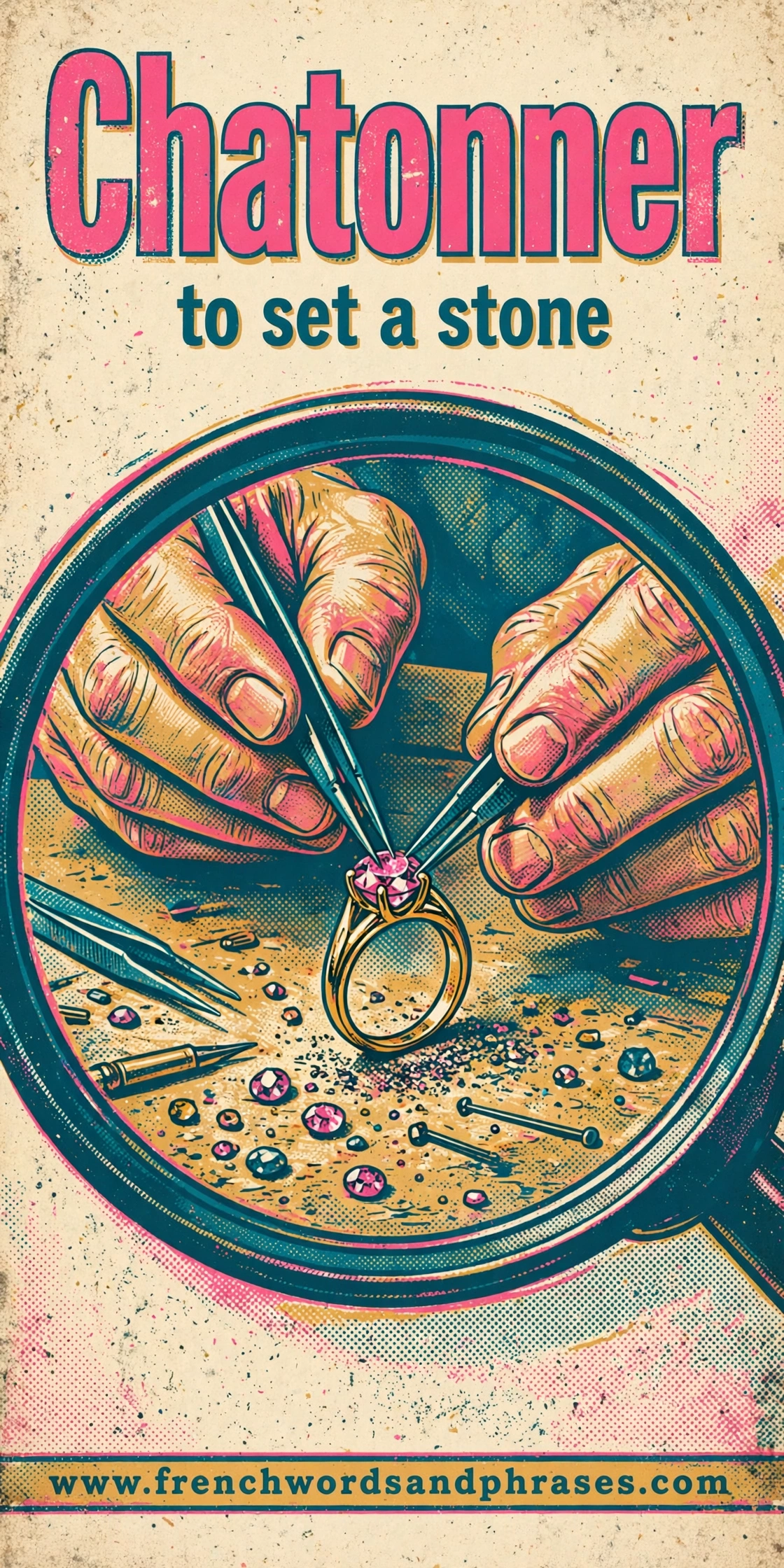
Chatonner means to set a stone — to fix a gem into the little clawed cup, the chaton, that holds it fast on a ring.
A jeweller’s bench under a strong lamp: tweezers, a loupe, a ruby no bigger than a tear. With infinite patience the goldsmith raises the tiny claws of the setting over the stone. Chatonner is that precise, silent moment when a loose gem becomes a jewel.
In this guide, you’ll learn how to conjugate chatonner in all the major French tenses and moods. Explore complete conjugation tables, French examples, English translations, and practice quizzes.
Understanding the French Verb Chatonner
Chatonner is a regular French verb belonging to the first group of verbs, those ending in-er.
It means to set a stone. It belongs to the vocabulary of the jewellery workshop — goldsmiths and setters chatonnent diamonds, emeralds and sapphires into rings, brooches and pendants — and outside the trade it is mostly met in books about jewellery and in the names of old crafts.
Verb classification: First group (-er)
Auxiliary verb: Avoir
Past participle: chatonné
Present participle: chatonnant
English equivalents: To set (a gem), to mount in a bezel; chatonner un diamant — to set a diamond; chatonner une émeraude — to set an emerald; un chaton — the bezel or setting of a ring; le sertissage — stone setting in general.
One important detail: chatonner is the jeweller’s own word, built on un chaton — the little cup, usually clawed, that grips a stone on a ring. The general trade verb for setting a stone is sertir, and le sertissage is the craft as a whole; chatonner names the bezel setting in particular. Beware a famous homonym: un chaton is also a kitten — only the workbench tells you which one is meant. The verb is rare and technical, but perfectly regular: je chatonne, nous chatonnons, past participle chatonné.
Experience the Word
Chatonner is the verb of the smallest architecture — a golden cup, four claws, and a stone held up to the light forever.
Imagine the workshop at closing time. One ring remains on the bench: the emerald is cut, the band is polished, and the setter bends over his loupe. Griffe après griffe, il chatonne — and suddenly the green stone catches the lamplight and the ring is alive.
A minute ago it was a loose stone in a paper packet. Now it is chatonnée — set, gripped, and ready to be worn for a hundred years.
How to Conjugate Chatonner: Complete French Conjugation Guide
Let’s explore every major conjugation of chatonner, beginning with the indicative mood.
How to Conjugate Chatonner in the Indicative Mood
The indicative mood is used to express facts, observations, actions, and events.
How to Conjugate Chatonner in the Present Tense (Présent)
Used for actions happening now, habitual actions, and general truths.
| Subject | Conjugation |
|---|---|
| je | chatonne |
| tu | chatonnes |
| il / elle | chatonne |
| nous | chatonnons |
| vous | chatonnez |
| ils / elles | chatonnent |
Example
Le bijoutier chatonne un saphir sur cette bague.
The jeweller is setting a sapphire in this ring.
Quick Quiz 1
Complete the sentence:
Nous ______ un saphir sur cette bague.
Reveal the answer
chatonnons
Nous chatonnons un saphir sur cette bague.
We are setting a sapphire in this ring.
How to Conjugate Chatonner in the Passé Composé
Used for completed actions in the past. Chatonner takes the auxiliary verb avoir.
| Subject | Conjugation |
|---|---|
| j’ | ai chatonné |
| tu | as chatonné |
| il / elle | a chatonné |
| nous | avons chatonné |
| vous | avez chatonné |
| ils / elles | ont chatonné |
Example
Il a chatonné l’émeraude en une heure.
He set the emerald in an hour.
How to Conjugate Chatonner in the Imparfait (Imperfect Tense)
Used for habitual past actions, descriptions, and ongoing situations in the past.
| Subject | Conjugation |
|---|---|
| je | chatonnais |
| tu | chatonnais |
| il / elle | chatonnait |
| nous | chatonnions |
| vous | chatonniez |
| ils / elles | chatonnaient |
Example
Autrefois, on chatonnait les pierres à la main, sans machine.
In the old days, stones were set by hand, without machines.
Quick Quiz 2
Choose the correct form:
He set the emerald in an hour.
Il ______ l’émeraude en une heure. (a chatonné / est chatonné)
Reveal the answer
a chatonné
Il a chatonné l’émeraude en une heure.
Chatonner takes avoir.
How to Conjugate Chatonner in the Plus-que-parfait
Used to describe an action that had already been completed before another past event.
| Subject | Conjugation |
|---|---|
| j’ | avais chatonné |
| tu | avais chatonné |
| il / elle | avait chatonné |
| nous | avions chatonné |
| vous | aviez chatonné |
| ils / elles | avaient chatonné |
Example
Elle avait chatonné le rubis avant l’arrivée de la cliente.
She had set the ruby before the customer arrived.
How to Conjugate Chatonner in the Passé Simple
Primarily used in formal writing, literature, and historical narratives. It is rarely used in everyday conversation.
| Subject | Conjugation |
|---|---|
| je | chatonnai |
| tu | chatonnas |
| il / elle | chatonna |
| nous | chatonnâmes |
| vous | chatonnâtes |
| ils / elles | chatonnèrent |
Example
Le joaillier chatonna la pierre au centre de la broche.
The jeweller set the stone in the centre of the brooch.
How to Conjugate Chatonner in the Passé Antérieur
A literary tense used to express an action completed immediately before another past action, generally in the passé simple.
| Subject | Conjugation |
|---|---|
| j’ | eus chatonné |
| tu | eus chatonné |
| il / elle | eut chatonné |
| nous | eûmes chatonné |
| vous | eûtes chatonné |
| ils / elles | eurent chatonné |
Example
Quand il eut chatonné le diamant, il polit la monture.
When he had set the diamond, he polished the mount.
How to Conjugate Chatonner in the Future Tense (Futur Simple)
Used to describe actions that will take place in the future.
| Subject | Conjugation |
|---|---|
| je | chatonnerai |
| tu | chatonneras |
| il / elle | chatonnera |
| nous | chatonnerons |
| vous | chatonnerez |
| ils / elles | chatonneront |
Example
Demain, je chatonnerai cette opale fragile.
Tomorrow, I will set this fragile opal.
How to Conjugate Chatonner in the Futur Antérieur (Future Perfect)
Used for an action that will have been completed before a particular point in the future.
| Subject | Conjugation |
|---|---|
| j’ | aurai chatonné |
| tu | auras chatonné |
| il / elle | aura chatonné |
| nous | aurons chatonné |
| vous | aurez chatonné |
| ils / elles | auront chatonné |
Example
À la fin de la semaine, ils auront chatonné toutes les pierres.
By the end of the week, they will have set all the stones.
How to Conjugate Chatonner in the Near Future (Futur Proche)
Used to describe something that is going to happen soon. Formed with aller + infinitive.
| Subject | Conjugation |
|---|---|
| je | vais chatonner |
| tu | vas chatonner |
| il / elle | va chatonner |
| nous | allons chatonner |
| vous | allez chatonner |
| ils / elles | vont chatonner |
Example
Le bijoutier va chatonner ton diamant, attends ici.
The jeweller is going to set your diamond, wait here.
How to Conjugate Chatonner in the Conditional Mood
The conditional mood expresses what would happen under certain circumstances. It is also frequently used to make polite requests or express wishes.
How to Conjugate Chatonner in the Present Conditional
| Subject | Conjugation |
|---|---|
| je | chatonnerais |
| tu | chatonnerais |
| il / elle | chatonnerait |
| nous | chatonnerions |
| vous | chatonneriez |
| ils / elles | chatonneraient |
Example
Avec des griffes plus fines, on chatonnerait mieux cette pierre.
With finer claws, we would set this stone better.
How to Conjugate Chatonner in the Past Conditional
| Subject | Conjugation |
|---|---|
| j’ | aurais chatonné |
| tu | aurais chatonné |
| il / elle | aurait chatonné |
| nous | aurions chatonné |
| vous | auriez chatonné |
| ils / elles | auraient chatonné |
Example
Il aurait chatonné le saphir si la monture avait été prête.
He would have set the sapphire if the mount had been ready.
Chatonner in the Literary Past Conditional Form
This less common literary form uses the imperfect subjunctive of avoir.
| Subject | Conjugation |
|---|---|
| j’ | eusse chatonné |
| tu | eusses chatonné |
| il / elle | eût chatonné |
| nous | eussions chatonné |
| vous | eussiez chatonné |
| ils / elles | eussent chatonné |
Example
L’orfèvre eût chatonné la pierre la plus rare du royaume.
The goldsmith would have set the rarest stone in the kingdom.
How to Conjugate Chatonner in the Subjunctive Mood
The subjunctive is used to express wishes, emotions, doubts, necessity, and uncertainty. It frequently follows expressions such as il faut que (it is necessary that) or bien que (although).
How to Conjugate Chatonner in the Present Subjunctive
| Subject | Conjugation |
|---|---|
| que je | chatonne |
| que tu | chatonnes |
| qu’il / qu’elle | chatonne |
| que nous | chatonnions |
| que vous | chatonniez |
| qu’ils / qu’elles | chatonnent |
Example
Il faut que tu chatonnes la pierre bien au centre.
You must set the stone right in the centre.
Quick Quiz 3
Complete the sentence using the subjunctive:
Il faut que vous ______ la pierre bien au centre.
Reveal the answer
chatonniez
Il faut que vous chatonniez la pierre bien au centre.
You must set the stone right in the centre.
How to Conjugate Chatonner in the Imperfect Subjunctive
A literary tense, rarely encountered in modern spoken French.
| Subject | Conjugation |
|---|---|
| que je | chatonnasse |
| que tu | chatonnasses |
| qu’il / qu’elle | chatonnât |
| que nous | chatonnassions |
| que vous | chatonnassiez |
| qu’ils / qu’elles | chatonnassent |
Example
La cliente voulait que le bijoutier chatonnât l’émeraude à l’ancienne.
The customer wanted the jeweller to set the emerald in the old-fashioned way.
How to Conjugate Chatonner in the Pluperfect Subjunctive
A literary construction used to express an action completed before another past action.
| Subject | Conjugation |
|---|---|
| que j’ | eusse chatonné |
| que tu | eusses chatonné |
| qu’il / qu’elle | eût chatonné |
| que nous | eussions chatonné |
| que vous | eussiez chatonné |
| qu’ils / qu’elles | eussent chatonné |
Example
On admirait qu’il eût chatonné si finement le diamant.
People admired that he had set the diamond so finely.
How to Conjugate Chatonner in the Past Subjunctive
| Subject | Conjugation |
|---|---|
| que j’ | aie chatonné |
| que tu | aies chatonné |
| qu’il / qu’elle | ait chatonné |
| que nous | ayons chatonné |
| que vous | ayez chatonné |
| qu’ils / qu’elles | aient chatonné |
Example
Je suis ravi qu’elle ait chatonné ma bague à temps.
I am delighted she set my ring in time.
How to Conjugate Chatonner in the Imperative
The imperative is used to give commands, instructions, invitations, or suggestions. Subject pronouns are omitted.
How to Conjugate Chatonner in the Present Imperative
| Person | Conjugation |
|---|---|
| (tu) | chatonne |
| (nous) | chatonnons |
| (vous) | chatonnez |
Example
Chatonne cette pierre avec soin, elle est fragile !
Set this stone carefully, it is fragile!
Quick Quiz 4
How would you say Set this stone carefully (tu form)?
Reveal the answer
Chatonne cette pierre avec soin !
French Participles of Chatonner
Participles are verb forms that can be used in compound tenses and other grammatical constructions.
Present Participle of Chatonner
chatonnant
En chatonnant le rubis, il a cassé une griffe.
While setting the ruby, he broke one claw.
Past Participle of Chatonner
chatonné
Chatonnée dans l’or jaune, l’émeraude brille de mille feux.
Set in yellow gold, the emerald blazes with light.
Chatonner in Everyday French: Real-Life Examples
Now that you know the conjugations, let’s see how chatonner appears in everyday French.
Example 1 — Present
Le bijoutier chatonne un diamant.
The jeweller is setting a diamond.
Example 2 — Passé composé
Elle a chatonné le rubis.
She set the ruby.
Example 3 — Imparfait
On chatonnait les pierres à la main.
Stones used to be set by hand.
Example 4 — Future
Je chatonnerai cette opale demain.
I will set this opal tomorrow.
Example 5 — Conditional
Tu chatonnerais mieux avec une loupe.
You would set better with a loupe.
Example 6 — Imperative
Chatonnons la pierre avant midi !
Let us set the stone before noon!
Beyond Translation: The Meaning of Chatonner
The jeweller’s chaton is no kitten: it comes from an old word for a little case or box — exactly what the setting is, a tiny golden box with claws.
Two chatons, one spelling.
French keeps the kitten and the bezel under the same word, and only context — fur or facets — tells them apart. The broader craft is le sertissage, from sertir, the verb you will hear in most workshops today.
How to Remember the French Verb Chatonner
Remember it this way: Chatonner is about the jeweller setting a ruby into its golden cup.
- Un chaton (jewellery) is the clawed cup that holds a stone; chatonner is to fix the stone into it.
- The trade’s everyday verb is sertir; chatonner is the bezel-setting word in particular.
- Regular -er: je chatonne, nous chatonnons, past participle chatonné — and no, it has nothing to do with kittens.
The key idea is the jeweller setting a ruby into its golden cup.
Test Your Knowledge of Chatonner
Let’s see how much you’ve learned. Try answering these questions before revealing the answers.
Question 1
What is un chaton in a jeweller’s workshop?
Reveal the answer
The bezel — the little clawed cup that grips a stone on a ring.
Question 2
How do you say The jeweller is setting a diamond in French?
Reveal the answer
Le bijoutier chatonne un diamant.
Question 3
Translate: She set the ruby.
Reveal the answer
Elle a chatonné le rubis.
Question 4
What is the past participle of chatonner?
Reveal the answer
Chatonné.
Question 5
Complete the sentence:
Il faut que tu ______ la pierre bien au centre.
Reveal the answer
chatonnes
Il faut que tu chatonnes la pierre bien au centre.
You must set the stone right in the centre.
Your Final Challenge
Can You Use It?
How would you say this in French?
He sets the emerald slowly, for a well-set stone outlives generations.
Reveal the answer
Il chatonne l’émeraude lentement, car une pierre bien sertie traverse les générations.
He sets the emerald slowly, for a well-set stone outlives generations.
A little French. A little curiosity. A richer everyday life.
LEARN FRENCH ONE WORD AT A TIME