A French Word to Live By
How to Conjugate Charpenter in French
/ʃaʁ.pɑ̃.te/
Charpenter means to cut timber, to construct — to hew, square and fit the great wooden beams that carry a roof.
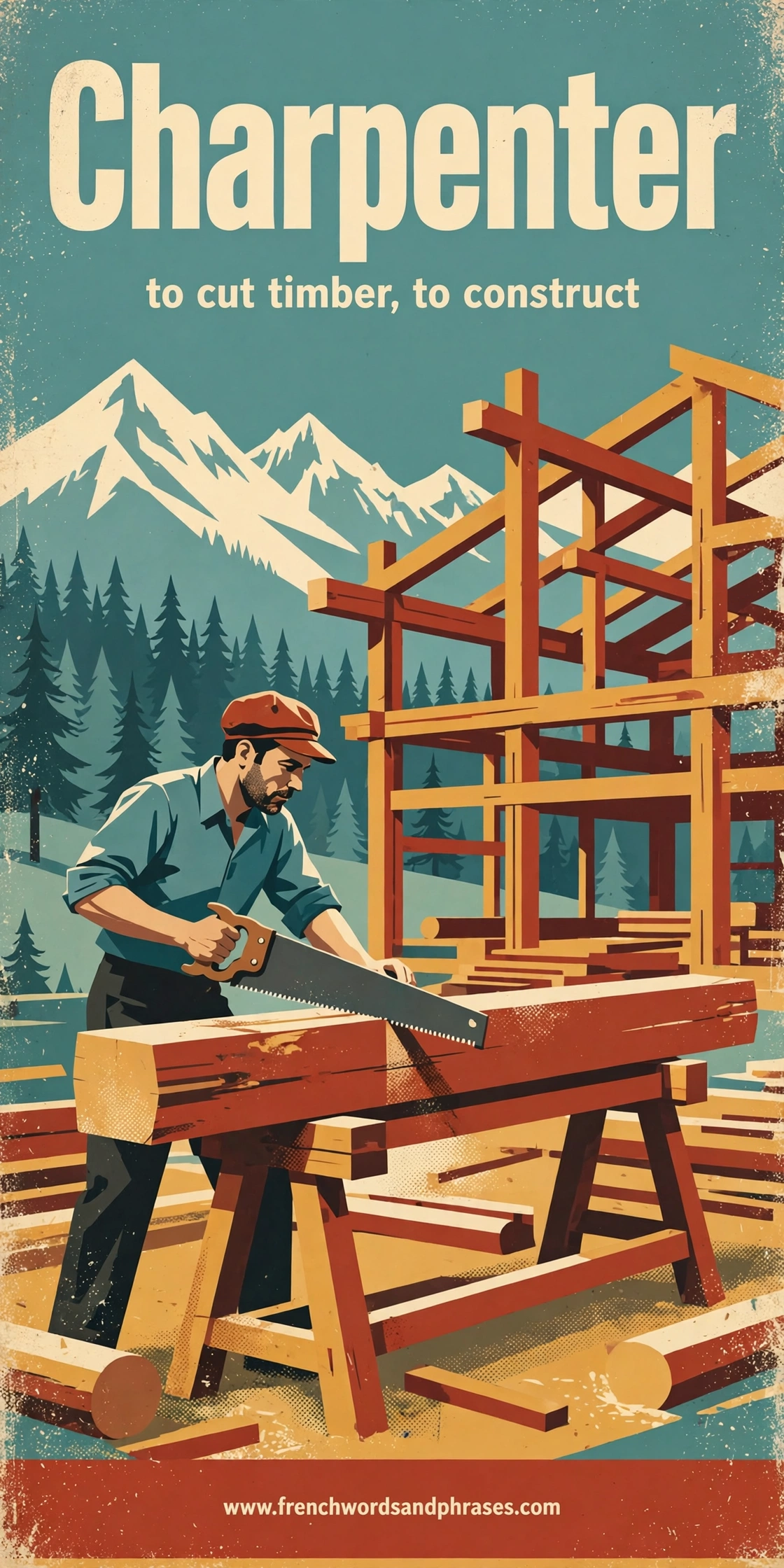
A barn raising in the old countryside: oak beams laid out on trestles, the carpenter walking the length of each one with his adze, squaring, notching, fitting. Charpenter is the verb of that work — turning raw tree trunks into the skeleton of a house.
In this guide, you’ll learn how to conjugate charpenter in all the major French tenses and moods. Explore complete conjugation tables, French examples, English translations, and practice quizzes.
Understanding the French Verb Charpenter
Charpenter is a regular French verb belonging to the first group of verbs, those ending in-er.
It means to cut timber, to construct. It is used by carpenters and roofers for cutting and assembling the frame of a roof, a barn or a timber-framed house, and it survives in the participle charpenté for anything solidly built — a horse, a shoulders-wide labourer, or the well-built plot of a book.
Verb classification: First group (-er)
Auxiliary verb: Avoir
Past participle: charpenté
Present participle: charpentant
English equivalents: To cut and shape timber, to frame; charpenter une toiture — to frame a roof; charpenter une grange — to build the frame of a barn; bien charpenté — strongly built (of a person, a horse or a novel); la charpente — the framework, the frame.
One important detail: charpenter is the carpenter’s own verb, from la charpente, the timber framework of a building — and of anything else with a skeleton: la charpente d’un roman is the structure of a novel. The adjective it leaves behind is everywhere: un homme bien charpenté is a broad-shouldered, strongly built man. The verb itself belongs to the building trade; for everyday building, French says construire. Conjugation is perfectly regular: je charpente, nous charpentons, past participle charpenté.
Experience the Word
Charpenter is the verb of the skeleton — before walls, before tiles, before a house is a house, someone has to charpenter its bones.
Imagine a farmyard at dawn. The oak trunks arrived yesterday; today the charpentier chalks his lines, hews, squares and notches, and by evening the whole frame of the barn stands against the sky, pegged together without a single nail.
No walls, no roof, no doors yet. But the barn exists — charpentée, framed in oak, waiting for its skin.
How to Conjugate Charpenter: Complete French Conjugation Guide
Let’s explore every major conjugation of charpenter, beginning with the indicative mood.
How to Conjugate Charpenter in the Indicative Mood
The indicative mood is used to express facts, observations, actions, and events.
How to Conjugate Charpenter in the Present Tense (Présent)
Used for actions happening now, habitual actions, and general truths.
| Subject | Conjugation |
|---|---|
| je | charpente |
| tu | charpentes |
| il / elle | charpente |
| nous | charpentons |
| vous | charpentez |
| ils / elles | charpentent |
Example
Les charpentiers charpentent la toiture de la grange.
The carpenters are framing the roof of the barn.
Quick Quiz 1
Complete the sentence:
Nous ______ le hangar demain matin.
Reveal the answer
charpenterons
Nous charpenterons le hangar demain matin.
We will frame the shed tomorrow morning.
How to Conjugate Charpenter in the Passé Composé
Used for completed actions in the past. Charpenter takes the auxiliary verb avoir.
| Subject | Conjugation |
|---|---|
| j’ | ai charpenté |
| tu | as charpenté |
| il / elle | a charpenté |
| nous | avons charpenté |
| vous | avez charpenté |
| ils / elles | ont charpenté |
Example
Mon grand-père a charpenté trois granges dans sa vie.
My grandfather framed three barns in his life.
How to Conjugate Charpenter in the Imparfait (Imperfect Tense)
Used for habitual past actions, descriptions, and ongoing situations in the past.
| Subject | Conjugation |
|---|---|
| je | charpentais |
| tu | charpentais |
| il / elle | charpentait |
| nous | charpentions |
| vous | charpentiez |
| ils / elles | charpentaient |
Example
Autrefois, on charpentait les maisons à la hache.
In the old days, people framed houses with an axe.
Quick Quiz 2
Choose the correct form:
They framed the house in one summer.
Ils ______ la maison en un été. (ont charpenté / sont charpenté)
Reveal the answer
ont charpenté
Ils ont charpenté la maison en un été.
Charpenter takes avoir.
How to Conjugate Charpenter in the Plus-que-parfait
Used to describe an action that had already been completed before another past event.
| Subject | Conjugation |
|---|---|
| j’ | avais charpenté |
| tu | avais charpenté |
| il / elle | avait charpenté |
| nous | avions charpenté |
| vous | aviez charpenté |
| ils / elles | avaient charpenté |
Example
Ils avaient charpenté la grange avant l’arrivée de l’hiver.
They had framed the barn before winter arrived.
How to Conjugate Charpenter in the Passé Simple
Primarily used in formal writing, literature, and historical narratives. It is rarely used in everyday conversation.
| Subject | Conjugation |
|---|---|
| je | charpentai |
| tu | charpentas |
| il / elle | charpenta |
| nous | charpentâmes |
| vous | charpentâtes |
| ils / elles | charpentèrent |
Example
Les ouvriers charpentèrent la nef en une saison.
The workmen framed the nave in a single season.
How to Conjugate Charpenter in the Passé Antérieur
A literary tense used to express an action completed immediately before another past action, generally in the passé simple.
| Subject | Conjugation |
|---|---|
| j’ | eus charpenté |
| tu | eus charpenté |
| il / elle | eut charpenté |
| nous | eûmes charpenté |
| vous | eûtes charpenté |
| ils / elles | eurent charpenté |
Example
Quand ils eurent charpenté le toit, ils levèrent la poutre faîtière.
When they had framed the roof, they raised the ridge beam.
How to Conjugate Charpenter in the Future Tense (Futur Simple)
Used to describe actions that will take place in the future.
| Subject | Conjugation |
|---|---|
| je | charpenterai |
| tu | charpenteras |
| il / elle | charpentera |
| nous | charpenterons |
| vous | charpenterez |
| ils / elles | charpenteront |
Example
Demain, nous charpenterons le hangar.
Tomorrow, we will frame the shed.
How to Conjugate Charpenter in the Futur Antérieur (Future Perfect)
Used for an action that will have been completed before a particular point in the future.
| Subject | Conjugation |
|---|---|
| j’ | aurai charpenté |
| tu | auras charpenté |
| il / elle | aura charpenté |
| nous | aurons charpenté |
| vous | aurez charpenté |
| ils / elles | auront charpenté |
Example
À la fin du mois, ils auront charpenté toute la maison.
By the end of the month, they will have framed the whole house.
How to Conjugate Charpenter in the Near Future (Futur Proche)
Used to describe something that is going to happen soon. Formed with aller + infinitive.
| Subject | Conjugation |
|---|---|
| je | vais charpenter |
| tu | vas charpenter |
| il / elle | va charpenter |
| nous | allons charpenter |
| vous | allez charpenter |
| ils / elles | vont charpenter |
Example
Le charpentier va charpenter le toit cette semaine.
The carpenter is going to frame the roof this week.
How to Conjugate Charpenter in the Conditional Mood
The conditional mood expresses what would happen under certain circumstances. It is also frequently used to make polite requests or express wishes.
How to Conjugate Charpenter in the Present Conditional
| Subject | Conjugation |
|---|---|
| je | charpenterais |
| tu | charpenterais |
| il / elle | charpenterait |
| nous | charpenterions |
| vous | charpenteriez |
| ils / elles | charpenteraient |
Example
Avec du chêne bien sec, on charpenterait plus solidement.
With well-seasoned oak, we would frame more solidly.
How to Conjugate Charpenter in the Past Conditional
| Subject | Conjugation |
|---|---|
| j’ | aurais charpenté |
| tu | aurais charpenté |
| il / elle | aurait charpenté |
| nous | aurions charpenté |
| vous | auriez charpenté |
| ils / elles | auraient charpenté |
Example
Il aurait charpenté la grange si le bois était arrivé à temps.
He would have framed the barn if the timber had arrived in time.
Charpenter in the Literary Past Conditional Form
This less common literary form uses the imperfect subjunctive of avoir.
| Subject | Conjugation |
|---|---|
| j’ | eusse charpenté |
| tu | eusses charpenté |
| il / elle | eût charpenté |
| nous | eussions charpenté |
| vous | eussiez charpenté |
| ils / elles | eussent charpenté |
Example
Il eût charpenté la maison entière à lui seul.
He would have framed the entire house single-handed.
How to Conjugate Charpenter in the Subjunctive Mood
The subjunctive is used to express wishes, emotions, doubts, necessity, and uncertainty. It frequently follows expressions such as il faut que (it is necessary that) or bien que (although).
How to Conjugate Charpenter in the Present Subjunctive
| Subject | Conjugation |
|---|---|
| que je | charpente |
| que tu | charpentes |
| qu’il / qu’elle | charpente |
| que nous | charpentions |
| que vous | charpentiez |
| qu’ils / qu’elles | charpentent |
Example
Il faut que tu charpentes cette poutre avant la pluie.
You must frame this beam before the rain.
Quick Quiz 3
Complete the sentence using the subjunctive:
Il faut que vous ______ la toiture avant l’hiver.
Reveal the answer
charpentiez
Il faut que vous charpentiez la toiture avant l’hiver.
You must frame the roof before winter.
How to Conjugate Charpenter in the Imperfect Subjunctive
A literary tense, rarely encountered in modern spoken French.
| Subject | Conjugation |
|---|---|
| que je | charpentasse |
| que tu | charpentasses |
| qu’il / qu’elle | charpentât |
| que nous | charpentassions |
| que vous | charpentassiez |
| qu’ils / qu’elles | charpentassent |
Example
Le maître voulait que l’apprenti charpentât comme autrefois, à la hache.
The master wanted the apprentice to frame as in the old days, with an axe.
How to Conjugate Charpenter in the Pluperfect Subjunctive
A literary construction used to express an action completed before another past action.
| Subject | Conjugation |
|---|---|
| que j’ | eusse charpenté |
| que tu | eusses charpenté |
| qu’il / qu’elle | eût charpenté |
| que nous | eussions charpenté |
| que vous | eussiez charpenté |
| qu’ils / qu’elles | eussent charpenté |
Example
On admirait qu’ils eussent charpenté la cathédrale sans machines.
People marvelled that they had framed the cathedral without machines.
How to Conjugate Charpenter in the Past Subjunctive
| Subject | Conjugation |
|---|---|
| que j’ | aie charpenté |
| que tu | aies charpenté |
| qu’il / qu’elle | ait charpenté |
| que nous | ayons charpenté |
| que vous | ayez charpenté |
| qu’ils / qu’elles | aient charpenté |
Example
Je suis fier qu’il ait charpenté sa propre maison.
I am proud that he framed his own house.
How to Conjugate Charpenter in the Imperative
The imperative is used to give commands, instructions, invitations, or suggestions. Subject pronouns are omitted.
How to Conjugate Charpenter in the Present Imperative
| Person | Conjugation |
|---|---|
| (tu) | charpente |
| (nous) | charpentons |
| (vous) | charpentez |
Example
Charpente cette poutre bien d’équerre !
Frame this beam good and square!
Quick Quiz 4
How would you say Frame this beam (tu form)?
Reveal the answer
Charpente cette poutre !
French Participles of Charpenter
Participles are verb forms that can be used in compound tenses and other grammatical constructions.
Present Participle of Charpenter
charpentant
En charpentant le toit, il chantait à tue-tête.
While framing the roof, he sang at the top of his voice.
Past Participle of Charpenter
charpenté
Charpentée en chêne massif, la grange a traversé trois siècles.
Framed in solid oak, the barn has lasted three centuries.
Charpenter in Everyday French: Real-Life Examples
Now that you know the conjugations, let’s see how charpenter appears in everyday French.
Example 1 — Present
Il charpente le toit de la grange.
He is framing the roof of the barn.
Example 2 — Passé composé
Ils ont charpenté la maison en un été.
They framed the house in one summer.
Example 3 — Imparfait
On charpentait les granges à la main.
People used to frame barns by hand.
Example 4 — Future
Nous charpenterons le hangar demain.
We will frame the shed tomorrow.
Example 5 — Conditional
Tu charpenterais plus vite avec une scie électrique.
You would frame faster with an electric saw.
Example 6 — Imperative
Charpentons la toiture avant l’hiver !
Let us frame the roof before winter!
Beyond Translation: The Meaning of Charpenter
English carpenter and French charpentier are the same word twice — both from Latin carpentarius, the maker of carpenta, wooden wagons.
Every structure has its charpente.
French uses the word for the frame of a roof, the skeleton of a ship (charpentier de marine is a shipwright), the bones of a body and the plot-frame of a novel — learn charpenter, and you can talk about how anything is put together.
How to Remember the French Verb Charpenter
Remember it this way: Charpenter is about the carpenter squaring oak beams for a roof.
- La charpente is the framework; charpenter is the work of making it — beams first, walls later.
- Bien charpenté describes people too: broad-shouldered and strongly built.
- Regular -er: je charpente, nous charpentons, past participle charpenté.
The key idea is the carpenter squaring oak beams for a roof.
Test Your Knowledge of Charpenter
Let’s see how much you’ve learned. Try answering these questions before revealing the answers.
Question 1
What is la charpente, and what does charpenter mean?
Reveal the answer
The timber framework of a building — charpenter is to cut and fit the beams that make it.
Question 2
How do you say They framed the house in one summer in French?
Reveal the answer
Ils ont charpenté la maison en un été.
Question 3
Translate: He is framing the roof of the barn.
Reveal the answer
Il charpente le toit de la grange.
Question 4
What is the past participle of charpenter?
Reveal the answer
Charpenté.
Question 5
Complete the sentence:
Il faut que tu ______ cette poutre avant la pluie.
Reveal the answer
charpentes
Il faut que tu charpentes cette poutre avant la pluie.
You must frame this beam before the rain.
Your Final Challenge
Can You Use It?
How would you say this in French?
He frames his barn as his father framed his own, beam after beam.
Reveal the answer
Il charpente sa grange comme son père charpentait la sienne, poutre après poutre.
He frames his barn as his father framed his own, beam after beam.
A little French. A little curiosity. A richer everyday life.
LEARN FRENCH ONE WORD AT A TIME