A French Word to Live By
How to Conjugate Charmer in French
/ʃaʁ.me/
Charmer means to charm, to delight — to win someone over completely, the way a spell works: quietly, pleasantly, and without any resistance at all.
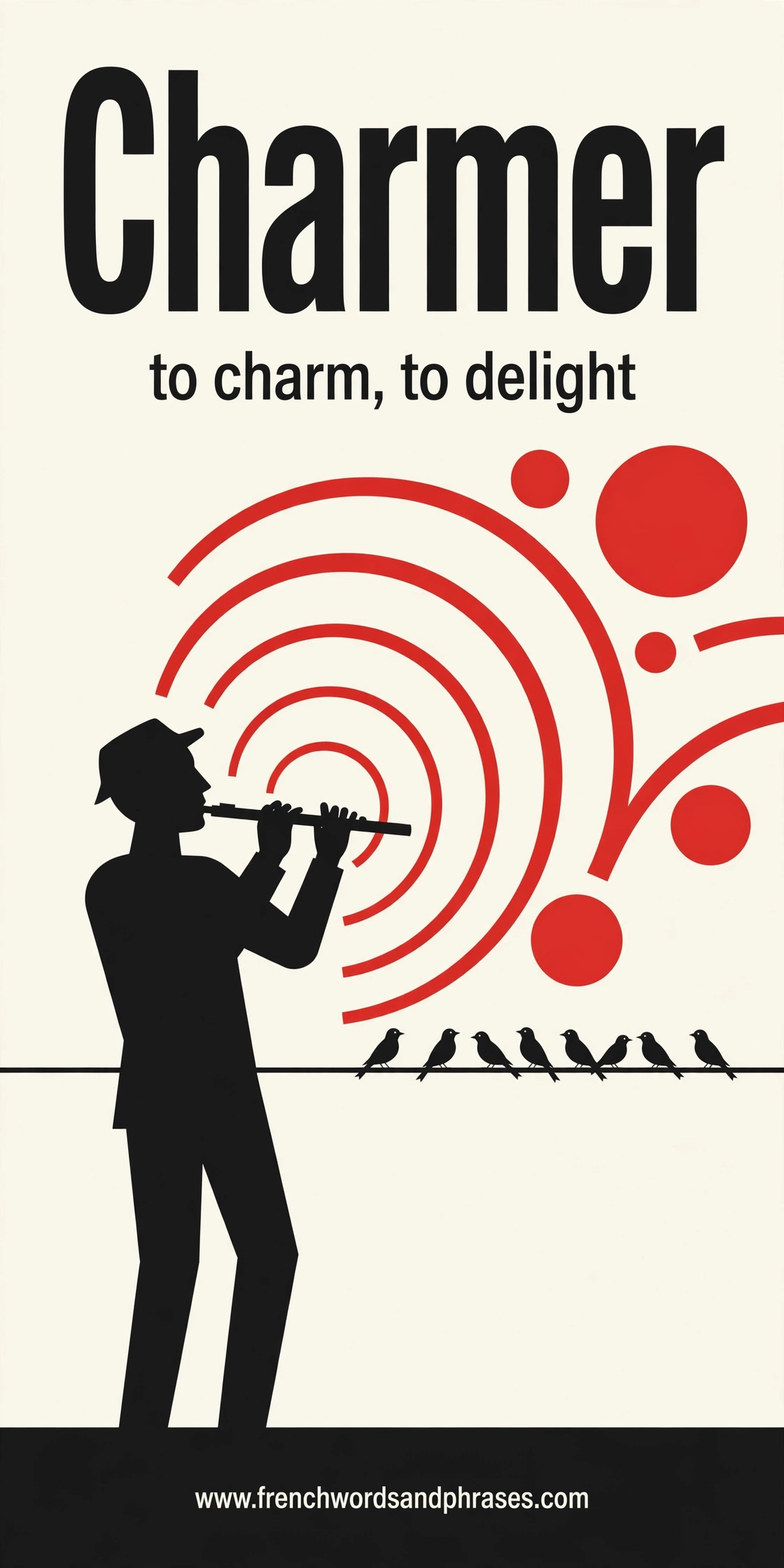
A singer holding a café audience silent, a harbour village at dusk, a flute player with a basket of snakes — charmer is the verb of the pleasing spell: people, audiences, places and even serpents are charmed, and none of them mind.
In this guide, you’ll learn how to conjugate charmer in all the major French tenses and moods. Explore complete conjugation tables, French examples, English translations, and practice quizzes.
Understanding the French Verb Charmer
Charmer is a regular French verb belonging to the first group of verbs, those ending in-er.
It means to charm, to delight. It is used of people, voices, places and music that win hearts at first contact, and in set phrases of good manners: être charmé de + infinitive is the elegant way to say you are delighted to do something. A place that charme does not merely please — it casts the gentle spell that makes visitors decide to stay.
Verb classification: First group (-er)
Auxiliary verb: Avoir
Past participle: charmé
Present participle: charmant
English equivalents: To charm, to delight, to enchant; charmer un public — to charm an audience; charmer les serpents — to charm snakes; être charmé de faire quelque chose — to be delighted to do something; un village charmant — a charming village; un ton charmeur — a wheedling tone.
One important detail: charmer is enchantment without malice. Its old magical sense survives in charmer les serpents, snake-charming, but today the verb simply means to delight and win over completely. Watch the family, though: charmant is a pure compliment — un village charmant — while charmeur is charm with an agenda, wheedling and slightly suspect: un ton charmeur. Politeness borrows the passive: je suis charmé de vous rencontrer, I am delighted to meet you. The verb itself is a regular -er.
Experience the Word
Charmer is the verb of the happy spell — nobody resists it, and nobody wants to.
Imagine a street singer in Lyon at the blue hour. The first notes rise over the square; conversations stop mid-sentence, a waiter pauses with his tray, children climb onto the fountain’s edge: elle charme la place entière, strangers and pigeons alike, and the square holds its breath until the last note.
No trick, no force. She has charmed — charmé — a whole square into silence.
How to Conjugate Charmer: Complete French Conjugation Guide
Let’s explore every major conjugation of charmer, beginning with the indicative mood.
How to Conjugate Charmer in the Indicative Mood
The indicative mood is used to express facts, observations, actions, and events.
How to Conjugate Charmer in the Present Tense (Présent)
Used for actions happening now, habitual actions, and general truths.
| Subject | Conjugation |
|---|---|
| je | charme |
| tu | charmes |
| il / elle | charme |
| nous | charmons |
| vous | charmez |
| ils / elles | charment |
Example
Sa voix charme tous ceux qui l’écoutent.
Her voice charms everyone who hears it.
Quick Quiz 1
Complete the sentence:
Le village ______ les voyageurs.
Reveal the answer
charme
Le village charme les voyageurs.
The village charms the travellers.
How to Conjugate Charmer in the Passé Composé
Used for completed actions in the past. Charmer takes the auxiliary verb avoir.
| Subject | Conjugation |
|---|---|
| j’ | ai charmé |
| tu | as charmé |
| il / elle | a charmé |
| nous | avons charmé |
| vous | avez charmé |
| ils / elles | ont charmé |
Example
Le village a charmé les voyageurs dès le premier soir.
The village charmed the travellers from the very first evening.
How to Conjugate Charmer in the Imparfait (Imperfect Tense)
Used for habitual past actions, descriptions, and ongoing situations in the past.
| Subject | Conjugation |
|---|---|
| je | charmais |
| tu | charmais |
| il / elle | charmait |
| nous | charmions |
| vous | charmiez |
| ils / elles | charmaient |
Example
Il charmait son public avec des histoires simples.
He used to charm his audience with simple stories.
Quick Quiz 2
Choose the correct form:
The village charmed us from the first evening.
Le village nous ______ dès le premier soir. (a charmés / est charmés)
Reveal the answer
a charmés
Le village nous a charmés dès le premier soir.
Charmer takes avoir.
How to Conjugate Charmer in the Plus-que-parfait
Used to describe an action that had already been completed before another past event.
| Subject | Conjugation |
|---|---|
| j’ | avais charmé |
| tu | avais charmé |
| il / elle | avait charmé |
| nous | avions charmé |
| vous | aviez charmé |
| ils / elles | avaient charmé |
Example
Elle avait charmé le jury dès la première chanson.
She had charmed the jury from the first song.
How to Conjugate Charmer in the Passé Simple
Primarily used in formal writing, literature, and historical narratives. It is rarely used in everyday conversation.
| Subject | Conjugation |
|---|---|
| je | charmai |
| tu | charmas |
| il / elle | charma |
| nous | charmâmes |
| vous | charmâtes |
| ils / elles | charmèrent |
Example
Le joueur de flûte charma les serpents un à un.
The flute player charmed the snakes one by one.
How to Conjugate Charmer in the Passé Antérieur
A literary tense used to express an action completed immediately before another past action, generally in the passé simple.
| Subject | Conjugation |
|---|---|
| j’ | eus charmé |
| tu | eus charmé |
| il / elle | eut charmé |
| nous | eûmes charmé |
| vous | eûtes charmé |
| ils / elles | eurent charmé |
Example
Quand elle eut charmé toute la salle, le silence devint applaudissement.
When she had charmed the whole hall, the silence turned into applause.
How to Conjugate Charmer in the Future Tense (Futur Simple)
Used to describe actions that will take place in the future.
| Subject | Conjugation |
|---|---|
| je | charmerai |
| tu | charmeras |
| il / elle | charmera |
| nous | charmerons |
| vous | charmerez |
| ils / elles | charmeront |
Example
Ce petit port charmera vos invités, c’est promis.
This little harbour will charm your guests, I promise.
How to Conjugate Charmer in the Futur Antérieur (Future Perfect)
Used for an action that will have been completed before a particular point in the future.
| Subject | Conjugation |
|---|---|
| j’ | aurai charmé |
| tu | auras charmé |
| il / elle | aura charmé |
| nous | aurons charmé |
| vous | aurez charmé |
| ils / elles | auront charmé |
Example
À la fin du concert, elle aura charmé mille spectateurs.
By the end of the concert, she will have charmed a thousand spectators.
How to Conjugate Charmer in the Near Future (Futur Proche)
Used to describe something that is going to happen soon. Formed with aller + infinitive.
| Subject | Conjugation |
|---|---|
| je | vais charmer |
| tu | vas charmer |
| il / elle | va charmer |
| nous | allons charmer |
| vous | allez charmer |
| ils / elles | vont charmer |
Example
Écoute cette mélodie, elle va te charmer.
Listen to this melody, it is going to charm you.
How to Conjugate Charmer in the Conditional Mood
The conditional mood expresses what would happen under certain circumstances. It is also frequently used to make polite requests or express wishes.
How to Conjugate Charmer in the Present Conditional
| Subject | Conjugation |
|---|---|
| je | charmerais |
| tu | charmerais |
| il / elle | charmerait |
| nous | charmerions |
| vous | charmeriez |
| ils / elles | charmeraient |
Example
Avec un tel sourire, il charmerait n’importe quel public.
With such a smile, he would charm any audience.
How to Conjugate Charmer in the Past Conditional
| Subject | Conjugation |
|---|---|
| j’ | aurais charmé |
| tu | aurais charmé |
| il / elle | aurait charmé |
| nous | aurions charmé |
| vous | auriez charmé |
| ils / elles | auraient charmé |
Example
Le village nous aurait charmés davantage au printemps.
The village would have charmed us even more in spring.
Charmer in the Literary Past Conditional Form
This less common literary form uses the imperfect subjunctive of avoir.
| Subject | Conjugation |
|---|---|
| j’ | eusse charmé |
| tu | eusses charmé |
| il / elle | eût charmé |
| nous | eussions charmé |
| vous | eussiez charmé |
| ils / elles | eussent charmé |
Example
Sa voix eût charmé les pierres elles-mêmes.
Her voice would have charmed the very stones.
How to Conjugate Charmer in the Subjunctive Mood
The subjunctive is used to express wishes, emotions, doubts, necessity, and uncertainty. It frequently follows expressions such as il faut que (it is necessary that) or bien que (although).
How to Conjugate Charmer in the Present Subjunctive
| Subject | Conjugation |
|---|---|
| que je | charme |
| que tu | charmes |
| qu’il / qu’elle | charme |
| que nous | charmions |
| que vous | charmiez |
| qu’ils / qu’elles | charment |
Example
Il est rare qu’un lieu charme autant les visiteurs.
It is rare for a place to charm visitors so much.
Quick Quiz 3
Complete the sentence using the subjunctive:
Il est rare qu’un lieu ______ autant les visiteurs.
Reveal the answer
charme
Il est rare qu’un lieu charme autant les visiteurs.
It is rare for a place to charm visitors so much.
How to Conjugate Charmer in the Imperfect Subjunctive
A literary tense, rarely encountered in modern spoken French.
| Subject | Conjugation |
|---|---|
| que je | charmasse |
| que tu | charmasses |
| qu’il / qu’elle | charmât |
| que nous | charmassions |
| que vous | charmassiez |
| qu’ils / qu’elles | charmassent |
Example
On aurait dit qu’elle charmât les oiseaux du jardin.
You would have said she charmed the birds in the garden.
How to Conjugate Charmer in the Pluperfect Subjunctive
A literary construction used to express an action completed before another past action.
| Subject | Conjugation |
|---|---|
| que j’ | eusse charmé |
| que tu | eusses charmé |
| qu’il / qu’elle | eût charmé |
| que nous | eussions charmé |
| que vous | eussiez charmé |
| qu’ils / qu’elles | eussent charmé |
Example
Les anciens racontaient qu’Orphée eût charmé les bêtes sauvages.
The ancients told how Orpheus had charmed the wild beasts.
How to Conjugate Charmer in the Past Subjunctive
| Subject | Conjugation |
|---|---|
| que j’ | aie charmé |
| que tu | aies charmé |
| qu’il / qu’elle | ait charmé |
| que nous | ayons charmé |
| que vous | ayez charmé |
| qu’ils / qu’elles | aient charmé |
Example
Je suis ravi que ce concert ait charmé vos parents.
I am delighted that this concert charmed your parents.
How to Conjugate Charmer in the Imperative
The imperative is used to give commands, instructions, invitations, or suggestions. Subject pronouns are omitted.
How to Conjugate Charmer in the Present Imperative
| Person | Conjugation |
|---|---|
| (tu) | charme |
| (nous) | charmons |
| (vous) | charmez |
Example
Charmez le jury dès la première note !
Charm the jury from the very first note!
Quick Quiz 4
How would you say Charm the jury (tu form)?
Reveal the answer
Charme le jury !
French Participles of Charmer
Participles are verb forms that can be used in compound tenses and other grammatical constructions.
Present Participle of Charmer
charmant
En charmant son public, elle oublie sa timidité.
By charming her audience, she forgets her shyness.
Past Participle of Charmer
charmé
Charmé par la vieille ville, il a décidé d’y rester.
Charmed by the old town, he decided to stay there.
Charmer in Everyday French: Real-Life Examples
Now that you know the conjugations, let’s see how charmer appears in everyday French.
Example 1 — Present
Sa voix charme tout le monde.
Her voice charms everyone.
Example 2 — Passé composé
Le village nous a charmés.
The village charmed us.
Example 3 — Imparfait
Il charmait le public avec ses histoires.
He used to charm the audience with his stories.
Example 4 — Future
Ce port charmera vos invités.
This harbour will charm your guests.
Example 5 — Conditional
Elle charmerait n’importe quel public.
She would charm any audience.
Example 6 — Imperative
Charme le jury dès le début !
Charm the jury from the start!
Beyond Translation: The Meaning of Charmer
Latin carmen is a song — and a spell, for a spell was originally something sung.
Every charm still has music inside it.
English charm travelled the same road from incantation to attractiveness, but French charmer keeps the whole journey visible: Orpheus charming the beasts, the snake-charmer’s flute, and the village that charms you into staying one more day are all the same verb, still singing.
How to Remember the French Verb Charmer
Remember it this way: Charmer is about a spell sung softly — the audience gives in happily.
- Carmen is a song and a spell: charmer is enchantment that pleases — think of the snake-charmer’s flute.
- Charmant is a pure compliment; charmeur is charm with an agenda. Choose your adjective carefully.
- Regular -er: je charme, nous charmons, past participle charmé — and être charmé de means to be delighted to.
The key idea is a spell sung softly — the audience gives in happily.
Test Your Knowledge of Charmer
Let’s see how much you’ve learned. Try answering these questions before revealing the answers.
Question 1
What is the difference between charmant and charmeur?
Reveal the answer
Charmant is a pure compliment — un village charmant; charmeur is wheedling, charm with an agenda — un ton charmeur.
Question 2
How do you say Her voice charms everyone in French?
Reveal the answer
Sa voix charme tout le monde.
Question 3
Translate: The village charmed us.
Reveal the answer
Le village nous a charmés.
Question 4
What is the past participle of charmer?
Reveal the answer
Charmé.
Question 5
Complete the sentence:
Il est rare qu’un lieu ______ autant les visiteurs.
Reveal the answer
charme
Il est rare qu’un lieu charme autant les visiteurs.
It is rare for a place to charm visitors so much.
Your Final Challenge
Can You Use It?
How would you say this in French?
She charms the hall from the first note, and silence turns into listening.
Reveal the answer
Elle charme la salle dès la première note, et le silence devient écoute.
She charms the hall from the first note, and silence turns into listening.
A little French. A little curiosity. A richer everyday life.
LEARN FRENCH ONE WORD AT A TIME