A French Word to Live By
How to Conjugate Charbonner in French
/ʃaʁ.bɔ.ne/
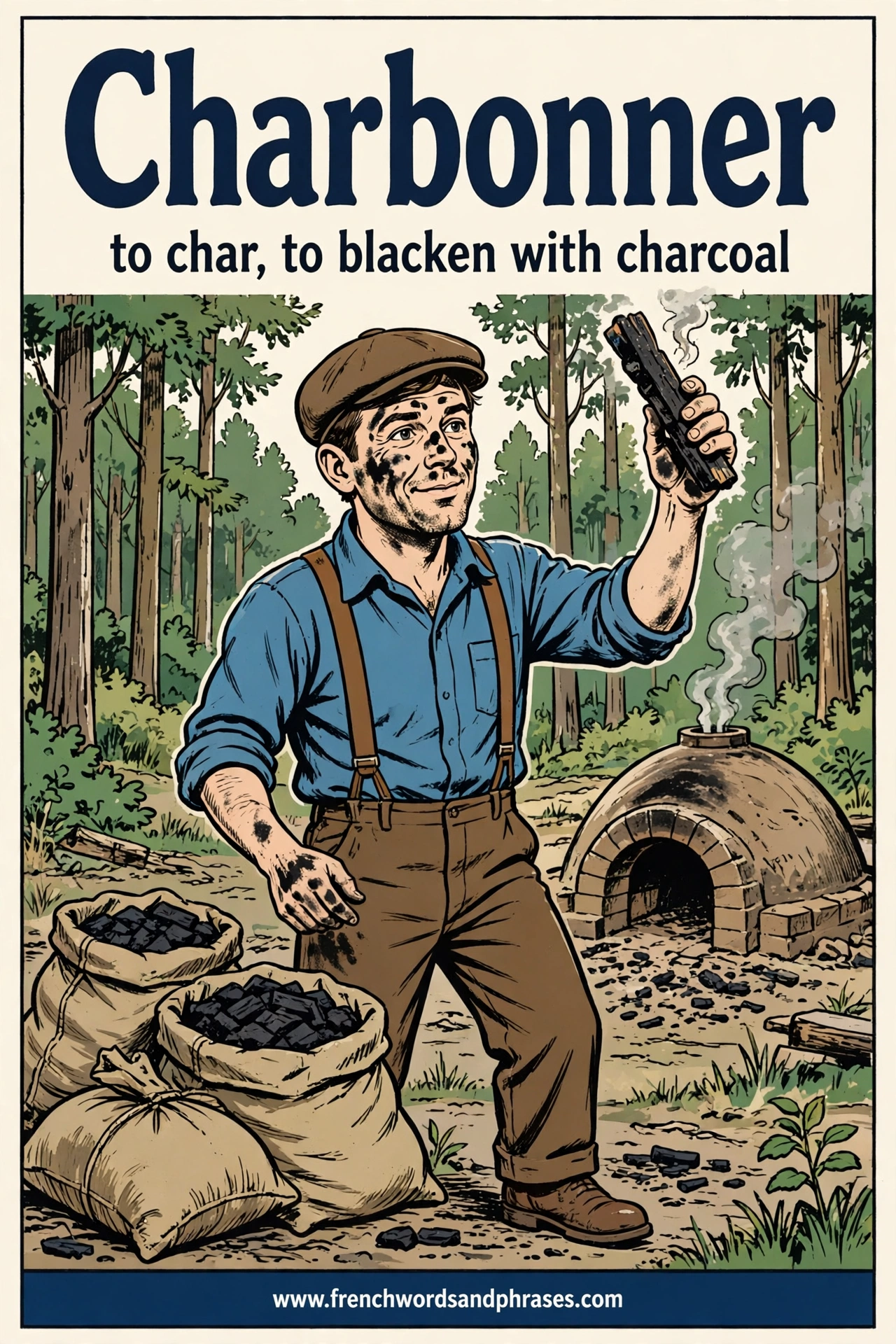
Charbonner means to char, to blacken with charcoal — to cover a surface with charcoal black, or to burn something black the way charcoal itself is black.
Sausages forgotten on a summer grill, a lamp wick burning badly and sooting its glass chimney, an artist’s fingers black from a charcoal sketch — charbonner is the verb of charcoal’s black touch, wherever fire or coal leaves its mark.
In this guide, you’ll learn how to conjugate charbonner in all the major French tenses and moods. Explore complete conjugation tables, French examples, English translations, and practice quizzes.
Understanding the French Verb Charbonner
Charbonner is a regular French verb belonging to the first group of verbs, those ending in-er.
It means to char, to blacken with charcoal. You will meet it at the barbecue, where meat chars outside while staying tender within, in the studio, where hands and paper blacken with charcoal, and around old lamps and stoves whose wicks and flues smoke. Deliberate charring is a technique — peppers and aubergines are charbonnés on purpose; accidental charring is a small kitchen disaster.
Verb classification: First group (-er)
Auxiliary verb: Avoir
Past participle: charbonné
Present participle: charbonnant
English equivalents: To char, to blacken with charcoal; charbonner la viande — to char the meat; charbonner un mur — to blacken a wall with charcoal or soot; la mèche charbonne — the wick is charring and smoking; un dessin au charbon — a charcoal drawing.
One important detail: charbonner is built on le charbon — coal, and charcoal — and it works in two directions. Transitive, it is what you do to something: charbonner la viande, to char the meat, charbonner un mur, to blacken a wall. Intransitive, it is what a bad flame does all by itself: la mèche charbonne, the wick of a lamp or candle burns smokily and chars. Mind the double n, and do not confuse it with charbon the disease (anthrax) in medical French — context always rules. Otherwise a regular -er verb.
Experience the Word
Charbonner is the verb of the blackened edge — the moment fire stops cooking and starts signing its name.
Imagine a summer barbecue in a garden in Provence. The cook turns away to argue about football; the sausages, forgotten on the fiercest corner of the grill, charbonnent joyeusement — black and crackling outside, still juicy within — and everyone agrees they are the best of the evening.
They are not burnt or ruined. They are charred — charbonnés — exactly as a grill intends.
How to Conjugate Charbonner: Complete French Conjugation Guide
Let’s explore every major conjugation of charbonner, beginning with the indicative mood.
How to Conjugate Charbonner in the Indicative Mood
The indicative mood is used to express facts, observations, actions, and events.
How to Conjugate Charbonner in the Present Tense (Présent)
Used for actions happening now, habitual actions, and general truths.
| Subject | Conjugation |
|---|---|
| je | charbonne |
| tu | charbonnes |
| il / elle | charbonne |
| nous | charbonnons |
| vous | charbonnez |
| ils / elles | charbonnent |
Example
La mèche de la lampe charbonne et fume.
The lamp wick is charring and smoking.
Quick Quiz 1
Complete the sentence:
La mèche de la lampe ______ et fume.
Reveal the answer
charbonne
La mèche de la lampe charbonne et fume.
The lamp wick is charring and smoking.
How to Conjugate Charbonner in the Passé Composé
Used for completed actions in the past. Charbonner takes the auxiliary verb avoir.
| Subject | Conjugation |
|---|---|
| j’ | ai charbonné |
| tu | as charbonné |
| il / elle | a charbonné |
| nous | avons charbonné |
| vous | avez charbonné |
| ils / elles | ont charbonné |
Example
Tu as charbonné les saucisses sur le gril !
You have charred the sausages on the grill!
How to Conjugate Charbonner in the Imparfait (Imperfect Tense)
Used for habitual past actions, descriptions, and ongoing situations in the past.
| Subject | Conjugation |
|---|---|
| je | charbonnais |
| tu | charbonnais |
| il / elle | charbonnait |
| nous | charbonnions |
| vous | charbonniez |
| ils / elles | charbonnaient |
Example
Le poêle charbonnait les murs de la cabane.
The stove used to blacken the walls of the hut with soot.
Quick Quiz 2
Choose the correct form:
You have charred the sausages!
Tu ______ les saucisses ! (as charbonné / es charbonné)
Reveal the answer
as charbonné
Tu as charbonné les saucisses !
Charbonner takes avoir.
How to Conjugate Charbonner in the Plus-que-parfait
Used to describe an action that had already been completed before another past event.
| Subject | Conjugation |
|---|---|
| j’ | avais charbonné |
| tu | avais charbonné |
| il / elle | avait charbonné |
| nous | avions charbonné |
| vous | aviez charbonné |
| ils / elles | avaient charbonné |
Example
Le feu avait charbonné la porte de la grange.
The fire had charred the barn door.
How to Conjugate Charbonner in the Passé Simple
Primarily used in formal writing, literature, and historical narratives. It is rarely used in everyday conversation.
| Subject | Conjugation |
|---|---|
| je | charbonnai |
| tu | charbonnas |
| il / elle | charbonna |
| nous | charbonnâmes |
| vous | charbonnâtes |
| ils / elles | charbonnèrent |
Example
La flamme charbonna le bord du parchemin.
The flame charred the edge of the parchment.
How to Conjugate Charbonner in the Passé Antérieur
A literary tense used to express an action completed immediately before another past action, generally in the passé simple.
| Subject | Conjugation |
|---|---|
| j’ | eus charbonné |
| tu | eus charbonné |
| il / elle | eut charbonné |
| nous | eûmes charbonné |
| vous | eûtes charbonné |
| ils / elles | eurent charbonné |
Example
Quand la chaleur eut charbonné la viande, il la retira du feu.
When the heat had charred the meat, he took it off the fire.
How to Conjugate Charbonner in the Future Tense (Futur Simple)
Used to describe actions that will take place in the future.
| Subject | Conjugation |
|---|---|
| je | charbonnerai |
| tu | charbonneras |
| il / elle | charbonnera |
| nous | charbonnerons |
| vous | charbonnerez |
| ils / elles | charbonneront |
Example
À feu trop vif, la viande charbonnera.
Over too fierce a heat, the meat will char.
How to Conjugate Charbonner in the Futur Antérieur (Future Perfect)
Used for an action that will have been completed before a particular point in the future.
| Subject | Conjugation |
|---|---|
| j’ | aurai charbonné |
| tu | auras charbonné |
| il / elle | aura charbonné |
| nous | aurons charbonné |
| vous | aurez charbonné |
| ils / elles | auront charbonné |
Example
Dans dix minutes, les poivrons auront charbonné.
In ten minutes, the peppers will have charred.
How to Conjugate Charbonner in the Near Future (Futur Proche)
Used to describe something that is going to happen soon. Formed with aller + infinitive.
| Subject | Conjugation |
|---|---|
| je | vais charbonner |
| tu | vas charbonner |
| il / elle | va charbonner |
| nous | allons charbonner |
| vous | allez charbonner |
| ils / elles | vont charbonner |
Example
Baisse le feu, ça va charbonner !
Turn down the heat, it is going to char!
How to Conjugate Charbonner in the Conditional Mood
The conditional mood expresses what would happen under certain circumstances. It is also frequently used to make polite requests or express wishes.
How to Conjugate Charbonner in the Present Conditional
| Subject | Conjugation |
|---|---|
| je | charbonnerais |
| tu | charbonnerais |
| il / elle | charbonnerait |
| nous | charbonnerions |
| vous | charbonneriez |
| ils / elles | charbonneraient |
Example
Sans surveillance, le pain charbonnerait sur la braise.
Unwatched, the bread would char on the embers.
How to Conjugate Charbonner in the Past Conditional
| Subject | Conjugation |
|---|---|
| j’ | aurais charbonné |
| tu | aurais charbonné |
| il / elle | aurait charbonné |
| nous | aurions charbonné |
| vous | auriez charbonné |
| ils / elles | auraient charbonné |
Example
Tu aurais charbonné le rôti sans la minuterie.
You would have charred the roast without the timer.
Charbonner in the Literary Past Conditional Form
This less common literary form uses the imperfect subjunctive of avoir.
| Subject | Conjugation |
|---|---|
| j’ | eusse charbonné |
| tu | eusses charbonné |
| il / elle | eût charbonné |
| nous | eussions charbonné |
| vous | eussiez charbonné |
| ils / elles | eussent charbonné |
Example
La bougie eût charbonné la nappe sans le plateau.
The candle would have charred the tablecloth without the tray.
How to Conjugate Charbonner in the Subjunctive Mood
The subjunctive is used to express wishes, emotions, doubts, necessity, and uncertainty. It frequently follows expressions such as il faut que (it is necessary that) or bien que (although).
How to Conjugate Charbonner in the Present Subjunctive
| Subject | Conjugation |
|---|---|
| que je | charbonne |
| que tu | charbonnes |
| qu’il / qu’elle | charbonne |
| que nous | charbonnions |
| que vous | charbonniez |
| qu’ils / qu’elles | charbonnent |
Example
Je ne veux pas que la viande charbonne.
I do not want the meat to char.
Quick Quiz 3
Complete the sentence using the subjunctive:
Je ne veux pas que la viande ______.
Reveal the answer
charbonne
Je ne veux pas que la viande charbonne.
I do not want the meat to char.
How to Conjugate Charbonner in the Imperfect Subjunctive
A literary tense, rarely encountered in modern spoken French.
| Subject | Conjugation |
|---|---|
| que je | charbonnasse |
| que tu | charbonnasses |
| qu’il / qu’elle | charbonnât |
| que nous | charbonnassions |
| que vous | charbonnassiez |
| qu’ils / qu’elles | charbonnassent |
Example
Il fallait surveiller le gril pour que rien ne charbonnât.
The grill had to be watched so that nothing would char.
How to Conjugate Charbonner in the Pluperfect Subjunctive
A literary construction used to express an action completed before another past action.
| Subject | Conjugation |
|---|---|
| que j’ | eusse charbonné |
| que tu | eusses charbonné |
| qu’il / qu’elle | eût charbonné |
| que nous | eussions charbonné |
| que vous | eussiez charbonné |
| qu’ils / qu’elles | eussent charbonné |
Example
On voyait que le feu eût charbonné la poutre depuis longtemps.
It was clear the beam had long been charred by the fire.
How to Conjugate Charbonner in the Past Subjunctive
| Subject | Conjugation |
|---|---|
| que j’ | aie charbonné |
| que tu | aies charbonné |
| qu’il / qu’elle | ait charbonné |
| que nous | ayons charbonné |
| que vous | ayez charbonné |
| qu’ils / qu’elles | aient charbonné |
Example
Dommage que les saucisses aient charbonné !
A shame the sausages got charred!
How to Conjugate Charbonner in the Imperative
The imperative is used to give commands, instructions, invitations, or suggestions. Subject pronouns are omitted.
How to Conjugate Charbonner in the Present Imperative
| Person | Conjugation |
|---|---|
| (tu) | charbonne |
| (nous) | charbonnons |
| (vous) | charbonnez |
Example
Ne charbonne pas les légumes, surveille le gril !
Do not char the vegetables, watch the grill!
Quick Quiz 4
How would you say Do not char the meat (tu form)?
Reveal the answer
Ne charbonne pas la viande !
French Participles of Charbonner
Participles are verb forms that can be used in compound tenses and other grammatical constructions.
Present Participle of Charbonner
charbonnant
En charbonnant légèrement, les poivrons deviennent doux.
By charring slightly, the peppers become sweet.
Past Participle of Charbonner
charbonné
Charbonnée à l’extérieur, la viande reste tendre dedans.
Charred on the outside, the meat stays tender inside.
Charbonner in Everyday French: Real-Life Examples
Now that you know the conjugations, let’s see how charbonner appears in everyday French.
Example 1 — Present
La mèche charbonne et fume.
The wick is charring and smoking.
Example 2 — Passé composé
Tu as charbonné les saucisses !
You have charred the sausages!
Example 3 — Imparfait
Le poêle charbonnait les murs.
The stove used to blacken the walls.
Example 4 — Future
À feu vif, la viande charbonnera.
Over a fierce heat, the meat will char.
Example 5 — Conditional
Sans surveillance, tout charbonnerait.
Unwatched, everything would char.
Example 6 — Imperative
Ne charbonne pas le pain !
Do not char the bread!
Beyond Translation: The Meaning of Charbonner
Le charbon is both coal from the mine and charcoal from the artist’s box — charbon de bois, wood turned black by fire.
Charbonner is fire leaving its signature in black.
English char is a near-twin, and the family resemblance is no accident: wherever something carbonises, French reaches for charbon — the grill, the lamp and the drawing all blacken the same way.
How to Remember the French Verb Charbonner
Remember it this way: Charbonner is about charcoal black — on the grill, on the wall, on the wick.
- Le charbon is charcoal: charbonner is what charcoal does — it blackens, and what fire does in its name.
- Two directions: you charbonnez la viande, and all by itself, la mèche charbonne — the wick smokes and chars.
- Regular -er with a double n: je charbonne, nous charbonnons, past participle charbonné.
The key idea is charcoal black — on the grill, on the wall, on the wick.
Test Your Knowledge of Charbonner
Let’s see how much you’ve learned. Try answering these questions before revealing the answers.
Question 1
What does la mèche charbonne mean?
Reveal the answer
The wick is charring and smoking — intransitive charbonner, of a lamp or candle burning badly.
Question 2
How do you say You have charred the sausages in French?
Reveal the answer
Tu as charbonné les saucisses.
Question 3
Translate: The lamp wick is charring and smoking.
Reveal the answer
La mèche de la lampe charbonne et fume.
Question 4
What is the past participle of charbonner?
Reveal the answer
Charbonné.
Question 5
Complete the sentence:
Je ne veux pas que la viande ______.
Reveal the answer
charbonne
Je ne veux pas que la viande charbonne.
I do not want the meat to char.
Your Final Challenge
Can You Use It?
How would you say this in French?
The wick chars gently and the lamp draws shadows on the wall.
Reveal the answer
La mèche charbonne doucement et la lampe dessine des ombres sur le mur.
The wick chars gently and the lamp draws shadows on the wall.
A little French. A little curiosity. A richer everyday life.
LEARN FRENCH ONE WORD AT A TIME