A French Word to Live By
How to Conjugate Chansonner in French
/ʃɑ̃.sɔ.ne/
Chansonner means to lampoon — to mock the powerful in song, turning ridicule into a tune everyone can hum.
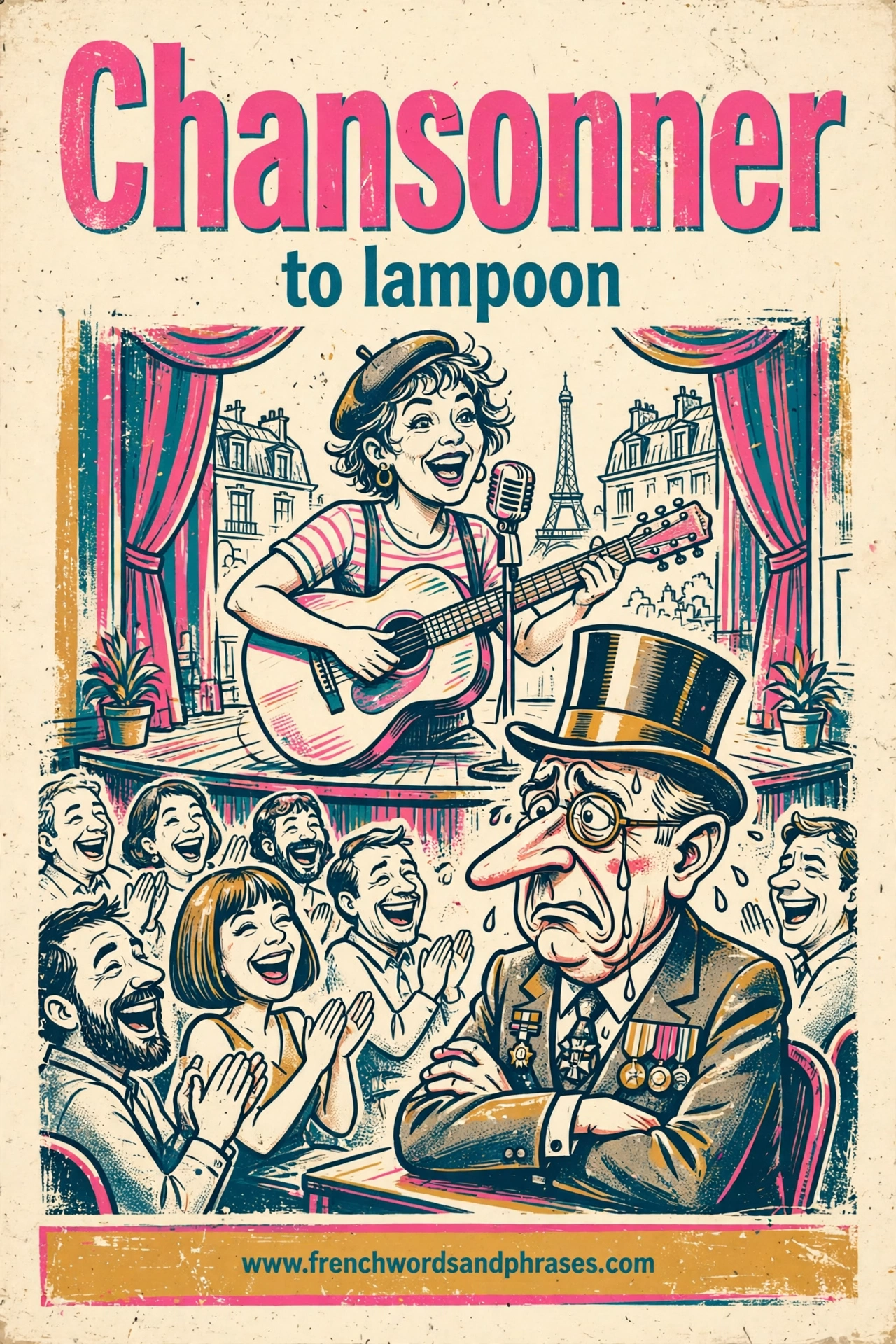
In a smoky Paris café-concert, a singer with a guitar reaches the verse about the minister, and the whole room grins before the punchline lands. Chansonner is the satirist’s verb: to lampoon somebody in a song, the oldest French way of answering power.
In this guide, you’ll learn how to conjugate chansonner in all the major French tenses and moods. Explore complete conjugation tables, French examples, English translations, and practice quizzes.
Understanding the French Verb Chansonner
Chansonner is a regular French verb belonging to the first group of verbs, those ending in-er.
It means to lampoon. It is commonly used of satirical singers, revues and carnival songs mocking politicians and celebrities, and it carries a smile rather than a snarl — to chansonner is to tease in verse, and being chansonné was once almost an honour, proof that one mattered. The tone is mockery, not attack: the tune must be catchy enough to survive the joke.
Verb classification: First group (-er)
Auxiliary verb: Avoir
Past participle: chansonné
Present participle: chansonnant
English equivalents: To lampoon, to satirize in song; chansonner les puissants — to lampoon the powerful; un chansonnier — a satirical singer-songwriter; chansonner quelqu’un dans une revue — to lampoon someone in a revue; se faire chansonner — to get lampooned.
One important detail: chansonner is simply une chanson turned into a weapon — the lampoon must be sung, or at least versified, to earn the verb. Its natural object is a person, usually a public one: chansonner un ministre, chansonner le maire. The artist who does it professionally is un chansonnier — not merely a singer, but a wit with a guitar, heir to Brassens and the café-concerts. The verb itself is perfectly regular: je chansonne, nous chansonnons, past participle chansonné.
Experience the Word
Chansonner is criticism you can whistle — power may ban a pamphlet, but it cannot un-sing a chorus.
Imagine the end-of-year revue at a Paris school. The pupils have rewritten a famous song about the headmaster’s moustache; the teachers are crying with laughter, and even the headmaster, chansonné in front of two hundred people, takes his bow with the singers.
He has been mocked in public. He has been chansonné — and somehow, it feels like a decoration.
How to Conjugate Chansonner: Complete French Conjugation Guide
Let’s explore every major conjugation of chansonner, beginning with the indicative mood.
How to Conjugate Chansonner in the Indicative Mood
The indicative mood is used to express facts, observations, actions, and events.
How to Conjugate Chansonner in the Present Tense (Présent)
Used for actions happening now, habitual actions, and general truths.
| Subject | Conjugation |
|---|---|
| je | chansonne |
| tu | chansonnes |
| il / elle | chansonne |
| nous | chansonnons |
| vous | chansonnez |
| ils / elles | chansonnent |
Example
Les étudiants chansonnent le doyen dans leur revue de fin d’année.
The students lampoon the dean in their end-of-year revue.
Quick Quiz 1
Complete the sentence:
Nous ______ le maire dans la revue de l’école.
Reveal the answer
chansonnons
Nous chansonnons le maire dans la revue de l’école.
We are lampooning the mayor in the school revue.
How to Conjugate Chansonner in the Passé Composé
Used for completed actions in the past. Chansonner takes the auxiliary verb avoir.
| Subject | Conjugation |
|---|---|
| j’ | ai chansonné |
| tu | as chansonné |
| il / elle | a chansonné |
| nous | avons chansonné |
| vous | avez chansonné |
| ils / elles | ont chansonné |
Example
Le cabaret a chansonné tous les ministres de l’année.
The cabaret lampooned every minister of the year.
How to Conjugate Chansonner in the Imparfait (Imperfect Tense)
Used for habitual past actions, descriptions, and ongoing situations in the past.
| Subject | Conjugation |
|---|---|
| je | chansonnais |
| tu | chansonnais |
| il / elle | chansonnait |
| nous | chansonnions |
| vous | chansonniez |
| ils / elles | chansonnaient |
Example
Autrefois, on chansonnait les puissants dans les cafés-concerts.
In the old days, the powerful were lampooned in the café-concerts.
Quick Quiz 2
Choose the correct form:
The cabaret lampooned all the ministers.
Le cabaret ______ tous les ministres. (a chansonné / est chansonné)
Reveal the answer
a chansonné
Le cabaret a chansonné tous les ministres.
Chansonner takes avoir.
How to Conjugate Chansonner in the Plus-que-parfait
Used to describe an action that had already been completed before another past event.
| Subject | Conjugation |
|---|---|
| j’ | avais chansonné |
| tu | avais chansonné |
| il / elle | avait chansonné |
| nous | avions chansonné |
| vous | aviez chansonné |
| ils / elles | avaient chansonné |
Example
Elle avait chansonné le maire dans trois couplets restés célèbres.
She had lampooned the mayor in three verses that remained famous.
How to Conjugate Chansonner in the Passé Simple
Primarily used in formal writing, literature, and historical narratives. It is rarely used in everyday conversation.
| Subject | Conjugation |
|---|---|
| je | chansonnai |
| tu | chansonnas |
| il / elle | chansonna |
| nous | chansonnâmes |
| vous | chansonnâtes |
| ils / elles | chansonnèrent |
Example
Brassens chansonna les bourgeois avec un sourire.
Brassens lampooned the bourgeois with a smile.
How to Conjugate Chansonner in the Passé Antérieur
A literary tense used to express an action completed immediately before another past action, generally in the passé simple.
| Subject | Conjugation |
|---|---|
| j’ | eus chansonné |
| tu | eus chansonné |
| il / elle | eut chansonné |
| nous | eûmes chansonné |
| vous | eûtes chansonné |
| ils / elles | eurent chansonné |
Example
Quand il eut chansonné le préfet, le public éclata de rire.
When he had lampooned the prefect, the audience burst out laughing.
How to Conjugate Chansonner in the Future Tense (Futur Simple)
Used to describe actions that will take place in the future.
| Subject | Conjugation |
|---|---|
| je | chansonnerai |
| tu | chansonneras |
| il / elle | chansonnera |
| nous | chansonnerons |
| vous | chansonnerez |
| ils / elles | chansonneront |
Example
Ce soir, l’humoriste chansonnera l’actualité de la semaine.
Tonight, the comedian will lampoon the week’s news in song.
How to Conjugate Chansonner in the Futur Antérieur (Future Perfect)
Used for an action that will have been completed before a particular point in the future.
| Subject | Conjugation |
|---|---|
| j’ | aurai chansonné |
| tu | auras chansonné |
| il / elle | aura chansonné |
| nous | aurons chansonné |
| vous | aurez chansonné |
| ils / elles | auront chansonné |
Example
À la fin du spectacle, il aura chansonné tout le gouvernement.
By the end of the show, he will have lampooned the entire government.
How to Conjugate Chansonner in the Near Future (Futur Proche)
Used to describe something that is going to happen soon. Formed with aller + infinitive.
| Subject | Conjugation |
|---|---|
| je | vais chansonner |
| tu | vas chansonner |
| il / elle | va chansonner |
| nous | allons chansonner |
| vous | allez chansonner |
| ils / elles | vont chansonner |
Example
Attention, les élèves vont chansonner le professeur de mathématiques !
Careful, the pupils are going to lampoon the maths teacher in song!
How to Conjugate Chansonner in the Conditional Mood
The conditional mood expresses what would happen under certain circumstances. It is also frequently used to make polite requests or express wishes.
How to Conjugate Chansonner in the Present Conditional
| Subject | Conjugation |
|---|---|
| je | chansonnerais |
| tu | chansonnerais |
| il / elle | chansonnerait |
| nous | chansonnerions |
| vous | chansonneriez |
| ils / elles | chansonneraient |
Example
Un bon chansonnier chansonnerait même le roi.
A good satirical singer would lampoon even the king.
How to Conjugate Chansonner in the Past Conditional
| Subject | Conjugation |
|---|---|
| j’ | aurais chansonné |
| tu | aurais chansonné |
| il / elle | aurait chansonné |
| nous | aurions chansonné |
| vous | auriez chansonné |
| ils / elles | auraient chansonné |
Example
Elle aurait chansonné le président si la censure l’avait permis.
She would have lampooned the president if censorship had allowed it.
Chansonner in the Literary Past Conditional Form
This less common literary form uses the imperfect subjunctive of avoir.
| Subject | Conjugation |
|---|---|
| j’ | eusse chansonné |
| tu | eusses chansonné |
| il / elle | eût chansonné |
| nous | eussions chansonné |
| vous | eussiez chansonné |
| ils / elles | eussent chansonné |
Example
Il eût chansonné la cour entière sans trembler.
He would have lampooned the entire court without trembling.
How to Conjugate Chansonner in the Subjunctive Mood
The subjunctive is used to express wishes, emotions, doubts, necessity, and uncertainty. It frequently follows expressions such as il faut que (it is necessary that) or bien que (although).
How to Conjugate Chansonner in the Present Subjunctive
| Subject | Conjugation |
|---|---|
| que je | chansonne |
| que tu | chansonnes |
| qu’il / qu’elle | chansonne |
| que nous | chansonnions |
| que vous | chansonniez |
| qu’ils / qu’elles | chansonnent |
Example
Il est amusant qu’ils chansonnent les puissants avec tant d’esprit.
It is amusing that they lampoon the powerful with such wit.
Quick Quiz 3
Complete the sentence using the subjunctive:
Il est amusant que vous ______ les puissants avec tant d’esprit.
Reveal the answer
chansonniez
Il est amusant que vous chansonniez les puissants avec tant d’esprit.
It is amusing that you lampoon the powerful with such wit.
How to Conjugate Chansonner in the Imperfect Subjunctive
A literary tense, rarely encountered in modern spoken French.
| Subject | Conjugation |
|---|---|
| que je | chansonnasse |
| que tu | chansonnasses |
| qu’il / qu’elle | chansonnât |
| que nous | chansonnassions |
| que vous | chansonnassiez |
| qu’ils / qu’elles | chansonnassent |
Example
On aimait qu’il chansonnât les ministres sans méchanceté.
People liked it that he lampooned ministers without malice.
How to Conjugate Chansonner in the Pluperfect Subjunctive
A literary construction used to express an action completed before another past action.
| Subject | Conjugation |
|---|---|
| que j’ | eusse chansonné |
| que tu | eusses chansonné |
| qu’il / qu’elle | eût chansonné |
| que nous | eussions chansonné |
| que vous | eussiez chansonné |
| qu’ils / qu’elles | eussent chansonné |
Example
On racontait qu’il eût chansonné le roi lui-même.
People said he had lampooned the king himself.
How to Conjugate Chansonner in the Past Subjunctive
| Subject | Conjugation |
|---|---|
| que j’ | aie chansonné |
| que tu | aies chansonné |
| qu’il / qu’elle | ait chansonné |
| que nous | ayons chansonné |
| que vous | ayez chansonné |
| qu’ils / qu’elles | aient chansonné |
Example
Je ris encore qu’elle ait chansonné le directeur devant tout le monde.
I still laugh that she lampooned the headmaster in front of everyone.
How to Conjugate Chansonner in the Imperative
The imperative is used to give commands, instructions, invitations, or suggestions. Subject pronouns are omitted.
How to Conjugate Chansonner in the Present Imperative
| Person | Conjugation |
|---|---|
| (tu) | chansonne |
| (nous) | chansonnons |
| (vous) | chansonnez |
Example
Chansonnez les puissants, jamais les faibles !
Lampoon the powerful, never the weak!
Quick Quiz 4
How would you say Lampoon the powerful (tu form)?
Reveal the answer
Chansonne les puissants !
French Participles of Chansonner
Participles are verb forms that can be used in compound tenses and other grammatical constructions.
Present Participle of Chansonner
chansonnant
En chansonnant les ministres, il est devenu célèbre.
By lampooning ministers in song, he became famous.
Past Participle of Chansonner
chansonné
Chansonné par tout Paris, le préfet finit par en rire.
Lampooned by all of Paris, the prefect ended up laughing about it.
Chansonner in Everyday French: Real-Life Examples
Now that you know the conjugations, let’s see how chansonner appears in everyday French.
Example 1 — Present
Les étudiants chansonnent le doyen dans leur revue.
The students lampoon the dean in their revue.
Example 2 — Passé composé
Le cabaret a chansonné tous les ministres.
The cabaret lampooned all the ministers.
Example 3 — Imparfait
On chansonnait les puissants dans les cafés-concerts.
The powerful were lampooned in the café-concerts.
Example 4 — Future
L’humoriste chansonnera l’actualité ce soir.
The comedian will lampoon the news in song tonight.
Example 5 — Conditional
Un bon chansonnier chansonnerait même le roi.
A good satirical singer would lampoon even the king.
Example 6 — Imperative
Chansonnez les puissants, jamais les faibles !
Lampoon the powerful, never the weak!
Beyond Translation: The Meaning of Chansonner
English lampoon itself came from French — from the old refrain lampons !, ‘let us drink!’, sung in mocking songs — and chansonner is the same tradition from the inside: ridicule set to music.
France has always sung its politics.
From the couplets against Mazarin to Brassens and the modern chansonniers, chansonner is how the powerless answer back — politely, memorably, and in rhymes that outlive the minister.
How to Remember the French Verb Chansonner
Remember it this way: Chansonner is about the satirical song about the minister that the whole café can hum.
- A chanson turned into a weapon: chansonner is to mock somebody in song, usually somebody powerful.
- The professional is un chansonnier — a satirical singer-songwriter, not just any singer.
- Regular -er: je chansonne, nous chansonnons, past participle chansonné.
The key idea is the satirical song about the minister that the whole café can hum.
Test Your Knowledge of Chansonner
Let’s see how much you’ve learned. Try answering these questions before revealing the answers.
Question 1
What must a lampoon be, to earn the verb chansonner?
Reveal the answer
Sung — chansonner is mockery set to song or verse; its artist is un chansonnier.
Question 2
How do you say The students lampoon the dean in their revue in French?
Reveal the answer
Les étudiants chansonnent le doyen dans leur revue.
Question 3
Translate: It is amusing that they lampoon the powerful with such wit.
Reveal the answer
Il est amusant qu’ils chansonnent les puissants avec tant d’esprit.
Question 4
What is the past participle of chansonner?
Reveal the answer
Chansonné.
Question 5
Complete the sentence:
En ______ les ministres, il est devenu célèbre.
Reveal the answer
chansonnant
En chansonnant les ministres, il est devenu célèbre.
By lampooning ministers in song, he became famous.
Your Final Challenge
Can You Use It?
How would you say this in French?
He has lampooned the powerful in song for thirty years, and the powerful always end up humming along.
Reveal the answer
Il chansonne les puissants depuis trente ans, et les puissants finissent toujours par fredonner.
He has lampooned the powerful in song for thirty years, and the powerful always end up humming along.
A little French. A little curiosity. A richer everyday life.
LEARN FRENCH ONE WORD AT A TIME