A French Word to Live By
How to Conjugate Chanfreiner in French
/ʃɑ̃.fʁɛ.ne/
Chanfreiner means to bevel, to chamfer — to cut away a sharp edge at an angle, so that wood, metal or glass meets the world softly.
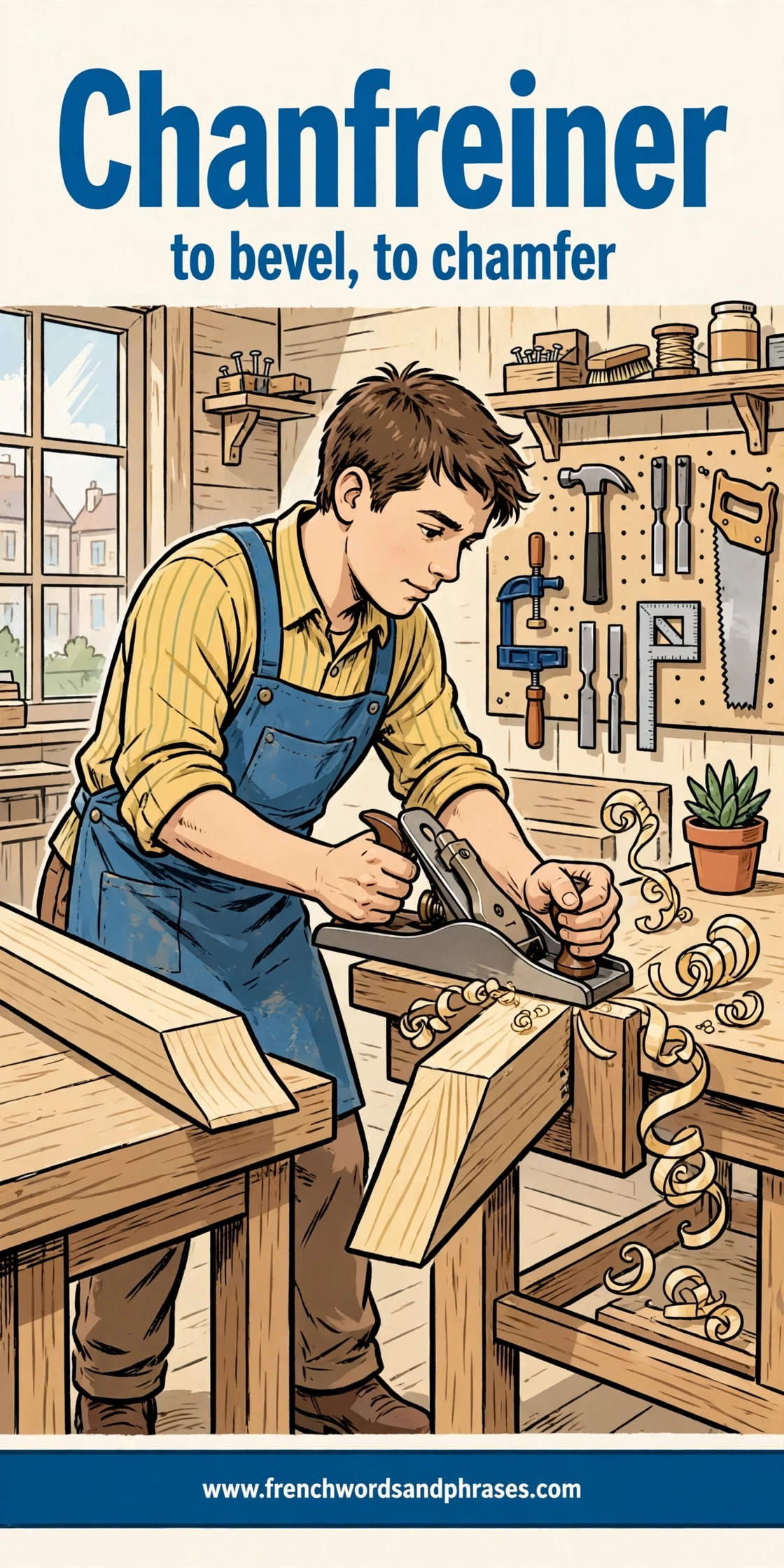
In the joiner’s workshop, a board with a knife-sharp corner is a board unfinished. Chanfreiner is the craftsman’s verb for taking that edge off at forty-five degrees — the small angled cut that makes furniture kind to hands and shins.
In this guide, you’ll learn how to conjugate chanfreiner in all the major French tenses and moods. Explore complete conjugation tables, French examples, English translations, and practice quizzes.
Understanding the French Verb Chanfreiner
Chanfreiner is a regular French verb belonging to the first group of verbs, those ending in-er.
It means to bevel, to chamfer. It is commonly used in joinery, metalwork and stonecutting for easing edges before assembly or finishing — for safety, for looks, and so that parts fit. A chanfrein also guides screws and bolts into their holes, which is why engineers chamfer the mouths of drilled holes; the verb follows the noun everywhere a sharp edge is given an angle.
Verb classification: First group (-er)
Auxiliary verb: Avoir
Past participle: chanfreiné
Present participle: chanfreinant
English equivalents: To bevel, to chamfer; chanfreiner une arête — to chamfer an edge; un chanfrein — a chamfer, a bevel; chanfreiner à quarante-cinq degrés — to bevel at forty-five degrees; une arête chanfreinée — a chamfered edge.
One important detail: chanfreiner is the verb of the noun un chanfrein, the chamfer itself — the narrow angled face that replaces a sharp corner. It is a workshop word, used for wood, metal, stone and glass, and it is perfectly regular: je chanfreine, nous chanfreinons, past participle chanfreiné. Do not confuse the result with biseauter, which bevels glass and mirrors in particular; chanfreiner is the general term, and the one carpenters and machinists reach for.
Experience the Word
Chanfreiner is the verb of the finishing touch — two seconds with a plane, and a piece stops being dangerous and starts being furniture.
Imagine the apprentice running his thumb along the shelf he has just made. The corner bites. The master hands him the block plane without a word: four strokes later the edge has its little flat face, the thumb slides over it safely, and the shelf is suddenly a professional object.
Nothing was added or decorated. He simply chanfreina — cut the corner away, and the board became kind.
How to Conjugate Chanfreiner: Complete French Conjugation Guide
Let’s explore every major conjugation of chanfreiner, beginning with the indicative mood.
How to Conjugate Chanfreiner in the Indicative Mood
The indicative mood is used to express facts, observations, actions, and events.
How to Conjugate Chanfreiner in the Present Tense (Présent)
Used for actions happening now, habitual actions, and general truths.
| Subject | Conjugation |
|---|---|
| je | chanfreine |
| tu | chanfreines |
| il / elle | chanfreine |
| nous | chanfreinons |
| vous | chanfreinez |
| ils / elles | chanfreinent |
Example
L’ébéniste chanfreine les bords de la planche.
The cabinetmaker chamfers the edges of the board.
Quick Quiz 1
Complete the sentence:
Nous ______ les quatre coins de la table.
Reveal the answer
chanfreinons
Nous chanfreinons les quatre coins de la table.
We are chamfering the four corners of the table.
How to Conjugate Chanfreiner in the Passé Composé
Used for completed actions in the past. Chanfreiner takes the auxiliary verb avoir.
| Subject | Conjugation |
|---|---|
| j’ | ai chanfreiné |
| tu | as chanfreiné |
| il / elle | a chanfreiné |
| nous | avons chanfreiné |
| vous | avez chanfreiné |
| ils / elles | ont chanfreiné |
Example
Il a chanfreiné l’angle du plateau pour l’adoucir.
He chamfered the corner of the top to soften it.
How to Conjugate Chanfreiner in the Imparfait (Imperfect Tense)
Used for habitual past actions, descriptions, and ongoing situations in the past.
| Subject | Conjugation |
|---|---|
| je | chanfreinais |
| tu | chanfreinais |
| il / elle | chanfreinait |
| nous | chanfreinions |
| vous | chanfreiniez |
| ils / elles | chanfreinaient |
Example
L’ouvrier chanfreinait chaque pièce avant l’assemblage.
The workman used to chamfer every piece before assembly.
Quick Quiz 2
Choose the correct form:
He chamfered the corner of the top.
Il ______ l’angle du plateau. (a chanfreiné / est chanfreiné)
Reveal the answer
a chanfreiné
Il a chanfreiné l’angle du plateau.
Chanfreiner takes avoir.
How to Conjugate Chanfreiner in the Plus-que-parfait
Used to describe an action that had already been completed before another past event.
| Subject | Conjugation |
|---|---|
| j’ | avais chanfreiné |
| tu | avais chanfreiné |
| il / elle | avait chanfreiné |
| nous | avions chanfreiné |
| vous | aviez chanfreiné |
| ils / elles | avaient chanfreiné |
Example
Elle avait chanfreiné les arêtes du miroir avant de le poser.
She had bevelled the edges of the mirror before fitting it.
How to Conjugate Chanfreiner in the Passé Simple
Primarily used in formal writing, literature, and historical narratives. It is rarely used in everyday conversation.
| Subject | Conjugation |
|---|---|
| je | chanfreinai |
| tu | chanfreinas |
| il / elle | chanfreina |
| nous | chanfreinâmes |
| vous | chanfreinâtes |
| ils / elles | chanfreinèrent |
Example
Le menuisier chanfreina le bord de la porte d’un geste sûr.
The joiner chamfered the edge of the door with a sure hand.
How to Conjugate Chanfreiner in the Passé Antérieur
A literary tense used to express an action completed immediately before another past action, generally in the passé simple.
| Subject | Conjugation |
|---|---|
| j’ | eus chanfreiné |
| tu | eus chanfreiné |
| il / elle | eut chanfreiné |
| nous | eûmes chanfreiné |
| vous | eûtes chanfreiné |
| ils / elles | eurent chanfreiné |
Example
Quand il eut chanfreiné la pièce, il la ponça finement.
When he had chamfered the piece, he sanded it smooth.
How to Conjugate Chanfreiner in the Future Tense (Futur Simple)
Used to describe actions that will take place in the future.
| Subject | Conjugation |
|---|---|
| je | chanfreinerai |
| tu | chanfreineras |
| il / elle | chanfreinera |
| nous | chanfreinerons |
| vous | chanfreinerez |
| ils / elles | chanfreineront |
Example
Demain, nous chanfreinerons les quatre coins de la table.
Tomorrow, we will chamfer the four corners of the table.
How to Conjugate Chanfreiner in the Futur Antérieur (Future Perfect)
Used for an action that will have been completed before a particular point in the future.
| Subject | Conjugation |
|---|---|
| j’ | aurai chanfreiné |
| tu | auras chanfreiné |
| il / elle | aura chanfreiné |
| nous | aurons chanfreiné |
| vous | aurez chanfreiné |
| ils / elles | auront chanfreiné |
Example
À la fin de la journée, il aura chanfreiné vingt planches.
By the end of the day, he will have chamfered twenty boards.
How to Conjugate Chanfreiner in the Near Future (Futur Proche)
Used to describe something that is going to happen soon. Formed with aller + infinitive.
| Subject | Conjugation |
|---|---|
| je | vais chanfreiner |
| tu | vas chanfreiner |
| il / elle | va chanfreiner |
| nous | allons chanfreiner |
| vous | allez chanfreiner |
| ils / elles | vont chanfreiner |
Example
Je vais chanfreiner cette arête trop vive.
I am going to chamfer this edge, it is too sharp.
How to Conjugate Chanfreiner in the Conditional Mood
The conditional mood expresses what would happen under certain circumstances. It is also frequently used to make polite requests or express wishes.
How to Conjugate Chanfreiner in the Present Conditional
| Subject | Conjugation |
|---|---|
| je | chanfreinerais |
| tu | chanfreinerais |
| il / elle | chanfreinerait |
| nous | chanfreinerions |
| vous | chanfreineriez |
| ils / elles | chanfreineraient |
Example
Avec un rabot électrique, on chanfreinerait plus vite.
With an electric plane, we would chamfer faster.
How to Conjugate Chanfreiner in the Past Conditional
| Subject | Conjugation |
|---|---|
| j’ | aurais chanfreiné |
| tu | aurais chanfreiné |
| il / elle | aurait chanfreiné |
| nous | aurions chanfreiné |
| vous | auriez chanfreiné |
| ils / elles | auraient chanfreiné |
Example
Il aurait chanfreiné le bord si son outil n’avait pas cassé.
He would have chamfered the edge if his tool had not broken.
Chanfreiner in the Literary Past Conditional Form
This less common literary form uses the imperfect subjunctive of avoir.
| Subject | Conjugation |
|---|---|
| j’ | eusse chanfreiné |
| tu | eusses chanfreiné |
| il / elle | eût chanfreiné |
| nous | eussions chanfreiné |
| vous | eussiez chanfreiné |
| ils / elles | eussent chanfreiné |
Example
L’artisan eût chanfreiné la pièce sans la moindre hésitation.
The craftsman would have chamfered the piece without the slightest hesitation.
How to Conjugate Chanfreiner in the Subjunctive Mood
The subjunctive is used to express wishes, emotions, doubts, necessity, and uncertainty. It frequently follows expressions such as il faut que (it is necessary that) or bien que (although).
How to Conjugate Chanfreiner in the Present Subjunctive
| Subject | Conjugation |
|---|---|
| que je | chanfreine |
| que tu | chanfreines |
| qu’il / qu’elle | chanfreine |
| que nous | chanfreinions |
| que vous | chanfreiniez |
| qu’ils / qu’elles | chanfreinent |
Example
Il faut que tu chanfreines l’angle avant de peindre.
You must chamfer the corner before painting.
Quick Quiz 3
Complete the sentence using the subjunctive:
Il faut que vous ______ l’angle avant de peindre.
Reveal the answer
chanfreiniez
Il faut que vous chanfreiniez l’angle avant de peindre.
You must chamfer the corner before painting.
How to Conjugate Chanfreiner in the Imperfect Subjunctive
A literary tense, rarely encountered in modern spoken French.
| Subject | Conjugation |
|---|---|
| que je | chanfreinasse |
| que tu | chanfreinasses |
| qu’il / qu’elle | chanfreinât |
| que nous | chanfreinassions |
| que vous | chanfreinassiez |
| qu’ils / qu’elles | chanfreinassent |
Example
Le patron voulait que l’apprenti chanfreinât les planches.
The boss wanted the apprentice to chamfer the boards.
How to Conjugate Chanfreiner in the Pluperfect Subjunctive
A literary construction used to express an action completed before another past action.
| Subject | Conjugation |
|---|---|
| que j’ | eusse chanfreiné |
| que tu | eusses chanfreiné |
| qu’il / qu’elle | eût chanfreiné |
| que nous | eussions chanfreiné |
| que vous | eussiez chanfreiné |
| qu’ils / qu’elles | eussent chanfreiné |
Example
On admirait qu’il eût chanfreiné le marbre sans l’ébrécher.
People admired that he had chamfered the marble without chipping it.
How to Conjugate Chanfreiner in the Past Subjunctive
| Subject | Conjugation |
|---|---|
| que j’ | aie chanfreiné |
| que tu | aies chanfreiné |
| qu’il / qu’elle | ait chanfreiné |
| que nous | ayons chanfreiné |
| que vous | ayez chanfreiné |
| qu’ils / qu’elles | aient chanfreiné |
Example
Je suis content qu’elle ait chanfreiné les bords du cadre.
I am glad she chamfered the edges of the frame.
How to Conjugate Chanfreiner in the Imperative
The imperative is used to give commands, instructions, invitations, or suggestions. Subject pronouns are omitted.
How to Conjugate Chanfreiner in the Present Imperative
| Person | Conjugation |
|---|---|
| (tu) | chanfreine |
| (nous) | chanfreinons |
| (vous) | chanfreinez |
Example
Chanfreine ce coin, il est dangereux pour les enfants !
Chamfer this corner, it is dangerous for the children!
Quick Quiz 4
How would you say Chamfer this corner (tu form)?
Reveal the answer
Chanfreine ce coin !
French Participles of Chanfreiner
Participles are verb forms that can be used in compound tenses and other grammatical constructions.
Present Participle of Chanfreiner
chanfreinant
En chanfreinant le métal, on évite les coupures.
By chamfering the metal, you avoid cuts.
Past Participle of Chanfreiner
chanfreiné
Chanfreinée à quarante-cinq degrés, l’arête ne coupe plus.
Chamfered at forty-five degrees, the edge no longer cuts.
Chanfreiner in Everyday French: Real-Life Examples
Now that you know the conjugations, let’s see how chanfreiner appears in everyday French.
Example 1 — Present
L’ébéniste chanfreine les bords de la planche.
The cabinetmaker chamfers the edges of the board.
Example 2 — Passé composé
Il a chanfreiné l’angle du plateau.
He chamfered the corner of the top.
Example 3 — Imparfait
L’ouvrier chanfreinait chaque pièce avant l’assemblage.
The workman used to chamfer every piece before assembly.
Example 4 — Future
Nous chanfreinerons les quatre coins de la table.
We will chamfer the four corners of the table.
Example 5 — Conditional
Avec un rabot électrique, on chanfreinerait plus vite.
With an electric plane, we would chamfer faster.
Example 6 — Imperative
Chanfreine ce coin, il est dangereux !
Chamfer this corner, it is dangerous!
Beyond Translation: The Meaning of Chanfreiner
English chamfer and French chanfrein are the same word wearing two accents — both come from the language of medieval craftsmen, and both name the little angled face that civilizes an edge.
A chanfrein is a courtesy in geometry.
It says: this object was finished by someone who thought about the hand that would touch it. That is why the verb survives in every trade where sharp meets skin — wood, metal, stone and glass alike.
How to Remember the French Verb Chanfreiner
Remember it this way: Chanfreiner is about the little angled face that makes a sharp corner kind.
- Un chanfrein is the chamfer itself — chanfreiner is making one: cutting a sharp edge away at an angle.
- Workshop word for wood, metal, stone and glass; the classic angle is forty-five degrees.
- Regular -er: je chanfreine, nous chanfreinons, past participle chanfreiné.
The key idea is the little angled face that makes a sharp corner kind.
Test Your Knowledge of Chanfreiner
Let’s see how much you’ve learned. Try answering these questions before revealing the answers.
Question 1
What is a chanfrein, in one phrase?
Reveal the answer
A chamfer — the narrow angled face cut in place of a sharp edge; chanfreiner is the verb for making it.
Question 2
How do you say The cabinetmaker chamfers the edges of the board in French?
Reveal the answer
L’ébéniste chanfreine les bords de la planche.
Question 3
Translate: You must chamfer the corner before painting.
Reveal the answer
Il faut que tu chanfreines l’angle avant de peindre.
Question 4
What is the past participle of chanfreiner?
Reveal the answer
Chanfreiné.
Question 5
Complete the sentence:
En ______ le métal, on évite les coupures.
Reveal the answer
chanfreinant
En chanfreinant le métal, on évite les coupures.
By chamfering the metal, you avoid cuts.
Your Final Challenge
Can You Use It?
How would you say this in French?
He chamfers the last corner, runs his thumb over it, and the table is finally kind.
Reveal the answer
Il chanfreine le dernier coin, passe le pouce dessus, et la table est enfin douce.
He chamfers the last corner, runs his thumb over it, and the table is finally kind.
A little French. A little curiosity. A richer everyday life.
LEARN FRENCH ONE WORD AT A TIME