A French Word to Live By
How to Conjugate Chambouler in French
/ʃɑ̃.bu.le/
Chambouler means to disturb, to turn upside down — one late train, one piece of news, and the whole day, or the whole life, lies in a new order.
A cancelled train at dawn, a letter that changes everything, a baby arriving in a house of strict routines — chambouler is the verb of the overturned plan: nothing is broken, but nothing is where it was, and nobody feels quite the same.
In this guide, you’ll learn how to conjugate chambouler in all the major French tenses and moods. Explore complete conjugation tables, French examples, English translations, and practice quizzes.
Understanding the French Verb Chambouler
Chambouler is a regular French verb belonging to the first group of verbs, those ending in-er.
It means to disturb, to turn upside down. It is commonly used for schedules and plans disrupted by delays and strikes, for routines overturned by babies, moves and new jobs, and for people emotionally shaken by news — the standard modern French verb for a life briefly turned upside down.
Verb classification: First group (-er)
Auxiliary verb: Avoir
Past participle: chamboulé
Present participle: chamboulant
English equivalents: To turn upside down, to disrupt, to throw into confusion; chambouler les plans — to upset the plans; chambouler une vie — to turn a life upside down; être tout chamboulé — to be deeply upset, shaken; ça me chamboule — it throws me completely.
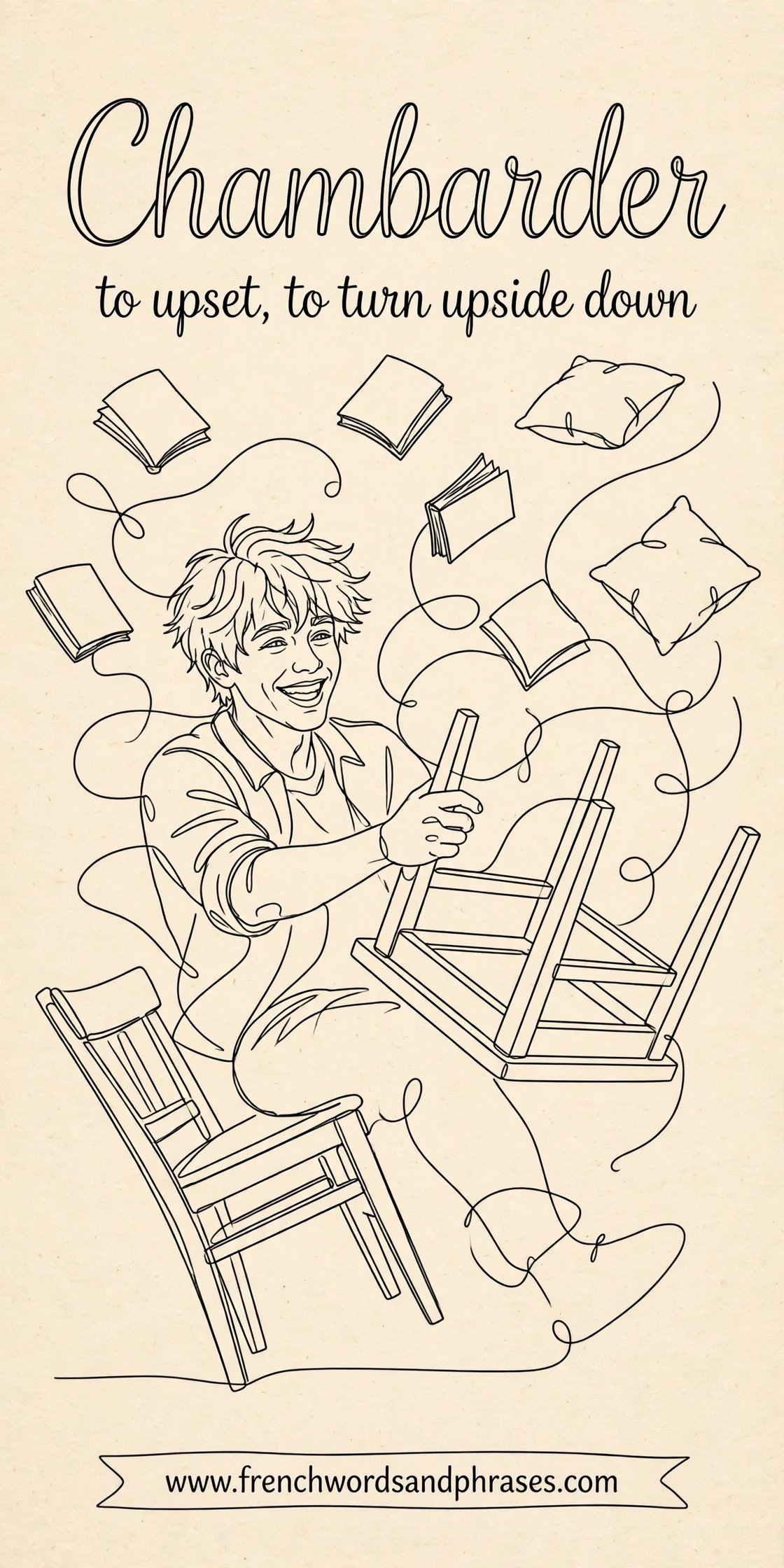
One important detail: chambouler is the neutral, everyday member of its pair — its cousin chambarder is familiar and mostly physical, while chambouler handles timetables, routines, families and feelings. Its most living form is the participle: être tout chamboulé, to be shaken up, overwhelmed, thrown — elle était toute chamboulée par la nouvelle. The verb itself is regular: je chamboule, nous chamboulons, and nothing is ever broken by it — only rearranged.
Experience the Word
Chambouler is the verb of the day that refuses to go as planned — order survives, but it is a new order.
Imagine a young father in his first week back at work. The baby has abolished the night, the alarm is a rumour, coffee is a food group — le bébé a tout chamboulé. His desk is the same desk, his job the same job, and yet the whole geography of his life has been redrawn in a week.
Nothing is ruined. Everything is rearranged — chamboulé — by eight pounds of new life.
How to Conjugate Chambouler: Complete French Conjugation Guide
Let’s explore every major conjugation of chambouler, beginning with the indicative mood.
How to Conjugate Chambouler in the Indicative Mood
The indicative mood is used to express facts, observations, actions, and events.
How to Conjugate Chambouler in the Present Tense (Présent)
Used for actions happening now, habitual actions, and general truths.
| Subject | Conjugation |
|---|---|
| je | chamboule |
| tu | chamboules |
| il / elle | chamboule |
| nous | chamboulons |
| vous | chamboulez |
| ils / elles | chamboulent |
Example
Ce retard chamboule tout notre programme.
This delay throws our whole schedule into chaos.
Quick Quiz 1
Complete the sentence:
Nous ______ tout le programme avec ce nouvel horaire.
Reveal the answer
chamboulons
Nous chamboulons tout le programme avec ce nouvel horaire.
We are disrupting the whole schedule with this new timetable.
How to Conjugate Chambouler in the Passé Composé
Used for completed actions in the past. Chambouler takes the auxiliary verb avoir.
| Subject | Conjugation |
|---|---|
| j’ | ai chamboulé |
| tu | as chamboulé |
| il / elle | a chamboulé |
| nous | avons chamboulé |
| vous | avez chamboulé |
| ils / elles | ont chamboulé |
Example
La nouvelle a chamboulé toute la famille.
The news turned the whole family upside down.
How to Conjugate Chambouler in the Imparfait (Imperfect Tense)
Used for habitual past actions, descriptions, and ongoing situations in the past.
| Subject | Conjugation |
|---|---|
| je | chamboulais |
| tu | chamboulais |
| il / elle | chamboulait |
| nous | chamboulions |
| vous | chambouliez |
| ils / elles | chamboulaient |
Example
Chaque déménagement chamboulait les habitudes des enfants.
Every move disrupted the children’s routines.
Quick Quiz 2
Choose the correct form:
The news turned the family upside down.
La nouvelle ______ la famille. (a chamboulé / est chamboulée)
Reveal the answer
a chamboulé
La nouvelle a chamboulé la famille.
Chambouler takes avoir.
How to Conjugate Chambouler in the Plus-que-parfait
Used to describe an action that had already been completed before another past event.
| Subject | Conjugation |
|---|---|
| j’ | avais chamboulé |
| tu | avais chamboulé |
| il / elle | avait chamboulé |
| nous | avions chamboulé |
| vous | aviez chamboulé |
| ils / elles | avaient chamboulé |
Example
Elle avait chamboulé sa vie en acceptant ce poste à l’étranger.
She had turned her life upside down by accepting that job abroad.
How to Conjugate Chambouler in the Passé Simple
Primarily used in formal writing, literature, and historical narratives. It is rarely used in everyday conversation.
| Subject | Conjugation |
|---|---|
| je | chamboulai |
| tu | chamboulas |
| il / elle | chamboula |
| nous | chamboulâmes |
| vous | chamboulâtes |
| ils / elles | chamboulèrent |
Example
La guerre chamboula l’Europe entière.
The war turned the whole of Europe upside down.
How to Conjugate Chambouler in the Passé Antérieur
A literary tense used to express an action completed immediately before another past action, generally in the passé simple.
| Subject | Conjugation |
|---|---|
| j’ | eus chamboulé |
| tu | eus chamboulé |
| il / elle | eut chamboulé |
| nous | eûmes chamboulé |
| vous | eûtes chamboulé |
| ils / elles | eurent chamboulé |
Example
Quand la nouvelle eut chamboulé le village, plus rien ne fut pareil.
When the news had shaken the village, nothing was ever the same again.
How to Conjugate Chambouler in the Future Tense (Futur Simple)
Used to describe actions that will take place in the future.
| Subject | Conjugation |
|---|---|
| je | chamboulerai |
| tu | chambouleras |
| il / elle | chamboulera |
| nous | chamboulerons |
| vous | chamboulerez |
| ils / elles | chambouleront |
Example
Ce bébé chamboulera vos nuits, vous verrez !
This baby will turn your nights upside down, you’ll see!
How to Conjugate Chambouler in the Futur Antérieur (Future Perfect)
Used for an action that will have been completed before a particular point in the future.
| Subject | Conjugation |
|---|---|
| j’ | aurai chamboulé |
| tu | auras chamboulé |
| il / elle | aura chamboulé |
| nous | aurons chamboulé |
| vous | aurez chamboulé |
| ils / elles | auront chamboulé |
Example
À la rentrée, la réforme aura chamboulé toutes les écoles.
By the new term, the reform will have disrupted every school.
How to Conjugate Chambouler in the Near Future (Futur Proche)
Used to describe something that is going to happen soon. Formed with aller + infinitive.
| Subject | Conjugation |
|---|---|
| je | vais chambouler |
| tu | vas chambouler |
| il / elle | va chambouler |
| nous | allons chambouler |
| vous | allez chambouler |
| ils / elles | vont chambouler |
Example
Ce changement d’horaire va chambouler toute l’équipe.
This schedule change is going to disrupt the whole team.
How to Conjugate Chambouler in the Conditional Mood
The conditional mood expresses what would happen under certain circumstances. It is also frequently used to make polite requests or express wishes.
How to Conjugate Chambouler in the Present Conditional
| Subject | Conjugation |
|---|---|
| je | chamboulerais |
| tu | chamboulerais |
| il / elle | chamboulerait |
| nous | chamboulerions |
| vous | chambouleriez |
| ils / elles | chambouleraient |
Example
Sans ce retard, rien ne chamboulerait nos vacances.
Without this delay, nothing would upset our holiday.
How to Conjugate Chambouler in the Past Conditional
| Subject | Conjugation |
|---|---|
| j’ | aurais chamboulé |
| tu | aurais chamboulé |
| il / elle | aurait chamboulé |
| nous | aurions chamboulé |
| vous | auriez chamboulé |
| ils / elles | auraient chamboulé |
Example
Un seul mot de plus aurait chamboulé toute la soirée.
One more word would have ruined the whole evening.
Chambouler in the Literary Past Conditional Form
This less common literary form uses the imperfect subjunctive of avoir.
| Subject | Conjugation |
|---|---|
| j’ | eusse chamboulé |
| tu | eusses chamboulé |
| il / elle | eût chamboulé |
| nous | eussions chamboulé |
| vous | eussiez chamboulé |
| ils / elles | eussent chamboulé |
Example
Le destin eût chamboulé leurs vies sans ce hasard heureux.
Fate would have turned their lives upside down without that happy chance.
How to Conjugate Chambouler in the Subjunctive Mood
The subjunctive is used to express wishes, emotions, doubts, necessity, and uncertainty. It frequently follows expressions such as il faut que (it is necessary that) or bien que (although).
How to Conjugate Chambouler in the Present Subjunctive
| Subject | Conjugation |
|---|---|
| que je | chamboule |
| que tu | chamboules |
| qu’il / qu’elle | chamboule |
| que nous | chamboulions |
| que vous | chambouliez |
| qu’ils / qu’elles | chamboulent |
Example
Je déteste que le moindre retard chamboule ta journée.
I hate that the slightest delay upsets your whole day.
Quick Quiz 3
Complete the sentence using the subjunctive:
Il ne faut pas qu’un détail ______ toute la cérémonie.
Reveal the answer
chamboulât
Il ne faut pas qu’un détail chamboulât toute la cérémonie.
A detail must not disrupt the whole ceremony.
How to Conjugate Chambouler in the Imperfect Subjunctive
A literary tense, rarely encountered in modern spoken French.
| Subject | Conjugation |
|---|---|
| que je | chamboulasse |
| que tu | chamboulasses |
| qu’il / qu’elle | chamboulât |
| que nous | chamboulassions |
| que vous | chamboulassiez |
| qu’ils / qu’elles | chamboulassent |
Example
Il ne fallait pas qu’un détail chamboulât toute la cérémonie.
A detail must not be allowed to disrupt the whole ceremony.
How to Conjugate Chambouler in the Pluperfect Subjunctive
A literary construction used to express an action completed before another past action.
| Subject | Conjugation |
|---|---|
| que j’ | eusse chamboulé |
| que tu | eusses chamboulé |
| qu’il / qu’elle | eût chamboulé |
| que nous | eussions chamboulé |
| que vous | eussiez chamboulé |
| qu’ils / qu’elles | eussent chamboulé |
Example
On disait que la nouvelle eût chamboulé le vieil homme.
People said the news had deeply upset the old man.
How to Conjugate Chambouler in the Past Subjunctive
| Subject | Conjugation |
|---|---|
| que j’ | aie chamboulé |
| que tu | aies chamboulé |
| qu’il / qu’elle | ait chamboulé |
| que nous | ayons chamboulé |
| que vous | ayez chamboulé |
| qu’ils / qu’elles | aient chamboulé |
Example
Je suis touché que son départ ait chamboulé tant de monde.
I am touched that his departure upset so many people.
How to Conjugate Chambouler in the Imperative
The imperative is used to give commands, instructions, invitations, or suggestions. Subject pronouns are omitted.
How to Conjugate Chambouler in the Present Imperative
| Person | Conjugation |
|---|---|
| (tu) | chamboule |
| (nous) | chamboulons |
| (vous) | chamboulez |
Example
Ne chamboule pas tous nos plans pour un caprice !
Do not throw all our plans into chaos over a whim!
Quick Quiz 4
How would you say Do not turn everything upside down (tu form)?
Reveal the answer
Ne chamboule pas tout !
French Participles of Chambouler
Participles are verb forms that can be used in compound tenses and other grammatical constructions.
Present Participle of Chambouler
chamboulant
En chamboulant les horaires, la direction a fâché tout le monde.
By disrupting the schedules, management angered everyone.
Past Participle of Chambouler
chamboulé
Chamboulée par la nouvelle, elle a fondu en larmes.
Overwhelmed by the news, she burst into tears.
Chambouler in Everyday French: Real-Life Examples
Now that you know the conjugations, let’s see how chambouler appears in everyday French.
Example 1 — Present
Ce retard chamboule tout notre programme.
This delay throws our whole schedule into chaos.
Example 2 — Passé composé
La nouvelle a chamboulé toute la famille.
The news turned the whole family upside down.
Example 3 — Imparfait
Les travaux chamboulaient tout le quartier.
The roadworks disrupted the whole neighbourhood.
Example 4 — Future
Le bébé chamboulera vos nuits.
The baby will turn your nights upside down.
Example 5 — Conditional
Rien ne chamboulerait nos plans sans ce retard.
Nothing would upset our plans without this delay.
Example 6 — Imperative
Ne chamboule pas tout, s’il te plaît !
Do not turn everything upside down, please!
Beyond Translation: The Meaning of Chambouler
English turn upside down covers the furniture, but chambouler also covers the heart: être tout chamboulé is one of the commonest French ways to say you are shaken, thrilled or overwhelmed.
Plans, routines and people — all can be chamboulés.
The word stays gentle even at its strongest: what is chamboulé is not destroyed, only rearranged — and half the time, French says it with a smile about a baby, a move or a piece of wonderful news.
How to Remember the French Verb Chambouler
Remember it this way: Chambouler is about the baby who redraws the whole geography of a life in one week.
- Être tout chamboulé is the living phrase: shaken, overwhelmed, thrown by news — good or bad.
- Chambouler for plans, routines and feelings; its familiar cousin chambarder is for the physical mess.
- Regular -er: je chamboule, nous chamboulons, past participle chamboulé.
The key idea is the baby who redraws the whole geography of a life in one week.
Test Your Knowledge of Chambouler
Let’s see how much you’ve learned. Try answering these questions before revealing the answers.
Question 1
What does être tout chamboulé mean?
Reveal the answer
To be deeply shaken or overwhelmed — elle était toute chamboulée par la nouvelle, she was thrown by the news.
Question 2
How do you say This delay throws our whole schedule into chaos in French?
Reveal the answer
Ce retard chamboule tout notre programme.
Question 3
Translate: The news turned the whole family upside down.
Reveal the answer
La nouvelle a chamboulé toute la famille.
Question 4
What is the past participle of chambouler?
Reveal the answer
Chamboulé.
Question 5
Complete the sentence:
Je déteste que le moindre retard ______ ta journée.
Reveal the answer
chamboule
Je déteste que le moindre retard chamboule ta journée.
I hate that the slightest delay upsets your whole day.
Your Final Challenge
Can You Use It?
How would you say this in French?
The baby has turned everything in the house upside down, and nobody would want to go back.
Reveal the answer
Le bébé a tout chamboulé dans la maison, et personne ne voudrait revenir en arrière.
The baby has turned everything in the house upside down, and nobody would want to go back.
A little French. A little curiosity. A richer everyday life.
LEARN FRENCH ONE WORD AT A TIME