A French Word to Live By
How to Conjugate Chambarder in French
/ʃɑ̃.baʁ.de/
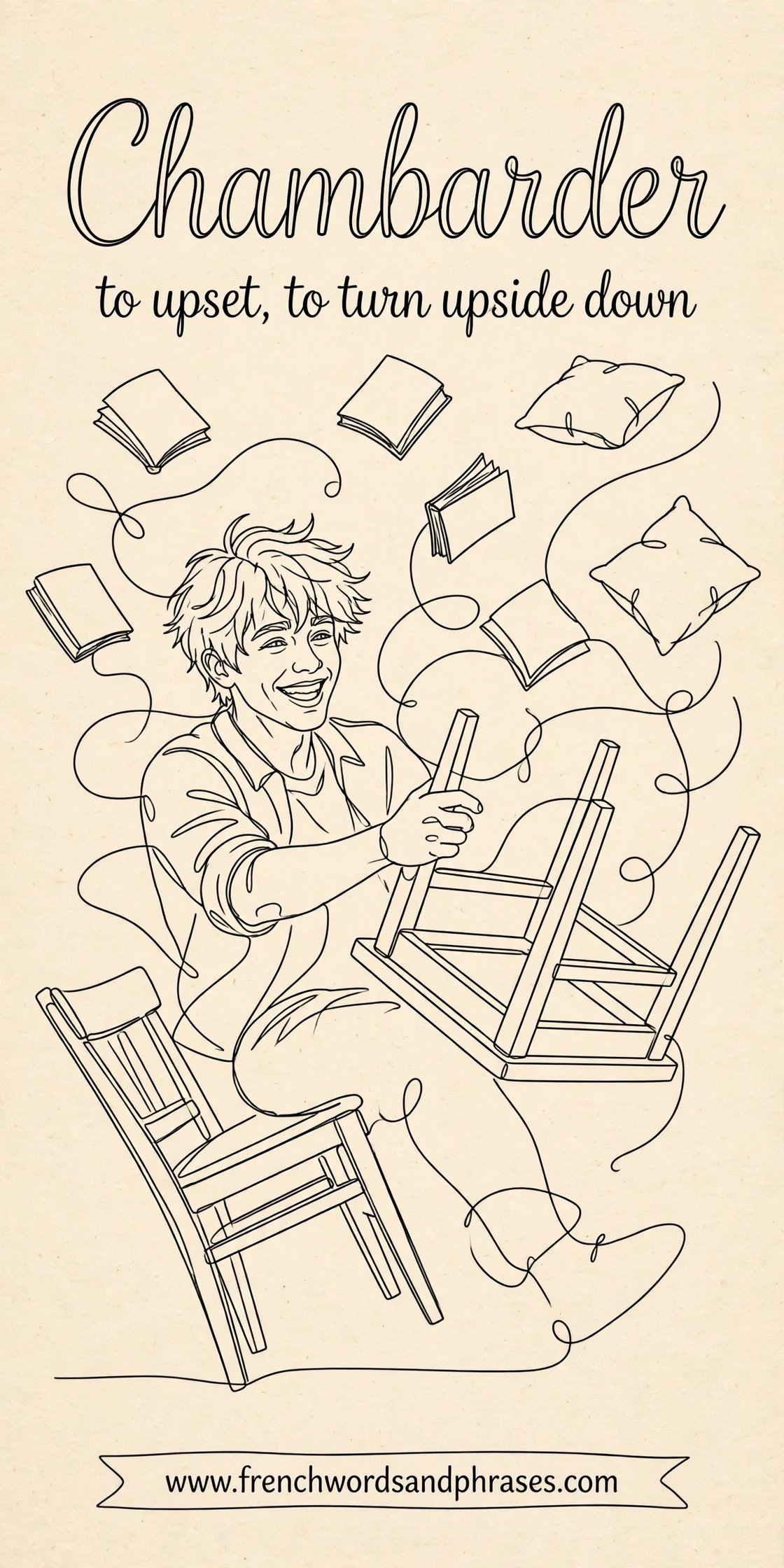
Chambarder means to upset, to turn upside down — to leave a room, a house or a whole plan in glorious disorder.
Children home alone for one hour, a cat shut in the library, a removal van at the door — chambarder is the familiar verb of the great upset: furniture moved, drawers emptied, everything exactly where it should not be.
In this guide, you’ll learn how to conjugate chambarder in all the major French tenses and moods. Explore complete conjugation tables, French examples, English translations, and practice quizzes.
Understanding the French Verb Chambarder
Chambarder is a regular French verb belonging to the first group of verbs, those ending in-er.
It means to upset, to turn upside down. It is commonly used of rooms, houses and gardens wrecked by children, animals, storms and house moves — physical disorder first of all, with plans and routines welcome to join in.
Verb classification: First group (-er)
Auxiliary verb: Avoir
Past participle: chambardé
Present participle: chambardant
English equivalents: To turn upside down, to upset, to throw into disorder; tout chambarder — to turn everything upside down; chambarder une chambre — to wreck a room; le chambard — the racket, the uproar (noun, familiar).
One important detail: chambarder belongs to familiar, spoken French — it is the verb you use of children, cats and removal men, not in a formal report. It is perfectly regular (je chambarde, nous chambardons), and its noun is le chambard, the racket or uproar: quel chambard ! For a plan or a life turned upside down in neutral French, prefer its tidier cousin chambouler; chambarder is for the mess you can see — and trip over.
Experience the Word
Chambarder is the verb of the room you cannot cross — every object moved, nothing broken, everything wrong.
Imagine grandparents returning from one quiet weekend away. The grandchildren wave from the door, smiling; inside, the living room has been chambardé — sofa cushions in the kitchen, books on the stairs, a tent made of the good curtains. One hour of children, and the house needs a map.
Nothing is lost or broken. It is simply upside down — chambardé, joyfully, completely.
How to Conjugate Chambarder: Complete French Conjugation Guide
Let’s explore every major conjugation of chambarder, beginning with the indicative mood.
How to Conjugate Chambarder in the Indicative Mood
The indicative mood is used to express facts, observations, actions, and events.
How to Conjugate Chambarder in the Present Tense (Présent)
Used for actions happening now, habitual actions, and general truths.
| Subject | Conjugation |
|---|---|
| je | chambarde |
| tu | chambardes |
| il / elle | chambarde |
| nous | chambardons |
| vous | chambardez |
| ils / elles | chambardent |
Example
Les enfants chambardent la maison en cinq minutes.
The children turn the house upside down in five minutes.
Quick Quiz 1
Complete the sentence:
Nous ______ le grenier pour retrouver les photos.
Reveal the answer
chambardons
Nous chambardons le grenier pour retrouver les photos.
We are turning the attic upside down to find the photos.
How to Conjugate Chambarder in the Passé Composé
Used for completed actions in the past. Chambarder takes the auxiliary verb avoir.
| Subject | Conjugation |
|---|---|
| j’ | ai chambardé |
| tu | as chambardé |
| il / elle | a chambardé |
| nous | avons chambardé |
| vous | avez chambardé |
| ils / elles | ont chambardé |
Example
Le déménagement a chambardé tout l’appartement.
The move turned the whole flat upside down.
How to Conjugate Chambarder in the Imparfait (Imperfect Tense)
Used for habitual past actions, descriptions, and ongoing situations in the past.
| Subject | Conjugation |
|---|---|
| je | chambardais |
| tu | chambardais |
| il / elle | chambardait |
| nous | chambardions |
| vous | chambardiez |
| ils / elles | chambardaient |
Example
Chaque été, les cousins chambardaient la maison de campagne.
Every summer, the cousins turned the country house upside down.
Quick Quiz 2
Choose the correct form:
The storm wrecked the garden.
La tempête ______ le jardin. (a chambardé / est chambardée)
Reveal the answer
a chambardé
La tempête a chambardé le jardin.
Chambarder takes avoir.
How to Conjugate Chambarder in the Plus-que-parfait
Used to describe an action that had already been completed before another past event.
| Subject | Conjugation |
|---|---|
| j’ | avais chambardé |
| tu | avais chambardé |
| il / elle | avait chambardé |
| nous | avions chambardé |
| vous | aviez chambardé |
| ils / elles | avaient chambardé |
Example
La tempête avait chambardé le jardin pendant la nuit.
The storm had wrecked the garden during the night.
How to Conjugate Chambarder in the Passé Simple
Primarily used in formal writing, literature, and historical narratives. It is rarely used in everyday conversation.
| Subject | Conjugation |
|---|---|
| je | chambardai |
| tu | chambardas |
| il / elle | chambarda |
| nous | chambardâmes |
| vous | chambardâtes |
| ils / elles | chambardèrent |
Example
L’armée chambarda le village en une nuit.
The army turned the village upside down in one night.
How to Conjugate Chambarder in the Passé Antérieur
A literary tense used to express an action completed immediately before another past action, generally in the passé simple.
| Subject | Conjugation |
|---|---|
| j’ | eus chambardé |
| tu | eus chambardé |
| il / elle | eut chambardé |
| nous | eûmes chambardé |
| vous | eûtes chambardé |
| ils / elles | eurent chambardé |
Example
Quand le chat eut chambardé la bibliothèque, les livres couvraient le sol.
When the cat had turned the bookcase upside down, the books covered the floor.
How to Conjugate Chambarder in the Future Tense (Futur Simple)
Used to describe actions that will take place in the future.
| Subject | Conjugation |
|---|---|
| je | chambarderai |
| tu | chambarderas |
| il / elle | chambardera |
| nous | chambarderons |
| vous | chambarderez |
| ils / elles | chambarderont |
Example
Ce nouveau patron chambardera tout le service.
This new boss will turn the whole department upside down.
How to Conjugate Chambarder in the Futur Antérieur (Future Perfect)
Used for an action that will have been completed before a particular point in the future.
| Subject | Conjugation |
|---|---|
| j’ | aurai chambardé |
| tu | auras chambardé |
| il / elle | aura chambardé |
| nous | aurons chambardé |
| vous | aurez chambardé |
| ils / elles | auront chambardé |
Example
À la fin des travaux, on aura chambardé chaque pièce de la maison.
By the end of the work, every room in the house will have been turned upside down.
How to Conjugate Chambarder in the Near Future (Futur Proche)
Used to describe something that is going to happen soon. Formed with aller + infinitive.
| Subject | Conjugation |
|---|---|
| je | vais chambarder |
| tu | vas chambarder |
| il / elle | va chambarder |
| nous | allons chambarder |
| vous | allez chambarder |
| ils / elles | vont chambarder |
Example
Attention, le chien va chambarder le salon !
Watch out, the dog is going to turn the living room upside down!
How to Conjugate Chambarder in the Conditional Mood
The conditional mood expresses what would happen under certain circumstances. It is also frequently used to make polite requests or express wishes.
How to Conjugate Chambarder in the Present Conditional
| Subject | Conjugation |
|---|---|
| je | chambarderais |
| tu | chambarderais |
| il / elle | chambarderait |
| nous | chambarderions |
| vous | chambarderiez |
| ils / elles | chambarderaient |
Example
Sans les enfants, personne ne chambarderait la cuisine.
Without the children, nobody would mess up the kitchen.
How to Conjugate Chambarder in the Past Conditional
| Subject | Conjugation |
|---|---|
| j’ | aurais chambardé |
| tu | aurais chambardé |
| il / elle | aurait chambardé |
| nous | aurions chambardé |
| vous | auriez chambardé |
| ils / elles | auraient chambardé |
Example
La nouvelle aurait chambardé tous nos plans si elle était arrivée plus tôt.
The news would have upset all our plans if it had come earlier.
Chambarder in the Literary Past Conditional Form
This less common literary form uses the imperfect subjunctive of avoir.
| Subject | Conjugation |
|---|---|
| j’ | eusse chambardé |
| tu | eusses chambardé |
| il / elle | eût chambardé |
| nous | eussions chambardé |
| vous | eussiez chambardé |
| ils / elles | eussent chambardé |
Example
La révolution eût chambardé le royaume de fond en comble.
The revolution would have turned the kingdom completely upside down.
How to Conjugate Chambarder in the Subjunctive Mood
The subjunctive is used to express wishes, emotions, doubts, necessity, and uncertainty. It frequently follows expressions such as il faut que (it is necessary that) or bien que (although).
How to Conjugate Chambarder in the Present Subjunctive
| Subject | Conjugation |
|---|---|
| que je | chambarde |
| que tu | chambardes |
| qu’il / qu’elle | chambarde |
| que nous | chambardions |
| que vous | chambardiez |
| qu’ils / qu’elles | chambardent |
Example
Il ne faut pas que les invités chambardent toute la maison.
The guests must not turn the whole house upside down.
Quick Quiz 3
Complete the sentence using the subjunctive:
On craignait que le vent ne ______ les stands du marché.
Reveal the answer
chambardât
On craignait que le vent ne chambardât les stands du marché.
People feared the wind would wreck the market stalls.
How to Conjugate Chambarder in the Imperfect Subjunctive
A literary tense, rarely encountered in modern spoken French.
| Subject | Conjugation |
|---|---|
| que je | chambardasse |
| que tu | chambardasses |
| qu’il / qu’elle | chambardât |
| que nous | chambardassions |
| que vous | chambardassiez |
| qu’ils / qu’elles | chambardassent |
Example
On craignait que le vent ne chambardât les stands du marché.
People feared the wind would wreck the market stalls.
How to Conjugate Chambarder in the Pluperfect Subjunctive
A literary construction used to express an action completed before another past action.
| Subject | Conjugation |
|---|---|
| que j’ | eusse chambardé |
| que tu | eusses chambardé |
| qu’il / qu’elle | eût chambardé |
| que nous | eussions chambardé |
| que vous | eussiez chambardé |
| qu’ils / qu’elles | eussent chambardé |
Example
On racontait que la fête eût chambardé tout le quartier.
People said the party had turned the whole neighbourhood upside down.
How to Conjugate Chambarder in the Past Subjunctive
| Subject | Conjugation |
|---|---|
| que j’ | aie chambardé |
| que tu | aies chambardé |
| qu’il / qu’elle | ait chambardé |
| que nous | ayons chambardé |
| que vous | ayez chambardé |
| qu’ils / qu’elles | aient chambardé |
Example
Je suis étonné que le chat ait chambardé la cuisine.
I am amazed the cat turned the kitchen upside down.
How to Conjugate Chambarder in the Imperative
The imperative is used to give commands, instructions, invitations, or suggestions. Subject pronouns are omitted.
How to Conjugate Chambarder in the Present Imperative
| Person | Conjugation |
|---|---|
| (tu) | chambarde |
| (nous) | chambardons |
| (vous) | chambardez |
Example
Ne chambardez pas ma chambre pendant mon absence !
Do not turn my room upside down while I am away!
Quick Quiz 4
How would you say Do not turn my room upside down (tu form)?
Reveal the answer
Ne chambarde pas ma chambre !
French Participles of Chambarder
Participles are verb forms that can be used in compound tenses and other grammatical constructions.
Present Participle of Chambarder
chambardant
En chambardant le grenier, il a retrouvé de vieilles photos.
While turning the attic upside down, he found old photos.
Past Participle of Chambarder
chambardé
Chambardée par les enfants, la chambre ressemblait à un champ de bataille.
Turned upside down by the children, the room looked like a battlefield.
Chambarder in Everyday French: Real-Life Examples
Now that you know the conjugations, let’s see how chambarder appears in everyday French.
Example 1 — Present
Les enfants chambardent la maison.
The children are turning the house upside down.
Example 2 — Passé composé
Le déménagement a chambardé l’appartement.
The move turned the flat upside down.
Example 3 — Imparfait
Les cousins chambardaient la maison chaque été.
The cousins turned the house upside down every summer.
Example 4 — Future
Le chien chambardera le salon, tu verras.
The dog will wreck the living room, you’ll see.
Example 5 — Conditional
Personne ne chambarderait la cuisine sans les enfants.
Nobody would mess up the kitchen without the children.
Example 6 — Imperative
Ne chambarde pas ma chambre !
Do not turn my room upside down!
Beyond Translation: The Meaning of Chambarder
English turn upside down does the same job, but chambarder does it in one familiar, affectionate word — and its family keeps the noise in: le chambard is the racket itself.
To chambarder is to make a chambard you can walk through.
Rooms, gardens and whole houses come out of it upside down, and the word is never quite angry: French reserves it for the disorder of children, animals and moving day.
How to Remember the French Verb Chambarder
Remember it this way: Chambarder is about the grandchildren, one hour, and a house that needs a map.
- Familiar register: the verb of children, cats and removal men — quel chambard !
- Physical mess first: rooms and houses upside down; for plans and lives, chambouler is the neutral twin.
- Regular -er: je chambarde, nous chambardons, past participle chambardé.
The key idea is the grandchildren, one hour, and a house that needs a map.
Test Your Knowledge of Chambarder
Let’s see how much you’ve learned. Try answering these questions before revealing the answers.
Question 1
What register is chambarder, and what is its noun?
Reveal the answer
Familiar, spoken French — its noun is le chambard, the racket or uproar: quel chambard !
Question 2
How do you say The children turn the house upside down in French?
Reveal the answer
Les enfants chambardent la maison.
Question 3
Translate: The move turned the whole flat upside down.
Reveal the answer
Le déménagement a chambardé tout l’appartement.
Question 4
What is the past participle of chambarder?
Reveal the answer
Chambardé.
Question 5
Complete the sentence:
Il ne faut pas que les invités ______ toute la maison.
Reveal the answer
chambardent
Il ne faut pas que les invités chambardent toute la maison.
The guests must not turn the whole house upside down.
Your Final Challenge
Can You Use It?
How would you say this in French?
The children turned the house upside down in one hour, and it will take a Sunday to put it back in order.
Reveal the answer
Les enfants ont chambardé la maison en une heure, et il faudra un dimanche pour la remettre en ordre.
The children turned the house upside down in one hour, and it will take a Sunday to put it back in order.
A little French. A little curiosity. A richer everyday life.
LEARN FRENCH ONE WORD AT A TIME