A French Word to Live By
How to Conjugate Chamailler in French
/ʃa.ma.je/
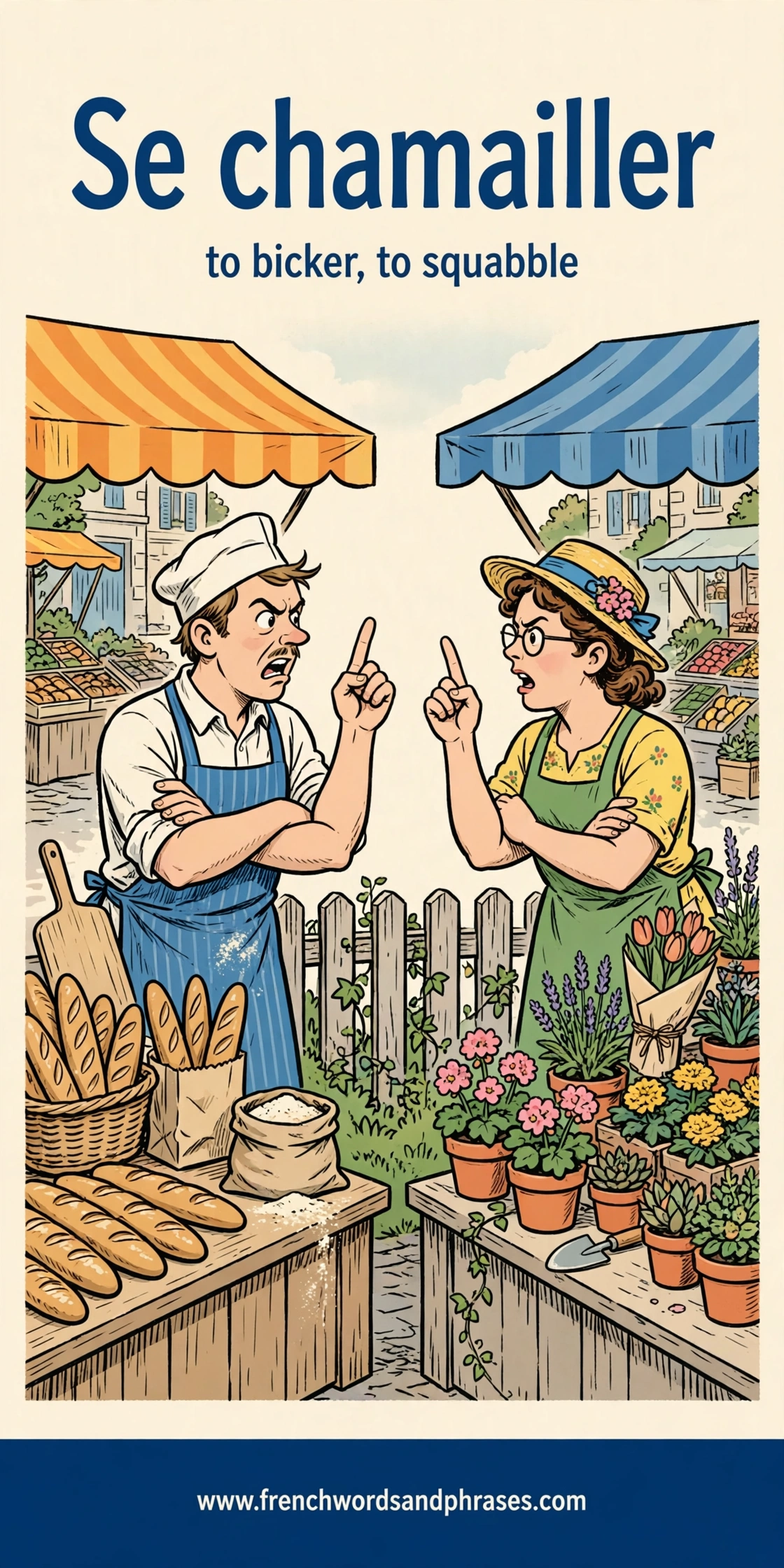
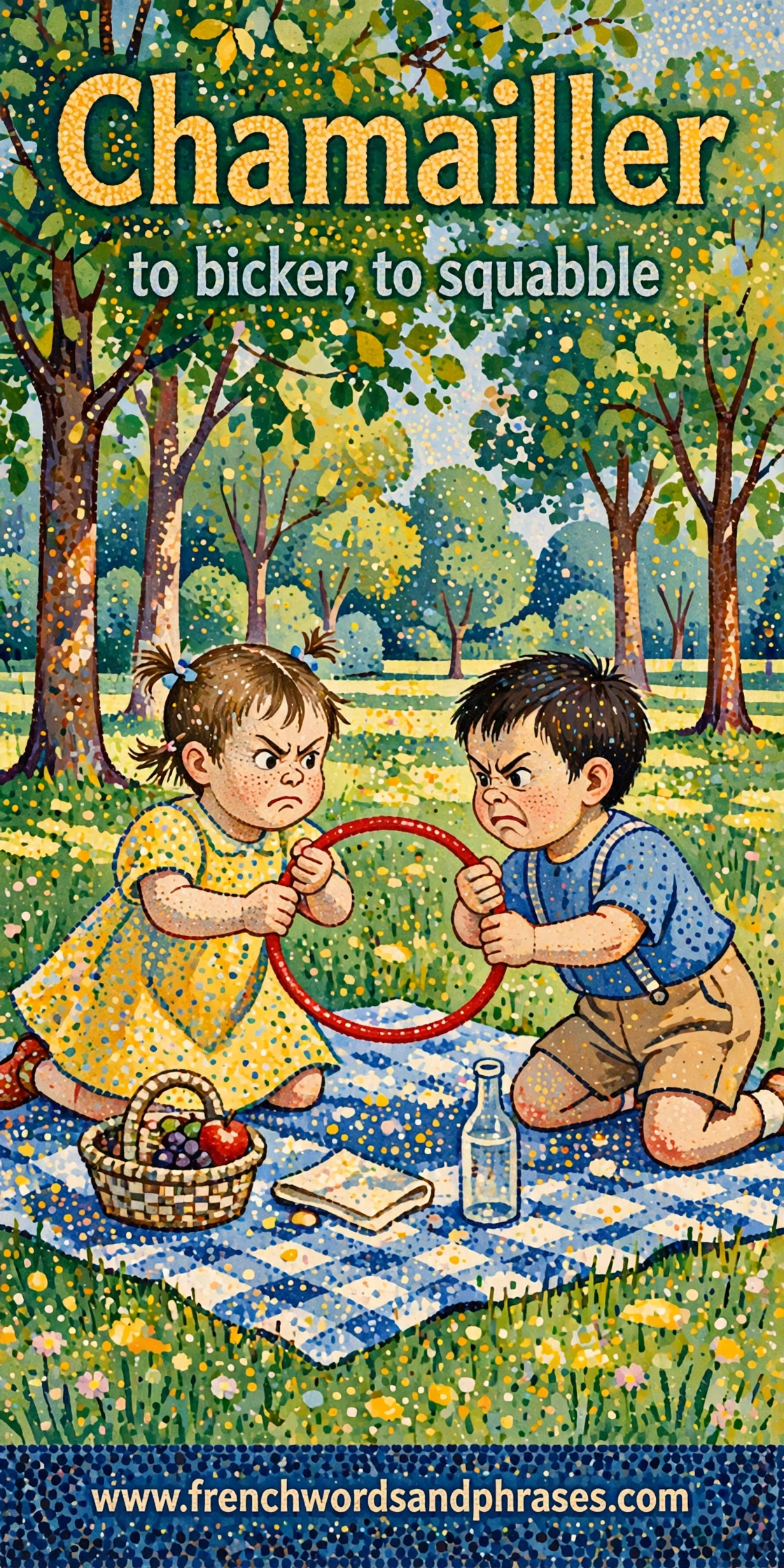
Chamailler means to bicker, to squabble — to quarrel noisily over almost nothing, the way children do over a toy or the last sweet.
Two brothers and one remote control, three cousins and the window seat, a whole classroom and a single red crayon — chamailler is the verb of the small, loud, quickly forgotten quarrel: much noise, little harm, and peace again by dinner.
In this guide, you’ll learn how to conjugate chamailler in all the major French tenses and moods. Explore complete conjugation tables, French examples, English translations, and practice quizzes.
Understanding the French Verb Chamailler
Chamailler is a regular French verb belonging to the first group of verbs, those ending in-er.
It means to bicker, to squabble. It is commonly used of children, siblings and cousins squabbling over toys, seats and sweets, and — with a smile — of adults whose quarrels are more noise than anger; the stakes are always, by definition, tiny.
Verb classification: First group (-er)
Auxiliary verb: Avoir
Past participle: chamaillé
Present participle: chamaillant
English equivalents: To bicker, to squabble, to wrangle; chamailler pour un rien — to squabble over nothing; les enfants chamaillent — the children are bickering; une chamaillerie — a squabble, a tiff.
One important detail: chamailler is almost always heard in its reflexive form, se chamailler — the page next door teaches that one in full. The plain verb survives on its own for children and crowds whose quarrel has no single partner: les enfants chamaillent dans la cour. The spelling is regular but the double l is followed by -ill- pronounced ‘y’: je chamaille, nous chamaillons, past participle chamaillé. And the word itself is slightly old-fashioned and gentle — a chamaillerie is a tiff, never a war.
Experience the Word
Chamailler is the verb of the storm in a teacup — thunder, lightning, and then everyone friends again by pudding.
Imagine the back seat of a car on the road to the sea. One cushion, two children: the cushion is pulled, voices rise, the parents count to ten — ils chamaillent. Ten minutes later both are asleep, heads together, the cushion forgotten on the floor.
Nothing was ever really wrong. They were only bickering — chamaillant — as children must.
How to Conjugate Chamailler: Complete French Conjugation Guide
Let’s explore every major conjugation of chamailler, beginning with the indicative mood.
How to Conjugate Chamailler in the Indicative Mood
The indicative mood is used to express facts, observations, actions, and events.
How to Conjugate Chamailler in the Present Tense (Présent)
Used for actions happening now, habitual actions, and general truths.
| Subject | Conjugation |
|---|---|
| je | chamaille |
| tu | chamailles |
| il / elle | chamaille |
| nous | chamaillons |
| vous | chamaillez |
| ils / elles | chamaillent |
Example
Les enfants chamaillent pour un malheureux bonbon.
The children are bickering over a single sweet.
Quick Quiz 1
Complete the sentence:
Nous ______ pour la télécommande comme des enfants.
Reveal the answer
chamaillons
Nous chamaillons pour la télécommande comme des enfants.
We are bickering over the remote like children.
How to Conjugate Chamailler in the Passé Composé
Used for completed actions in the past. Chamailler takes the auxiliary verb avoir.
| Subject | Conjugation |
|---|---|
| j’ | ai chamaillé |
| tu | as chamaillé |
| il / elle | a chamaillé |
| nous | avons chamaillé |
| vous | avez chamaillé |
| ils / elles | ont chamaillé |
Example
Les deux frères ont chamaillé toute la soirée pour la télécommande.
The two brothers bickered all evening over the remote control.
How to Conjugate Chamailler in the Imparfait (Imperfect Tense)
Used for habitual past actions, descriptions, and ongoing situations in the past.
| Subject | Conjugation |
|---|---|
| je | chamaillais |
| tu | chamaillais |
| il / elle | chamaillait |
| nous | chamaillions |
| vous | chamailliez |
| ils / elles | chamaillaient |
Example
À leur âge, ils chamaillaient pour un rien.
At their age, they used to squabble over nothing.
Quick Quiz 2
Choose the correct form:
The brothers bickered all evening.
Les frères ______ toute la soirée. (ont chamaillé / sont chamaillés)
Reveal the answer
ont chamaillé
Les frères ont chamaillé toute la soirée.
Chamailler takes avoir.
How to Conjugate Chamailler in the Plus-que-parfait
Used to describe an action that had already been completed before another past event.
| Subject | Conjugation |
|---|---|
| j’ | avais chamaillé |
| tu | avais chamaillé |
| il / elle | avait chamaillé |
| nous | avions chamaillé |
| vous | aviez chamaillé |
| ils / elles | avaient chamaillé |
Example
Elles avaient chamaillé avant même le début du voyage.
They had already bickered before the trip had even begun.
How to Conjugate Chamailler in the Passé Simple
Primarily used in formal writing, literature, and historical narratives. It is rarely used in everyday conversation.
| Subject | Conjugation |
|---|---|
| je | chamaillai |
| tu | chamaillas |
| il / elle | chamailla |
| nous | chamaillâmes |
| vous | chamaillâtes |
| ils / elles | chamaillèrent |
Example
Les écoliers chamaillèrent dans la cour jusqu’à la cloche.
The schoolchildren squabbled in the yard until the bell.
How to Conjugate Chamailler in the Passé Antérieur
A literary tense used to express an action completed immediately before another past action, generally in the passé simple.
| Subject | Conjugation |
|---|---|
| j’ | eus chamaillé |
| tu | eus chamaillé |
| il / elle | eut chamaillé |
| nous | eûmes chamaillé |
| vous | eûtes chamaillé |
| ils / elles | eurent chamaillé |
Example
Quand les voisins eurent chamaillé une heure, le silence revint dans l’immeuble.
When the neighbours had squabbled for an hour, silence returned to the building.
How to Conjugate Chamailler in the Future Tense (Futur Simple)
Used to describe actions that will take place in the future.
| Subject | Conjugation |
|---|---|
| je | chamaillerai |
| tu | chamailleras |
| il / elle | chamaillera |
| nous | chamaillerons |
| vous | chamaillerez |
| ils / elles | chamailleront |
Example
Demain, ils chamailleront encore pour la place près de la fenêtre.
Tomorrow, they will bicker again over the seat by the window.
How to Conjugate Chamailler in the Futur Antérieur (Future Perfect)
Used for an action that will have been completed before a particular point in the future.
| Subject | Conjugation |
|---|---|
| j’ | aurai chamaillé |
| tu | auras chamaillé |
| il / elle | aura chamaillé |
| nous | aurons chamaillé |
| vous | aurez chamaillé |
| ils / elles | auront chamaillé |
Example
À la fin des vacances, les cousins auront chamaillé cent fois.
By the end of the holidays, the cousins will have bickered a hundred times.
How to Conjugate Chamailler in the Near Future (Futur Proche)
Used to describe something that is going to happen soon. Formed with aller + infinitive.
| Subject | Conjugation |
|---|---|
| je | vais chamailler |
| tu | vas chamailler |
| il / elle | va chamailler |
| nous | allons chamailler |
| vous | allez chamailler |
| ils / elles | vont chamailler |
Example
Écoute-les, ils vont chamailler pour le dernier morceau de gâteau.
Listen to them — they are going to squabble over the last piece of cake.
How to Conjugate Chamailler in the Conditional Mood
The conditional mood expresses what would happen under certain circumstances. It is also frequently used to make polite requests or express wishes.
How to Conjugate Chamailler in the Present Conditional
| Subject | Conjugation |
|---|---|
| je | chamaillerais |
| tu | chamaillerais |
| il / elle | chamaillerait |
| nous | chamaillerions |
| vous | chamailleriez |
| ils / elles | chamailleraient |
Example
Sans les parents, les enfants chamailleraient du matin au soir.
Without the parents, the children would bicker from morning to night.
How to Conjugate Chamailler in the Past Conditional
| Subject | Conjugation |
|---|---|
| j’ | aurais chamaillé |
| tu | aurais chamaillé |
| il / elle | aurait chamaillé |
| nous | aurions chamaillé |
| vous | auriez chamaillé |
| ils / elles | auraient chamaillé |
Example
Ils auraient chamaillé moins si on leur avait donné deux ballons.
They would have bickered less if they had been given two balls.
Chamailler in the Literary Past Conditional Form
This less common literary form uses the imperfect subjunctive of avoir.
| Subject | Conjugation |
|---|---|
| j’ | eusse chamaillé |
| tu | eusses chamaillé |
| il / elle | eût chamaillé |
| nous | eussions chamaillé |
| vous | eussiez chamaillé |
| ils / elles | eussent chamaillé |
Example
Les dieux de l’Olympe eussent chamaillé pour une pomme d’or.
The gods of Olympus would have squabbled over a golden apple.
How to Conjugate Chamailler in the Subjunctive Mood
The subjunctive is used to express wishes, emotions, doubts, necessity, and uncertainty. It frequently follows expressions such as il faut que (it is necessary that) or bien que (although).
How to Conjugate Chamailler in the Present Subjunctive
| Subject | Conjugation |
|---|---|
| que je | chamaille |
| que tu | chamailles |
| qu’il / qu’elle | chamaille |
| que nous | chamaillions |
| que vous | chamailliez |
| qu’ils / qu’elles | chamaillent |
Example
Il est fatigant que les enfants chamaillent sans arrêt.
It is tiring that the children bicker non-stop.
Quick Quiz 3
Complete the sentence using the subjunctive:
Il est fatigant que vous ______ pour des riens.
Reveal the answer
chamailliez
Il est fatigant que vous chamailliez pour des riens.
It is tiring that you bicker over nothing.
How to Conjugate Chamailler in the Imperfect Subjunctive
A literary tense, rarely encountered in modern spoken French.
| Subject | Conjugation |
|---|---|
| que je | chamaillasse |
| que tu | chamaillasses |
| qu’il / qu’elle | chamaillât |
| que nous | chamaillassions |
| que vous | chamaillassiez |
| qu’ils / qu’elles | chamaillassent |
Example
La maîtresse ne supportait pas qu’ils chamaillassent pendant la leçon.
The teacher could not stand them squabbling during the lesson.
How to Conjugate Chamailler in the Pluperfect Subjunctive
A literary construction used to express an action completed before another past action.
| Subject | Conjugation |
|---|---|
| que j’ | eusse chamaillé |
| que tu | eusses chamaillé |
| qu’il / qu’elle | eût chamaillé |
| que nous | eussions chamaillé |
| que vous | eussiez chamaillé |
| qu’ils / qu’elles | eussent chamaillé |
Example
On racontait que les héritiers eussent chamaillé pour la maison de famille.
People said the heirs had squabbled over the family house.
How to Conjugate Chamailler in the Past Subjunctive
| Subject | Conjugation |
|---|---|
| que j’ | aie chamaillé |
| que tu | aies chamaillé |
| qu’il / qu’elle | ait chamaillé |
| que nous | ayons chamaillé |
| que vous | ayez chamaillé |
| qu’ils / qu’elles | aient chamaillé |
Example
Je suis étonné qu’ils aient chamaillé pour si peu.
I am surprised they bickered over so little.
How to Conjugate Chamailler in the Imperative
The imperative is used to give commands, instructions, invitations, or suggestions. Subject pronouns are omitted.
How to Conjugate Chamailler in the Present Imperative
| Person | Conjugation |
|---|---|
| (tu) | chamaille |
| (nous) | chamaillons |
| (vous) | chamaillez |
Example
Ne chamaillez pas pour un jouet, partagez !
Do not bicker over a toy — share!
Quick Quiz 4
How would you say Do not bicker over a toy (tu form)?
Reveal the answer
Ne chamaille pas pour un jouet !
French Participles of Chamailler
Participles are verb forms that can be used in compound tenses and other grammatical constructions.
Present Participle of Chamailler
chamaillant
En chamaillant pour des riens, ils perdent leur après-midi.
By bickering over nothing, they waste their afternoon.
Past Participle of Chamailler
chamaillé
Le repas a commencé tard : tout le monde avait chamaillé pour le menu.
The meal started late: everyone had bickered over the menu.
Chamailler in Everyday French: Real-Life Examples
Now that you know the conjugations, let’s see how chamailler appears in everyday French.
Example 1 — Present
Les enfants chamaillent pour un bonbon.
The children are bickering over a sweet.
Example 2 — Passé composé
Les frères ont chamaillé pour la télécommande.
The brothers bickered over the remote.
Example 3 — Imparfait
Ils chamaillaient pour un rien.
They used to squabble over nothing.
Example 4 — Future
Ils chamailleront encore demain.
They will bicker again tomorrow.
Example 5 — Conditional
Sans nous, ils chamailleraient toute la journée.
Without us, they would bicker all day.
Example 6 — Imperative
Ne chamaillez pas, partagez !
Do not bicker — share!
Beyond Translation: The Meaning of Chamailler
English bicker and squabble share the honours, but French chamailler carries its own music — the word is said to imitate the clatter of a little quarrel, and its noun, une chamaillerie, is almost affectionate.
No one chamailles over anything that matters.
The moment the subject turns serious, French reaches for other verbs — se disputer, se quereller. Chamailler is for cushions, crayons and the last sweet.
How to Remember the French Verb Chamailler
Remember it this way: Chamailler is about two children, one cushion, in the back seat of the car.
- A chamaillerie is a tiff: noise over nothing, forgotten by dinner.
- In real life it is usually reflexive — se chamailler — but children and crowds can chamailler on their own.
- Regular -er with the -ill- ‘y’ sound: je chamaille, nous chamaillons, past participle chamaillé.
The key idea is two children, one cushion, in the back seat of the car.
Test Your Knowledge of Chamailler
Let’s see how much you’ve learned. Try answering these questions before revealing the answers.
Question 1
How serious is a quarrel described by chamailler?
Reveal the answer
Never serious — chamailler is bickering over almost nothing; for a real quarrel French uses se disputer or se quereller.
Question 2
How do you say The children are bickering over a sweet in French?
Reveal the answer
Les enfants chamaillent pour un bonbon.
Question 3
Translate: They used to squabble over nothing.
Reveal the answer
Ils chamaillaient pour un rien.
Question 4
What is the past participle of chamailler?
Reveal the answer
Chamaillé.
Question 5
Complete the sentence:
Il est fatigant que les enfants ______ sans arrêt.
Reveal the answer
chamaillent
Il est fatigant que les enfants chamaillent sans arrêt.
It is tiring that the children bicker non-stop.
Your Final Challenge
Can You Use It?
How would you say this in French?
The children bicker over a sweet, then share it, laughing.
Reveal the answer
Les enfants chamaillent pour un bonbon, puis le partagent en riant.
The children bicker over a sweet, then share it, laughing.
A little French. A little curiosity. A richer everyday life.
LEARN FRENCH ONE WORD AT A TIME