A French Word to Live By
How to Conjugate Ceinturer in French
/sɛ̃.ty.ʁe/
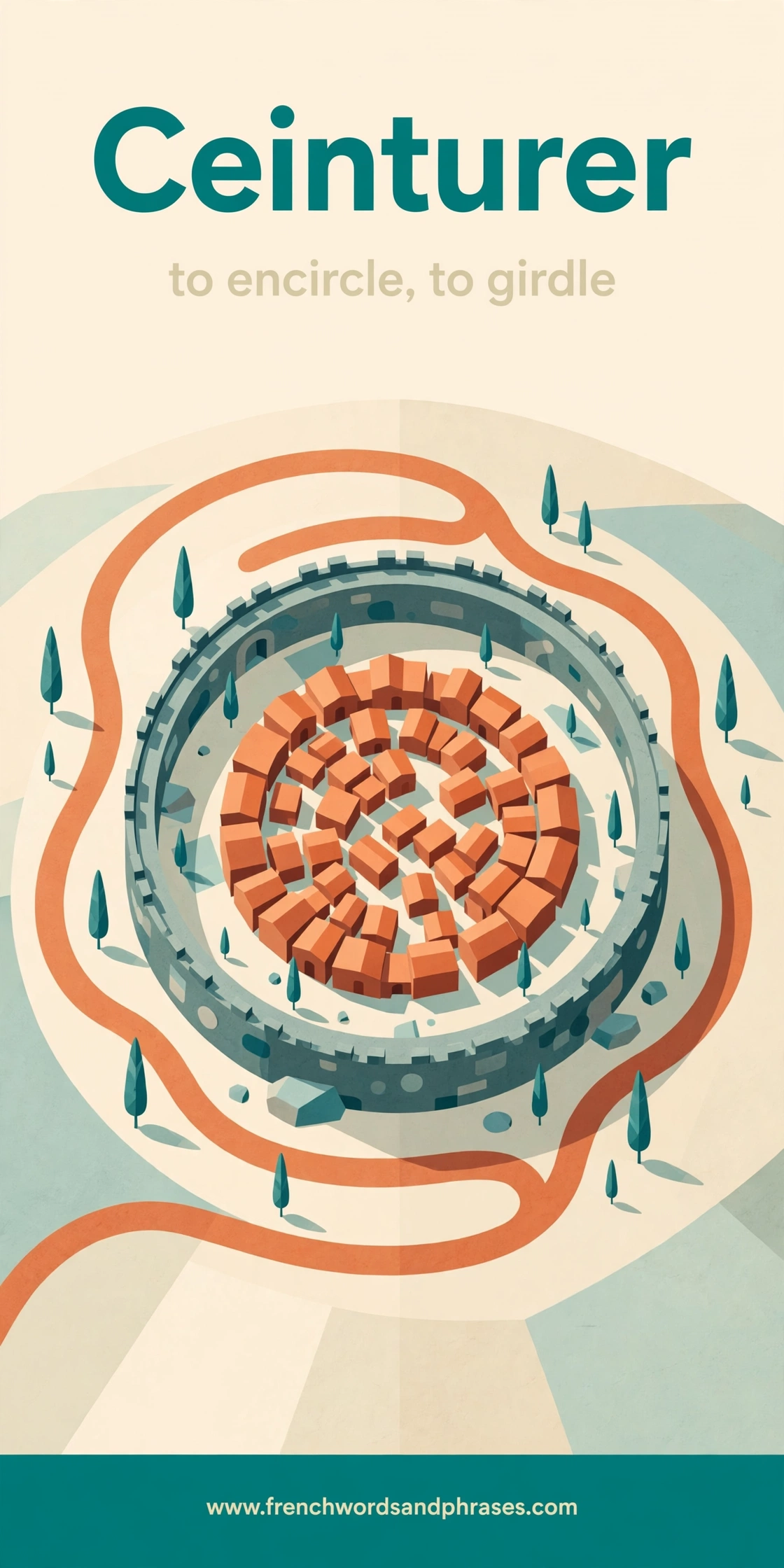
Ceinturer means to encircle, to girdle — to wrap right round something the way a belt wraps a waist.
A ring road wrapping itself round a city, ramparts round an old town, a security guard’s arms round a runaway’s waist — ceinturer is what a belt does, said of roads, walls, rivers and people: to go all the way round and hold fast.
In this guide, you’ll learn how to conjugate ceinturer in all the major French tenses and moods. Explore complete conjugation tables, French examples, English translations, and practice quizzes.
Understanding the French Verb Ceinturer
Ceinturer is a regular French verb belonging to the first group of verbs, those ending in-er.
It means to encircle, to girdle. It is commonly used in geography and town planning for ring roads, walls and rivers that encircle a place, in sport and security for the waist-high grab, and in the passive for anything hemmed in — une vallée ceinturée de montagnes, a town ceinturée par la neige.
Verb classification: First group (-er)
Auxiliary verb: Avoir
Past participle: ceinturé
Present participle: ceinturant
English equivalents: To encircle, to go all round, to belt; ceinturer une ville — to ring a town (of a road or a wall); ceinturer un lac — to run all round a lake; ceinturer quelqu’un — to grab someone round the waist; ceinturé par les montagnes — encircled by mountains.
One important detail: ceinturer is simply the noun une ceinture, a belt, turned into a verb — whatever makes a belt round something ceinture it. It is perfectly regular (je ceinture, nous ceinturons) and has two favourite pictures: a road, wall or river going round a place, and a person’s arms going round someone’s waist — in rugby and security work, ceinturer un adversaire is to grab him round the waist and hold him. Do not confuse it with its irregular cousin ceindre: ceinturer is the plain, everyday -er verb.
Experience the Word
Ceinturer is the verb of the complete circle — nothing escapes what ceinture it.
Imagine the old town from the air at dusk. The medieval ramparts still draw their perfect ring, the ring road draws a second one outside it, and between the two circles the town glows — ceinturée twice over, held like a jewel in its setting.
The town has not moved in eight hundred years. It is encircled — ceinturée — and proud of it.
How to Conjugate Ceinturer: Complete French Conjugation Guide
Let’s explore every major conjugation of ceinturer, beginning with the indicative mood.
How to Conjugate Ceinturer in the Indicative Mood
The indicative mood is used to express facts, observations, actions, and events.
How to Conjugate Ceinturer in the Present Tense (Présent)
Used for actions happening now, habitual actions, and general truths.
| Subject | Conjugation |
|---|---|
| je | ceinture |
| tu | ceintures |
| il / elle | ceinture |
| nous | ceinturons |
| vous | ceinturez |
| ils / elles | ceinturent |
Example
Une route étroite ceinture le village.
A narrow road runs all round the village.
Quick Quiz 1
Complete the sentence:
Nous ______ le jardin d’une haie.
Reveal the answer
ceinturons
Nous ceinturons le jardin d’une haie.
We are putting a hedge all round the garden.
How to Conjugate Ceinturer in the Passé Composé
Used for completed actions in the past. Ceinturer takes the auxiliary verb avoir.
| Subject | Conjugation |
|---|---|
| j’ | ai ceinturé |
| tu | as ceinturé |
| il / elle | a ceinturé |
| nous | avons ceinturé |
| vous | avez ceinturé |
| ils / elles | ont ceinturé |
Example
L’agent a ceinturé l’homme qui courait vers la sortie.
The officer grabbed the man running for the exit round the waist.
How to Conjugate Ceinturer in the Imparfait (Imperfect Tense)
Used for habitual past actions, descriptions, and ongoing situations in the past.
| Subject | Conjugation |
|---|---|
| je | ceinturais |
| tu | ceinturais |
| il / elle | ceinturait |
| nous | ceinturions |
| vous | ceinturiez |
| ils / elles | ceinturaient |
Example
Les remparts ceinturaient la vieille ville.
The ramparts used to encircle the old town.
Quick Quiz 2
Choose the correct form:
The valley is encircled by mountains.
La vallée ______ par les montagnes. (est ceinturée / a ceinturé)
Reveal the answer
est ceinturée
La vallée est ceinturée par les montagnes.
Passive: the valley receives the encircling.
How to Conjugate Ceinturer in the Plus-que-parfait
Used to describe an action that had already been completed before another past event.
| Subject | Conjugation |
|---|---|
| j’ | avais ceinturé |
| tu | avais ceinturé |
| il / elle | avait ceinturé |
| nous | avions ceinturé |
| vous | aviez ceinturé |
| ils / elles | avaient ceinturé |
Example
La rivière avait ceinturé la plaine avant les digues.
The river had encircled the plain before the dykes were built.
How to Conjugate Ceinturer in the Passé Simple
Primarily used in formal writing, literature, and historical narratives. It is rarely used in everyday conversation.
| Subject | Conjugation |
|---|---|
| je | ceinturai |
| tu | ceinturas |
| il / elle | ceintura |
| nous | ceinturâmes |
| vous | ceinturâtes |
| ils / elles | ceinturèrent |
Example
Une haie de buis ceintura le jardin du monastère.
A box hedge encircled the monastery garden.
How to Conjugate Ceinturer in the Passé Antérieur
A literary tense used to express an action completed immediately before another past action, generally in the passé simple.
| Subject | Conjugation |
|---|---|
| j’ | eus ceinturé |
| tu | eus ceinturé |
| il / elle | eut ceinturé |
| nous | eûmes ceinturé |
| vous | eûtes ceinturé |
| ils / elles | eurent ceinturé |
Example
Quand la police eut ceinturé le quartier, les recherches commencèrent.
When the police had cordoned off the district, the search began.
How to Conjugate Ceinturer in the Future Tense (Futur Simple)
Used to describe actions that will take place in the future.
| Subject | Conjugation |
|---|---|
| je | ceinturerai |
| tu | ceintureras |
| il / elle | ceinturera |
| nous | ceinturerons |
| vous | ceinturerez |
| ils / elles | ceintureront |
Example
Le nouveau boulevard ceinturera la ville entière.
The new boulevard will ring the whole city.
How to Conjugate Ceinturer in the Futur Antérieur (Future Perfect)
Used for an action that will have been completed before a particular point in the future.
| Subject | Conjugation |
|---|---|
| j’ | aurai ceinturé |
| tu | auras ceinturé |
| il / elle | aura ceinturé |
| nous | aurons ceinturé |
| vous | aurez ceinturé |
| ils / elles | auront ceinturé |
Example
À la fin des travaux, le sentier aura ceinturé tout le lac.
By the end of the works, the path will have gone all round the lake.
How to Conjugate Ceinturer in the Near Future (Futur Proche)
Used to describe something that is going to happen soon. Formed with aller + infinitive.
| Subject | Conjugation |
|---|---|
| je | vais ceinturer |
| tu | vas ceinturer |
| il / elle | va ceinturer |
| nous | allons ceinturer |
| vous | allez ceinturer |
| ils / elles | vont ceinturer |
Example
Le videur va ceinturer le client qui refuse de sortir.
The bouncer is going to grab the customer who refuses to leave round the waist.
How to Conjugate Ceinturer in the Conditional Mood
The conditional mood expresses what would happen under certain circumstances. It is also frequently used to make polite requests or express wishes.
How to Conjugate Ceinturer in the Present Conditional
| Subject | Conjugation |
|---|---|
| je | ceinturerais |
| tu | ceinturerais |
| il / elle | ceinturerait |
| nous | ceinturerions |
| vous | ceintureriez |
| ils / elles | ceintureraient |
Example
Un fossé ceinturerait le château contre les voleurs.
A moat would encircle the castle against thieves.
How to Conjugate Ceinturer in the Past Conditional
| Subject | Conjugation |
|---|---|
| j’ | aurais ceinturé |
| tu | aurais ceinturé |
| il / elle | aurait ceinturé |
| nous | aurions ceinturé |
| vous | auriez ceinturé |
| ils / elles | auraient ceinturé |
Example
La neige aurait ceinturé le village sans le chasse-neige.
The snow would have hemmed the village in without the snowplough.
Ceinturer in the Literary Past Conditional Form
This less common literary form uses the imperfect subjunctive of avoir.
| Subject | Conjugation |
|---|---|
| j’ | eusse ceinturé |
| tu | eusses ceinturé |
| il / elle | eût ceinturé |
| nous | eussions ceinturé |
| vous | eussiez ceinturé |
| ils / elles | eussent ceinturé |
Example
La muraille eût ceinturé la cité pour l’éternité.
The wall would have encircled the city for eternity.
How to Conjugate Ceinturer in the Subjunctive Mood
The subjunctive is used to express wishes, emotions, doubts, necessity, and uncertainty. It frequently follows expressions such as il faut que (it is necessary that) or bien que (although).
How to Conjugate Ceinturer in the Present Subjunctive
| Subject | Conjugation |
|---|---|
| que je | ceinture |
| que tu | ceintures |
| qu’il / qu’elle | ceinture |
| que nous | ceinturions |
| que vous | ceinturiez |
| qu’ils / qu’elles | ceinturent |
Example
Je veux qu’une haie ceinture le jardin.
I want a hedge to run all round the garden.
Quick Quiz 3
Complete the sentence using the subjunctive:
Je veux qu’une piste ______ tout le parc.
Reveal the answer
ceinture
Je veux qu’une piste ceinture tout le parc.
I want a track to go all round the park.
How to Conjugate Ceinturer in the Imperfect Subjunctive
A literary tense, rarely encountered in modern spoken French.
| Subject | Conjugation |
|---|---|
| que je | ceinturasse |
| que tu | ceinturasses |
| qu’il / qu’elle | ceinturât |
| que nous | ceinturassions |
| que vous | ceinturassiez |
| qu’ils / qu’elles | ceinturassent |
Example
On rêvait qu’un canal ceinturât la ville.
People dreamed that a canal might encircle the town.
How to Conjugate Ceinturer in the Pluperfect Subjunctive
A literary construction used to express an action completed before another past action.
| Subject | Conjugation |
|---|---|
| que j’ | eusse ceinturé |
| que tu | eusses ceinturé |
| qu’il / qu’elle | eût ceinturé |
| que nous | eussions ceinturé |
| que vous | eussiez ceinturé |
| qu’ils / qu’elles | eussent ceinturé |
Example
On disait que les remparts eussent ceinturé la ville entière.
It was said that the ramparts had encircled the whole town.
How to Conjugate Ceinturer in the Past Subjunctive
| Subject | Conjugation |
|---|---|
| que j’ | aie ceinturé |
| que tu | aies ceinturé |
| qu’il / qu’elle | ait ceinturé |
| que nous | ayons ceinturé |
| que vous | ayez ceinturé |
| qu’ils / qu’elles | aient ceinturé |
Example
Je suis content que la piste ait ceinturé tout le parc.
I am glad the track has gone all the way round the park.
How to Conjugate Ceinturer in the Imperative
The imperative is used to give commands, instructions, invitations, or suggestions. Subject pronouns are omitted.
How to Conjugate Ceinturer in the Present Imperative
| Person | Conjugation |
|---|---|
| (tu) | ceinture |
| (nous) | ceinturons |
| (vous) | ceinturez |
Example
Ceinture-le fermement, il va tomber !
Grab him firmly round the waist, he is going to fall!
Quick Quiz 4
How would you say Grab him round the waist (tu form)?
Reveal the answer
Ceinture-le !
French Participles of Ceinturer
Participles are verb forms that can be used in compound tenses and other grammatical constructions.
Present Participle of Ceinturer
ceinturant
En ceinturant le village, la route le protège des crues.
By running round the village, the road protects it from floods.
Past Participle of Ceinturer
ceinturé
Ceinturée par les montagnes, la vallée reste isolée.
Encircled by mountains, the valley remains cut off.
Ceinturer in Everyday French: Real-Life Examples
Now that you know the conjugations, let’s see how ceinturer appears in everyday French.
Example 1 — Present
La route ceinture le lac.
The road runs all round the lake.
Example 2 — Passé composé
L’agent a ceinturé le voleur.
The officer grabbed the thief round the waist.
Example 3 — Imparfait
Les remparts ceinturaient la ville.
The ramparts encircled the town.
Example 4 — Future
Le boulevard ceinturera la ville.
The boulevard will ring the city.
Example 5 — Conditional
Une haie ceinturerait le jardin.
A hedge would run round the garden.
Example 6 — Imperative
Ceinture-le, il glisse !
Grab him round the waist, he is slipping!
Beyond Translation: The Meaning of Ceinturer
English girdle is the natural translation, and it is no accident — a girdle is a belt, and ceinturer is ceinture at work.
To ceinturer is to belt something in.
The word comes from Latin cinctura, a girdle, the same root as ceindre: where ceindre is the solemn, literary verb of girding yourself, ceinturer is its practical descendant, drawing ring roads round cities and arms round waists.
How to Remember the French Verb Ceinturer
Remember it this way: Ceinturer is about the ring road belting the city — and the guard’s arms round a waist.
- Built on ceinture, a belt: to ceinturer is to belt something round.
- Two main pictures: a road or wall round a place, and arms round someone’s waist — ceinturer un voleur.
- Regular -er: je ceinture, nous ceinturons, past participle ceinturé.
The key idea is the ring road belting the city — and the guard’s arms round a waist.
Test Your Knowledge of Ceinturer
Let’s see how much you’ve learned. Try answering these questions before revealing the answers.
Question 1
What noun is ceinturer built on?
Reveal the answer
Ceinture — a belt: to ceinturer is to wrap round something like a belt.
Question 2
How do you say The road runs all round the lake in French?
Reveal the answer
La route ceinture le lac.
Question 3
Translate: The officer grabbed the thief round the waist.
Reveal the answer
L’agent a ceinturé le voleur.
Question 4
What is the past participle of ceinturer?
Reveal the answer
Ceinturé.
Question 5
Complete the sentence:
Les remparts ______ la vieille ville autrefois.
Reveal the answer
ceinturaient
Les remparts ceinturaient la vieille ville autrefois.
The ramparts used to encircle the old town.
Your Final Challenge
Can You Use It?
How would you say this in French?
The old rampart still encircles the town, faithful as a belt of stone.
Reveal the answer
Le vieux rempart ceinture encore la ville, fidèle comme une ceinture de pierre.
The old rampart still encircles the town, faithful as a belt of stone.
A little French. A little curiosity. A richer everyday life.
LEARN FRENCH ONE WORD AT A TIME