A French Word to Live By
How to Conjugate Catcher in French
/kat.ʃe/
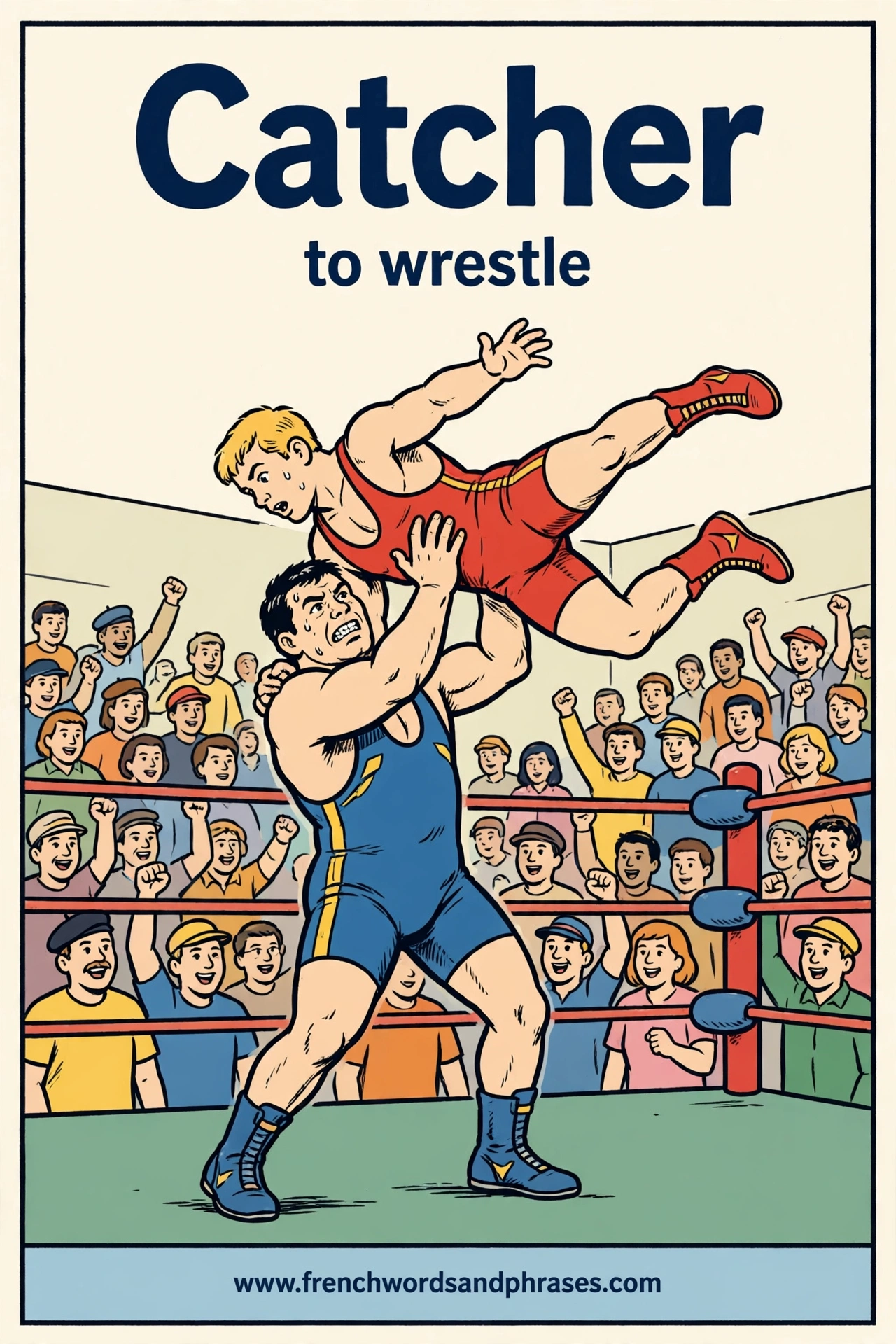
Catcher means to wrestle — to perform in the ring as a catcheur, in the theatrical, masked, roaring world of French wrestling shows.
A small hall smelling of liniment and popcorn, a masked giant climbing through the ropes, children screaming for the hero and booing the villain — catcher is the verb of French professional wrestling: part sport, part theatre, all spectacle.
In this guide, you’ll learn how to conjugate catcher in all the major French tenses and moods. Explore complete conjugation tables, French examples, English translations, and practice quizzes.
Understanding the French Verb Catcher
Catcher is a regular French verb belonging to the first group of verbs, those ending in-er.
It means to wrestle. It is used of professional wrestlers in halls, fairs and on television, and jokingly of any rough-and-tumble contest — des enfants qui catchent sur la pelouse. For sport wrestling as a discipline, French says lutter; catcher always keeps the smell of the show: masks, nicknames, rivalries and a crowd that knows its lines.
Verb classification: First group (-er)
Auxiliary verb: Avoir
Past participle: catché
Present participle: catchant
English equivalents: To wrestle (professional, show wrestling); catcher sur un ring — to wrestle in a ring; catcher pour le titre — to wrestle for the title; un catcheur, une catcheuse — a wrestler; le catch — wrestling (the show).
One important detail: catcher is English in French clothing — borrowed from catch-as-catch-can, the old Lancashire wrestling style, and fully naturalised as a regular -er verb: je catche, nous catchons, il a catché. It does NOT mean to catch a ball — that is attraper. Catcher belongs to the ring: its family is le catch (the show itself), un catcheur and une catcheuse (the wrestlers), and the wrestling it names is the theatrical professional kind, not Olympic wrestling, which is la lutte.
Experience the Word
Catcher is the verb of the ring as theatre — the fall is choreographed, the rivalry is scripted, and the bruises are entirely real.
Imagine a village fair in 1962. Under a striped tent, the local hero — a baker by day — climbs into the ring as L’Ours des Vosges, the Bear of the Vosges. He catches, he roars, he loses nobly in the third round, and the whole village walks home happy, hoarse and half convinced it was real.
By day he sells bread. By night he wrestles — il catche — and the village would not have it any other way.
How to Conjugate Catcher: Complete French Conjugation Guide
Let’s explore every major conjugation of catcher, beginning with the indicative mood.
How to Conjugate Catcher in the Indicative Mood
The indicative mood is used to express facts, observations, actions, and events.
How to Conjugate Catcher in the Present Tense (Présent)
Used for actions happening now, habitual actions, and general truths.
| Subject | Conjugation |
|---|---|
| je | catche |
| tu | catches |
| il / elle | catche |
| nous | catchons |
| vous | catchez |
| ils / elles | catchent |
Example
Il catche chaque samedi dans une petite salle de banlieue.
He wrestles every Saturday in a small suburban hall.
Quick Quiz 1
Complete the sentence:
Nous ______ sur ce ring depuis des années.
Reveal the answer
catchons
Nous catchons sur ce ring depuis des années.
We have been wrestling in this ring for years.
How to Conjugate Catcher in the Passé Composé
Used for completed actions in the past. Catcher takes the auxiliary verb avoir.
| Subject | Conjugation |
|---|---|
| j’ | ai catché |
| tu | as catché |
| il / elle | a catché |
| nous | avons catché |
| vous | avez catché |
| ils / elles | ont catché |
Example
Elle a catché contre la championne devant mille spectateurs.
She wrestled against the champion before a thousand spectators.
How to Conjugate Catcher in the Imparfait (Imperfect Tense)
Used for habitual past actions, descriptions, and ongoing situations in the past.
| Subject | Conjugation |
|---|---|
| je | catchais |
| tu | catchais |
| il / elle | catchait |
| nous | catchions |
| vous | catchiez |
| ils / elles | catchaient |
Example
Autrefois, on catchait dans les fêtes de village.
In the old days, people used to wrestle at village fairs.
Quick Quiz 2
Choose the correct form:
She wrestled against the champion.
Elle ______ contre la championne. (a catché / a attrapé)
Reveal the answer
a catché
Elle a catché contre la championne.
In the ring, wrestlers catchent; attraper is for balls.
How to Conjugate Catcher in the Plus-que-parfait
Used to describe an action that had already been completed before another past event.
| Subject | Conjugation |
|---|---|
| j’ | avais catché |
| tu | avais catché |
| il / elle | avait catché |
| nous | avions catché |
| vous | aviez catché |
| ils / elles | avaient catché |
Example
Il avait catché pendant dix ans avant de devenir entraîneur.
He had wrestled for ten years before becoming a trainer.
How to Conjugate Catcher in the Passé Simple
Primarily used in formal writing, literature, and historical narratives. It is rarely used in everyday conversation.
| Subject | Conjugation |
|---|---|
| je | catchai |
| tu | catchas |
| il / elle | catcha |
| nous | catchâmes |
| vous | catchâtes |
| ils / elles | catchèrent |
Example
Ce soir-là, le géant catcha comme jamais.
That evening, the giant wrestled like never before.
How to Conjugate Catcher in the Passé Antérieur
A literary tense used to express an action completed immediately before another past action, generally in the passé simple.
| Subject | Conjugation |
|---|---|
| j’ | eus catché |
| tu | eus catché |
| il / elle | eut catché |
| nous | eûmes catché |
| vous | eûtes catché |
| ils / elles | eurent catché |
Example
Quand il eut catché son dernier match, le public l’ovationna.
When he had wrestled his last match, the crowd gave him an ovation.
How to Conjugate Catcher in the Future Tense (Futur Simple)
Used to describe actions that will take place in the future.
| Subject | Conjugation |
|---|---|
| je | catcherai |
| tu | catcheras |
| il / elle | catchera |
| nous | catcherons |
| vous | catcherez |
| ils / elles | catcheront |
Example
Demain, tu catcheras pour le titre régional.
Tomorrow, you will wrestle for the regional title.
How to Conjugate Catcher in the Futur Antérieur (Future Perfect)
Used for an action that will have been completed before a particular point in the future.
| Subject | Conjugation |
|---|---|
| j’ | aurai catché |
| tu | auras catché |
| il / elle | aura catché |
| nous | aurons catché |
| vous | aurez catché |
| ils / elles | auront catché |
Example
À trente ans, il aura catché sur tous les rings d’Europe.
By thirty, he will have wrestled in every ring in Europe.
How to Conjugate Catcher in the Near Future (Futur Proche)
Used to describe something that is going to happen soon. Formed with aller + infinitive.
| Subject | Conjugation |
|---|---|
| je | vais catcher |
| tu | vas catcher |
| il / elle | va catcher |
| nous | allons catcher |
| vous | allez catcher |
| ils / elles | vont catcher |
Example
Regarde, le champion va catcher sans son masque !
Look, the champion is going to wrestle without his mask!
How to Conjugate Catcher in the Conditional Mood
The conditional mood expresses what would happen under certain circumstances. It is also frequently used to make polite requests or express wishes.
How to Conjugate Catcher in the Present Conditional
| Subject | Conjugation |
|---|---|
| je | catcherais |
| tu | catcherais |
| il / elle | catcherait |
| nous | catcherions |
| vous | catcheriez |
| ils / elles | catcheraient |
Example
Avec un meilleur entraîneur, elle catcherait au niveau national.
With a better trainer, she would wrestle at national level.
How to Conjugate Catcher in the Past Conditional
| Subject | Conjugation |
|---|---|
| j’ | aurais catché |
| tu | aurais catché |
| il / elle | aurait catché |
| nous | aurions catché |
| vous | auriez catché |
| ils / elles | auraient catché |
Example
Il aurait catché en finale sans sa blessure au genou.
He would have wrestled in the final without his knee injury.
Catcher in the Literary Past Conditional Form
This less common literary form uses the imperfect subjunctive of avoir.
| Subject | Conjugation |
|---|---|
| j’ | eusse catché |
| tu | eusses catché |
| il / elle | eût catché |
| nous | eussions catché |
| vous | eussiez catché |
| ils / elles | eussent catché |
Example
Il eût catché jusqu’au bout de ses forces.
He would have wrestled to the very end of his strength.
How to Conjugate Catcher in the Subjunctive Mood
The subjunctive is used to express wishes, emotions, doubts, necessity, and uncertainty. It frequently follows expressions such as il faut que (it is necessary that) or bien que (although).
How to Conjugate Catcher in the Present Subjunctive
| Subject | Conjugation |
|---|---|
| que je | catche |
| que tu | catches |
| qu’il / qu’elle | catche |
| que nous | catchions |
| que vous | catchiez |
| qu’ils / qu’elles | catchent |
Example
Je ne crois pas qu’il catche encore à son âge.
I do not believe he still wrestles at his age.
Quick Quiz 3
Complete the sentence using the subjunctive:
Je suis content que tu ______ devant tes parents.
Reveal the answer
aies catché
Je suis content que tu aies catché devant tes parents.
I am glad you wrestled in front of your parents.
How to Conjugate Catcher in the Imperfect Subjunctive
A literary tense, rarely encountered in modern spoken French.
| Subject | Conjugation |
|---|---|
| que je | catchasse |
| que tu | catchasses |
| qu’il / qu’elle | catchât |
| que nous | catchassions |
| que vous | catchassiez |
| qu’ils / qu’elles | catchassent |
Example
On s’étonnait qu’elle catchât avec une telle énergie.
People were astonished that she wrestled with such energy.
How to Conjugate Catcher in the Pluperfect Subjunctive
A literary construction used to express an action completed before another past action.
| Subject | Conjugation |
|---|---|
| que j’ | eusse catché |
| que tu | eusses catché |
| qu’il / qu’elle | eût catché |
| que nous | eussions catché |
| que vous | eussiez catché |
| qu’ils / qu’elles | eussent catché |
Example
On racontait qu’il eût catché contre des ours, autrefois.
People said he had once wrestled against bears.
How to Conjugate Catcher in the Past Subjunctive
| Subject | Conjugation |
|---|---|
| que j’ | aie catché |
| que tu | aies catché |
| qu’il / qu’elle | ait catché |
| que nous | ayons catché |
| que vous | ayez catché |
| qu’ils / qu’elles | aient catché |
Example
Je suis content que tu aies catché devant tes parents.
I am glad you wrestled in front of your parents.
How to Conjugate Catcher in the Imperative
The imperative is used to give commands, instructions, invitations, or suggestions. Subject pronouns are omitted.
How to Conjugate Catcher in the Present Imperative
| Person | Conjugation |
|---|---|
| (tu) | catche |
| (nous) | catchons |
| (vous) | catchez |
Example
Catche avec le cœur, pas avec la colère !
Wrestle with your heart, not with anger!
Quick Quiz 4
How would you say Wrestle with your heart (tu form)?
Reveal the answer
Catche avec le cœur !
French Participles of Catcher
Participles are verb forms that can be used in compound tenses and other grammatical constructions.
Present Participle of Catcher
catchant
En catchant, il a appris le respect de l’adversaire.
By wrestling, he learned respect for his opponent.
Past Participle of Catcher
catché
Catchée devant son public, la championne a triomphé.
Wrestling before her home crowd, the champion triumphed.
Catcher in Everyday French: Real-Life Examples
Now that you know the conjugations, let’s see how catcher appears in everyday French.
Example 1 — Present
Il catche chaque samedi soir.
He wrestles every Saturday evening.
Example 2 — Passé composé
Elle a catché contre la championne.
She wrestled against the champion.
Example 3 — Imparfait
On catchait dans les fêtes de village.
People used to wrestle at village fairs.
Example 4 — Future
Tu catcheras pour le titre régional.
You will wrestle for the regional title.
Example 5 — Conditional
Elle catcherait au niveau national avec un meilleur entraîneur.
She would wrestle at national level with a better trainer.
Example 6 — Imperative
Catche avec le cœur !
Wrestle with your heart!
Beyond Translation: The Meaning of Catcher
English gave French the word and the spectacle: catch-as-catch-can crossed the Channel with music-hall wrestlers, and French kept the name, the masks and the melodrama while making the verb a model citizen — regular -er endings on an English stem.
Le catch is theatre that happens to hurt.
France embraced it after the war, when televised bouts drew millions and masked heroes like L’Ange Blanc became household names — catcher is the verb that still smells of those Saturday nights.
How to Remember the French Verb Catcher
Remember it this way: Catcher is about the masked baker by day, L’Ours des Vosges in the ring by night.
- Not to catch a ball — that is attraper. Catcher is the ring: le catch, un catcheur, une catcheuse.
- English stem, French manners: perfectly regular -er — je catche, nous catchons, catché.
- For Olympic-style wrestling the noun is la lutte and the verb lutter; catcher is the show.
The key idea is the masked baker by day, L’Ours des Vosges in the ring by night.
Test Your Knowledge of Catcher
Let’s see how much you’ve learned. Try answering these questions before revealing the answers.
Question 1
How do you say to catch a ball in French — is it catcher?
Reveal the answer
No — attraper. Catcher means to wrestle professionally; a ball is attrapé, never catché.
Question 2
How do you say She wrestled against the champion in French?
Reveal the answer
Elle a catché contre la championne.
Question 3
Translate: He wrestles every Saturday.
Reveal the answer
Il catche chaque samedi.
Question 4
What is the past participle of catcher?
Reveal the answer
Catché.
Question 5
Complete the sentence:
Je ne crois pas qu’il ______ encore à son âge.
Reveal the answer
catche
Je ne crois pas qu’il catche encore à son âge.
I do not believe he still wrestles at his age.
Your Final Challenge
Can You Use It?
How would you say this in French?
The baker wrestles on Saturday nights, and the whole village holds its breath.
Reveal the answer
Le boulanger catche le samedi soir, et tout le village retient son souffle.
The baker wrestles on Saturday nights, and the whole village holds its breath.
A little French. A little curiosity. A richer everyday life.
LEARN FRENCH ONE WORD AT A TIME