A French Word to Live By
How to Conjugate Catapulter in French
/ka.ta.pyl.te/
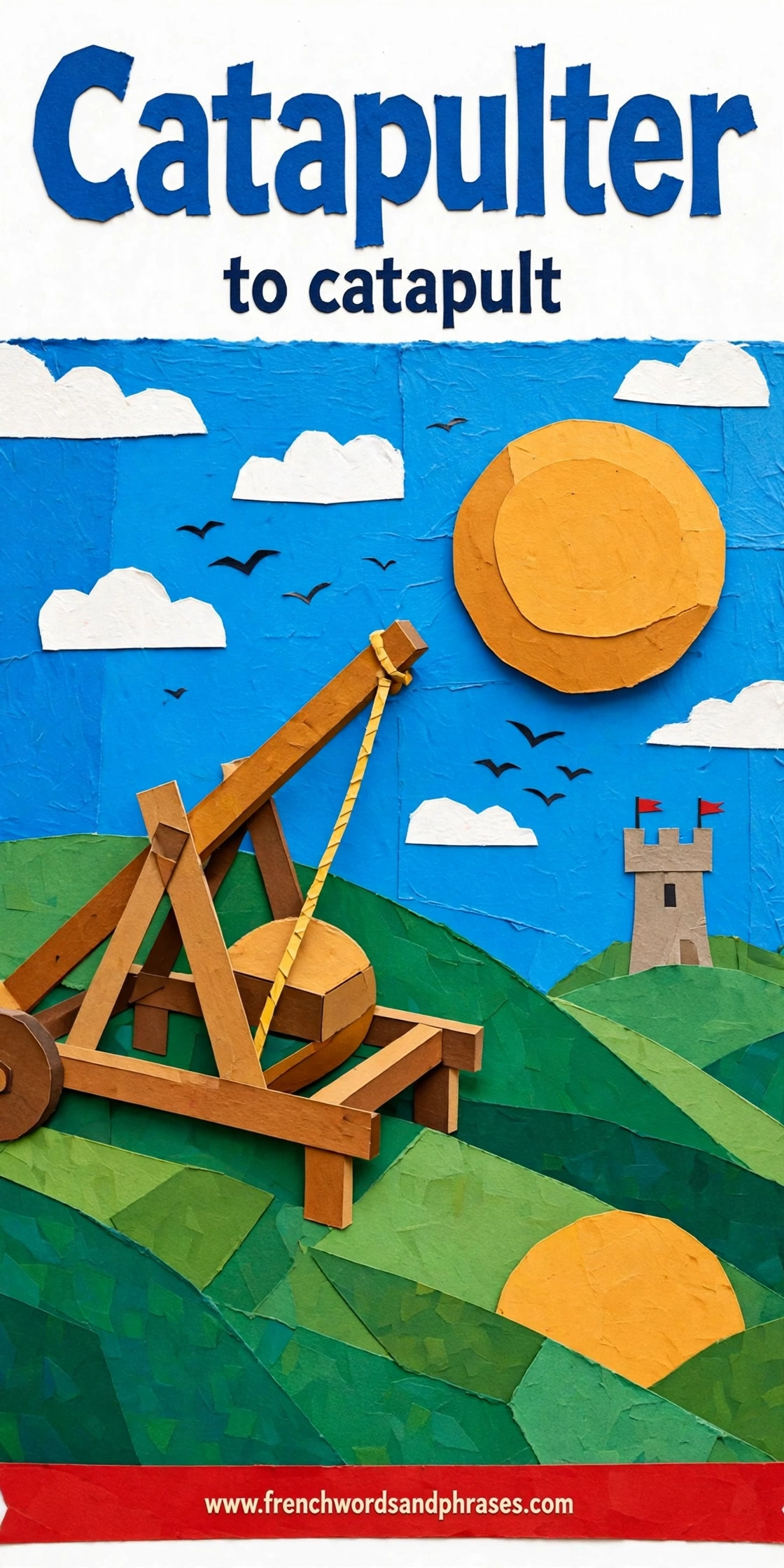
Catapulter means to catapult — to hurl something through the air, or to thrust a person suddenly into fame, power or trouble.
A medieval siege engine flinging stones over castle walls, a pilot ejected from his cockpit, an unknown actor thrown overnight onto every magazine cover — catapulter is the verb of the sudden launch: no climb, no ladder, just flight.
In this guide, you’ll learn how to conjugate catapulter in all the major French tenses and moods. Explore complete conjugation tables, French examples, English translations, and practice quizzes.
Understanding the French Verb Catapulter
Catapulter is a regular French verb belonging to the first group of verbs, those ending in-er.
It means to catapult. Beyond castle walls and toy catapults, it is the standard journalistic verb for sudden, unearned-looking promotion — un rôle qui l’a catapulté parmi les stars — and it always suggests speed and a certain violence: nobody is gently catapulté anywhere.
Verb classification: First group (-er)
Auxiliary verb: Avoir
Past participle: catapulté
Present participle: catapultant
English equivalents: To catapult, to hurl, to fling; catapulter des pierres — to catapult stones; catapulter quelqu’un au sommet — to catapult someone to the top; être catapulté à un poste — to be thrust into a job; catapulter quelqu’un dans la gloire — to catapult someone to fame.
One important detail: catapulter is a perfectly regular -er verb — je catapulte, nous catapultons, catapulté — and its modern life is mostly figurative. People are catapultés: catapulté au sommet, catapulté à la tête de l’entreprise, catapulté malgré lui dans l’affaire. The passive flavour is built into the word: like a stone from a siege engine, the person catapulté did not choose the trajectory. Note the construction: catapulter quelqu’un à / dans / au sommet de — the landing place takes à or dans, never a bare object.
Experience the Word
Catapulter is the verb of promotion without the staircase — one morning unknown, the next morning airborne.
Imagine a young singer who has played empty bars for six years. A producer hears one song, a video explodes overnight, and by Friday her face is on the side of buses — catapultée, in three days, from the bar stool to the stadium, still holding the same guitar.
She did not climb, she did not queue. She was launched — catapultée — and the landing is another story.
How to Conjugate Catapulter: Complete French Conjugation Guide
Let’s explore every major conjugation of catapulter, beginning with the indicative mood.
How to Conjugate Catapulter in the Indicative Mood
The indicative mood is used to express facts, observations, actions, and events.
How to Conjugate Catapulter in the Present Tense (Présent)
Used for actions happening now, habitual actions, and general truths.
| Subject | Conjugation |
|---|---|
| je | catapulte |
| tu | catapultes |
| il / elle | catapulte |
| nous | catapultons |
| vous | catapultez |
| ils / elles | catapultent |
Example
La machine catapulte les pierres par-dessus le mur.
The machine catapults the stones over the wall.
Quick Quiz 1
Complete the sentence:
Nous ______ les pierres par-dessus le mur.
Reveal the answer
catapultons
Nous catapultons les pierres par-dessus le mur.
We are catapulting the stones over the wall.
How to Conjugate Catapulter in the Passé Composé
Used for completed actions in the past. Catapulter takes the auxiliary verb avoir.
| Subject | Conjugation |
|---|---|
| j’ | ai catapulté |
| tu | as catapulté |
| il / elle | a catapulté |
| nous | avons catapulté |
| vous | avez catapulté |
| ils / elles | ont catapulté |
Example
Ce rôle l’a catapulté au sommet du cinéma français.
This role catapulted him to the top of French cinema.
How to Conjugate Catapulter in the Imparfait (Imperfect Tense)
Used for habitual past actions, descriptions, and ongoing situations in the past.
| Subject | Conjugation |
|---|---|
| je | catapultais |
| tu | catapultais |
| il / elle | catapultait |
| nous | catapultions |
| vous | catapultiez |
| ils / elles | catapultaient |
Example
Les soldats catapultaient des boulets enflammés sur la ville.
The soldiers used to catapult flaming shot onto the town.
Quick Quiz 2
Choose the correct form:
This role catapulted him to the top.
Ce rôle l’______ au sommet. (a catapulté / est catapulté)
Reveal the answer
a catapulté
Ce rôle l’a catapulté au sommet.
Catapulter takes avoir.
How to Conjugate Catapulter in the Plus-que-parfait
Used to describe an action that had already been completed before another past event.
| Subject | Conjugation |
|---|---|
| j’ | avais catapulté |
| tu | avais catapulté |
| il / elle | avait catapulté |
| nous | avions catapulté |
| vous | aviez catapulté |
| ils / elles | avaient catapulté |
Example
Le succès l’avait catapultée dans un monde inconnu.
Success had catapulted her into an unknown world.
How to Conjugate Catapulter in the Passé Simple
Primarily used in formal writing, literature, and historical narratives. It is rarely used in everyday conversation.
| Subject | Conjugation |
|---|---|
| je | catapultai |
| tu | catapultas |
| il / elle | catapulta |
| nous | catapultâmes |
| vous | catapultâtes |
| ils / elles | catapultèrent |
Example
Le siège catapulta le pilote hors de l’avion en feu.
The seat catapulted the pilot out of the burning plane.
How to Conjugate Catapulter in the Passé Antérieur
A literary tense used to express an action completed immediately before another past action, generally in the passé simple.
| Subject | Conjugation |
|---|---|
| j’ | eus catapulté |
| tu | eus catapulté |
| il / elle | eut catapulté |
| nous | eûmes catapulté |
| vous | eûtes catapulté |
| ils / elles | eurent catapulté |
Example
Quand le ressort eut catapulté la balle, les enfants crièrent.
When the spring had catapulted the ball, the children shouted.
How to Conjugate Catapulter in the Future Tense (Futur Simple)
Used to describe actions that will take place in the future.
| Subject | Conjugation |
|---|---|
| je | catapulterai |
| tu | catapulteras |
| il / elle | catapultera |
| nous | catapulterons |
| vous | catapulterez |
| ils / elles | catapulteront |
Example
Demain, ils catapulteront la fusée miniature dans le ciel.
Tomorrow, they will catapult the miniature rocket into the sky.
How to Conjugate Catapulter in the Futur Antérieur (Future Perfect)
Used for an action that will have been completed before a particular point in the future.
| Subject | Conjugation |
|---|---|
| j’ | aurai catapulté |
| tu | auras catapulté |
| il / elle | aura catapulté |
| nous | aurons catapulté |
| vous | aurez catapulté |
| ils / elles | auront catapulté |
Example
À la fin du film, ce rôle l’aura catapulté parmi les stars.
By the end of the film, this role will have catapulted him among the stars.
How to Conjugate Catapulter in the Near Future (Futur Proche)
Used to describe something that is going to happen soon. Formed with aller + infinitive.
| Subject | Conjugation |
|---|---|
| je | vais catapulter |
| tu | vas catapulter |
| il / elle | va catapulter |
| nous | allons catapulter |
| vous | allez catapulter |
| ils / elles | vont catapulter |
Example
Ce concours va catapulter de jeunes talents sur scène.
This competition is going to catapult young talents onto the stage.
How to Conjugate Catapulter in the Conditional Mood
The conditional mood expresses what would happen under certain circumstances. It is also frequently used to make polite requests or express wishes.
How to Conjugate Catapulter in the Present Conditional
| Subject | Conjugation |
|---|---|
| je | catapulterais |
| tu | catapulterais |
| il / elle | catapulterait |
| nous | catapulterions |
| vous | catapulteriez |
| ils / elles | catapulteraient |
Example
Un seul article catapulterait ce village inconnu dans les guides.
A single article would catapult this unknown village into the guidebooks.
How to Conjugate Catapulter in the Past Conditional
| Subject | Conjugation |
|---|---|
| j’ | aurais catapulté |
| tu | aurais catapulté |
| il / elle | aurait catapulté |
| nous | aurions catapulté |
| vous | auriez catapulté |
| ils / elles | auraient catapulté |
Example
Sans ce prix, on ne l’aurait jamais catapulté à ce poste.
Without this prize, they would never have thrust him into that job.
Catapulter in the Literary Past Conditional Form
This less common literary form uses the imperfect subjunctive of avoir.
| Subject | Conjugation |
|---|---|
| j’ | eusse catapulté |
| tu | eusses catapulté |
| il / elle | eût catapulté |
| nous | eussions catapulté |
| vous | eussiez catapulté |
| ils / elles | eussent catapulté |
Example
La fortune l’eût catapulté au premier rang.
Fortune would have catapulted him into the front rank.
How to Conjugate Catapulter in the Subjunctive Mood
The subjunctive is used to express wishes, emotions, doubts, necessity, and uncertainty. It frequently follows expressions such as il faut que (it is necessary that) or bien que (although).
How to Conjugate Catapulter in the Present Subjunctive
| Subject | Conjugation |
|---|---|
| que je | catapulte |
| que tu | catapultes |
| qu’il / qu’elle | catapulte |
| que nous | catapultions |
| que vous | catapultiez |
| qu’ils / qu’elles | catapultent |
Example
Il est possible que ce film te catapulte vers la gloire.
It is possible this film will catapult you to fame.
Quick Quiz 3
Complete the sentence using the subjunctive:
Il est possible que ce concours vous ______ sur scène.
Reveal the answer
catapulte
Il est possible que ce concours vous catapulte sur scène.
It is possible this competition will catapult you onto the stage.
How to Conjugate Catapulter in the Imperfect Subjunctive
A literary tense, rarely encountered in modern spoken French.
| Subject | Conjugation |
|---|---|
| que je | catapultasse |
| que tu | catapultasses |
| qu’il / qu’elle | catapultât |
| que nous | catapultassions |
| que vous | catapultassiez |
| qu’ils / qu’elles | catapultassent |
Example
On ne pensait pas qu’un seul livre le catapultât si haut.
Nobody thought a single book would catapult him so high.
How to Conjugate Catapulter in the Pluperfect Subjunctive
A literary construction used to express an action completed before another past action.
| Subject | Conjugation |
|---|---|
| que j’ | eusse catapulté |
| que tu | eusses catapulté |
| qu’il / qu’elle | eût catapulté |
| que nous | eussions catapulté |
| que vous | eussiez catapulté |
| qu’ils / qu’elles | eussent catapulté |
Example
On disait qu’elle eût catapulté l’entreprise en un an.
People said she had propelled the company in a single year.
How to Conjugate Catapulter in the Past Subjunctive
| Subject | Conjugation |
|---|---|
| que j’ | aie catapulté |
| que tu | aies catapulté |
| qu’il / qu’elle | ait catapulté |
| que nous | ayons catapulté |
| que vous | ayez catapulté |
| qu’ils / qu’elles | aient catapulté |
Example
Je suis surpris que ce rôle l’ait catapultée si vite.
I am surprised this role catapulted her so fast.
How to Conjugate Catapulter in the Imperative
The imperative is used to give commands, instructions, invitations, or suggestions. Subject pronouns are omitted.
How to Conjugate Catapulter in the Present Imperative
| Person | Conjugation |
|---|---|
| (tu) | catapulte |
| (nous) | catapultons |
| (vous) | catapultez |
Example
Catapulte la balle par-dessus la haie !
Catapult the ball over the hedge!
Quick Quiz 4
How would you say Catapult the ball over the hedge (tu form)?
Reveal the answer
Catapulte la balle par-dessus la haie !
French Participles of Catapulter
Participles are verb forms that can be used in compound tenses and other grammatical constructions.
Present Participle of Catapulter
catapultant
En catapultant les pierres, ils défendaient le château.
By catapulting the stones, they defended the castle.
Past Participle of Catapulter
catapulté
Catapulté au sommet, il a gardé les pieds sur terre.
Catapulted to the top, he kept his feet on the ground.
Catapulter in Everyday French: Real-Life Examples
Now that you know the conjugations, let’s see how catapulter appears in everyday French.
Example 1 — Present
La machine catapulte les pierres.
The machine catapults the stones.
Example 2 — Passé composé
Ce rôle l’a catapulté au sommet.
This role catapulted him to the top.
Example 3 — Imparfait
Les soldats catapultaient des boulets enflammés.
The soldiers used to catapult flaming shot.
Example 4 — Future
Ce concours catapultera de jeunes talents.
This competition will catapult young talents.
Example 5 — Conditional
Un seul article catapulterait ce village dans les guides.
A single article would catapult this village into the guidebooks.
Example 6 — Imperative
Catapulte la balle par-dessus la haie !
Catapult the ball over the hedge!
Beyond Translation: The Meaning of Catapulter
The catapulte was the Roman siege engine, from the Greek katapeltēs — kata, against, and pallein, to hurl: the machine for hurling things at walls.
French careers still fly the same trajectory.
To be catapulté is to arrive at the top without visiting the floors in between — the word always keeps a little of the siege engine’s violence, and a suspicion that what flew up so fast might come down the same way.
How to Remember the French Verb Catapulter
Remember it this way: Catapulter is about the siege engine — stones over walls, actors into fame, overnight.
- Mostly figurative today: catapulté au sommet, catapulté à un poste — sudden promotion, no staircase.
- The landing takes à or dans: catapulter quelqu’un au sommet, dans la gloire.
- Regular -er: je catapulte, nous catapultons, past participle catapulté.
The key idea is the siege engine — stones over walls, actors into fame, overnight.
Test Your Knowledge of Catapulter
Let’s see how much you’ve learned. Try answering these questions before revealing the answers.
Question 1
What construction follows catapulter quelqu’un for the landing place?
Reveal the answer
À or dans — catapulter quelqu’un au sommet, dans la gloire, à un poste.
Question 2
How do you say This role catapulted him to the top in French?
Reveal the answer
Ce rôle l’a catapulté au sommet.
Question 3
Translate: The machine catapults the stones over the wall.
Reveal the answer
La machine catapulte les pierres par-dessus le mur.
Question 4
What is the past participle of catapulter?
Reveal the answer
Catapulté.
Question 5
Complete the sentence:
Il est possible que ce film te ______ vers la gloire.
Reveal the answer
catapulte
Il est possible que ce film te catapulte vers la gloire.
It is possible this film will catapult you to fame.
Your Final Challenge
Can You Use It?
How would you say this in French?
Catapulted to the top overnight, he kept his old hat and his old friends.
Reveal the answer
Catapulté au sommet en une nuit, il a gardé son vieux chapeau et ses vieux amis.
Catapulted to the top overnight, he kept his old hat and his old friends.
A little French. A little curiosity. A richer everyday life.
LEARN FRENCH ONE WORD AT A TIME