A French Word to Live By
Translate Âgé to English
/aʒe/
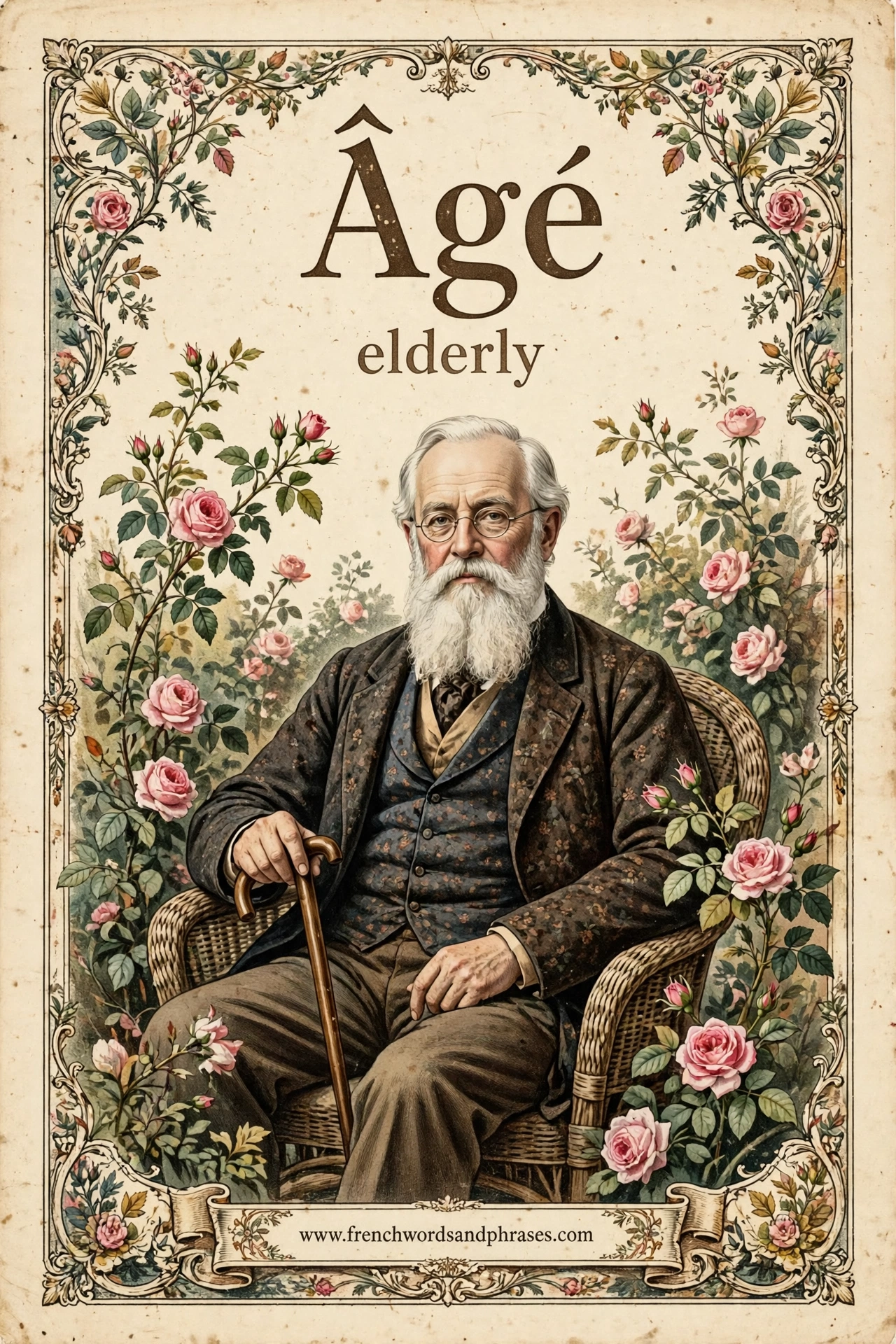
Âgé means elderly.
At a long table in a village hall, the whole family has gathered for one person’s ninetieth birthday — children, grandchildren, and a great-granddaughter asleep in a pram. The guest of honour cuts her own cake, slowly and precisely. French describes her with respect, in one careful word: âgée.
In this guide, you’ll learn what âgé means in English, how its regular forms are built, why it is the polite way to call someone old, and the construction âgé de that attaches an exact age to it. Explore French examples, English translations, and practice quizzes.
Understanding the French Adjective Âgé
Âgé is a French adjective of quality — the adjective of advanced years. It agrees in the most regular way: âgé, âgée, âgés, âgées. In official French, les personnes âgées is the standard, respectful term for elderly people.
It means elderly or aged: un homme âgé, an elderly man; une dame âgée, an elderly lady. With a number, it states an exact age: âgé de quatre-vingts ans, aged eighty. It describes people above all, though an old dog or an old tree can be âgé too.
Type: Adjective of quality — advanced age
Answers the question: What is it like? — elderly
Changes form: Yes — âgé, âgée, âgés, âgées
English equivalents: Elderly; aged; old (respectful).
One important usage detail: âgé is the polite choice for people, where vieux can sound blunt. And learn its signature construction: âgé de plus a number of years — une femme âgée de quatre-vingt-dix ans, a woman aged ninety.
Experience the Word
Âgé is the adjective of the ninetieth birthday — the word a family uses when age has become an achievement rather than a number.
Imagine the birthday guest again, accepting a bouquet with both hands. Nobody at the table would call her vieille to her face. Âgée is the word that bows slightly as it speaks.
You have not just counted someone’s years. You have honoured them.
How to Use Âgé in French: Complete Guide
Let’s explore how âgé works in French, beginning with the whole word on one card.
Âgé at a Glance
Before the details, here is the whole word on one card.
The Whole Word on One Card
Meaning, type, position and forms — âgé in four lines.
| Point | Âgé |
|---|---|
| Meaning | elderly |
| Type | adjective of quality — advanced age |
| Usual position | after the noun — un homme âgé |
| Form | âgé / âgée / âgés / âgées |
Example
C’est une dame âgée très active.
She is a very active elderly lady.
The Four Forms of Âgé
Âgé agrees with the noun it describes, following the regular -é pattern: the feminine adds an e, the plurals add an s.
| Form | Âgé | Example |
|---|---|---|
| Masculine singular | âgé | un homme âgé — an elderly man |
| Feminine singular | âgée | une femme âgée — an elderly woman |
| Masculine plural | âgés | des hommes âgés — elderly men |
| Feminine plural | âgées | des femmes âgées — elderly women |
Example
Les hommes âgés et les femmes âgées jouent aux cartes.
The elderly men and elderly women play cards.
Quick Quiz 1
Which form of âgé goes with femmes (feminine plural)?
Reveal the answer
âgées
Des femmes âgées.
Elderly women.
Âgée: The Regular Feminine
No doubles, no surprises: the feminine of âgé is formed by adding a single e. It changes the spelling only — âgé and âgée sound exactly alike, circumflex and all.
| Situation | Example |
|---|---|
| The rule | just add -e — âgé → âgée |
| The sound | âgé and âgée sound exactly the same |
| Masculine plural | âgés — des voisins âgés |
| Feminine plural | âgées — des voisines âgées |
Example
Ma voisine âgée aime son jardin.
My elderly neighbour loves her garden.
Where Âgé Goes: After the Noun
Âgé follows the noun, like most adjectives of quality, and it introduces its famous construction with de: âgé de, followed by the number of years.
| Pattern | Example |
|---|---|
| After the noun | un voisin âgé — an elderly neighbour |
| After être | elle est âgée — she is elderly |
| With de + age | âgé de quatre-vingts ans — aged eighty |
| Before the noun | un âgé voisin — not in everyday French |
Example
Un monsieur âgé de quatre-vingt-dix ans monte les escaliers.
A gentleman aged ninety climbs the stairs.
Quick Quiz 2
How do you say ‘aged eighty’ with âgé?
Reveal the answer
âgé de quatre-vingts ans
Un homme âgé de quatre-vingts ans.
A man aged eighty.
More Advanced in Years: Comparing with Âgé
Âgé compares the regular way, with plus, moins and aussi — though French more often compares ages directly, with plus âgé que or, simply, aîné for the elder of two.
| Degree | Example |
|---|---|
| As old as | aussi âgé que — as old as |
| Older | plus âgé — older, more elderly |
| Less old | moins âgé — younger, less old |
| The oldest (masc.) | le plus âgé — le plus âgé des frères |
| The oldest (fem.) | la plus âgée — la plus âgée des sœurs |
Example
Ma grand-mère est plus âgée que mon grand-père.
My grandmother is older than my grandfather.
Everyday Expressions with Âgé
Âgé is the word of town halls and family announcements — and at the other end of life, French pairs it with its tiny opposite, en bas âge, for the very young.
| Expression | In English |
|---|---|
| les personnes âgées | elderly people — the official, respectful term |
| une dame âgée | an elderly lady |
| âgé de soixante ans | aged sixty, sixty years old |
| un public âgé | an older audience |
| un chien âgé | an elderly dog |
| en bas âge | very young, in infancy — the opposite end of life |
Example
La mairie organise un repas pour les personnes âgées.
The town hall organises a meal for elderly people.
Quick Quiz 3
What does les personnes âgées mean?
Reveal the answer
Elderly people
Les personnes âgées du village se réunissent le jeudi.
The village’s elderly people meet on Thursdays.
Âgé and Its Neighbours
Âgé shares its years with vieux, the everyday word for old; around them stand the words for every stage of a long life.
| French | In English |
|---|---|
| vieux | old — everyday for things, blunt for people |
| ancien | old, former — of things and past roles |
| d’un certain âge | getting on in years — a tactful phrase |
| aîné | elder, eldest — of siblings |
| jeune | young — the opposite |
Example
Mon voisin est d’un certain âge, mais très actif.
My neighbour is getting on in years, but very active.
Watch Out: The Traps Around Âgé
The traps here are the circumflex, the de construction, and a question of tact between âgé and vieux.
| Trap | The truth |
|---|---|
| The circumflex | âge and âgé keep their hat — it marks the word’s history and its sound /a/ |
| Exact ages | use âgé de + years: âgée de vingt ans, aged twenty — even for the young |
| âgé vs vieux | vieux is fine for a house, blunt for a grandmother; âgé is the respectful word for people |
| Agreement | elle est âgée — the feminine adds its e after être too |
Example
Ma grand-mère, âgée de quatre-vingt-huit ans, jardine encore.
My grandmother, aged eighty-eight, still gardens.
Quick Quiz 4
Which word is more respectful for a person — vieux or âgé?
Reveal the answer
âgé
Une dame âgée habite au coin de la rue.
An elderly lady lives on the corner of the street.
Âgé in Everyday French: Real-Life Examples
Now that you know the word, let’s see how âgé appears in everyday French.
Example 1 — In the village
Une dame âgée habite la maison aux volets bleus.
An elderly lady lives in the house with the blue shutters.
Example 2 — Family
Mon grand-père, âgé de quatre-vingt-dix ans, marche chaque jour.
My grandfather, aged ninety, walks every day.
Example 3 — At the town hall
Le club des personnes âgées se réunit le mardi.
The elderly people’s club meets on Tuesdays.
Example 4 — At the vet’s
Notre chien âgé dort beaucoup maintenant.
Our elderly dog sleeps a lot now.
Example 5 — Neighbours
Le voisin âgé aime raconter ses souvenirs.
The elderly neighbour loves telling his memories.
Example 6 — A contrast
Elle s’occupe de ses parents âgés et de son bébé en bas âge.
She looks after her elderly parents and her infant baby.
Beyond Translation: The Meaning of Âgé
English says elderly for the meaning of âgé — and French, like English, keeps this word slightly formal, slightly ceremonious. It is the adjective of official letters and family respect, the word that appears on town-hall notices and birthday banners alike.
To call someone âgé in French is to speak of their years with a small bow.
The circumflex on its first letter is a souvenir of a lost s — the word once carried more letters, as its bearers once carried more years. French kept the hat, and kept the respect.
How to Remember the French Adjective Âgé
Remember it this way: Âgé is the respectful adjective — regular in its forms, placed behind the noun, and carrying its exact age with de.
- You see the family together — âgé, âgée, âgés, âgées — built by adding e and s.
- You attach the number with de — âgé de quatre-vingts ans, aged eighty.
- You choose it for people — âgé bows where vieux might blunder.
The key idea is âgé agrees the regular -é way, stands after the noun, and takes de before an exact age.
Test Your Knowledge of Âgé
Let’s see how much you’ve learned. Try answering these questions before revealing the answers.
Question 1
What does âgé mean?
Reveal the answer
Elderly — old, said respectfully of people.
Question 2
What is the feminine plural of âgé?
Reveal the answer
âgées — des femmes âgées.
Question 3
Translate: an elderly lady.
Reveal the answer
Une dame âgée.
Question 4
How do you say ‘aged ninety’?
Reveal the answer
Âgé de quatre-vingt-dix ans.
Question 5
Complete the sentence:
Les personnes ______ se réunissent le jeudi.
Reveal the answer
âgées
Les personnes âgées se réunissent le jeudi.
The elderly people meet on Thursdays.
Your Final Challenge
Can You Use It?
How would you say this in French?
“My neighbour is an elderly lady of eighty.”
Reveal the answer
Ma voisine est une dame âgée de quatre-vingts ans.
My neighbour is an elderly lady of eighty.
A little French. A little curiosity. A richer everyday life.
LEARN FRENCH ONE WORD AT A TIME