A French Word to Live By
Translate Gros to English
/ɡʁo/
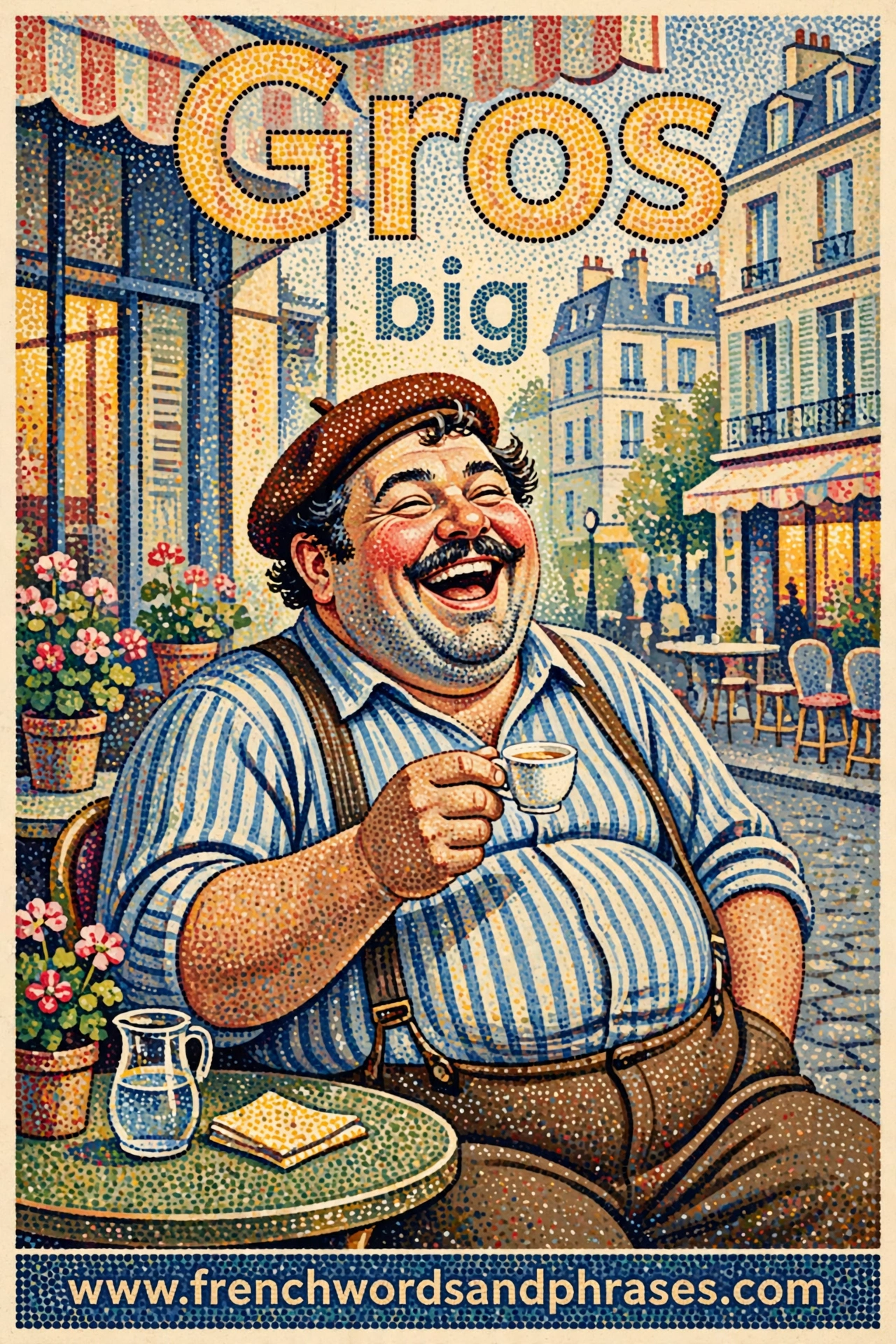
Gros means big.
In a village bookshop, a small boy tries to lift the biggest dictionary in the shop with both hands, wobbling under its weight while the bookseller laughs. It is not tall, it is not long — it is simply enormous in every direction. French has one round word for it — gros.
In this guide, you’ll learn what gros means in English, why it usually stands in front of the noun, why its masculine plural never changes, and how to use it about things with confidence while choosing kinder words for people. Explore French examples, English translations, and practice quizzes.
Understanding the French Adjective Gros
Gros is a French adjective of size — the adjective of bulk and weight. It agrees with the noun it describes: gros, grosse, gros, grosses. Watch the masculine plural: gros already ends in s, so it stays exactly the same.
It means big above all: un gros livre, a big book; une grosse voiture, a big car; une grosse somme, a large sum. Said of a person, gros takes on its second sense — fat, stout — and there it can land bluntly, so French speakers often choose it for things and reach for gentler words for people.
Type: Adjective of quality — size and bulk
Answers the question: What is it like? — big
Changes form: Yes — gros, grosse, gros, grosses (the masculine plural is unchanged)
English equivalents: Big; large; fat, stout (of people — use with care).
One important usage detail: gros usually stands BEFORE the noun — un gros gâteau, une grosse maison. And a word about people: calling someone gros means calling them fat, plainly and sometimes hurtfully. For a person, fort or corpulent is far kinder.
Experience the Word
Gros is the adjective of the pumpkin that wins the village fair — carried in by two men, weighed like a baby, photographed like a celebrity.
Imagine a child at the market pointing at the biggest cheese on the stall, a wheel wider than he is tall. He does not know the word grand yet. He knows the cheese takes up the whole table, and his word for that is gros.
You have not just measured something. You have felt its weight before lifting it.
How to Use Gros in French: Complete Guide
Let’s explore how gros works in French, beginning with the whole word on one card.
Gros at a Glance
Before the details, here is the whole word on one card.
The Whole Word on One Card
Meaning, type, position and forms — gros in four lines.
| Point | Gros |
|---|---|
| Meaning | big |
| Type | adjective of quality — size and bulk |
| Usual position | before the noun — un gros livre |
| Form | gros / grosse / gros / grosses |
Example
C’est un gros livre très lourd.
It’s a big, very heavy book.
The Four Forms of Gros
Gros agrees with the noun it describes. Watch two things: the feminine doubles the s, and the masculine plural does not change at all.
| Form | Gros | Example |
|---|---|---|
| Masculine singular | gros | un gros chien — a big dog |
| Feminine singular | grosse | une grosse pomme — a big apple |
| Masculine plural | gros | de gros livres — big books |
| Feminine plural | grosses | de grosses pommes — big apples |
Example
Il a un gros chien et de grosses pommes dans le jardin.
He has a big dog and big apples in the garden.
Quick Quiz 1
Which form of gros goes with pomme (feminine)?
Reveal the answer
grosse
Une grosse pomme.
A big apple.
Grosse: The Feminine with a Double S
The feminine of gros doubles the s and adds an e — gros becomes grosse — and the sound opens up: in grosse, you hear the s clearly. The masculine plural, already ending in s, stays gros.
| Situation | Example |
|---|---|
| The rule | double the s and add e — gros → grosse |
| The sound | in grosse you hear the s: /ɡʁos/ |
| Masculine plural | gros — unchanged: de gros chiens |
| Feminine plural | grosses — de grosses valises |
Example
Elle porte une grosse valise rouge.
She is carrying a big red suitcase.
Where Gros Goes: In Front of the Noun
Gros belongs to the family of short, everyday adjectives that lead the noun. It also sits happily after être, and in a few fixed phrases it settles after the noun for good.
| Pattern | Example |
|---|---|
| gros + noun | un gros gâteau — a big cake |
| After être | ce chien est gros — this dog is big |
| With an adverb | un très gros livre — a very big book |
| Fixed phrase | un cœur gros — a heavy heart (in avoir le cœur gros) |
Example
Un gros orage arrive sur la ville.
A big storm is coming over the town.
Quick Quiz 2
Where does gros usually stand — before or after the noun?
Reveal the answer
Before
Un gros livre, une grosse maison.
A big book, a big house.
Bigger Still: Comparing with Gros
Gros compares the regular way, with plus, moins and aussi — and the superlative agrees as usual: le plus gros, la plus grosse.
| Degree | Example |
|---|---|
| As big as | aussi gros que — as big as |
| Bigger | plus gros — bigger |
| Less big | moins gros — less big, smaller |
| The biggest (masc.) | le plus gros — le plus gros des chiens |
| The biggest (fem.) | la plus grosse — la plus grosse des pommes |
Example
Ton chien est plus gros que le mien.
Your dog is bigger than mine.
Everyday Expressions with Gros
Gros hides inside some of the most useful phrases in French — including en gros, the two words that sum up a whole story in outline.
| Expression | In English |
|---|---|
| en gros | roughly, in outline, in short |
| un gros mot | a swear word |
| une grosse somme | a large sum of money |
| une grosse voix | a deep, booming voice |
| avoir le cœur gros | to have a heavy heart, to feel like crying |
| un gros dormeur | a heavy sleeper, someone who sleeps a lot |
Example
En gros, le voyage dure trois jours.
Roughly speaking, the trip lasts three days.
Quick Quiz 3
What does en gros mean?
Reveal the answer
Roughly, in short
En gros, tout va bien.
In short, everything is fine.
Gros and Its Neighbours
Gros measures bulk; its neighbours measure height, vastness and thickness — and petit waits at the other end of the scale.
| French | In English |
|---|---|
| grand | big, tall — the general word for size and height |
| énorme | enormous, huge — stronger than gros |
| immense | immense — of spaces and quantities |
| épais | thick — of books, walls and fog |
| petit | small — the opposite |
Example
C’est un grand chien, énorme et très gros.
It’s a big dog, enormous and very bulky.
Watch Out: The Traps Around Gros
Three traps: the unchanging masculine plural, the forgotten double s, and the difference between describing a suitcase and describing a person.
| Trap | The truth |
|---|---|
| Masculine plural | gros already ends in s — de gros livres, never ‘gross’ |
| Spelling | the feminine doubles the s — grosse, grosses |
| About people | gros said of a person means fat and can hurt; fort or corpulent is kinder |
| gros mot | means a swear word, not a big word |
Example
Il a dit un gros mot et la maîtresse l’a entendu.
He said a swear word and the teacher heard him.
Quick Quiz 4
What is the masculine plural of gros?
Reveal the answer
gros
De gros chiens jouent dans le parc.
Big dogs are playing in the park.
Gros in Everyday French: Real-Life Examples
Now that you know the word, let’s see how gros appears in everyday French.
Example 1 — At the market
Regarde cette grosse courge, elle est énorme !
Look at this big pumpkin, it’s enormous!
Example 2 — At the library
Je cherche un gros dictionnaire français.
I’m looking for a big French dictionary.
Example 3 — Money
Ils ont gagné une grosse somme à la loterie.
They won a large sum in the lottery.
Example 4 — The weather
Un gros orage arrive, rentrons à la maison.
A big storm is coming, let’s go home.
Example 5 — Summing up
En gros, le projet est terminé.
In short, the project is finished.
Example 6 — Feelings
Elle a le cœur gros après son départ.
She has a heavy heart after his departure.
Beyond Translation: The Meaning of Gros
English keeps its sizes separate — big for the box, large for the sum, fat kept carefully for last — but French rolls them into one round, heavy word. Gros is size you can feel in your arms.
To say gros in French is to say: this takes up room in the world.
That is why the word serves for storms and suitcases, for voices and for sorrows — un cœur gros is a heart swollen to the size of everything it cannot say.
How to Remember the French Adjective Gros
Remember it this way: Gros is the heavyweight adjective — it leads the noun, doubles its s for her, and refuses to change for masculine plurals.
- You see the family together — gros, grosse, gros, grosses — with a double s in the feminine.
- You put it in front — un gros livre, une grosse somme.
- You keep it for things, mostly — for people, fort is the kinder word.
The key idea is gros stands before the noun, doubles its s in grosse, and its masculine plural never changes.
Test Your Knowledge of Gros
Let’s see how much you’ve learned. Try answering these questions before revealing the answers.
Question 1
What does gros mean?
Reveal the answer
Big — large and bulky; of a person, fat, so use it with care.
Question 2
What are the forms of gros?
Reveal the answer
gros, grosse, gros, grosses — the masculine plural is the same as the singular.
Question 3
Translate: a big house.
Reveal the answer
Une grosse maison.
Question 4
What does en gros mean?
Reveal the answer
Roughly, in short
En gros, tout est prêt.
In short, everything is ready.
Question 5
Complete the sentence:
Elle porte de ______ valises.
Reveal the answer
grosses
Elle porte de grosses valises.
She is carrying big suitcases.
Your Final Challenge
Can You Use It?
How would you say this in French?
“Roughly speaking, it is a big house.”
Reveal the answer
En gros, c’est une grosse maison.
Roughly speaking, it is a big house.
A little French. A little curiosity. A richer everyday life.
LEARN FRENCH ONE WORD AT A TIME