A French Word to Live By
Translate Juge to English
/ʒyʒ/
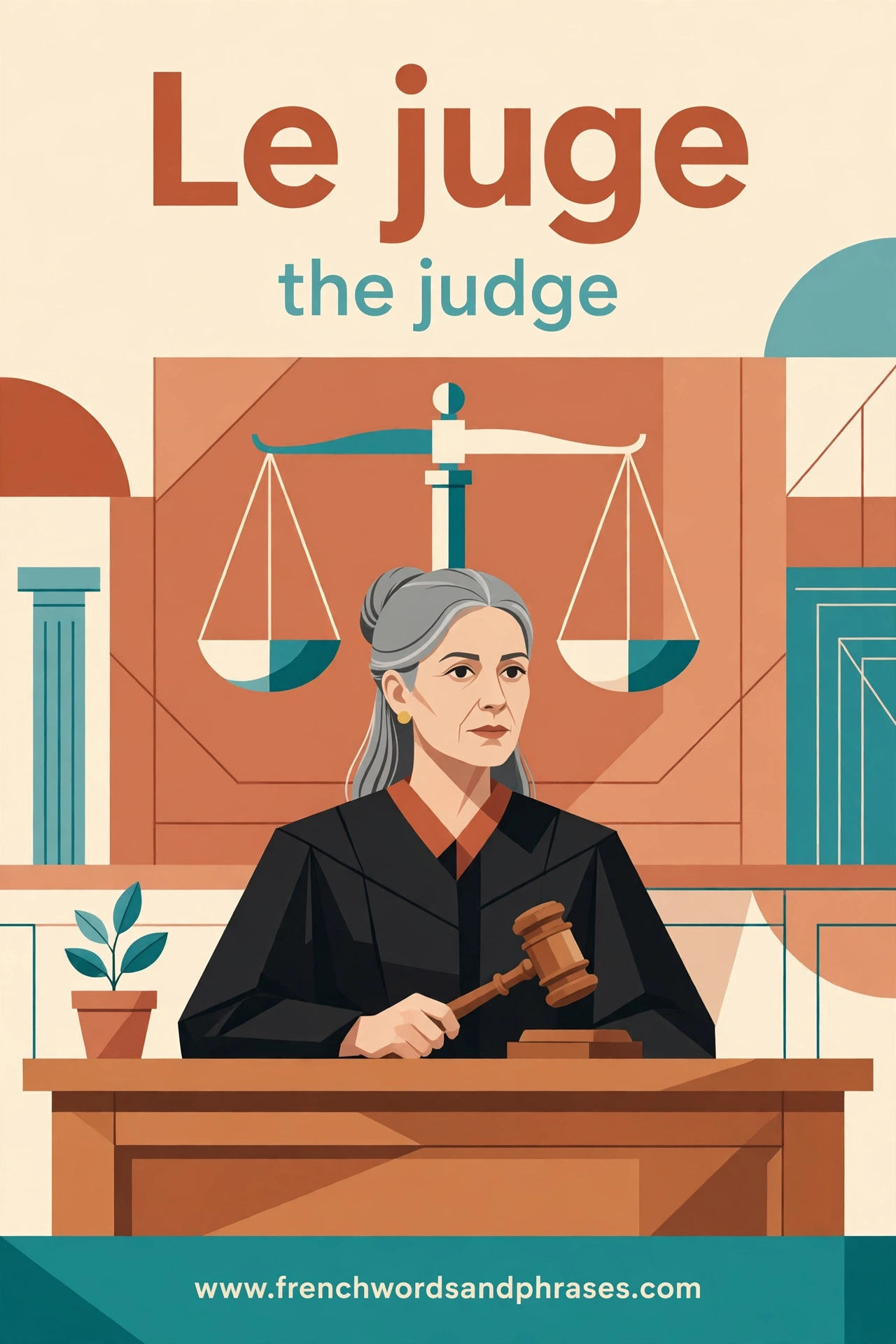
Le juge means the judge.
The courtroom door closes and everyone stands. A woman takes her seat above the room, opens the file, and looks slowly from one side to the other — la juge is ready to listen, and the trial can begin.
In this guide, you’ll learn what juge means in English, how to use it with its articles, how to form its plural, and how it appears in everyday French. Explore French examples, English translations, and practice quizzes.
Understanding the French Noun Juge
Juge is a French profession noun with the same form for men and women. A man is le juge, un juge; a woman is la juge, une juge. Only the article changes — exactly the pattern of comptable, and a great kindness to learners.
It means the judge — the magistrate who listens to both sides of a case and decides according to the law. A juge presides over the procès (the trial), questions the témoins (the witnesses) and delivers the decision. The word also steps outside the courtroom: competitions have their juges too — un juge de concours judges a contest, just as English uses judge for both robes and scorecards.
Gender: Masculine and feminine — the same word for both: le juge, la juge
Definite article: le — le juge (the judge, a man); la — la juge (a woman)
Indefinite article: un — un juge (a judge, a man); une — une juge (a woman)
Plural: les juges — for men, women, or everyone together
English equivalents: The judge; a magistrate.
One important usage detail: because the word never changes, the article carries the information — listen for le or la, un or une. Meet also the specialist: le juge d’instruction, la juge d’instruction, the investigating judge who prepares the biggest criminal cases — a famous figure of French justice, with no real equivalent in English law.
Experience the Word
Juge is more than a job title. It is the still point of the courtroom — the one person who must listen to everyone and favour no one.
Imagine the hardest moment of a trial: two stories, both believed by the people telling them, and a room holding its breath. The juge asks one more question, quietly, and the truth begins to move.
You have not just taken a seat in court. You have become le juge — the one who must decide.
How to Use Juge in French: Complete Guide
Let’s explore how juge works in French, beginning with its articles — where the article alone tells you man or woman.
Juge with the Definite Article (Le, La, Les)
The word stays juge in every line — only le, la and les change around it.
| Form | French |
|---|---|
| Masculine singular | le juge |
| Feminine singular | la juge |
| Plural (everyone) | les juges |
Example
La juge écoute les deux avocats en silence.
The judge (a woman) listens to the two lawyers in silence.
Juge with the Indefinite Article (Un, Une, Des)
Used for a judge in general — and again, un or une is the only clue to man or woman.
| Form | French |
|---|---|
| Masculine singular | un juge |
| Feminine singular | une juge |
| Plural (everyone) | des juges |
Example
Une juge expérimentée préside l’audience.
An experienced judge (a woman) is presiding over the hearing.
In the Courtroom
Trials, witnesses and verdicts — the furniture of the juge’s day.
| French | In English |
|---|---|
| le tribunal | the court |
| un procès | a trial |
| la justice | justice |
| un juge d’instruction | an investigating judge |
| un témoin | a witness |
| rendre un verdict | to deliver a verdict |
Example
Le juge pose une question au témoin.
The judge (a man) asks the witness a question.
Quick Quiz 1
Madame Kahn is a judge. Which sentence is correct: « Madame Kahn est un juge » or « Madame Kahn est une juge »?
Reveal the answer
Madame Kahn est une juge — the word stays the same, but the article becomes une for a woman.
Madame Kahn est une juge respectée.
Madame Kahn is a respected judge.
The Plural of Juge
Juge adds an -s in the plural — les juges, one form for men, women and mixed benches alike.
| Form | French |
|---|---|
| Singular (m.) | le juge |
| Singular (f.) | la juge |
| Plural (everyone) | les juges |
Example
Les juges entrent dans la salle en silence.
The judges enter the room in silence.
Juge with Possessive Adjectives (Mon, Ma…)
Possessives follow the article’s lead — mon juge for a man, ma juge for a woman.
| Owner | French |
|---|---|
| my | mon juge, ma juge |
| your (tu) | ton juge, ta juge |
| his / her | son juge, sa juge |
| our | notre juge |
| your (vous) | votre juge |
| their | leur juge |
Example
Notre juge annonce la décision à midi.
Our judge announces the decision at noon.
Quick Quiz 2
Complete the sentence:
______ juge écoute le témoin avec attention. (Their — a woman)
Reveal the answer
Leur
Leur juge écoute le témoin avec attention.
Their judge (a woman) listens to the witness carefully — leur is the same for both genders.
Juge with Demonstrative Adjectives (Ce, Cette, Ces)
Used to point: ce for a man, cette for a woman, ces for the whole bench.
| Form | French |
|---|---|
| Masculine singular | ce juge |
| Feminine singular | cette juge |
| Plural | ces juges |
Example
Cette juge pose des questions très précises.
This judge (a woman) asks very precise questions.
Juge with Adjectives
The noun never changes, but the adjective still agrees: sévère for everyone, juste for everyone, expérimenté or expérimentée.
| Adjective | With Juge |
|---|---|
| juste (fair) | un juge juste, une juge juste |
| sévère (strict) | un juge sévère, une juge sévère |
| expérimenté (experienced) | un juge expérimenté, une juge expérimentée |
| nouveau (new) | un nouveau juge, une nouvelle juge |
| respecté (respected) | un juge respecté, une juge respectée |
Example
C’est une juge juste mais très sévère.
She is a fair but very strict judge.
Quick Quiz 3
Complete the sentence:
Nous attendons une juge ______. (experienced)
Reveal the answer
expérimentée
Nous attendons une juge expérimentée.
We are waiting for an experienced judge (a woman) — the adjective, not the noun, shows the feminine.
Everyday Expressions with Juge
Courtrooms, contests and one wise warning — the juge phrases of the week.
| Expression | In English |
|---|---|
| devant le juge | before the judge, in court |
| une juge d’instruction | an investigating judge (woman) |
| être juge et partie | to be judge and party — to have a conflict of interest |
| un juge de concours | a competition judge |
| le juge décide | the judge decides |
| nommer un juge | to appoint a judge |
Example
Les deux parties passent devant la juge demain.
The two parties appear before the judge (a woman) tomorrow.
Words from the Same Family as Juge
Judging, justice and decisions — the words that travel with juge.
| French | In English |
|---|---|
| juger | to judge |
| le jugement | the judgement |
| la justice | justice |
| juste | fair, just |
| le procès | the trial |
| la loi | the law |
Example
La juge juge l’affaire selon la loi.
The judge judges the case according to the law.
Quick Quiz 4
A colleague says of your boss: « Il est juge et partie. » Is that a compliment?
Reveal the answer
No — it means he judges his own case: être juge et partie is to decide in a matter where you have an interest yourself.
On ne peut pas être juge et partie.
You cannot be both judge and party.
Juge in Everyday French: Real-Life Examples
Now that you know the word, let’s see how juge appears in everyday French.
Example 1 — In court
La juge ouvre l’audience à neuf heures.
The judge (a woman) opens the hearing at nine o’clock.
Example 2 — A question
Le juge interroge le témoin.
The judge (a man) questions the witness.
Example 3 — The decision
Les juges annoncent leur décision demain.
The judges will announce their decision tomorrow.
Example 4 — A competition
Une juge de concours goûte les plats des candidats.
A competition judge (a woman) tastes the candidates’ dishes.
Example 5 — A career
Après ses études de droit, il est devenu juge.
After his law studies, he became a judge.
Example 6 — Respect
Cette juge est connue pour sa patience.
This judge (a woman) is known for her patience.
Beyond Translation: The Meaning of Juge
Juge comes from the Latin judex — the one who says the law, jus dicere. French keeps the word spare and equal: one form for the man, one form for the woman, and the article to tell them apart. Behind the word stands the whole architecture of French justice — the tribunal, the procès, the slow public search for a decision that both sides must accept.
To say juge is to hand the decision to someone sworn to listen first.
It evokes the hush as the court stands, the file opened on the high desk — and the many women who now preside in France’s courts, announced simply by la.
How to Remember the French Noun Juge
Remember it this way: Juge is the judge — one word for everyone, where only the article changes: le juge, la juge.
- You change only the article — un juge, une juge, le mot ne bouge pas.
- You picture the courtroom — le tribunal, le procès, les témoins.
- You keep the warning — on ne peut pas être juge et partie.
The key idea is le juge, la juge — the article does the talking.
Test Your Knowledge of Juge
Let’s see how much you’ve learned. Try answering these questions before revealing the answers.
Question 1
How do you say a woman judge in French?
Reveal the answer
Une juge — the word is identical; only the article changes.
Question 2
What does un témoin mean?
Reveal the answer
A witness — the person le juge questions during le procès.
Question 3
Translate: The judge (a woman) listens to the witness.
Reveal the answer
La juge écoute le témoin.
Question 4
What is un juge d’instruction?
Reveal the answer
An investigating judge — the magistrate who prepares the biggest criminal cases in France.
Question 5
Complete the sentence:
______ juges entrent dans la salle. (The)
Reveal the answer
Les
Les juges entrent dans la salle.
The judges enter the room.
Your Final Challenge
Can You Use It?
How would you say this in French?
“The judge (a woman) is listening to the two lawyers.”
Reveal the answer
La juge écoute les deux avocats.
The judge (a woman) is listening to the two lawyers.
A little French. A little curiosity. A richer everyday life.
LEARN FRENCH ONE WORD AT A TIME