A French Word to Live By
Translate Têtu to English
/tety/
Têtu means stubborn.
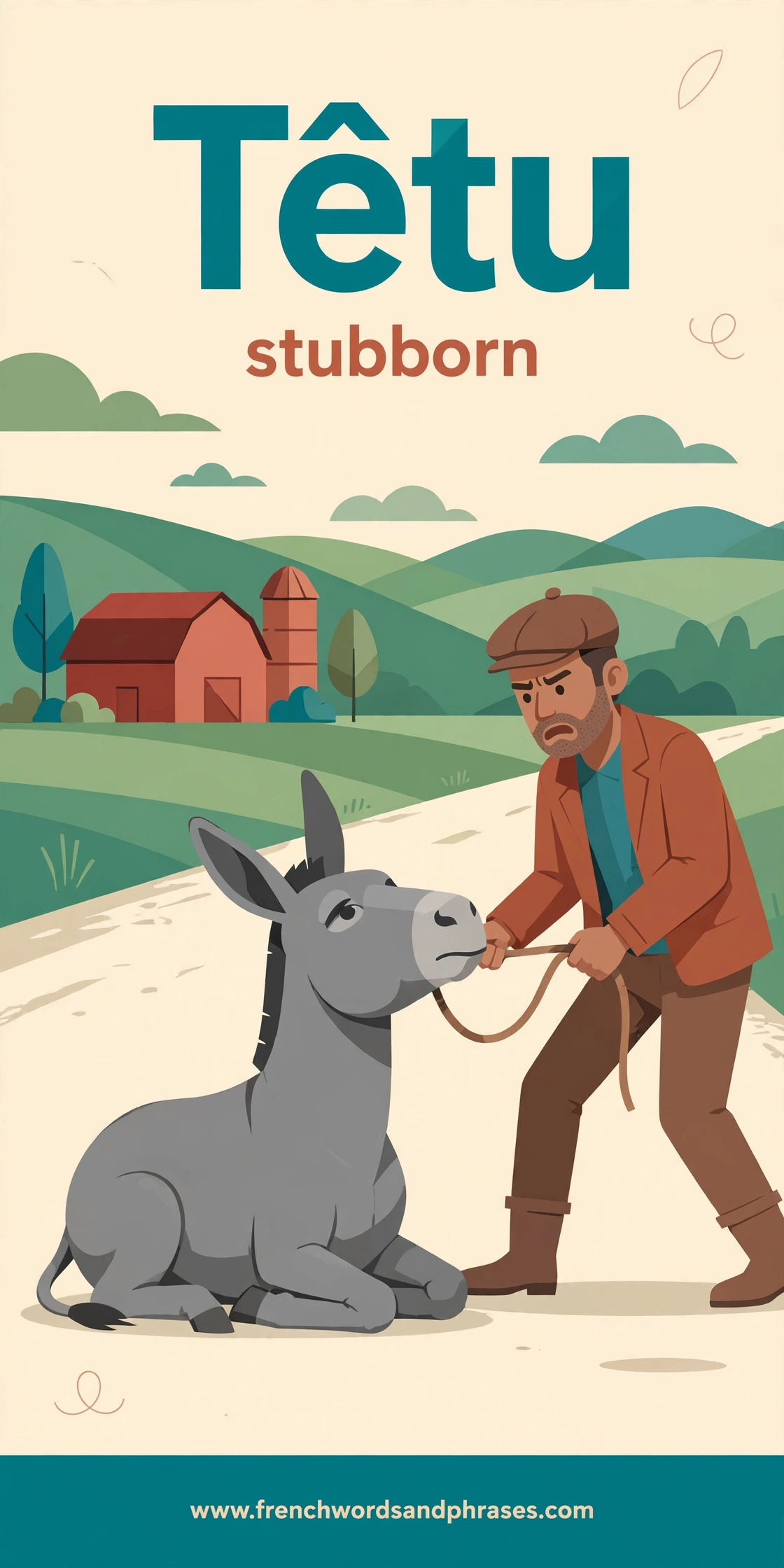
A country lane, a small donkey loaded with baskets, and a farmer pulling the rope with all his strength. The donkey has planted its four feet in the dust and is studying the horizon like a statue. The farmer sighs the word everyone in France would use for them both: têtu.
In this guide, you’ll learn what têtu means in English, how its feminine keeps the circumflex accent, where it stands in the sentence, and why French compares stubborn people to mules. Explore French examples, English translations, and practice quizzes.
Understanding the French Adjective Têtu
Têtu is a French adjective of quality — the adjective of the unbudging will. It agrees like a regular adjective — têtu, têtue, têtus, têtues — and it is built on the word tête, head: the picture is of a head that refuses to turn.
It means stubborn — refusing to change your mind, your plans or your direction. It describes children (un enfant têtu, a stubborn child), adults (un vieil homme têtu) and animals, above all the famous mule. It can scold, but it can also admire: the same word fits a toddler in a tantrum and a grandmother who never gives up.
Type: Adjective of quality — character and will
Answers the question: What is he or she like? — stubborn
Changes form: Yes — têtu, têtue, têtus, têtues
English equivalents: Stubborn; obstinate; headstrong.
One important usage detail: têtu stands AFTER the noun — un enfant têtu — and after être: elle est têtue. For the comparison every learner remembers, French reaches for the farmyard: têtu comme une mule, stubborn as a mule.
Experience the Word
Têtu is the adjective of the planted feet — the toddler in the supermarket aisle, the donkey on the lane, the negotiator who has said his last word.
Imagine a little girl of four who has decided that her shoes are on the right feet, whatever the shoes themselves may think. Arms crossed, chin up, she is not angry — she is simply immovable, and the whole family is smiling.
You have not just described a difficult character. You have saluted a will that will not be moved.
How to Use Têtu in French: Complete Guide
Let’s explore how têtu works in French, beginning with the whole word on one card.
Têtu at a Glance
Before the details, here is the whole word on one card.
The Whole Word on One Card
Meaning, type, position and forms — têtu in four lines.
| Point | Têtu |
|---|---|
| Meaning | stubborn |
| Type | adjective of quality — character and will |
| Usual position | after the noun — un enfant têtu |
| Form | têtu / têtue / têtus / têtues |
Example
C’est un enfant têtu.
He’s a stubborn child.
The Four Forms of Têtu
Têtu agrees with the noun it describes. The feminine adds an e — and the little hat, the circumflex, stays on the ê in every form.
| Form | Têtu | Example |
|---|---|---|
| Masculine singular | têtu | un garçon têtu — a stubborn boy |
| Feminine singular | têtue | une fille têtue — a stubborn girl |
| Masculine plural | têtus | des garçons têtus — stubborn boys |
| Feminine plural | têtues | des filles têtues — stubborn girls |
Example
Mon fils est têtu et ma fille est têtue.
My son is stubborn and my daughter is stubborn.
Quick Quiz 1
Which form of têtu goes with fille (feminine)?
Reveal the answer
têtue
Une fille têtue.
A stubborn girl.
Têtue: The Feminine Keeps the Accent
The feminine of têtu is formed by adding an e — and the circumflex on the ê never leaves. Têtu and têtue sound exactly alike; only the spelling changes.
| Situation | Example |
|---|---|
| The rule | just add -e — têtu → têtue |
| The accent | the circumflex stays — têtue, têtus, têtues |
| The sound | têtu and têtue sound exactly the same: /tety/ |
| Feminine plural | têtues — des sœurs têtues |
Example
Ma sœur est têtue, elle ne change jamais d’avis.
My sister is stubborn, she never changes her mind.
Where Têtu Goes: After the Noun
Têtu follows the noun it describes, like most adjectives of character, and it is perfectly at home after être, with an adverb in front of it.
| Pattern | Example |
|---|---|
| After the noun | un enfant têtu — a stubborn child |
| After être | il est têtu — he is stubborn |
| With an adverb | un homme très têtu — a very stubborn man |
| Before the noun | un têtu enfant — not in everyday French |
Example
C’est un vieil homme têtu mais généreux.
He’s a stubborn but generous old man.
Quick Quiz 2
Where does têtu stand — before or after the noun?
Reveal the answer
After
Un enfant têtu, une fille têtue.
A stubborn child, a stubborn girl.
More Stubborn: Comparing with Têtu
Têtu compares the regular way, with plus, moins and aussi — and the superlative agrees as usual: le plus têtu, la plus têtue.
| Degree | Example |
|---|---|
| As stubborn as | aussi têtu que — as stubborn as |
| More stubborn | plus têtu — more stubborn |
| Less stubborn | moins têtu — less stubborn |
| The most stubborn (masc.) | le plus têtu — le plus têtu des frères |
| The most stubborn (fem.) | la plus têtue — la plus têtue des sœurs |
Example
Mon frère est plus têtu que moi.
My brother is more stubborn than me.
Everyday Expressions with Têtu
Around têtu gathers the whole farmyard of French stubbornness — the mule above all, who has been carrying this reputation for centuries.
| Expression | In English |
|---|---|
| têtu comme une mule | stubborn as a mule |
| un caractère têtu | a stubborn character, a stubborn streak |
| rester têtu | to dig your heels in, to refuse to budge |
| une tête de mule | a stubborn person (literally, a mule’s head) — the noun cousin |
| têtu mais loyal | stubborn but loyal — the affectionate verdict |
Example
Ne discute pas avec lui, c’est une vraie tête de mule.
Don’t argue with him, he’s truly stubborn.
Quick Quiz 3
What does têtu comme une mule mean?
Reveal the answer
Stubborn as a mule
Il est têtu comme une mule.
He’s stubborn as a mule.
Têtu and Its Neighbours
Têtu shares its field with obstiné and entêté; tenace is its respectable side, and souple is everything it refuses to be.
| French | In English |
|---|---|
| obstiné | obstinate, determined — a close synonym |
| entêté | headstrong — built on tête too |
| borné | narrow-minded, stubborn in your views |
| tenace | tenacious — stubbornness as a virtue |
| souple | flexible — the opposite |
| docile | docile, compliant — the opposite for children and animals |
Example
Il est obstiné, presque borné, jamais souple.
He is obstinate, almost narrow-minded, never flexible.
Watch Out: The Traps Around Têtu
The traps here are the wandering accent, and a word that sounds like an insult but is often a caress.
| Trap | The truth |
|---|---|
| From tête | têtu is built on tête, the head — a têtu person won’t turn their head |
| The accent | the circumflex never leaves — têtu, têtue, têtus, têtues |
| Not always an insult | têtu can be affectionate — un petit têtu, said with a smile |
| entêté | a close synonym from the same family — not a different idea |
Example
Mon petit têtu, viens manger !
My little stubborn one, come and eat!
Quick Quiz 4
Which animal is a stubborn person compared to in French?
Reveal the answer
A mule
Têtu comme une mule.
Stubborn as a mule.
Têtu in Everyday French: Real-Life Examples
Now that you know the word, let’s see how têtu appears in everyday French.
Example 1 — Family
Mon fils est têtu, il veut toujours avoir raison.
My son is stubborn, he always wants to be right.
Example 2 — At the market
Le vendeur est têtu, il ne baisse pas son prix.
The seller is stubborn, he won’t lower his price.
Example 3 — On the farm
L’âne est têtu, il refuse d’avancer.
The donkey is stubborn, it refuses to move.
Example 4 — At work
Elle est têtue mais elle finit toujours ses projets.
She’s stubborn but she always finishes her projects.
Example 5 — Grandparents
Mon grand-père est têtu comme une mule.
My grandfather is stubborn as a mule.
Example 6 — Advice
Ne sois pas têtu, écoute les conseils des autres.
Don’t be stubborn, listen to other people’s advice.
Beyond Translation: The Meaning of Têtu
English says stubborn for the meaning of têtu — but têtu wears its origin on its face: it is built on tête, the head. A têtu person is someone whose head simply will not turn.
To call someone têtu in French is to picture a head held high and a chin set firm.
And the word is not always a reproach — said of a child with a smile, or of a grandmother who still walks to the market at ninety, têtu can carry real admiration for a will that does not bend.
How to Remember the French Adjective Têtu
Remember it this way: Têtu is the headstrong adjective — it comes from tête, keeps its circumflex in every form, and stands behind the noun.
- You picture the head that won’t turn — têtu is tête with an ending.
- You keep the little hat in the feminine — têtue, always with the circumflex.
- You compare like a farmer — têtu comme une mule.
The key idea is têtu comes from tête, keeps its circumflex in têtue, and compares to a mule.
Test Your Knowledge of Têtu
Let’s see how much you’ve learned. Try answering these questions before revealing the answers.
Question 1
What does têtu mean?
Reveal the answer
Stubborn — refusing to change your mind or your direction.
Question 2
What are the forms of têtu?
Reveal the answer
têtu, têtue, têtus, têtues — the circumflex stays in all of them.
Question 3
Translate: a stubborn child.
Reveal the answer
Un enfant têtu.
Question 4
Complete the sentence:
Il est têtu comme une ______ .
Reveal the answer
mule
Il est têtu comme une mule.
He’s stubborn as a mule.
Question 5
What word is têtu built on?
Reveal the answer
tête — the head. A têtu person won’t turn their head.
Your Final Challenge
Can You Use It?
How would you say this in French?
“My son is stubborn, but he always finishes what he starts.”
Reveal the answer
Mon fils est têtu, mais il finit toujours ce qu’il commence.
My son is stubborn, but he always finishes what he starts.
A little French. A little curiosity. A richer everyday life.
LEARN FRENCH ONE WORD AT A TIME