A French Word to Live By
Translate Qui sème le vent récolte la tempête to English
/ki sɛm lə vɑ̃ ʁe.kɔlt la tɑ̃.pɛt/
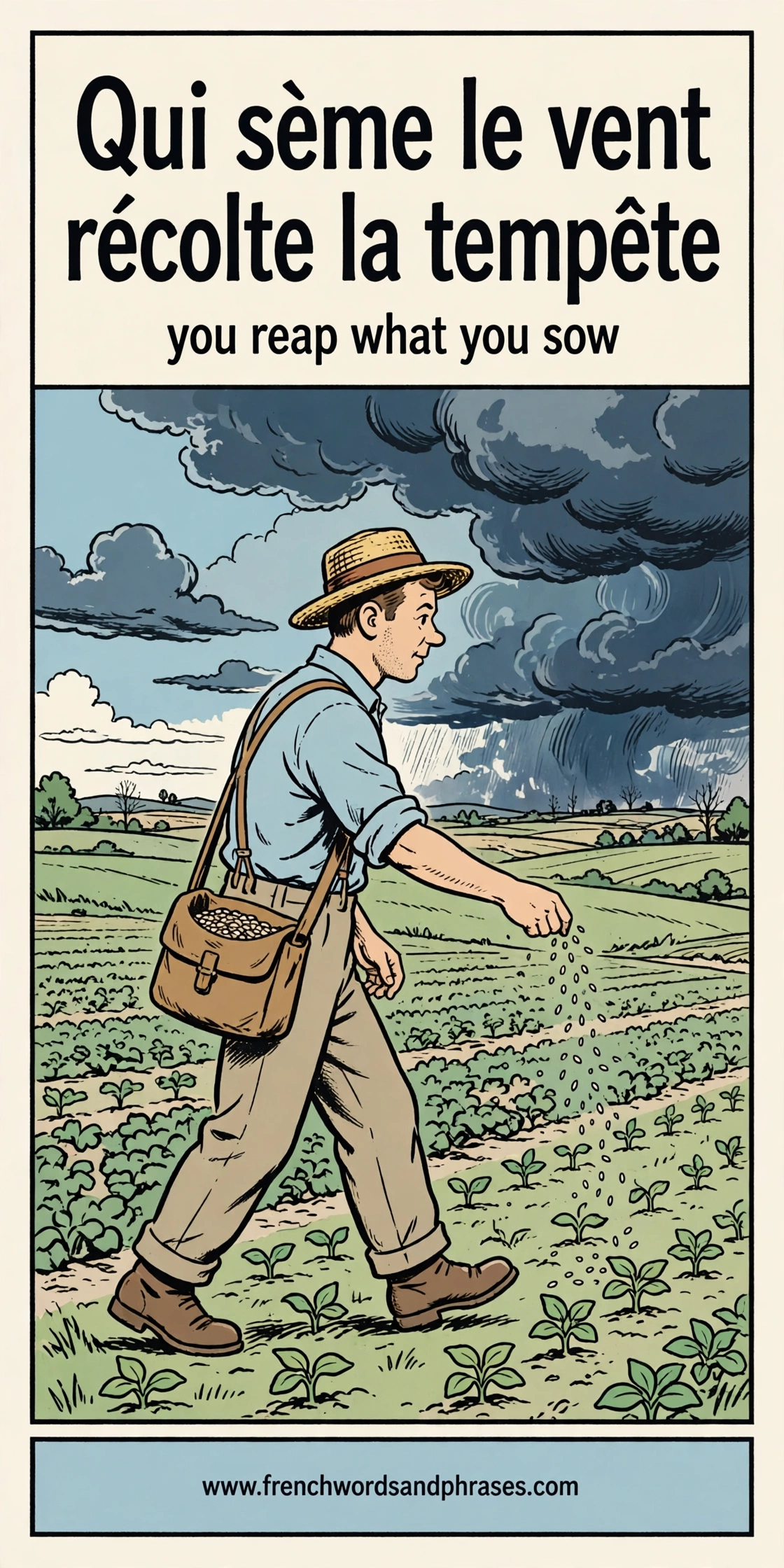
Qui sème le vent récolte la tempête means you reap what you sow — actions return, multiplied, on the one who started them.
A deputy in a televised debate has spent months stirring up anger against his opponents — insults, rumours, threats. Now the anger turns against his own party, and the oldest journalist in the room shakes her head: « Qui sème le vent récolte la tempête. »
Let’s explore how qui sème le vent récolte la tempête works in French, beginning with the whole phrase on one card.
Understanding the French Phrase Qui sème le vent récolte la tempête
Qui sème le vent récolte la tempête is a French proverb built from qui (whoever), sème (sows, from semer), le vent (the wind), récolte (reaps, harvests) and la tempête (the storm). It is a complete farming sentence, and it comes from the Bible — the prophet Hosea — before it belongs to any field.
It means you reap what you sow — but with a French multiplication: sow a little wind, and you harvest a whole storm. The picture is agricultural and unfair on purpose: what comes back is far bigger than what was planted. French speakers use it when trouble-makers meet their own trouble — in politics, in offices, in families — whenever consequences return wearing a larger coat.
Type: Proverb — a complete farming sentence of biblical origin (Hosea 8:7)
Answers the need: Saying someone’s own actions have returned on them, multiplied
Register: Neutral to solemn — journalism, speeches and serious conversation; weighty, not jokey
Strength: Strong — it judges: the storm was earned, not unlucky
One important usage detail: the proverb is a verdict pronounced on consequences, usually about a third party, after the storm has broken — it is rarely said to the sower’s face beforehand as a warning. Its tone is satisfied but grave: the speaker is not celebrating the storm, only noting that the seed and the harvest match.
Experience the Word
Qui sème le vent récolte la tempête is the proverb of consequences with interest — plant a breeze of trouble, and the sky returns a hurricane.
Imagine the manager who governed by fear for years: secret reports, favourites, whispered threats. The day the whole team resigns in one week, nobody in the building is surprised. The harvest was planted long ago, one small wind at a time.
French keeps this proverb for serious moments. It is the closest the language comes to a law of moral physics: nothing sown is ever lost.
How to Use Qui sème le vent récolte la tempête in French: Complete Guide
Let’s explore how qui sème le vent récolte la tempête works in French, beginning with the whole phrase on one card.
Qui sème le vent récolte la tempête at a Glance
The Whole Phrase on One Card
Real meaning, literal picture, English twin and register — qui sème le vent récolte la tempête in five lines.
| Point | Qui sème le vent récolte la tempête |
|---|---|
| What it really means | your actions come back on you — bigger than they started |
| Word for word | whoever sows the wind reaps the storm |
| English equivalent | you reap what you sow |
| Register | neutral to solemn — journalism, speeches, serious talk |
| Use it for | trouble-makers meeting their own trouble, in politics, work and family life |
Example
Il a menti pendant des années ; aujourd’hui, qui sème le vent récolte la tempête.
He lied for years; today, you reap what you sow.
Word by Word: Building the Storm
Five small pieces — take them one by one and the weather turns.
| Word | Literal meaning | Its job in the phrase |
|---|---|---|
| qui | whoever | the open subject — any sower, in any century |
| sème | sows | third person of semer, to sow seed — here, to stir up trouble |
| le vent | the wind | the small beginning: words, rumours, provocations |
| récolte | reaps, harvests | the return — récolter is what a farmer does to a crop |
| la tempête | the storm | the harvest itself: the same weather, a hundred times stronger |
Example
Le fermier sème le blé au printemps et le récolte en été.
The farmer sows the wheat in spring and harvests it in summer.
Quick Quiz 1
What makes this proverb harsher than plain ‘you reap what you sow’?
Reveal the answer
The multiplication — you sow wind, a small thing, and reap a tempête, a storm: the harvest is far bigger than the seed.
Il a semé une petite rumeur, il récolte un scandale.
He sowed a little rumour, he is reaping a scandal.
When You Say It: The Harvest Moments
The proverb fires at moments like these — the consequences have arrived, and someone names their origin.
| Situation | Example |
|---|---|
| Politics | après des mois d’insultes, son parti se divise : qui sème le vent récolte la tempête — after months of insults, his party is splitting |
| At the office | le directeur qui gouvernait par la peur voit son équipe partir — the manager who ruled by fear watches his team leave |
| A rumour-monger caught | ses propres rumeurs se retournent contre elle — her own rumours turn against her |
| Family trouble | il a semé la dispute entre ses frères, et la famille se déchire — he sowed the quarrel between his brothers, and the family is tearing itself apart |
| In the press | le journal titre : qui sème le vent récolte la tempête — the newspaper headlines the proverb |
Example
À force de diviser le village, le maire a perdu tout le monde : qui sème le vent récolte la tempête.
By dividing the village for so long, the mayor lost everyone: you reap what you sow.
Make It Yours: The Proverb in Other Forms
The sentence is fixed and solemn — speakers mostly quote it whole, or bend its verbs toward the person concerned.
| Form | French | In English |
|---|---|---|
| The full proverb | qui sème le vent récolte la tempête | whoever sows the wind reaps the storm |
| To the sower | tu sèmes le vent, tu récolteras la tempête | you are sowing the wind, you will reap the storm |
| About him | il a semé le vent, il récolte la tempête | he sowed the wind, he is reaping the storm |
| Shortened verdict | vent semé, tempête récoltée | wind sown, storm reaped |
| As a warning, rare | attention à ce que tu sèmes | mind what you sow |
| Question form | qui sème le vent récolte quoi ? | whoever sows the wind reaps what? |
Example
Tu sèmes le vent depuis des mois ; ne t’étonne pas de la tempête.
You have been sowing the wind for months; don’t be surprised by the storm.
Quick Quiz 2
Where does this proverb originally come from — a farming manual, or the Bible?
Reveal the answer
The Bible — the prophet Hosea (8:7): ‘they sow the wind, and they shall reap the whirlwind’. The farm gave the words, the prophet gave the judgment.
Le proverbe vient du livre d’Osée, dans la Bible.
The proverb comes from the book of Hosea, in the Bible.
Everyday Expressions: Building on the Harvest
The proverb slots into these everyday frames — each one ready to use as it stands.
| Frame | In English |
|---|---|
| qui sème le vent récolte la tempête | you reap what you sow |
| récolter ce qu’on a semé | to reap what you have sown — the general law, without the weather |
| semer la discorde | to sow discord — to stir up quarrels |
| semer la pagaille | to cause chaos — informal, literally to sow mess |
| les conséquences de ses actes | the consequences of your actions — the plain modern phrase |
Example
Il a passé l’année à semer la discorde dans le service.
He spent the year sowing discord in the department.
Close Cousins: The Other Returns
French has a whole shelf of consequence phrases — the storm is the solemn one; its cousins pay back, return or simply follow.
| Expression | The difference |
|---|---|
| qui sème le vent récolte la tempête | you reap what you sow — multiplied, solemn, biblical |
| on récolte ce qu’on a semé | you reap what you sow — the same law stated plainly, seed for seed |
| tel père, tel fils | like father, like son — inheritance, not consequences |
| la roue tourne | the wheel turns — fortunes reverse, without anyone sowing anything |
| bien mal acquis ne profite jamais | ill-gotten gains never prosper — the money version of the same justice |
Example
Après des années au sommet, la roue a tourné pour lui.
After years at the top, the wheel turned for him.
Quick Quiz 3
A kind, generous man is showered with help when he falls ill. Is qui sème le vent the right proverb?
Reveal the answer
No — the proverb is for trouble sown and trouble reaped. For kindness returned, French would say on récolte ce qu’on a semé, said warmly — or simply, la gentillesse revient toujours.
Il a aidé tout le village ; le village l’aide à son tour.
He helped the whole village; the village helps him in return.
Qui sème le vent and Its Neighbours
The consequence shelf around the proverb — the seed, the weather and the harvest.
| French | In English |
|---|---|
| semer | to sow |
| la discorde | discord — the proverb’s usual crop |
| le vent | the wind — the small beginning |
| la tempête | the storm — the multiplied return |
| récolter | to reap, to harvest |
| assumer les conséquences | to face the consequences — the sower’s last task |
Example
Il devra assumer les conséquences de ses paroles.
He will have to face the consequences of his words.
Watch Out: The Traps Around Qui sème le vent
The traps: a storm that is only weather, verbs that change their vowels, and a verdict used as a threat.
| Trap | The truth |
|---|---|
| the weather trap | une tempête on the news is a real storm at sea; in the proverb, la tempête is the trouble that returns — context decides |
| semer changes its vowel | je sème, tu sèmes, il sème, but nous semons — the è appears where the ending is silent, like acheter |
| récolter is regular | unlike semer, récolter keeps its é: je récolte, nous récoltons — do not let the proverb’s poetry change it |
| a verdict, not a threat | said to someone’s face in advance, the proverb sounds like a curse; French speakers mostly pronounce it afterwards, about a third party |
Example
La tempête a détruit le port, mais celle de sa carrière, il l’a semée lui-même.
The storm destroyed the harbour, but the storm of his career he sowed himself.
Quick Quiz 4
True or false: je sème and nous semons — the vowel changes between them.
Reveal the answer
True — semer behaves like acheter: è before silent endings (je sème), plain e before spoken ones (nous semons).
Nous semons en avril, et je sème le long du mur.
We sow in April, and I sow along the wall.
Qui sème le vent récolte la tempête in Everyday French: Real-Life Examples
Now that you know the word, let’s see how qui sème le vent récolte la tempête appears in everyday French.
Example 1 — The politician
Après des mois d’attaques, son propre camp l’abandonne : qui sème le vent récolte la tempête.
After months of attacks, his own side is abandoning him: you reap what you sow.
Example 2 — The manager
Il gouvernait par la peur ; toute son équipe a démissionné.
He ruled by fear; his whole team resigned.
Example 3 — The rumour-monger
Ses rumeurs se sont retournées contre elle.
Her rumours turned against her.
Example 4 — The family quarrel
Il a semé la dispute entre les frères, et maintenant plus personne ne se parle.
He sowed the quarrel between the brothers, and now nobody speaks to each other.
Example 5 — In the newspaper
Le journal conclut : on récolte toujours ce qu’on a semé.
The newspaper concludes: you always reap what you have sown.
Example 6 — The quiet verdict
Personne n’est surpris : qui sème le vent récolte la tempête.
Nobody is surprised: you reap what you sow.
Beyond Translation: The Meaning of Qui sème le vent récolte la tempête
English keeps the farm and drops the weather: you reap what you sow, seed for seed, a fair exchange. French keeps Hosea’s terrifying arithmetic — the seed is wind, almost nothing, a few words in the air; the harvest is a storm that flattens houses. The injustice is the lesson: consequences are never the same size as their causes.
To say qui sème le vent récolte la tempête is to warn that small cruelties are not small for long.
That is why journalists reach for it when a demagogue falls, and why it is never said lightly: it is a proverb with a prophet inside it.
How to Remember the French Phrase Qui sème le vent récolte la tempête
Remember it this way: Qui sème le vent is the farmer’s warning with a prophet’s arithmetic — a handful of wind in, a sky full of storm out.
- You keep the multiplication — vent in, tempête out: the harvest is always bigger than the seed.
- You hear the two farm verbs — semer (je sème, nous semons) plants it, récolter gathers it in.
- You save it for verdicts — solemn, biblical, pronounced after the storm, usually about someone else.
The key idea is qui sème le vent récolte la tempête means you reap what you sow — actions return, multiplied.
Test Your Knowledge of Qui sème le vent récolte la tempête
Let’s see how much you’ve learned. Try answering these questions before revealing the answers.
Question 1
What does qui sème le vent récolte la tempête mean?
Reveal the answer
You reap what you sow — the trouble someone starts returns on them, larger than it began.
Question 2
What is the literal, word-for-word meaning?
Reveal the answer
Whoever sows the wind reaps the storm — semer is to sow, récolter is to harvest, and une tempête is a storm.
Question 3
Where does the proverb come from?
Reveal the answer
From the Bible — the prophet Hosea (8:7): they sow the wind and reap the whirlwind.
Question 4
How do you say ‘to sow discord’ in French?
Reveal the answer
Semer la discorde — the proverb’s most common modern crop.
Question 5
Complete the sentence:
Qui sème le vent ______ la tempête. (Whoever sows the wind reaps the storm.)
Reveal the answer
récolte
Qui sème le vent récolte la tempête.
Whoever sows the wind reaps the storm.
Your Final Challenge
Can You Use It?
How would you say this in French?
“He stirred up trouble for years, and now you reap what you sow.”
Reveal the answer
Il a semé le vent pendant des années, et maintenant il récolte la tempête.
He stirred up trouble for years, and now you reap what you sow.
A little French. A little curiosity. A richer everyday life.
LEARN FRENCH ONE WORD AT A TIME