A French Word to Live By
Translate Chat échaudé craint l’eau froide to English
/ʃa e.ʃo.de kʁɛ̃ lo fʁwad/
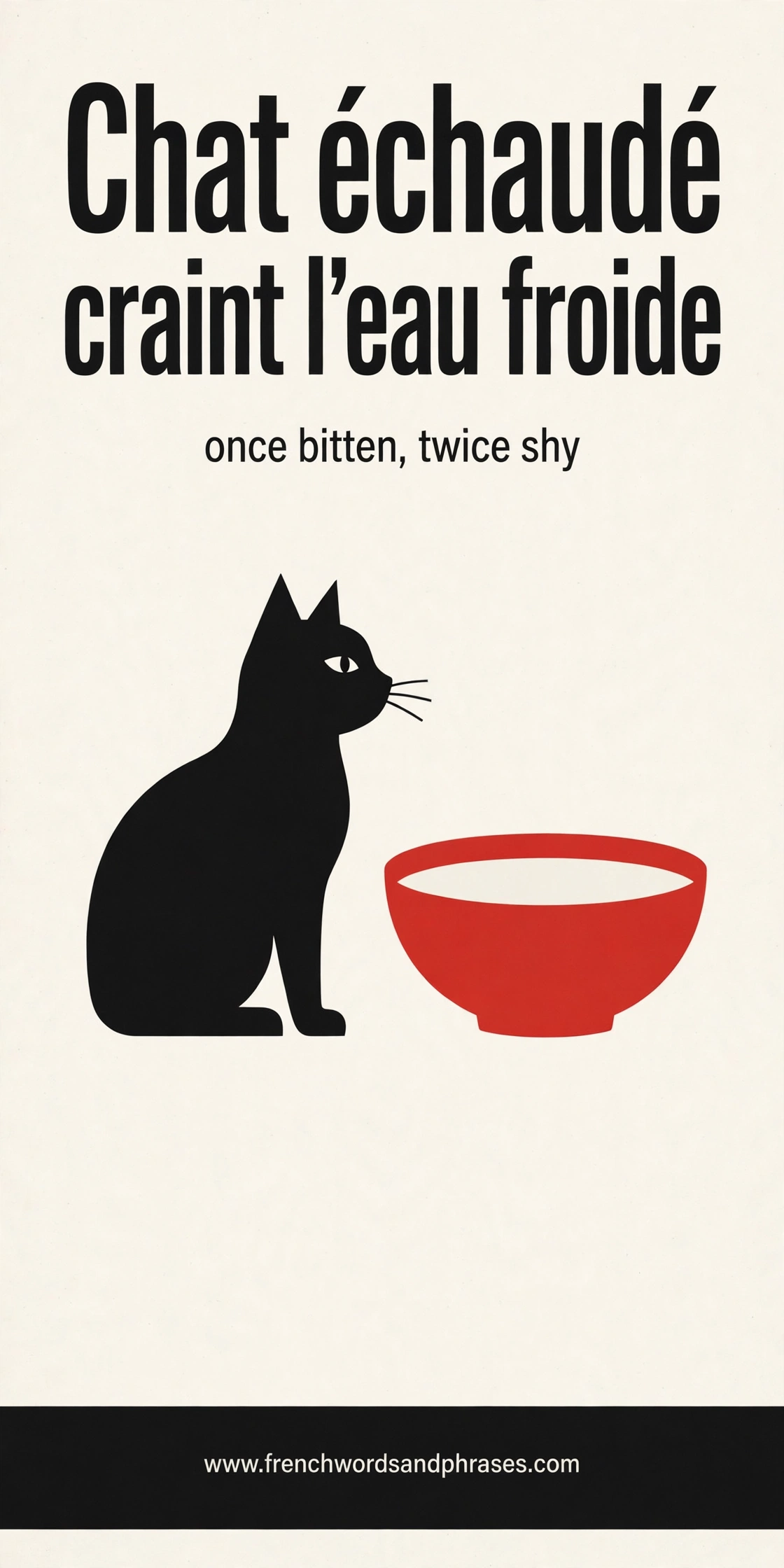
Chat échaudé craint l’eau froide means once bitten, twice shy — a bad experience makes you cautious for a long time afterwards.
A friend in Marseille once invested his savings in a friend’s restaurant, and lost everything when it closed. Years later, another friend proposes a new business — a good one, this time. He smiles, shakes his head and answers with the old proverb: « Chat échaudé craint l’eau froide. »
Let’s explore how chat échaudé craint l’eau froide works in French, beginning with the whole phrase on one card.
Understanding the French Phrase Chat échaudé craint l’eau froide
Chat échaudé craint l’eau froide is a French proverb built from un chat (a cat), échaudé (scalded), craint (fears, from craindre) and l’eau froide (cold water). It is a complete sentence: a cat scalded by hot water afterwards fears even cold water.
It means once bitten, twice shy — after one painful experience, you stay wary long after the danger has passed. The cat was scalded once by hot water; now it runs from every water, even the cold water that could never hurt it. French speakers use the proverb about money, love, work and trust — any wound that teaches too well.
Type: Proverb — a complete sentence with a small animal story inside
Answers the need: Explaining why a past hurt makes someone cautious now
Register: Neutral — safe everywhere, in speech and writing, often said with sympathy
Strength: Gentle — it explains caution, it does not mock it
One important usage detail: the proverb is often shortened to its first two words — chat échaudé… — and the listener completes it silently. It describes a lasting wariness, not a moment of fear: the scalding is in the past, the fear is in the present, and even harmless things (the cold water) now look dangerous.
Experience the Word
Chat échaudé craint l’eau froide is the memory of pain doing its job too well — one burn, and a lifetime of flinching.
Imagine the investor who checks every document three times, the traveller who will not fly after one terrible storm, the heart that will not love after one betrayal. Each of them met the hot water once. The proverb does not laugh at them; it recognises them.
French proverbs are full of animals carrying human lessons. The cat carries this one: experience teaches, but it also exaggerates.
How to Use Chat échaudé craint l’eau froide in French: Complete Guide
Let’s explore how chat échaudé craint l’eau froide works in French, beginning with the whole phrase on one card.
Chat échaudé craint l’eau froide at a Glance
The Whole Phrase on One Card
Real meaning, literal picture, English twin and register — chat échaudé craint l’eau froide in five lines.
| Point | Chat échaudé craint l’eau froide |
|---|---|
| What it really means | a bad experience leaves you wary of anything similar |
| Word for word | a scalded cat fears cold water |
| English equivalent | once bitten, twice shy |
| Register | neutral — everyday speech and writing, sympathetic in tone |
| Use it for | money lost, love gone wrong, any lesson learned the hard way |
Example
Après sa faillite, il ne prête plus d’argent : chat échaudé craint l’eau froide.
After his bankruptcy, he no longer lends money: once bitten, twice shy.
Word by Word: Building the Scalded Cat
Five small pieces — take them one by one and the little story tells itself.
| Word | Literal meaning | Its job in the phrase |
|---|---|---|
| chat | a cat | the hero of the story — every learner who was ever hurt |
| échaudé | scalded | burned by hot liquid — the past wound, carried in one word |
| craint | fears | third person of craindre, to fear — the present habit the wound created |
| l’eau | the water | water in general now, not just the water that burned |
| froide | cold | the sting of the proverb: even harmless cold water is feared |
Example
Le chat échaudé fuit même l’eau froide.
The scalded cat flees even cold water.
Quick Quiz 1
What does échaudé mean — wet, scalded, or frightened?
Reveal the answer
Scalded — burned by hot liquid. The fear comes next, in the verb craint.
Il s’est échaudé la main avec la soupe.
He scalded his hand with the soup.
When You Say It: The Wary Moments
Chat échaudé fires at moments like these — someone refuses, hesitates, or checks three times, because of an old wound.
| Situation | Example |
|---|---|
| Money | il a perdu ses économies une fois, chat échaudé — he lost his savings once, once bitten |
| Love | après son divorce, elle ne veut plus se marier : chat échaudé — after her divorce, she won’t marry again: twice shy |
| Work | il vérifie tout deux fois, chat échaudé craint l’eau froide — he checks everything twice, once bitten, twice shy |
| Travel | après ce vol terrible, elle craint même les petits trajets — after that awful flight, she fears even short trips |
| About yourself | je sais, je suis un chat échaudé — I know, I’m once bitten, twice shy |
Example
Elle refuse le poste ; après sa dernière expérience, chat échaudé craint l’eau froide.
She is refusing the job; after her last experience, once bitten, twice shy.
Make It Yours: The Proverb in Other Forms
Proverbs resist grammar changes — but this one shortens, and its key adjective travels on its own.
| Form | French | In English |
|---|---|---|
| The full proverb | chat échaudé craint l’eau froide | a scalded cat fears cold water |
| Shortened | chat échaudé… | once bitten… (the rest is understood) |
| About yourself | je suis un chat échaudé | I am once bitten, twice shy |
| The adjective alone | échaudé par l’expérience | made wary by the experience |
| Explaining someone | il est devenu prudent, chat échaudé | he has become careful, once bitten |
| Question form | chat échaudé, toi aussi ? | once bitten, you too? |
Example
Depuis l’accident, c’est un vrai chat échaudé au volant.
Since the accident, he is truly once bitten, twice shy at the wheel.
Quick Quiz 2
Why does the cat fear cold water, when it was hot water that hurt it?
Reveal the answer
Because the lesson overshoots — that is the proverb’s whole point: after a wound, even harmless things look dangerous.
L’eau froide ne brûle pas, mais le chat ne le sait plus.
Cold water does not burn, but the cat no longer knows it.
Everyday Expressions: Building on the Cat
Chat échaudé slots into these everyday frames — each one ready to use as it stands.
| Frame | In English |
|---|---|
| chat échaudé craint l’eau froide | once bitten, twice shy |
| être échaudé par une expérience | to be made wary by an experience |
| apprendre à ses dépens | to learn the hard way — at your own expense |
| devenir prudent | to become cautious |
| se méfier de tout | to distrust everything — the cat’s extreme version |
Example
Échaudé par deux faillites, il lit chaque contrat jusqu’au bout.
Made wary by two bankruptcies, he reads every contract to the end.
Close Cousins: The Other Lessons of Pain
French has a whole shelf of hard-lesson phrases — the cat is the wary one; its cousins regret, distrust or refuse to repeat.
| Expression | The difference |
|---|---|
| chat échaudé craint l’eau froide | once bitten, twice shy — lasting wariness after one wound |
| apprendre à ses dépens | to learn at your own expense — the lesson itself, without the lasting fear |
| on ne m’y reprendra plus | I won’t be caught again — a vow, angrier than the cat |
| se méfier | to be wary, to distrust — the plain verb, usable in any situation |
| une fois suffit | once is enough — the shortest refusal to repeat an experience |
Example
Il a appris à ses dépens que les promesses ne suffisent pas.
He learned the hard way that promises are not enough.
Quick Quiz 3
A friend says: on ne m’y reprendra plus ! Is he wary like the cat, or angry?
Reveal the answer
Angry — it is a vow: ‘they won’t catch me again’. The cat’s proverb explains fear; this phrase declares war.
On ne m’y reprendra plus, ce magasin est fini pour moi.
They won’t catch me again — that shop is finished for me.
Chat échaudé and Its Neighbours
The caution shelf around the proverb — the wound, the fear and the slow return of trust.
| French | In English |
|---|---|
| une brûlure | a burn |
| la méfiance | wariness, distrust |
| craindre | to fear |
| chat échaudé | once bitten, twice shy |
| reprendre confiance | to regain confidence — the long road back |
| un risque calculé | a calculated risk — caution grown wise |
Example
Avec le temps, sa méfiance s’est calmée et il a repris confiance.
With time, his wariness faded and he regained confidence.
Watch Out: The Traps Around Chat échaudé
The traps: a cat that is not cooked, a verb with a formal twin, and a fear that must have a past.
| Trap | The truth |
|---|---|
| échaudé is not ‘cooked’ | échauder is to scald with hot liquid — a hand, a tongue, a cat; it is not a cooking method |
| craindre is irregular | je crains, tu crains, il craint — the -dre verbs (craindre, plaindre, éteindre) share this pattern |
| no wound, no proverb | the proverb needs a real past hurt; for ordinary nervousness, French says être prudent or se méfier |
| the article disappears | the proverb opens with bare chat, no un or le — proverb French often drops the article for rhythm |
Example
Il craint les chiens depuis qu’un chien l’a mordu enfant.
He fears dogs since a dog bit him as a child.
Quick Quiz 4
True or false: you can say chat échaudé about someone who is simply careful by nature, with no bad experience behind it.
Reveal the answer
False — the proverb always points back to a wound: the scalding came first, the fear second.
Sans l’accident, il n’aurait jamais été un chat échaudé.
Without the accident, he would never have been once bitten, twice shy.
Chat échaudé craint l’eau froide in Everyday French: Real-Life Examples
Now that you know the word, let’s see how chat échaudé craint l’eau froide appears in everyday French.
Example 1 — The lost savings
Il ne prête plus jamais d’argent : chat échaudé craint l’eau froide.
He never lends money any more: once bitten, twice shy.
Example 2 — After the divorce
Après son divorce, elle craint de retomber amoureuse.
After her divorce, she is afraid of falling in love again.
Example 3 — The careful driver
Depuis l’accident, il conduit lentement, en vrai chat échaudé.
Since the accident, he drives slowly, truly once bitten, twice shy.
Example 4 — At the office
Échaudée par son ancien patron, elle demande tout par écrit.
Made wary by her old boss, she asks for everything in writing.
Example 5 — The shortened form
Tu comprends, chat échaudé… je préfère attendre.
You understand, once bitten… I prefer to wait.
Example 6 — The slow recovery
Il faudra du temps avant que ce chat échaudé reprenne confiance.
It will take time before this once-bitten cat trusts again.
Beyond Translation: The Meaning of Chat échaudé craint l’eau froide
English is bitten; French is scalded. The English picture is an animal attack — quick, external, almost an accident of nature. The French picture happens in a kitchen: hot water, a moment’s carelessness, and a creature that will cross the room to avoid a cold tap for the rest of its life.
To say chat échaudé craint l’eau froide is to forgive the fear while naming its exaggeration.
The cold water never hurt anyone. The proverb knows it, the cat knows it — and the cat stays wary anyway, which is exactly what makes the saying so human.
How to Remember the French Phrase Chat échaudé craint l’eau froide
Remember it this way: Chat échaudé is the kitchen lesson — one scalding, and even cold water looks like an enemy for life.
- You picture the cat and the kettle — échaudé means scalded, burned by hot liquid.
- You keep the overshoot — the cat fears l’eau froide, the harmless water: that exaggeration IS the meaning.
- You can shorten it — chat échaudé… alone is enough; every French listener finishes the sentence silently.
The key idea is chat échaudé craint l’eau froide means once bitten, twice shy — one wound, lasting wariness.
Test Your Knowledge of Chat échaudé craint l’eau froide
Let’s see how much you’ve learned. Try answering these questions before revealing the answers.
Question 1
What does chat échaudé craint l’eau froide mean?
Reveal the answer
Once bitten, twice shy — a bad experience makes you cautious long afterwards.
Question 2
What is the literal, word-for-word meaning?
Reveal the answer
A scalded cat fears cold water — échaudé means scalded, and craint is ‘fears’, from craindre.
Question 3
Why does the cat fear cold water in particular?
Reveal the answer
Because the lesson overshoots — after the wound, even harmless things look dangerous.
Question 4
How can the proverb be shortened in conversation?
Reveal the answer
Chat échaudé… — the first two words alone, and the listener completes the rest silently.
Question 5
Complete the sentence:
Chat ______ craint l’eau froide. (A scalded cat fears cold water.)
Reveal the answer
échaudé
Chat échaudé craint l’eau froide.
A scalded cat fears cold water.
Your Final Challenge
Can You Use It?
How would you say this in French?
“After that experience, he is once bitten, twice shy.”
Reveal the answer
Après cette expérience, chat échaudé craint l’eau froide.
After that experience, he is once bitten, twice shy.
A little French. A little curiosity. A richer everyday life.
LEARN FRENCH ONE WORD AT A TIME